 1K+ Reviews
 SAP
SAP
The Future of Sustainable Business with SAP Responsible Design
Sustainability is becoming an important part of product design, packaging, and modern enterprise processes.
Read ArticleAchieve professional excellence in security management with the Certified Protection Professional (CPP) training by Multisoft Virtual Academy. This expertly designed program provides in-depth knowledge and practical insights to help you excel in CPP certification. Enroll today to gain advanced skills and boost your career in the dynamic field of protection management.

Share your details for best career advice.

Pick a weekend and begin your learning journey with live instructor-led sessions.
Choose a convenient training time that fits your preferred schedule.
Learn from expert instructors in real-time
Engage in Q&A and discussions
Learn from anywhere on any device
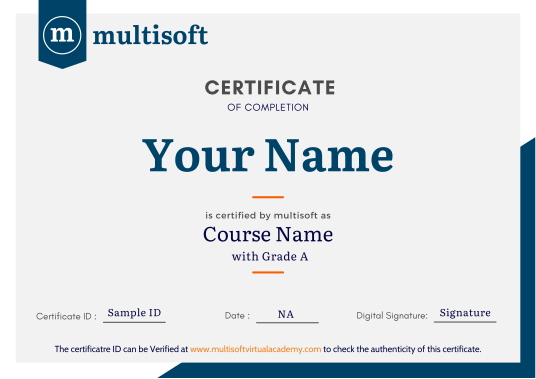
Earn a recognized certificate
Prefer learning on your own schedule? Choose our Self-Paced Training and access structured learning resources designed to help you continue your professional learning anytime, anywhere.
Learn through structured recorded training sessions.
Study according to your preferred time and schedule.
Access course-aligned resources for structured learning.
Receive a training certificate after successful completion.
Fill in your details and our training advisor will contact you with self-paced training information.
 DOWNLOAD CURRICULUM
Certified Protection Professional (CPP) training is an advanced security management program designed to prepare professionals for the globally recognized CPP certification by ASIS International. This training covers key areas like risk management, asset protection, physical security, crisis management, and information security. It equips participants with the skills to address complex security challenges and advance their careers in the security industry.
1: Plan, develop, implement, and manage the organization’s security program to protect the organization’s assets. Knowledge of:
2: Develop, manage, or conduct the security risk assessment process. Knowledge of:
3: Evaluate methods to improve the security program on a continuous basis through the use of auditing, review, and assessment. Knowledge of:
4: Develop and manage professional relationships with external organizations to achieve security objectives. Knowledge of:
5: Develop, implement, and manage workforce security awareness programs to achieve organizational goals and objectives. Knowledge of:
DOWNLOAD CURRICULUM
1: Develop and manage budgets and financial controls to achieve fiscal responsibility. Knowledge of:
2: Develop, implement, and manage policies, procedures, plans, and directives to achieve organizational objectives. Knowledge of:
3: Develop procedures/techniques to measure and improve organizational productivity. Knowledge of:
4: Develop, implement, and manage security staffing processes and personnel development programs in order to achieve organizational objectives. Knowledge of:
5: Monitor and ensure an acceptable ethical climate in accordance with regulatory requirements and organizational culture. Knowledge of:
6: Develop performance requirements and contractual terms for security vendors/suppliers. Knowledge of:
DOWNLOAD CURRICULUM
1: Identify, develop, implement, and manage investigative operations. Knowledge of:
2: Manage or conduct the collection, preservation, and disposition of evidence to support investigative actions. Knowledge of:
3: Manage or conduct surveillance processes. Knowledge of:
4: Manage and conduct investigations requiring specialized tools, techniques, and resources. Knowledge of:
5: Manage or conduct investigative interviews. Knowledge of:
6: Provide support to legal counsel in actual or potential criminal or civil proceedings. Knowledge of:
DOWNLOAD CURRICULUM
1: Develop, implement, and manage background investigation processes for hiring, promotion, and retention of individuals. Knowledge of:
2: Develop, implement, manage, and evaluate policies and procedures to protect individuals in the workplace against human threats (e.g., harassment, violence, active assailant). Knowledge of:
3: Develop, implement, and manage executive protection programs. Knowledge of:
DOWNLOAD CURRICULUM
1: Conduct facility surveys to determine the current status of physical security. Knowledge of:
2: Select, implement, and manage physical security strategies to mitigate security risks. Knowledge of:
3: Assess the effectiveness of physical security measures by testing and monitoring. Knowledge of:
DOWNLOAD CURRICULUM
1: Conduct surveys to evaluate the current status of information security programs. Knowledge of:
2: Develop policies and procedures to ensure information is evaluated and protected against vulnerabilities and threats. Knowledge of:
3: Implement and manage an integrated information security program. Knowledge of:
DOWNLOAD CURRICULUM
1: Assess and prioritize threats to mitigate potential consequences of incidents. Knowledge of:
2: Prepare and plan how the organization responds to incidents. Knowledge of:
3: Respond to and manage an incident. Knowledge of:
4: Manage incident recovery and resumption of operations. Knowledge of:
DOWNLOAD CURRICULUM

Build strong Certified Protection Professional (CPP) Corporate & Certification Program skills under expert trainers with 13+ years of industry experience, focusing on real-time project handling, integrations, and financial system implementations.
Our Certified Protection Professional (CPP) Corporate & Certification Program trainers bring over 13+ years of hands-on industry experience.
Our Certified Protection Professional (CPP) Corporate & Certification Program trainers have trained over 3350+ students in real-world cloud courses
Gain practical knowledge through live projects guided by industry-certified trainers.
Experience practical learning through real-world scenarios, case studies & industry assignments.
Get expert guidance to prepare, practice, and successfully clear certification exams.
Training is tailored to course content based on learner requirements and industry needs.
SAP
Sustainability is becoming an important part of product design, packaging, and modern enterprise processes.
Read Article Automation
Discover how automation can support software testing workflows and improve efficiency across enterprise processes.
Read Article Engineering
Explore practical engineering concepts, software applications, and workflows used across modern projects.
Read Article Data
Data
Understand how structured data governance practices can support quality, consistency, and enterprise data management.
Read ArticleExplore the learning features designed to make online professional training more structured, flexible, practical, and learner-focused.
Look beyond course topics and consider the learning support and experience available throughout your training.
Learn through structured virtual training sessions.
Training options suited to different schedules.
Connect course concepts with professional scenarios.
Get opportunities to discuss concepts and questions.
Support your training with useful course resources.
Review your understanding after course learning.
Combine guided online learning, practical understanding, flexible scheduling, and learner assistance in one structured training experience.
Share your details and we’ll help you choose the right training solution for your team.
Strengthen your professional capabilities with structured learning, practical insights, and industry-relevant knowledge.
Gain practical knowledge aligned with current professional and industry requirements.
Understand key concepts through structured sessions, examples, and practical scenarios.
Strengthen your skills for relevant roles and responsibilities across organizations.
Explore how course concepts are applied across relevant business and technical environments.
Learn through structured online training designed for working professionals and learners.
Keep your professional knowledge current and prepare for evolving technologies and practices.
Real experiences from professionals who upskilled with our training and accelerated their careers.









To meet the learning needs of professionals across different geographical locations, Multisoft Systems offers flexible online training options so you can learn from anywhere. Choose your preferred location below.
Live instructor-led online training

 +91 8130666206
 Build Your Own Schedule
  One to One Schedule
  Download Curriculum
 Let's Get Started