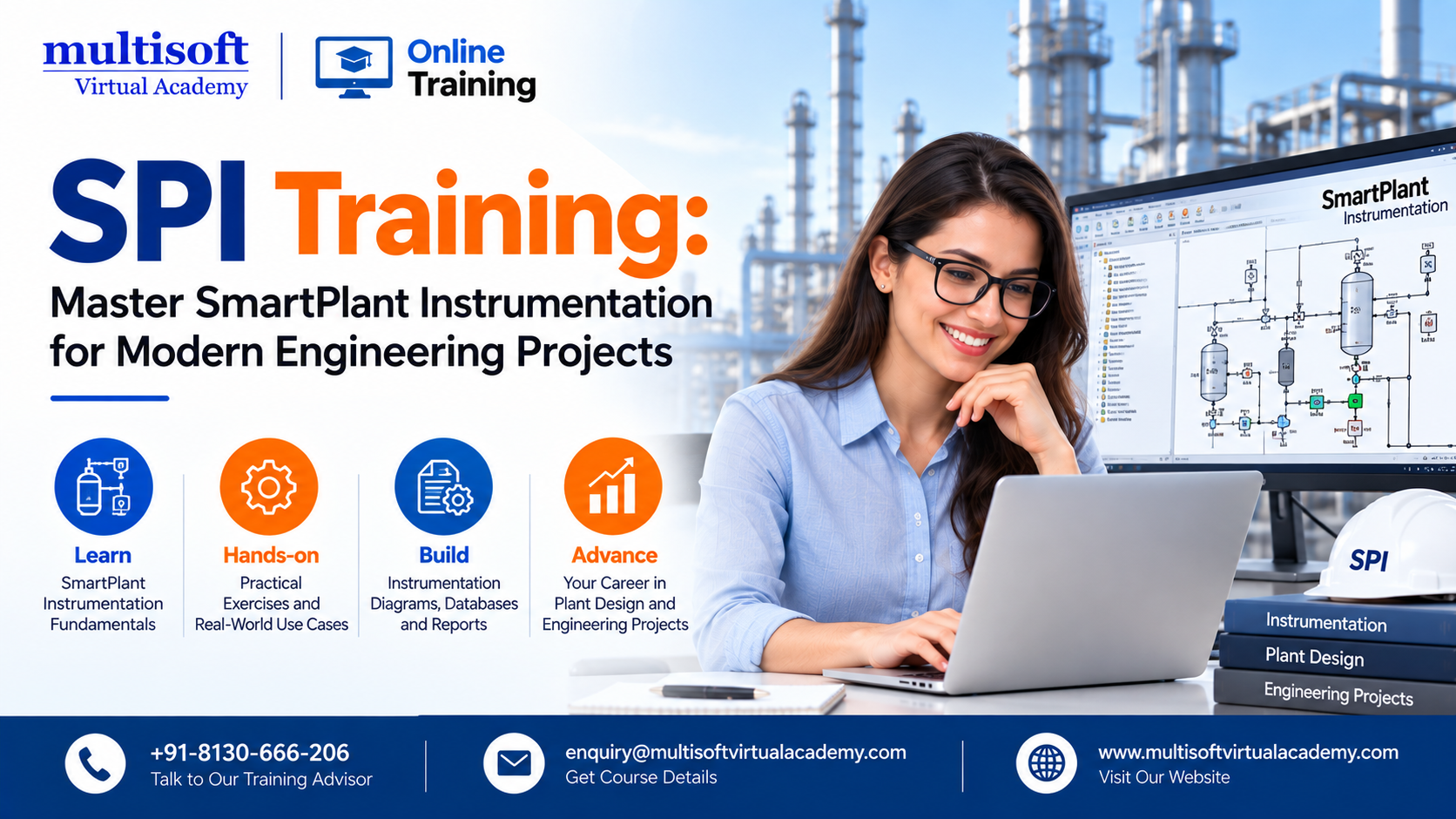
The engineering and process industries are becoming increasingly dependent on digital tools to manage complex instrumentation data, engineering documentation, and plant design workflows. As projects in oil and gas, petrochemicals, power generation, chemicals, and manufacturing become more data-driven, professionals need specialized software skills to improve accuracy, productivity, and project coordination. SPI Training provides an effective pathway for engineers and designers who want to develop practical expertise in SmartPlant Instrumentation, also known as SPI or INtools.
SmartPlant Instrumentation is designed to support instrumentation and control engineering activities throughout a project lifecycle. Professionals can work with instrument indexes, specifications, process data, wiring, loop drawings, datasheets, reports, and other engineering deliverables within an integrated environment.
For instrumentation engineers, designers, EPC professionals, and technical specialists, learning SPI can help bridge the gap between traditional engineering practices and modern digital plant-design workflows.
SPI Training refers to structured learning focused on SmartPlant Instrumentation, a software platform used for instrumentation and control system engineering. The training typically introduces participants to the software environment, project structures, instrumentation databases, engineering modules, documentation, and reporting processes.
A well-designed SmartPlant Instrumentation Training program combines fundamental concepts with practical exercises. Instead of learning isolated software functions, participants can understand how different activities connect within an engineering project.
Typical areas covered in an SPI or INtools course may include:
The exact curriculum can vary according to the learner's role, project requirements, and level of experience.
Instrumentation engineering involves managing large quantities of technical information. A project may contain thousands of instruments, loops, specifications, cables, signals, and associated engineering documents. Managing these details manually can increase the possibility of inconsistencies and data-entry errors.
SmartPlant Instrumentation supports a structured, database-driven approach to engineering information. This makes it particularly relevant to large EPC and plant engineering projects.
Industry training resources describe SPI applications around activities such as creating instruments, control loops, specification sheets, wiring information, and loop drawings.
For professionals, this means that SPI INtools Training is not simply about learning software commands. It is about understanding how instrumentation information is created, maintained, connected, validated, and delivered throughout an engineering workflow.
A comprehensive SmartPlant Instrumentation Course should focus on skills that can be applied to real engineering assignments.
The instrument index is an important component of instrumentation engineering. Training can introduce learners to creating, editing, organizing, and maintaining instrument records.
Participants can learn how instrument information relates to other engineering data and deliverables.
SPI can be used to manage specifications and datasheet-related information. Learners can understand how specifications are created, assigned, updated, and maintained.
This knowledge is particularly useful for engineers working on detailed design and EPC projects.
Control loops connect instruments and control-system components within an engineering design. SPI Training can help participants understand how loops are created, associated, modified, and documented.
Loop drawing generation is another important area because accurate drawings are essential for engineering review, construction, commissioning, and maintenance activities.
Instrumentation decisions depend heavily on process information. SPI workflows can help professionals manage process data associated with instruments and lines.
Understanding this relationship can improve consistency between process engineering information and instrumentation deliverables.
Wiring is another major area of SmartPlant Instrumentation. Training may cover cables, junction boxes, panels, marshaling, systems, and related wiring information.
This knowledge is valuable for E&I engineers and designers involved in detailed plant engineering.
Engineering teams frequently need reports for design reviews, procurement, construction, commissioning, and project documentation.
An SPI INtools Training program can introduce learners to report generation and the organization of engineering information required for project deliverables.
SPI Certification Training or professional SPI learning can be relevant to a broad range of engineering professionals.
The course can be particularly useful for:
Beginners can use structured training to understand the fundamentals, while experienced professionals can focus on advanced workflows, administration, troubleshooting, and productivity improvement.
Oil and gas and EPC projects typically involve extensive engineering documentation and multidisciplinary coordination. Instrumentation teams must maintain consistency between process information, equipment data, instrument records, specifications, wiring, and drawings.
This makes SPI Training for instrumentation engineers particularly relevant to professionals working in project engineering environments.
A practical training program can help learners understand how instrumentation information fits into the wider project workflow. It can also provide exposure to real-world engineering scenarios instead of focusing only on theoretical software demonstrations.
Professionals can further benefit by learning how SPI works alongside other plant engineering systems and workflows.
Not every SmartPlant Instrumentation Training program offers the same learning experience. Before selecting a course, professionals should evaluate several factors.
The course should include practical exercises rather than relying entirely on presentations. Working with sample engineering scenarios helps learners understand how software functions are applied.
The curriculum should reflect commonly used instrumentation workflows, including instrument indexes, specifications, process data, wiring, loops, reports, and documentation.
Trainers with practical engineering knowledge can explain not only how a feature works but also when and why it should be used.
Online instructor-led, self-paced, and customized corporate formats can make training accessible to professionals with different schedules and requirements.
Realistic project exercises can help learners understand how individual tasks connect together. This is especially valuable for professionals preparing to work on EPC and plant engineering projects.
SPI Online Training can be an effective option for working professionals, provided the program includes structured instruction, demonstrations, practical assignments, and opportunities to clarify technical questions.
Online training can eliminate geographical limitations and allow professionals to learn from their workplace or home. Instructor-led virtual programs can also provide real-time interaction.
For example, virtual SPI training models may combine instructor-led sessions with demonstrations, tutorials, and assessments.
However, learners should verify whether the training includes access to a suitable practice environment. Some virtual programs may provide instructional material without providing access to the actual software environment.
Learning SmartPlant Instrumentation can complement an engineer's existing technical background and help develop specialized digital engineering skills.
Potential benefits include:
However, an SPI course should be viewed as a skill-development investment rather than a guarantee of employment or a specific salary. Career outcomes depend on experience, technical knowledge, project exposure, qualifications, and market conditions.
Engineering organizations are increasingly adopting digital approaches to improve the management of complex plant information. As projects become more integrated, engineers who understand both engineering principles and specialized digital tools can become valuable contributors.
The role of instrumentation professionals is also evolving. Modern engineers need to work with structured engineering data, multidisciplinary teams, digital documentation, and increasingly connected project environments.
Developing expertise through SmartPlant Instrumentation Training can therefore be a practical step for professionals who want to strengthen their digital engineering capabilities.
The most valuable learning approach combines software knowledge with a strong understanding of instrumentation engineering fundamentals. Professionals should focus not only on memorizing commands but also on understanding engineering logic, data relationships, project standards, and documentation requirements.
Learners can maximize the value of their training by following a practical approach:
Start with instrumentation fundamentals: Understand instruments, loops, process data, specifications, and engineering drawings before moving into complex software functions.
Practice regularly: Repetition helps transform software procedures into practical skills.
Work on project scenarios: Try to understand how an instrument moves from initial definition through specification, loop development, wiring, documentation, and reporting.
Ask workflow-based questions: Instead of asking only which button performs a function, understand why that function is required within the engineering process.
Review engineering standards: Software skills become more useful when combined with knowledge of project specifications and industry practices.
Build a portfolio of practical exercises: Documenting completed sample projects can help demonstrate your learning journey during professional discussions and interviews.
SPI Training is professional training focused on SmartPlant Instrumentation, also known as SPI or INtools. It teaches users how to manage instrumentation engineering data, specifications, loops, wiring, documentation, and reports.
SPI and INtools are commonly used names associated with SmartPlant Instrumentation. Many training providers therefore use terms such as SPI INtools Training, SmartPlant Instrumentation Training, and SPI Training when describing related programs.
Instrumentation engineers, designers, E&I professionals, control engineers, engineering graduates, and professionals involved in EPC or plant engineering can consider learning SmartPlant Instrumentation.
Yes. SPI is relevant to instrumentation engineering workflows involving instrument data, specifications, loops, wiring, documentation, and project deliverables.
Yes. Online instructor-led and self-paced formats are available. The quality of the program depends on the curriculum, trainer expertise, practical exercises, and software access provided.
As engineering projects become more digitally connected, specialized software expertise is becoming an increasingly important part of an instrumentation professional's skill set. SPI Training can help engineers and designers develop practical knowledge of SmartPlant Instrumentation, from instrument indexes and specifications to loops, wiring, documentation, and reporting. A structured learning program can also help professionals connect software capabilities with real engineering workflows and project requirements. For professionals looking to strengthen their SmartPlant Instrumentation and digital engineering capabilities, Multisoft Virtual Academy acts as a best service provider, offering focused learning solutions designed to support practical skill development and professional growth.
| Start Date | Time (IST) | Day | |||
|---|---|---|---|---|---|
| 26 Sep 2026 | 06:00 PM - 10:00 AM | Sat, Sun | |||
| 27 Sep 2026 | 06:00 PM - 10:00 AM | Sat, Sun | |||
| 03 Oct 2026 | 06:00 PM - 10:00 AM | Sat, Sun | |||
| 04 Oct 2026 | 06:00 PM - 10:00 AM | Sat, Sun | |||
|
Schedule does not suit you, Schedule Now! | Want to take one-on-one training, Enquiry Now! |
|||||






 Join our Live Instructor-Led online classes delivered by industry experts
 Let's Get Started