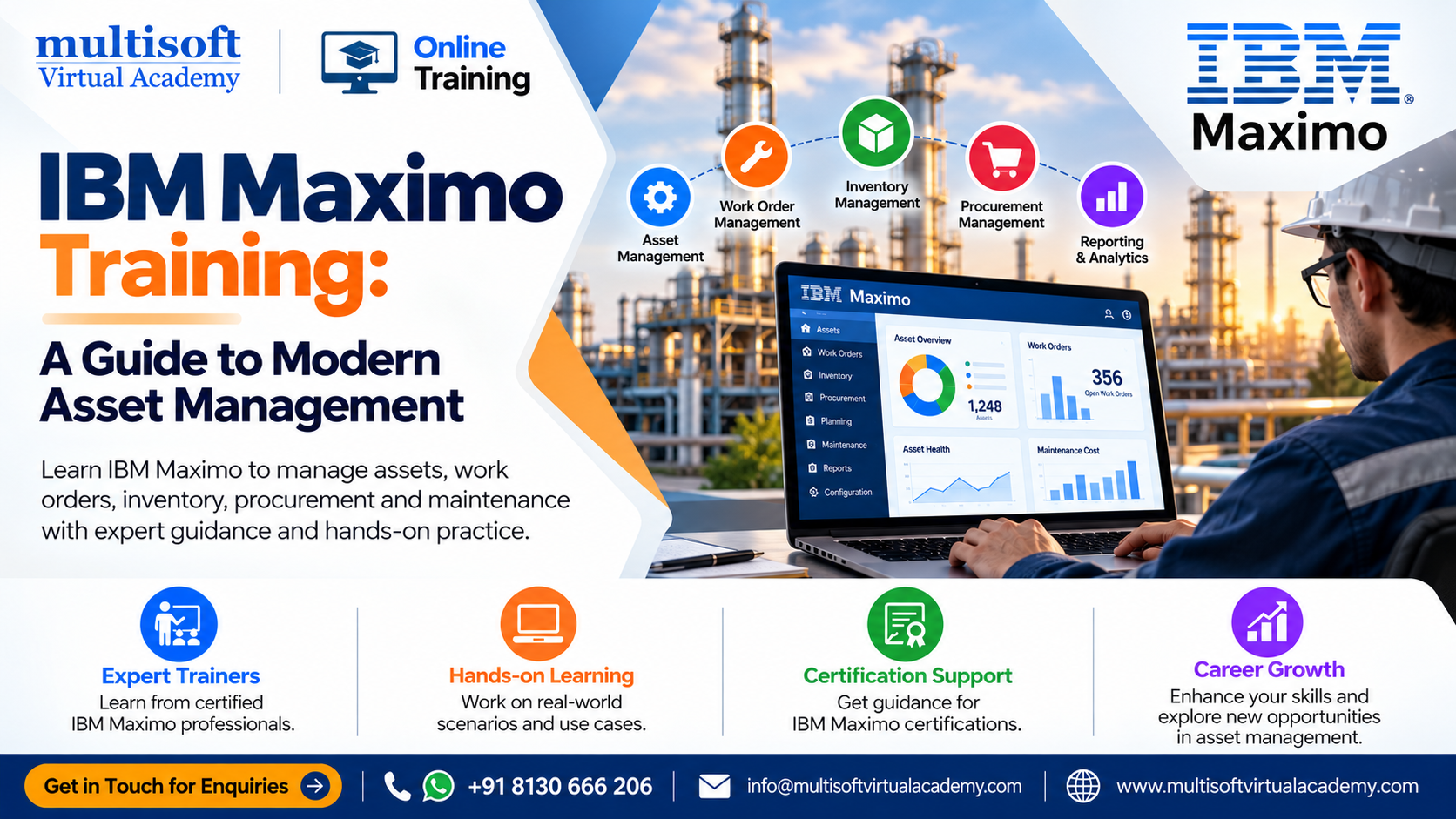
Organizations that operate industrial equipment, production facilities, transportation systems, and critical infrastructure need reliable ways to manage their physical assets. Equipment failures, delayed maintenance, poor inventory planning, and incomplete service records can increase costs and interrupt operations. Enterprise asset management software helps businesses organize maintenance activities, improve asset visibility, and make better operational decisions.
IBM Maximo Training helps professionals understand how enterprise asset management works and how Maximo supports maintenance planning, work order processing, inventory control, and asset lifecycle management. The training can benefit maintenance engineers, IT professionals, functional consultants, administrators, and business analysts who want to develop skills relevant to asset-intensive industries.
As organizations continue to modernize maintenance operations, understanding asset management systems can help professionals contribute to more organized and data-informed workflows.
IBM Maximo is an enterprise asset management solution designed to help organizations manage physical assets, maintenance operations, and associated business information. The IBM Maximo Application Suite brings together applications that support asset management, monitoring, health assessment, inspections, and related operational activities.
Maximo can help businesses maintain equipment records, schedule maintenance, manage spare parts, process work orders, and review maintenance history. By organizing these activities in a structured environment, organizations can improve information visibility and coordinate work more effectively.
For example, a power generation company may use Maximo to maintain equipment records, schedule inspections, assign maintenance tasks, and monitor spare parts availability. A manufacturing organization may use it to manage production equipment and document repair activities.
The exact capabilities available depend on the Maximo version, licensed applications, and system configuration.
Learning an enterprise asset management platform requires more than understanding its interface. Professionals also need to understand how asset records, maintenance tasks, inventory, and operational reporting work together.
Asset lifecycle management involves maintaining information about equipment from acquisition and installation through operation, maintenance, and retirement.
Training introduces learners to asset records, locations, classifications, specifications, and equipment hierarchies. These concepts help users organize asset information and maintain records that support maintenance planning.
Maintenance teams must coordinate inspections, repairs, labor, materials, and equipment availability. Maximo provides structured workflows for managing these activities.
Through training, learners can understand how maintenance requirements are recorded, prioritized, assigned, and completed. This knowledge can help professionals follow established maintenance procedures more consistently.
Incomplete work orders, inconsistent records, and delayed approvals can create problems for maintenance teams. Learning how to manage work processes and update operational information helps users understand how to maintain more reliable records.
Software alone cannot eliminate maintenance issues. Results depend on accurate information, suitable processes, trained employees, and appropriate implementation.
IBM Maximo offers learning opportunities for functional users, administrators, and technical professionals. A structured course can introduce core asset management concepts before progressing to configuration, workflow development, automation scripting, or system administration.
A practical IBM Maximo Training Course should cover the functions that match the learner's responsibilities and professional goals.
Asset management begins with reliable information about equipment and its physical location. Learners may study asset creation, location hierarchies, classifications, specifications, meters, and related records.
Understanding these structures helps users maintain consistent information and locate equipment details when planning maintenance activities.
Work orders document maintenance tasks and provide a framework for organizing the work required to complete them.
Training may include:
These activities help learners understand how maintenance work progresses from an initial request to completion and documentation.
Preventive maintenance involves performing scheduled activities to help maintain equipment in suitable operating condition.
Maximo training may cover preventive maintenance records, maintenance frequencies, job plan associations, meter-based schedules, and work order generation.
Learners can explore how recurring maintenance requirements are organized and how maintenance schedules support operational planning.
Spare parts availability is important for timely equipment repairs. Poor inventory control can result in unnecessary purchasing costs or maintenance delays.
Training may introduce item records, storerooms, stock balances, inventory transactions, material reservations, and purchasing workflows.
Professionals can learn how inventory information connects with maintenance activities and supports the availability of required materials.
Maintenance organizations often purchase spare parts, external services, and equipment-related supplies. Purchasing processes help coordinate requirements with vendors and procurement teams.
Depending on the syllabus, training may include purchase requisitions, purchase orders, vendor information, contracts, and receiving activities.
Workflows define how records move through business processes. They can support approvals, notifications, assignments, and other actions based on configured conditions.
Workflow training may be useful for administrators and consultants who need to understand how Maximo processes can be aligned with organizational procedures.
Technical training may introduce automation scripting for supported business rules and system behaviors.
Depending on the environment, learners may explore scripting concepts, launch points, object relationships, and validation logic. Prior programming knowledge can be helpful for more advanced topics.
Maintenance reports help organizations review work orders, equipment histories, inventory information, and other operational records.
Learners should understand how to retrieve relevant data, review reports, and interpret the information available in their environment. More advanced analytics depend on the tools and applications deployed by the organization.
IBM Maximo Application Suite Training introduces learners to a broader collection of applications designed to support asset-intensive operations.
Important learning areas may include the following:
Maximo Manage: Supports core enterprise asset management activities, including assets, work management, inventory, and maintenance processes.
Maximo Monitor: Helps organizations monitor equipment and operational information using available data sources.
Maximo Health: Supports the assessment of asset health and related reliability information.
Maximo Predict: Provides predictive maintenance capabilities for supported use cases.
Maximo Mobile: Supports mobile workflows for maintenance personnel and field workers.
Maximo Visual Inspection: Supports inspection use cases involving visual information and applicable AI capabilities.
These applications have different purposes and may not all be included in every implementation. Learners should check the course syllabus to determine which applications and functions are covered.
IBM Maximo implementation involves configuring and deploying the system to support an organization's asset management requirements. The process requires collaboration between business users, maintenance specialists, IT teams, and implementation consultants.
The project team identifies existing maintenance processes, reporting needs, asset structures, inventory requirements, and operational challenges. These requirements guide solution planning.
Configuration activities may include setting up organizations, sites, locations, asset records, security groups, workflows, and other system elements. The required configuration depends on the business process and deployment architecture.
Organizations moving from another system may need to migrate equipment details, maintenance histories, inventory records, and related information.
Data quality checks are important because incomplete or inconsistent records can affect the usefulness of the new system.
Maximo may exchange information with ERP platforms, procurement systems, monitoring tools, and other applications. Understanding integration requirements helps project teams coordinate data flows and investigate issues.
Testing helps confirm that important business processes work as intended. Typical scenarios may include asset creation, work order completion, preventive maintenance scheduling, inventory transactions, and purchasing activities.
Deployment also involves user preparation, documentation, and support planning to help employees adopt the system.
IBM Maximo can be relevant to industries that operate large equipment inventories or depend on structured maintenance processes.
The suitability of Maximo depends on an organization's operating model, system requirements, and implementation choices.
IBM Maximo training can be useful for professionals who work with assets, maintenance processes, enterprise applications, or industrial operations.
Maintenance engineers can learn how to organize maintenance records and understand work management processes.
Asset managers can develop knowledge of asset hierarchies, lifecycle information, and maintenance planning.
Functional consultants can build an understanding of business processes and application configuration.
Technical consultants and developers can explore automation scripting, integrations, and technical configuration.
System administrators can learn about user access, security, environment management, and application administration.
Business analysts can improve their understanding of asset management workflows and requirements gathering.
Beginners can start with the core concepts before moving into advanced technical or administrative topics.
Developing IBM Maximo knowledge may support career development in enterprise asset management and maintenance technology.
Potential roles include:
Career outcomes depend on practical ability, relevant work experience, technical knowledge, and employer requirements. Training can build a foundation, but hands-on practice and familiarity with real operational processes remain important.
Before choosing an IBM Maximo Online Training program, evaluate its learning objectives and practical coverage.
Review the syllabus: Ensure it covers the topics relevant to your role, whether asset management, maintenance planning, administration, or technical development.
Prioritize practical learning: Exercises involving work orders, assets, preventive maintenance, and inventory can help reinforce concepts.
Check the software version: Confirm whether the course covers Maximo Application Suite or another Maximo environment.
Understand the trainer's expertise: Look for clear instruction and relevant experience with the application and its business processes.
Confirm certification details: Check whether the program offers a course-completion certificate or prepares learners for a separate IBM credential.
Choose a suitable learning format: Consider live instructor-led training, self-paced learning, or one-to-one sessions based on your schedule and learning needs.
IBM Maximo Training teaches users how to work with enterprise asset management processes, including asset records, work orders, preventive maintenance, inventory, and reporting.
Yes. Beginners can start with basic asset management concepts and the application interface before progressing to advanced configuration or technical development.
It is a collection of applications supporting asset management and related activities such as monitoring, asset health assessment, maintenance, and inspections.
Some courses introduce configuration, data migration, integrations, testing, and deployment. The level of detail depends on the selected program.
It can help learners develop relevant software knowledge for asset management and maintenance-related roles. Employment opportunities depend on experience, skills, and employer requirements.
IBM Maximo supports organizations in managing physical assets, organizing maintenance work, and improving access to operational information. Learning asset lifecycle management, work orders, preventive maintenance, inventory control, workflow development, and implementation fundamentals can help professionals build useful enterprise asset management skills. Selecting a course with relevant practical exercises and suitable software-version coverage can make the learning experience more valuable. Multisoft Virtual Academy provides IBM Maximo Training for professionals who want to develop their understanding of asset management, maintenance operations, and Maximo Application Suite workflows.
| Start Date | Time (IST) | Day | |||
|---|---|---|---|---|---|
| 31 Oct 2026 | 06:00 PM - 10:00 AM | Sat, Sun | |||
| 01 Nov 2026 | 06:00 PM - 10:00 AM | Sat, Sun | |||
| 07 Nov 2026 | 06:00 PM - 10:00 AM | Sat, Sun | |||
| 08 Nov 2026 | 06:00 PM - 10:00 AM | Sat, Sun | |||
|
Schedule does not suit you, Schedule Now! | Want to take one-on-one training, Enquiry Now! |
|||||




 Join our Live Instructor-Led online classes delivered by industry experts
 Let's Get Started
