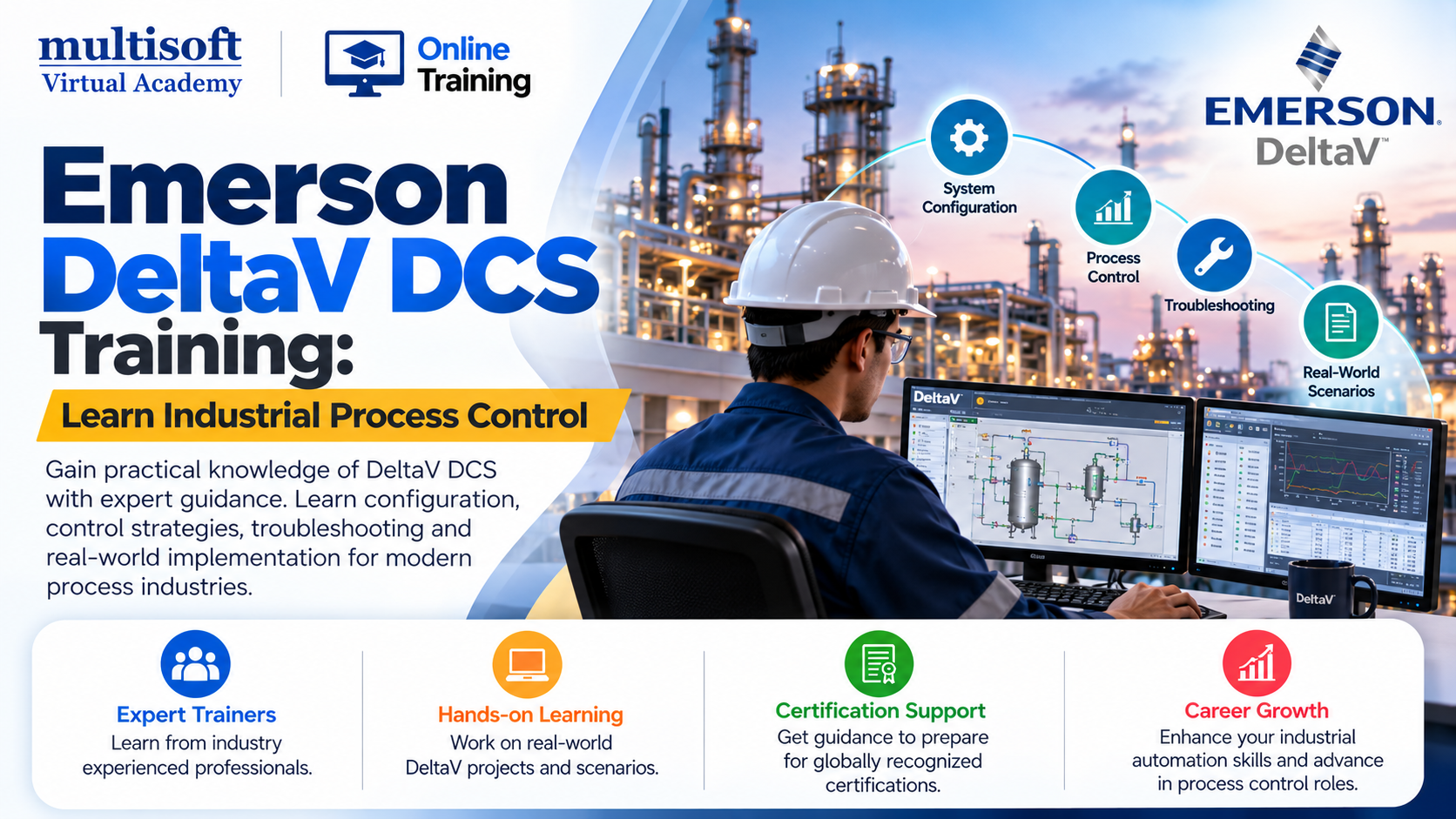
Industrial automation has become essential for organizations that operate complex production facilities. Modern plants need reliable systems to monitor equipment, regulate process variables, manage alarms, and maintain consistent operating conditions. Distributed Control Systems (DCS) help industrial teams coordinate these activities through integrated control hardware and software.
The Emerson DeltaV DCS Training program introduces professionals to the technology and engineering principles used in DeltaV-based automation environments. It helps learners understand control system architecture, controller configuration, process logic, operator interfaces, and system diagnostics. These capabilities are relevant to engineers and technicians working in process industries where operational reliability and accurate control are important.
Whether you are beginning a career in industrial automation or expanding your existing engineering knowledge, learning how a DCS operates can provide a stronger foundation for working with modern industrial control technologies.
The Emerson DeltaV Distributed Control System is an industrial automation platform designed to support process monitoring, control, and plant operations. It brings together controllers, input/output devices, engineering tools, operator workstations, and other system components to manage industrial processes.
Unlike a standalone control device, a distributed control system coordinates multiple control functions across an industrial facility. Engineers can configure control strategies, monitor process information, and provide operators with the information required to supervise plant activities.
For example, a manufacturing facility may need to regulate liquid levels, maintain specific temperatures, and control material flow throughout a production process. The DCS uses field measurements and configured control logic to help maintain the required operating conditions.
Understanding DeltaV requires knowledge of both the software environment and the underlying principles of instrumentation and process control. Practical training helps learners connect these concepts with the configuration tasks performed during engineering and maintenance activities.
Industrial facilities rely on skilled automation professionals to maintain control systems and support efficient plant operations. Learning DeltaV can help professionals develop technical knowledge relevant to these responsibilities.
A distributed control system contains several interconnected components that work together to monitor and control a process. Understanding their functions is important when configuring, operating, or troubleshooting an automation system.
Training typically introduces controllers, I/O modules, operator workstations, engineering stations, communication networks, and supporting software components. This knowledge helps learners understand how process signals move through the control environment.
Control strategies determine how a system responds to changing process conditions. Engineers must understand how inputs, control logic, operating parameters, and outputs interact to produce the intended response.
A practical DeltaV course may introduce function blocks, control modules, analog and digital signals, interlocks, and PID control. These concepts help learners understand the structure of industrial control logic.
Operators need accurate information about equipment status and process conditions. Control system displays help present measurements, alarms, trends, and operating information in a form that supports decision-making.
Training introduces the principles behind operator graphics and process monitoring. It also helps learners understand the relationship between configured control functions and the information displayed to operators.
Control system faults can result from incorrect configuration, signal problems, communication failures, hardware issues, or unexpected process behavior.
Learning structured diagnostic methods helps professionals investigate these situations systematically. Training can provide a foundation for identifying possible causes, reviewing system information, and following approved troubleshooting procedures.
A well-designed Emerson DeltaV DCS Training Course should combine conceptual explanations with practical activities. The following subjects are useful when evaluating a training program.
The course should begin with the basic concepts of distributed control systems and the DeltaV engineering environment.
Learners may study:
These topics establish the foundation needed to understand more advanced configuration activities.
Controllers execute configured logic, while input/output modules provide the connection between the control system and field instrumentation.
Training may cover controller setup, I/O assignments, signal configuration, channel mapping, and the relationship between field devices and control modules.
Participants should learn why accurate signal identification and configuration validation are important. Incorrect assignments can affect process monitoring and control, making systematic verification an essential engineering practice.
Control modules organize the logic used to manage process variables and equipment functions. Function blocks provide configurable elements for implementing specific control operations.
Depending on the course level, learners may practice creating control modules, connecting signals, configuring parameters, and examining control logic.
These exercises help participants understand how engineering requirements are translated into a structured control strategy.
PID control is commonly used to regulate industrial variables such as temperature, pressure, flow, and liquid level.
Training may explain the relationship between the process variable, setpoint, controller output, and operating mode. Learners can also explore how PID parameters influence system response.
For example, a temperature control loop may compare the measured temperature with a target value and adjust a heating control output accordingly.
Configuring a loop and tuning it for a real process are different activities. Appropriate tuning requires consideration of process behavior, equipment limitations, and site-specific operating procedures.
Human-machine interface (HMI) displays provide operators with a visual representation of process conditions and equipment status.
Training may introduce graphic development, process symbols, equipment representations, tag references, faceplates, and navigation between displays.
Well-designed operator graphics should make important information easy to recognize. Clear presentation can help operators understand process conditions and respond appropriately to changes.
Alarm systems notify operators when process conditions require attention. Effective alarm configuration helps ensure that important conditions are communicated clearly.
A DeltaV course may cover alarm priorities, alarm summaries, acknowledgement procedures, event records, and alarm-related configuration.
Learners should understand that alarm management involves more than activating notifications. Alarms must be meaningful, appropriately prioritized, and consistent with the facility's alarm philosophy and operating requirements.
Some industrial processes manufacture products through defined sequences of production steps. Batch automation helps coordinate these steps and manage the equipment involved.
Where included in the curriculum, training may introduce recipes, equipment modules, process cells, batch execution, and the relationship between control logic and production procedures.
This knowledge may be particularly useful to professionals working in pharmaceuticals, chemicals, food processing, and other batch-oriented industries.
Industrial control systems require ongoing monitoring and maintenance. Professionals need to understand how to investigate configuration issues, communication problems, hardware faults, and other system abnormalities.
Advanced training may include diagnostic tools, configuration backups, user access concepts, system administration, and recovery procedures.
The specific content depends on the software version and the responsibilities associated with the learner's role.
DeltaV DCS knowledge can be relevant to a range of process industries. Each sector has different control requirements, engineering standards, and operating procedures.
Oil and gas: Automation supports monitoring and control across processing facilities and other industrial operations.
Chemical manufacturing: Control systems help regulate process variables and coordinate production activities involving chemical reactions and material handling.
Pharmaceutical manufacturing: Automated control supports production processes where consistency, traceability, and controlled operating conditions are important.
Food and beverage: Manufacturers may use process automation to coordinate production stages and monitor temperature, flow, and other variables.
Power and energy: Certain industrial energy and utility applications use distributed control technologies to coordinate equipment and monitor operating conditions.
Pulp and paper: Control systems help manage interconnected processes and maintain consistent production conditions.
The exact suitability of DeltaV depends on the facility's engineering requirements and selected automation architecture.
DeltaV training can support professionals who work with industrial instrumentation, process control, and automation systems.
Instrumentation engineers can develop a better understanding of how field signals connect with configured control strategies.
Control system engineers can strengthen their knowledge of system architecture, controller configuration, and control logic.
Automation engineers can expand their understanding of process monitoring, configuration, and system integration.
DCS operators can learn more about operator displays, process variables, alarms, and control system fundamentals.
Maintenance technicians can develop a foundation for investigating instrumentation and control system problems.
Engineering graduates can gain introductory knowledge of industrial automation technologies and the principles behind distributed control systems.
Previous exposure to instrumentation, industrial processes, or control engineering is beneficial. Beginners should select a course that explains the fundamentals before introducing advanced engineering tasks.
Professionals with relevant automation knowledge may pursue roles involving process control, instrumentation, commissioning, system maintenance, and industrial engineering.
Possible career paths include:
Training can strengthen technical knowledge, but career progression also depends on practical experience, qualifications, troubleshooting ability, and familiarity with industrial standards.
Candidates interested in engineering positions should focus on understanding control principles and developing practical skills rather than relying exclusively on course completion.
Choosing a suitable course requires careful evaluation of its curriculum and practical learning opportunities.
Check whether the course covers the topics relevant to your goals. An introductory program may focus on system fundamentals, while an engineering course may emphasize controller configuration, control modules, and graphics.
Hands-on activities help learners understand how configuration tasks are performed. Ask whether the course includes guided exercises, simulated projects, or access to a suitable practice environment.
Different DeltaV releases may have differences in functionality and engineering workflows. Verify which version is covered and whether it aligns with your learning or workplace requirements.
An instructor who understands industrial control principles can explain not only how a task is performed but also why it matters in an engineering environment.
Before enrolling, clarify software access, learning materials, session recordings, practical support, and any prerequisites.
Confirm whether the provider offers a course-completion certificate or preparation for a separate vendor certification. These credentials should not be treated as interchangeable.
It is a learning program that introduces professionals to DeltaV distributed control system architecture, configuration, process control, operator graphics, alarm management, and troubleshooting.
Yes. Beginners with basic knowledge of instrumentation or process control can start with a foundational course. Advanced configuration and commissioning activities may require additional experience.
Typical subjects include DCS architecture, controller and I/O configuration, control modules, PID loops, HMI graphics, alarms, diagnostics, and selected batch automation concepts.
DeltaV is used in process automation environments, including chemical manufacturing, life sciences, oil and gas, and other industrial sectors. The specific application depends on the plant's requirements.
Training can help professionals develop relevant technical knowledge. Career opportunities depend on qualifications, practical experience, employer requirements, and the ability to apply control system concepts effectively.
Emerson DeltaV DCS provides an important foundation for process monitoring, control, and automation across industrial environments. Understanding system architecture, controller configuration, PID loops, operator graphics, alarms, and troubleshooting can help professionals develop skills relevant to modern control engineering. When selecting a course, prioritize practical learning, a suitable syllabus, and instruction that connects software functions with real industrial requirements. Multisoft Virtual Academy offers Emerson DeltaV DCS Training for professionals seeking to strengthen their knowledge of distributed control systems and develop practical capabilities in industrial process automation.
| Start Date | Time (IST) | Day | |||
|---|---|---|---|---|---|
| 31 Oct 2026 | 06:00 PM - 10:00 AM | Sat, Sun | |||
| 01 Nov 2026 | 06:00 PM - 10:00 AM | Sat, Sun | |||
| 07 Nov 2026 | 06:00 PM - 10:00 AM | Sat, Sun | |||
| 08 Nov 2026 | 06:00 PM - 10:00 AM | Sat, Sun | |||
|
Schedule does not suit you, Schedule Now! | Want to take one-on-one training, Enquiry Now! |
|||||




 Join our Live Instructor-Led online classes delivered by industry experts
 Let's Get Started
