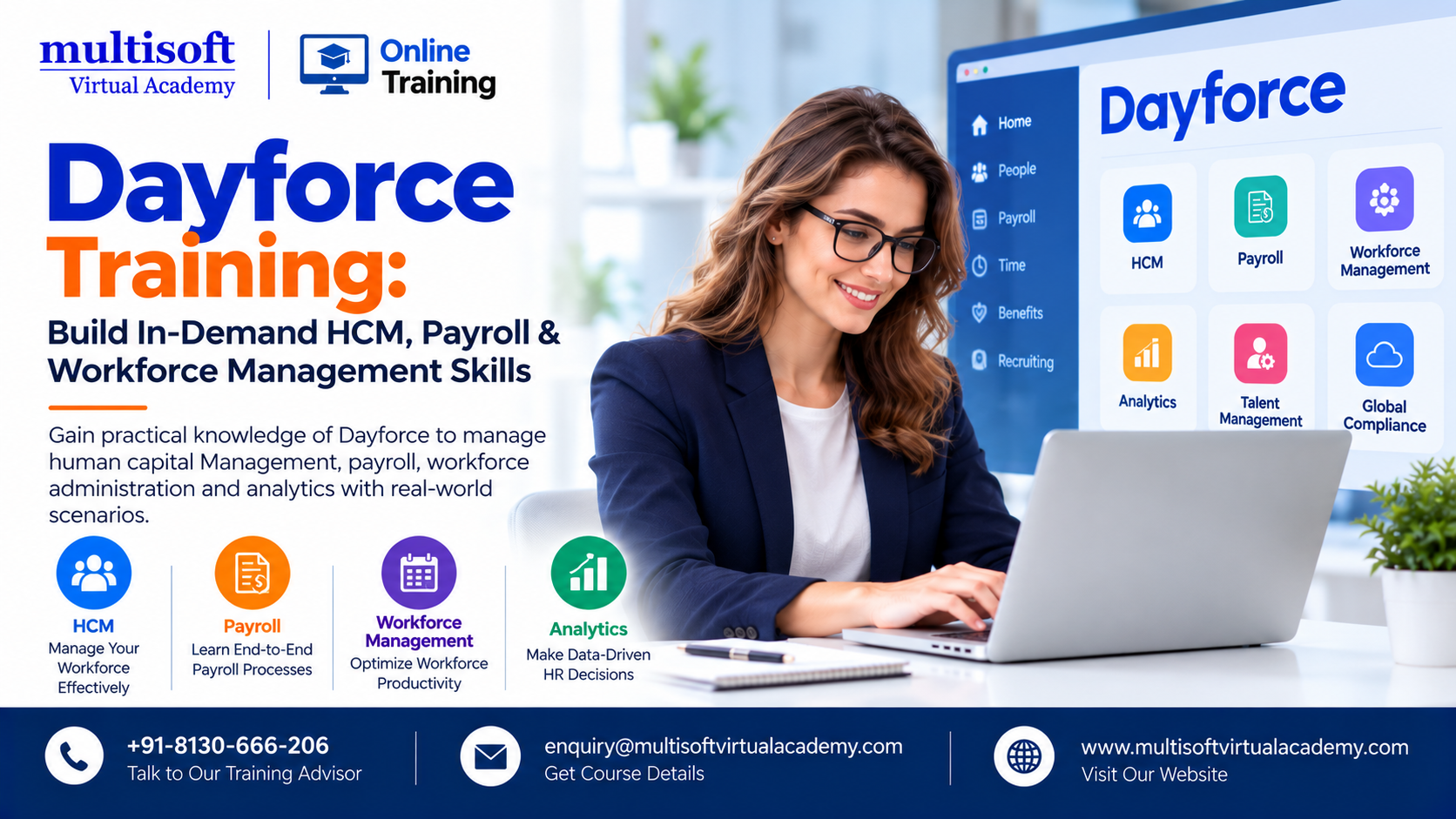
Human capital management is becoming increasingly technology-driven as organizations seek better ways to manage employees, payroll, scheduling, benefits, talent, compliance, and workforce data. In this environment, professionals who understand modern cloud HCM platforms can bring significant value to HR and business operations.
Dayforce Training provides a structured way to develop practical knowledge of Dayforce HCM and its connected workforce capabilities. The platform brings together areas such as human resources, payroll, workforce management, talent, and learning, making it particularly relevant for professionals working with integrated HR technology.
As organizations continue modernizing their HR operations, Dayforce HCM Training, payroll training, workforce management learning, and related implementation skills are becoming valuable areas of professional development.
Dayforce Training is a cloud-based human capital management platform designed to connect important workforce processes within a unified environment. Depending on an organization's configuration, professionals may work with employee information, payroll, workforce management, talent, benefits, learning, reporting, and related HR processes.
The integrated approach is important because HR activities rarely operate independently. Employee information can influence payroll, scheduling can affect working hours and compensation, and workforce data can support management decisions.
Learning how these processes interact is one of the major advantages of structured Dayforce Training.
The Dayforce ecosystem also includes learning capabilities that allow organizations to create, assign, and track learning activities, manage certifications, and associate skills with courses and learning plans.
HR departments are moving away from fragmented systems and manual processes toward integrated cloud platforms. Organizations want better visibility into workforce information while improving efficiency, employee experience, compliance, and decision-making.
Dayforce itself highlights training as an important part of successful implementation and adoption, offering instructor-led, self-directed, virtual, classroom, and other learning approaches.
For professionals, this creates opportunities to develop knowledge across multiple areas instead of focusing on a single isolated HR process.
Some of the strongest reasons to consider Dayforce HCM Training include:
A well-structured Dayforce Training Course should go beyond basic navigation. Learners benefit most when training connects platform functionality with realistic HR and workforce processes.
Typical learning areas can include:
Learners can begin by understanding the architecture, terminology, navigation, organizational structures, employee records, and fundamental HCM concepts.
A strong foundation makes it easier to understand advanced configurations and interconnected modules later.
HR professionals need accurate employee information and well-organized workforce processes. Training can cover employee records, organizational structures, employment information, HR workflows, and related administrative activities.
Understanding these fundamentals helps professionals work more confidently with employee lifecycle processes.
Payroll is a critical part of any HCM environment because errors can directly affect employees and organizational compliance.
Dayforce Payroll Training may cover areas such as:
Modern payroll is increasingly connected to workforce activities such as schedules, overtime, leave, job changes, and employee information. Dayforce has also highlighted the growing connection between workforce decisions and payroll outcomes.
Workforce management is another important area for professionals working with Dayforce.
Training may introduce concepts such as:
These capabilities can help organizations improve workforce visibility and make better operational decisions.
Modern organizations increasingly focus on employee development, skills, recruitment, performance, and career progression.
Dayforce Talent Management Training can help learners understand how talent-related processes fit into a broader HCM environment.
Potential topics include:
Benefits administration can become complicated when organizations manage different employee groups, eligibility rules, plans, and enrollment requirements.
Training can help learners understand benefits-related workflows and how employee information interacts with benefits processes.
Learning management is increasingly becoming part of strategic workforce development.
Dayforce Learning allows organizations to create, assign, and track learning activities while connecting learning opportunities with workforce skills. It also supports certification management and learning records. Dayforce Help
Professionals can therefore explore how training, skills, certifications, and employee development can be managed within an integrated HCM environment.
Dayforce Certification Training and professional learning programs can be useful for several categories of learners.
HR specialists can develop a stronger understanding of how technology supports employee lifecycle management and HR operations.
Payroll specialists can expand their knowledge of integrated payroll processes and how workforce information affects payroll operations.
Administrators can learn how to manage configurations, employee information, workflows, security, reporting, and other system-related activities.
Professionals planning to work as Dayforce consultants can benefit from understanding both technical functionality and business processes.
People involved in scheduling, time tracking, workforce planning, and attendance management can develop specialized platform knowledge.
Technology professionals supporting HR applications can gain useful insight into HCM functionality, integrations, data, and system processes.
Professionals entering the HR technology field can use structured training to develop foundational knowledge before progressing toward more advanced roles.
The value of training depends on how effectively learners can apply their knowledge. A practical program should help develop both platform-specific understanding and broader HCM capabilities.
Important skills may include:
HCM administration: Understanding employee and organizational information.
Payroll management: Working with payroll processes, earnings, deductions, and related information.
Workforce management: Understanding scheduling, time, attendance, and workforce processes.
Reporting and analytics: Interpreting workforce information to support operational decisions.
Configuration: Understanding how business requirements can be translated into system configurations.
Talent management: Supporting employee development and skills-related processes.
Learning management: Managing courses, learning plans, skills, and certifications.
Problem-solving: Identifying process issues and determining appropriate system-based solutions.
Data has become an important part of modern HR decision-making. Organizations increasingly want to understand workforce trends rather than simply maintain employee records.
Workforce analytics can help organizations examine areas such as:
This makes Dayforce Workforce Management Training and analytics-related knowledge increasingly relevant for professionals who want to move from transactional HR responsibilities toward data-supported workforce management.
Artificial intelligence is also influencing the future of HR technology. AI can support areas such as skills identification, learning recommendations, workforce insights, automation, and employee experiences.
Dayforce's current learning capabilities, for example, include AI-assisted course creation and AI-supported learning recommendations designed to help organizations address skills gaps. Dayforce
For professionals, this means that learning Dayforce should not be limited to understanding today's workflows. It is also useful to understand how automation, analytics, skills intelligence, and AI may influence future HR operations.
Professionals choosing Dayforce Online Training should evaluate the quality and structure of the program rather than selecting a course based only on duration or price.
Consider the following factors:
Choose training that connects concepts with realistic HR, payroll, and workforce scenarios.
A knowledgeable trainer can explain not only how a feature works but also why organizations use it.
The program should cover the areas relevant to your career objectives, such as HCM, payroll, workforce management, reporting, or administration.
Online and virtual learning can be particularly useful for working professionals who need to balance professional responsibilities with skill development.
Practical exercises can help learners understand workflows more effectively than theory alone.
Cloud HCM platforms evolve continuously. Training content should therefore remain aligned with current platform functionality and modern workforce requirements.
Dayforce itself provides multiple learning formats, including classroom, virtual, self-study, and instructor-led approaches, demonstrating the importance of flexible learning models.
Certification and structured training can provide a way to demonstrate knowledge, but professionals should avoid treating certification as a substitute for practical expertise.
The strongest career profile combines:
Training + practical knowledge + business-process understanding + problem-solving + relevant experience
Dayforce's learning functionality also supports certifications that can be linked with courses and learning plans. Organizations can configure certifications to be earned after employees complete specified learning requirements.
Professionals should therefore focus on understanding how HCM technology solves actual business problems rather than simply memorizing platform features.
Professionals with relevant Dayforce knowledge may explore career paths such as:
Career opportunities will vary according to experience, technical knowledge, location, employer requirements, and specialization.
Learning an enterprise HCM platform is more effective when approached systematically.
Start with the fundamentals and understand the overall HCM ecosystem before moving into specialized modules. Once you understand the relationship between employee data, payroll, workforce management, talent, and reporting, individual features become easier to understand.
Next, focus on practical scenarios. Instead of learning individual screens in isolation, think about business situations such as onboarding an employee, managing working time, processing payroll, creating a schedule, handling benefits, or generating workforce reports.
Finally, keep learning after completing formal training. Cloud platforms evolve, and Dayforce's current documentation continues to receive updates, including the 2026.2 learning documentation.
Continuous learning is especially important for professionals who want to build long-term careers in HCM technology.
Dayforce Training can be a valuable career-development path for HR professionals, payroll specialists, HCM administrators, consultants, workforce management professionals, and technology teams seeking practical knowledge of modern cloud-based HCM. As organizations increasingly connect HR, payroll, workforce management, talent, learning, analytics, and AI-driven capabilities, professionals who understand these interconnected processes can position themselves for broader opportunities in HR technology.
For learners looking to develop structured and career-focused expertise, Multisoft Virtual Academy provides professional training solutions designed to help individuals build practical knowledge of Dayforce HCM, payroll, workforce management, and related enterprise technologies. A focused learning path can help bridge the gap between theoretical concepts and the practical skills expected in today's evolving HCM environment.
| Start Date | Time (IST) | Day | |||
|---|---|---|---|---|---|
| 03 Oct 2026 | 06:00 PM - 10:00 AM | Sat, Sun | |||
| 04 Oct 2026 | 06:00 PM - 10:00 AM | Sat, Sun | |||
| 10 Oct 2026 | 06:00 PM - 10:00 AM | Sat, Sun | |||
| 11 Oct 2026 | 06:00 PM - 10:00 AM | Sat, Sun | |||
|
Schedule does not suit you, Schedule Now! | Want to take one-on-one training, Enquiry Now! |
|||||






 Join our Live Instructor-Led online classes delivered by industry experts
 Let's Get Started