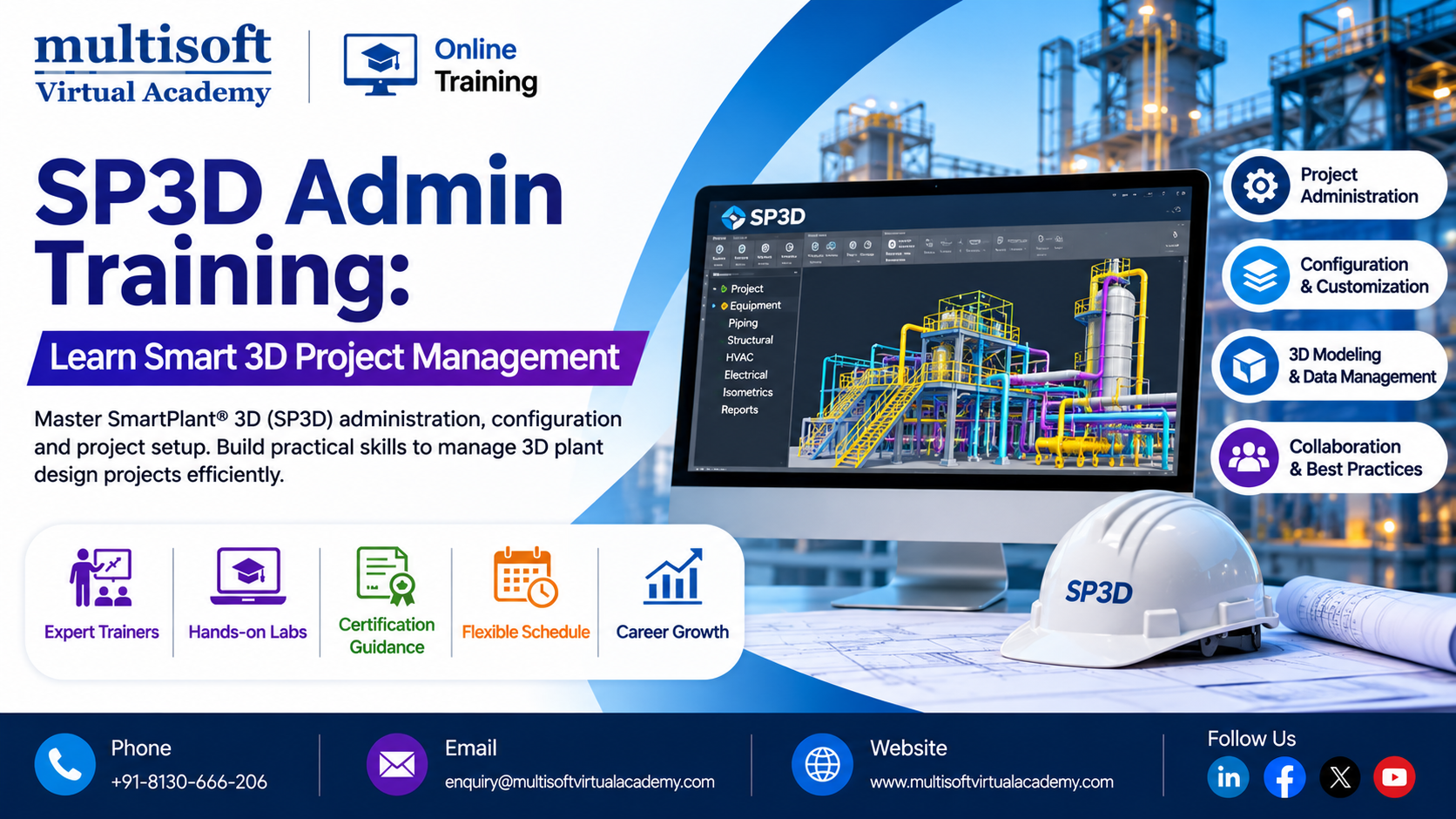
The development of modern industrial facilities requires advanced engineering applications that can manage complex plant structures, equipment information, and multidisciplinary design activities. Organizations involved in oil and gas, petrochemical, power generation, and infrastructure projects use intelligent 3D design environments to improve engineering coordination and maintain accurate project information.
Hexagon Smart 3D, widely known as SP3D, is an engineering application used for intelligent plant design and project data management. While designers focus on creating and modifying 3D models, administrators ensure that the software environment remains properly configured and accessible.
SP3D Admin Training provides professionals with an understanding of the administrative processes required to manage Smart 3D environments. It introduces important activities such as project creation, database configuration, user management, reference data administration, system maintenance, and technical troubleshooting.
For engineering professionals who want to expand their knowledge beyond modeling activities, learning Smart 3D administration can be a valuable step toward developing specialized technical skills.
An SP3D administrator is responsible for managing the technical environment that supports engineering design teams. The role involves maintaining project databases, configuring administrative settings, controlling user permissions, and ensuring that engineering resources are available when required.
Administrators also help resolve issues that may affect the working environment and coordinate maintenance activities according to project requirements.
Their responsibilities may include:
A good administrator needs an understanding of Smart 3D functionality along with database concepts and industrial engineering workflows.
Industrial engineering projects depend on accurate information and coordinated software environments. When project configurations or database settings are not maintained correctly, engineering teams may face delays and difficulties accessing essential information.
Learning administration helps professionals understand how to maintain the environment behind the design process.
Every engineering project has specific requirements relating to plant structures, systems, reference information, and user access. Administrators configure these elements to establish an organized project environment.
Smart 3D uses databases to manage engineering information. Understanding database relationships, maintenance procedures, and integrity checks helps administrators support reliable project operations.
Different engineering teams require access to specific project resources. Administration knowledge helps professionals understand how users, permissions, catalogs, and other resources are managed.
Piping, equipment, structural, electrical, and instrumentation teams may work within the same engineering environment. Proper administration helps maintain consistency and supports coordinated project activities.
Administrative problems can arise from configuration settings, database connectivity, permissions, or other technical dependencies. Training helps learners understand systematic methods for investigating such issues.
A professional SP3D Admin Course should cover the essential administrative functions used to manage a Smart 3D project. The following subjects provide a useful foundation for understanding the software environment.
Understanding the software architecture helps learners identify how different components of the Smart 3D environment interact.
This module may introduce:
These concepts help administrators understand the technical foundation before performing project-level activities.
Project administration begins with establishing an appropriate environment for engineering activities. Administrators need to understand how project requirements influence the structure and configuration of a Smart 3D installation.
Important topics may include site creation, plant configuration, project hierarchy, system organization, project settings, and administrative resource management.
Practical learning can help participants understand how to prepare a project environment for different engineering teams.
Database management is a major responsibility within Smart 3D administration. Engineering information is maintained through interconnected database structures that support modeling and project activities.
Training may cover:
Learners should understand the purpose of each database and how administrative changes can affect project information.
Engineering organizations often involve multiple project participants with different responsibilities. Administrators need to manage access according to organizational policies and project requirements.
This module may cover:
Effective permission management helps maintain controlled access to engineering information and administrative functions.
Reference data provides standardized information that designers use when developing engineering models. It can include component definitions, specifications, properties, and other technical details.
An administrator should understand how catalogs and reference information are organized and maintained.
Training may introduce catalog structures, reference data management, specification administration, and bulk loading concepts.
This knowledge is useful for maintaining consistency across engineering projects. Changes to reference data should always be reviewed and tested before being applied to active project environments.
Large plant design projects may involve teams working from different offices or locations. Workshare capabilities support collaboration by helping coordinate engineering information across project environments.
Training may explain workshare concepts, shared model information, synchronization activities, and external reference model management.
Understanding these processes helps administrators support distributed engineering teams and maintain consistency in project information.
Database protection is essential for organizations managing large engineering projects. Administrators need to understand how backup procedures and recovery planning support business continuity.
A training program may introduce backup strategies, restoration concepts, database recovery, and test environment preparation.
Participants should understand that database maintenance must follow approved procedures. Incorrect operations may affect project data and system availability.
Administrators often investigate technical issues reported by engineering users. These may involve application errors, database connections, missing permissions, configuration problems, or reference data inconsistencies.
Training may introduce error log review, administrative diagnostics, problem investigation, and basic troubleshooting approaches.
A systematic troubleshooting process helps identify the possible source of an issue before corrective action is taken.
Although administration and design activities operate within the same software environment, their responsibilities are different.
| SP3D Administration | SP3D Design |
| Project setup and configuration | 3D model development |
| Database management | Equipment modeling |
| User and permission control | Piping design |
| Catalog administration | Structural modeling |
| Reference data maintenance | Pipe support design |
| Workshare administration | Model coordination |
| System troubleshooting | Drawing extraction |
| Database backup and recovery | Engineering model review |
Professionals interested in managing software environments may prefer administration training. Those who want to focus on creating plant models should consider discipline-specific SP3D design training.
SP3D administration skills can be relevant to organizations involved in complex industrial engineering projects.
Oil and Gas: Refineries, offshore platforms, and processing facilities require structured engineering information and coordinated design environments.
Petrochemical: Chemical processing plants involve interconnected equipment, piping, and structural systems that depend on reliable engineering data.
Power Generation: Power facilities require organized plant models and coordinated engineering activities throughout project development.
EPC Companies: EPC organizations manage multidisciplinary engineering teams and large project databases. Administrative knowledge helps support the applications used by these teams.
Industrial Manufacturing: Manufacturing organizations may use intelligent 3D design applications for new installations, plant modifications, and facility development.
The exact responsibilities of an SP3D administrator depend on the organization's software configuration and project structure.
This training can be useful for professionals interested in developing technical expertise in engineering application administration.
Basic knowledge of engineering applications and database concepts can make the learning process easier.
Developing Smart 3D administration knowledge may help professionals explore opportunities in engineering software management and technical project support.
Potential career profiles include:
Employers may look for additional knowledge of databases, technical support procedures, engineering workflows, and related software applications.
Training provides a learning foundation, while practical experience helps professionals understand how administrative responsibilities are handled in real industrial projects.
Selecting an appropriate training program requires careful evaluation of the curriculum and learning environment.
Review whether the program includes architecture, project configuration, database management, permission groups, catalog administration, workshare, backup, and troubleshooting.
Administration requires more than theoretical knowledge. Look for training that includes guided exercises and demonstrations based on realistic project situations.
Choose a program with instructors who understand Smart 3D administration and can explain technical topics using practical engineering examples.
Smart 3D features and workflows can differ between software versions. Ask which version is covered and whether participants receive access to a suitable practice environment.
Check the availability of course materials, recorded sessions, instructor interaction, and post-training learning support.
A course that combines structured explanations with practical learning can help participants develop a better understanding of administrative responsibilities.
It helps professionals learn how to configure, maintain, and support Smart 3D project environments. The training covers databases, project settings, user access, reference data, and other administrative activities.
Yes. The role involves understanding software architecture, databases, project configuration, access management, and troubleshooting.
Yes. Existing Smart 3D designers can expand their knowledge by learning administrative functions and gaining practical experience with databases and project configuration.
Basic understanding of database structures, connectivity, maintenance, and backup concepts is beneficial. Advanced requirements depend on the administrator's responsibilities and the project environment.
Some training providers offer a course-completion certificate. Learners should confirm whether the program includes a provider-issued certificate or preparation for a separate vendor certification.
Yes. Practical experience helps professionals understand project dependencies, investigate errors, manage databases, and perform administrative activities more confidently.
Smart 3D administration provides the technical foundation needed to maintain organized and reliable plant design environments. Understanding project configuration, database management, permission control, catalog administration, workshare, and troubleshooting can help professionals support complex engineering operations. Building these capabilities through structured training and practical exercises can strengthen technical knowledge and prepare learners for administrative responsibilities in industrial projects. Multisoft Virtual Academy offers SP3D Admin Training for professionals who want to develop Smart 3D administration expertise and improve their understanding of engineering software management and plant design environments.
| Start Date | Time (IST) | Day | |||
|---|---|---|---|---|---|
| 14 Nov 2026 | 06:00 PM - 10:00 AM | Sat, Sun | |||
| 15 Nov 2026 | 06:00 PM - 10:00 AM | Sat, Sun | |||
| 21 Nov 2026 | 06:00 PM - 10:00 AM | Sat, Sun | |||
| 22 Nov 2026 | 06:00 PM - 10:00 AM | Sat, Sun | |||
|
Schedule does not suit you, Schedule Now! | Want to take one-on-one training, Enquiry Now! |
|||||





 Let's Get Started
