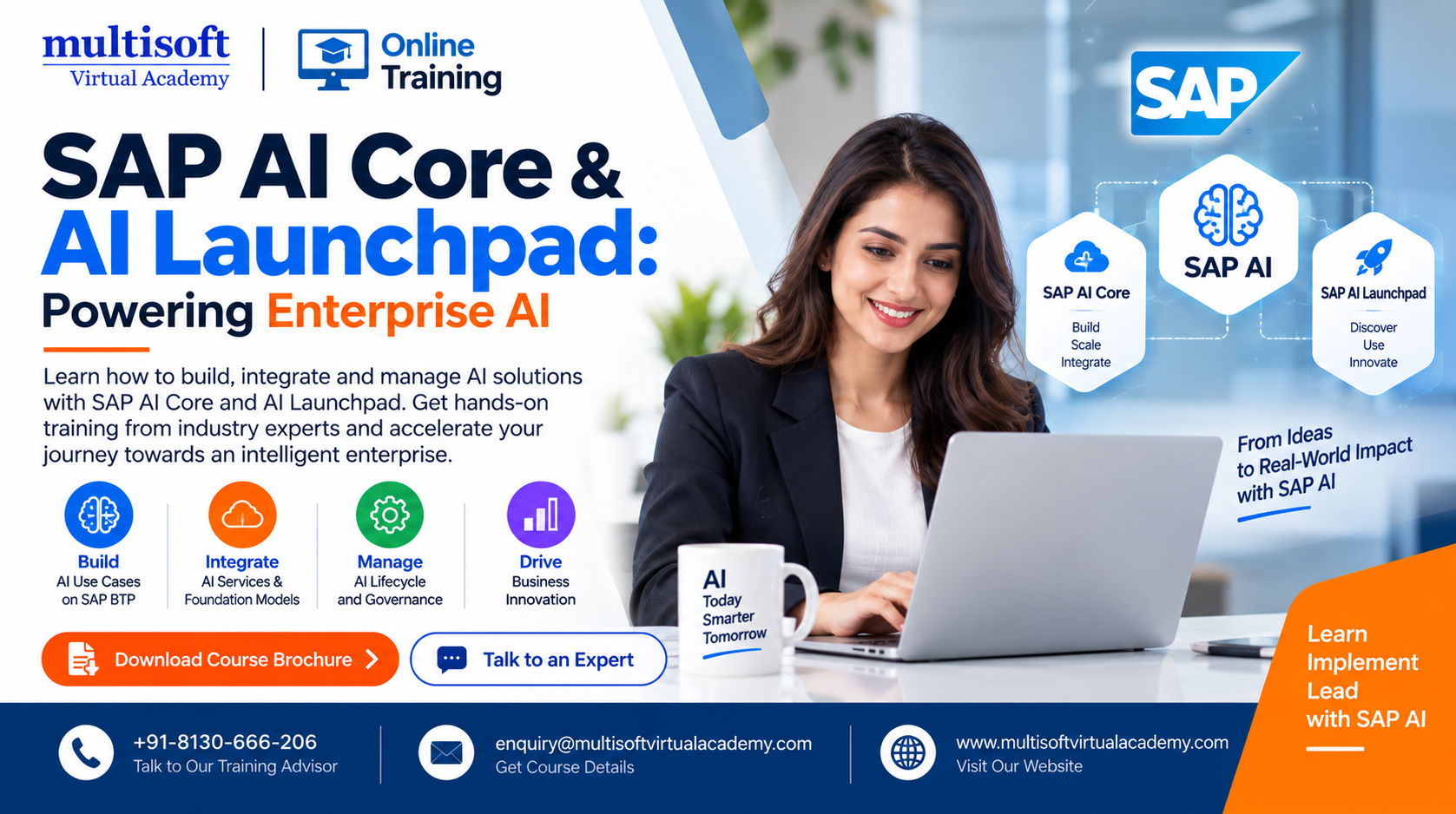
Artificial intelligence is rapidly changing how organizations manage data, automate processes, and make business decisions. As enterprises move beyond basic automation toward generative AI and intelligent workflows, they need reliable platforms that can support AI development, deployment, governance, and continuous improvement.
This is where SAP AI Core & AI Launchpad become increasingly important.
Built within the SAP Business Technology Platform (SAP BTP) ecosystem, SAP AI Core provides the runtime and operational foundation for AI scenarios, while SAP AI Launchpad offers a centralized environment for managing AI use cases across supported AI runtimes. Together, they help organizations move from AI experimentation to scalable enterprise implementation.
With the growing adoption of SAP Business AI, Generative AI, large language models (LLMs), AI agents, and intelligent automation, understanding these technologies can help organizations prepare for the next generation of digital transformation.
SAP AI Core & AI Launchpad is an AI service within SAP Business Technology Platform designed to manage the execution and operations of AI assets in a standardized and scalable environment.
It supports the lifecycle of AI scenarios, including activities such as model training, deployment, execution, monitoring, and retraining. It can also work with open-source machine learning frameworks and integrate AI capabilities into SAP business applications.
For enterprises, this means AI development does not have to remain isolated in experimental environments. Organizations can create AI workflows that are connected to business applications and operational processes.
SAP AI Core can support use cases involving:
Its ability to operate with scalable infrastructure makes it particularly relevant for organizations looking to bring AI workloads into production.
SAP AI Launchpad is a multitenant SaaS application on SAP Business Technology Platform that provides centralized management of AI use cases across AI runtime instances such as SAP AI Core.
Instead of managing AI activities through disconnected environments, organizations can use SAP AI Launchpad to manage AI scenarios, AI assets, prompts, deployments, resource groups, and related administrative activities from a centralized interface.
SAP AI Launchpad also provides access to generative AI capabilities through the Generative AI Hub. This makes it useful for teams working with modern AI models and enterprise generative AI applications.
Key capabilities include:
This centralized approach can make enterprise AI operations easier to organize and govern.
Although SAP AI Core and SAP AI Launchpad work closely together, they serve different purposes.
SAP AI Core acts primarily as the AI runtime and operational foundation. It manages AI workloads, workflows, models, executions, and deployments.
SAP AI Launchpad acts as a centralized management environment that enables teams to interact with and manage AI use cases across runtime instances.
A simple way to understand the difference is:
SAP AI Core = AI execution and operations
Together, they provide an environment where organizations can develop, deploy, manage, and monitor enterprise AI scenarios more systematically.
Generative AI has become one of the most important areas of enterprise technology. Organizations are exploring applications involving content generation, conversational assistants, document processing, knowledge retrieval, software development, customer service, and intelligent decision support.
SAP’s Generative AI Hub extends generative AI capabilities within SAP AI Core and SAP AI Launchpad. It enables organizations to access supported generative AI models, manage model interactions, experiment with prompts, and integrate generative AI into business applications under enterprise controls.
This is particularly significant because enterprises need more than access to an LLM. They also need:
SAP’s approach combines these requirements with the broader SAP ecosystem.
SAP Business Technology Platform provides a foundation for integrating data, applications, analytics, automation, and AI.
As organizations modernize their SAP environments, AI is increasingly becoming part of the broader technology architecture rather than an isolated application.
SAP AI Core can help developers and AI teams build and operate AI workloads, while AI Launchpad provides centralized management capabilities. This makes the combination relevant for companies seeking to connect AI initiatives with existing SAP business processes.
For example, an organization could explore AI applications involving:
SAP AI Core is designed to integrate with SAP solutions while supporting popular open-source AI frameworks, helping organizations incorporate AI capabilities into business applications.
Managing multiple AI projects can become complicated as organizations scale. AI Launchpad provides a centralized environment for managing AI use cases across runtime instances.
This can help teams maintain greater visibility into AI activities.
AI applications can require different levels of computing resources depending on their workload. SAP AI Core provides a scalable runtime environment for AI execution and operations.
This helps organizations move AI workloads from development toward production.
The Generative AI Hub provides access to supported generative AI capabilities and helps organizations experiment with prompts and model interactions.
This creates opportunities to develop enterprise applications around LLMs and generative AI.
Enterprise AI requires continuous management. Models may need to be trained, evaluated, deployed, monitored, updated, and retrained.
SAP AI Core supports AI lifecycle management, while AI Launchpad provides tools for managing AI scenarios and related activities.
Enterprise AI must operate within organizational security, authorization, compliance, and governance requirements.
Centralized AI management can help organizations establish more consistent controls around AI workloads and access.
The evolution of SAP Business AI is increasingly focused on embedding intelligence into business workflows rather than simply providing standalone AI tools.
SAP's 2026 product direction places significant emphasis on AI agents, business context, automation, and the autonomous enterprise.
One of the most important developments around SAP AI Core is the Generative AI Hub.
Large language models can perform tasks such as text generation, summarization, classification, question answering, and conversational interactions. However, enterprises need mechanisms to connect these capabilities to business data and applications.
The Generative AI Hub provides a governed environment for working with supported generative AI models and integrating them into enterprise scenarios.
This can support applications such as:
Enterprise Chatbots: Employees can interact with business information using natural language.
Document Intelligence: AI can help analyze and process large volumes of business documents.
Content Generation: Teams can explore AI-assisted creation of business content.
Knowledge Assistants: AI applications can help users find and understand organizational information.
Intelligent Automation: Generative AI can become part of larger automated workflows.
The objective is not simply to use AI for experimentation but to connect AI capabilities with real business requirements.
Moving an AI model from a development environment into production is one of the biggest challenges for enterprise AI teams.
A successful deployment requires more than a trained model. Teams must consider infrastructure, scalability, security, monitoring, dependencies, data, and ongoing maintenance.
SAP AI Core provides infrastructure and lifecycle capabilities that support AI model deployment and operations.
AI teams can work with workflows, models, deployments, repositories, containers, and other components required to operate AI scenarios. SAP documentation also describes integration with technologies such as Kubernetes, Docker repositories, Git repositories, and workflow tooling.
This creates a more structured path from AI development to production implementation.
AI lifecycle management is essential because enterprise AI does not end after deployment.
Organizations need to understand:
SAP AI Launchpad helps centralize these activities and provides statistics that can assist organizations in understanding AI use-case consumption and planning computing requirements.
This becomes increasingly valuable as enterprises operate multiple AI applications simultaneously.
The next phase of enterprise AI is moving beyond simple question-and-answer applications.
AI agents are designed to perform tasks, interact with systems, follow workflows, and support decision-making with appropriate human oversight.
SAP has increasingly positioned its Business AI strategy around agentic AI and the concept of the autonomous enterprise. Recent SAP announcements highlight AI agents that can execute business workflows while maintaining governance and human accountability.
This development makes AI infrastructure increasingly important.
AI agents require:
SAP AI Core and related AI platform capabilities can therefore become important building blocks for organizations developing enterprise-grade AI solutions.
Professionals working with SAP, cloud, data, machine learning, and enterprise AI can benefit from understanding these technologies.
The subject is particularly relevant for:
Professionals who already understand SAP BTP, cloud platforms, programming, machine learning, or enterprise applications may find it easier to connect AI concepts with practical business scenarios.
A strong learning path should combine SAP and AI knowledge rather than focusing on only one technology.
Important areas include:
Understand the role of SAP Business Technology Platform and how its services support enterprise application development and integration.
Learn fundamental concepts such as model training, inference, deployment, evaluation, and monitoring.
Develop knowledge of LLMs, prompt engineering, embeddings, grounding, orchestration, and enterprise generative AI.
Understand AI workflows, deployments, executions, resource groups, runtime concepts, and lifecycle management.
Learn how AI use cases, prompts, resources, deployments, and AI runtime environments can be managed centrally.
Understand security, authorization, responsible AI, data protection, monitoring, and operational governance.
Knowledge of containers, Kubernetes, Git, APIs, CI/CD, and cloud infrastructure can provide valuable support when working with enterprise AI deployments.
The future of enterprise technology is increasingly centered on intelligent applications and AI-powered business processes.
Organizations are moving from isolated AI experiments toward integrated AI systems capable of working with enterprise data and business workflows.
SAP's recent Business AI developments demonstrate this direction, with increasing emphasis on generative AI, AI agents, intelligent automation, and AI-powered business processes.
As this transformation continues, professionals who understand both SAP ecosystems and modern AI technologies can play an important role in implementing enterprise AI solutions.
The combination of SAP AI Core, SAP AI Launchpad, Generative AI Hub, SAP BTP, SAP Business AI, LLMs, and agentic AI represents a powerful area for technology professionals and organizations preparing for the next stage of digital transformation.
SAP AI Core & AI Launchpad provide an important foundation for organizations that want to develop, operate, and manage AI applications in an enterprise environment. From AI model deployment and lifecycle management to generative AI, LLM integration, governance, and emerging agentic AI use cases, these technologies can help businesses move toward more intelligent and automated operations.
For organizations and professionals looking to develop practical expertise in enterprise AI, choosing the right learning and implementation partner is equally important. Multisoft Virtual Academy provides specialized training and professional learning support designed to help learners understand emerging SAP and AI technologies and apply their knowledge to real-world business scenarios.
| Start Date | Time (IST) | Day | |||
|---|---|---|---|---|---|
| 26 Sep 2026 | 06:00 PM - 10:00 AM | Sat, Sun | |||
| 27 Sep 2026 | 06:00 PM - 10:00 AM | Sat, Sun | |||
| 03 Oct 2026 | 06:00 PM - 10:00 AM | Sat, Sun | |||
| 04 Oct 2026 | 06:00 PM - 10:00 AM | Sat, Sun | |||
|
Schedule does not suit you, Schedule Now! | Want to take one-on-one training, Enquiry Now! |
|||||






 Join our Live Instructor-Led online classes delivered by industry experts
 Let's Get Started