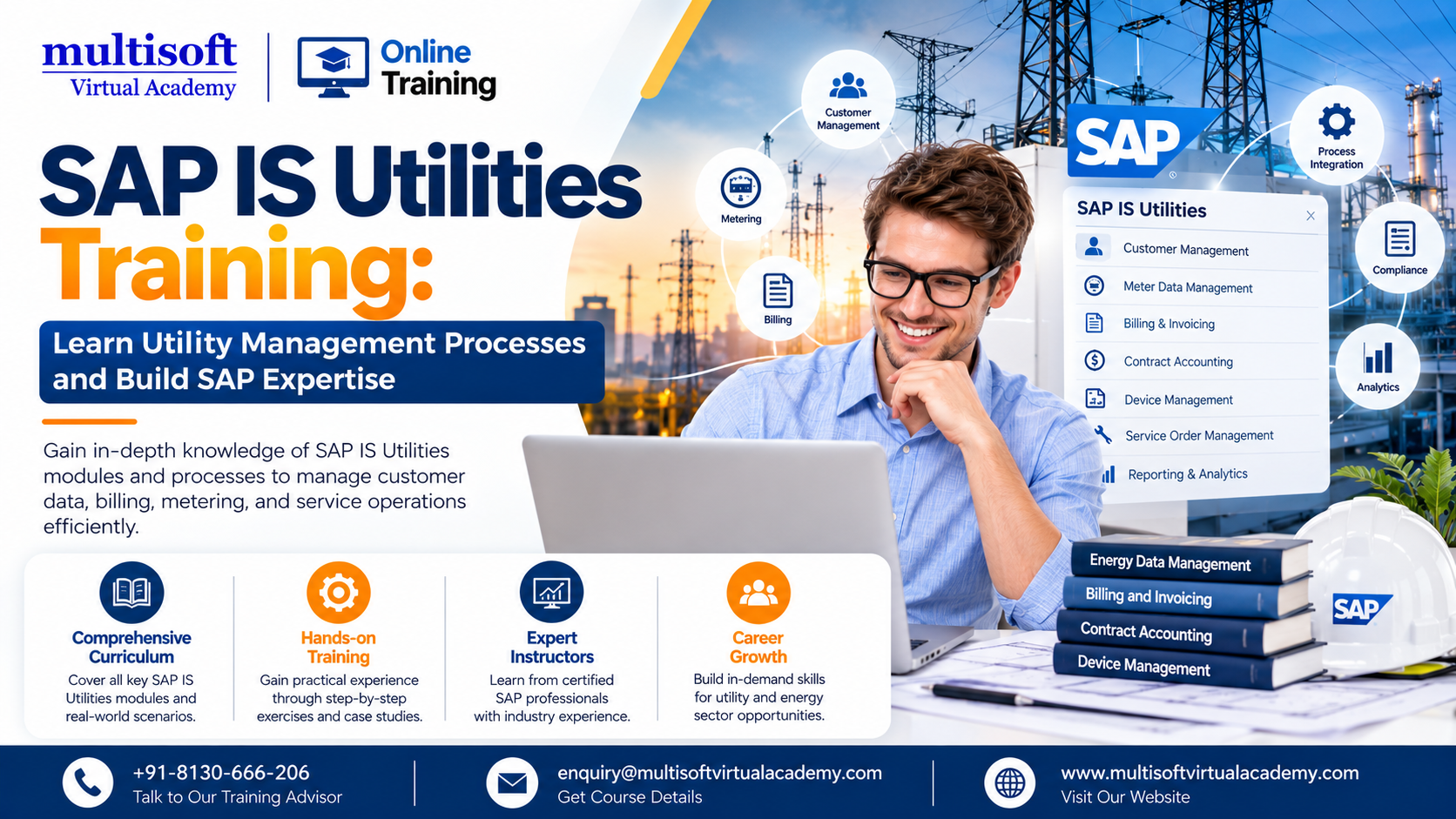
The energy and utilities sector relies on efficient information systems to manage customer accounts, service connections, consumption records, billing operations, and financial transactions. As utility providers expand their digital capabilities, specialized enterprise solutions have become essential for handling complex business requirements. SAP Industry Solution for Utilities (SAP IS-U) is designed to support these activities through integrated processes and industry-specific functionality.
SAP IS Utilities Training provides an opportunity for learners to understand how SAP supports the daily operations of electricity, gas, and water service providers. It introduces the functional concepts behind utility customer management, meter reading, billing, invoicing, and contract accounting while helping professionals develop knowledge relevant to SAP-based utility environments.
Multisoft Virtual Academy offers professional technology training for individuals and organizations seeking to strengthen their enterprise software knowledge. Learners interested in SAP utilities can explore the available course curriculum, practical learning opportunities, and instructor-led options to identify a program aligned with their career goals.
This guide covers the fundamentals of SAP IS-U, its major functional areas, essential learning topics, professional applications, and the factors to consider when choosing a training program.
SAP IS-U is an industry-specific SAP solution that supports the commercial and customer-related operations of utility companies. It helps organizations manage large volumes of customer information, service agreements, metering data, consumption calculations, and financial transactions.
Utility providers operate differently from many other businesses. Their processes may involve multiple service locations, recurring consumption measurements, different pricing arrangements, and frequent changes to customer contracts. Managing these activities requires accurate data and coordination between several business functions.
SAP IS-U helps connect these processes within an integrated system. For example, a utility company can maintain customer and contract information, process meter readings, calculate consumption charges, and generate invoices through related application workflows.
The solution may also integrate with financial systems, customer service applications, energy data platforms, and external utility market systems, depending on the organization's implementation.
By enrolling in SAP IS Utilities Training, learners can develop an understanding of these processes and discover how different application components contribute to utility business operations.
Utility organizations require professionals who understand both their business operations and the enterprise applications used to manage them. Learning SAP IS-U can help bridge the gap between industry requirements and software functionality.
Training introduces learners to the business activities associated with utility services. These include customer registration, service activation, contract administration, consumption monitoring, billing, and payment management.
Understanding these workflows helps learners recognize how SAP supports utility operations from customer onboarding to financial settlement.
SAP IS-U includes specialized functions that differ from those found in general-purpose ERP applications. Training helps participants become familiar with its business objects, transaction flows, configuration concepts, and functional dependencies.
This knowledge can be particularly useful for professionals interested in SAP consulting, implementation, and application support.
Utility billing involves calculating charges using consumption information and applicable pricing conditions. Depending on the service and business model, calculations may include different rates, consumption periods, taxes, and other billing elements.
SAP IS Utilities Course explains the relationship between meter readings, billing calculations, and invoice generation.
Organizations may require SAP IS-U professionals for implementation, system enhancement, testing, migration, and ongoing support.
A structured learning program can help participants understand common business scenarios and prepare for further practical experience.
Professionals with knowledge of utility processes may explore opportunities with utility companies, SAP consulting organizations, and IT service providers supporting energy and infrastructure businesses.
Career progression depends on experience, technical capabilities, project exposure, and the requirements of individual employers.
The course syllabus can differ between providers. However, a comprehensive program should introduce the core SAP IS-U functional areas and explain how they connect to support end-to-end business processes.
The first stage introduces SAP IS-U terminology, its business purpose, and its position within the wider SAP ecosystem.
Learners explore how utility companies use the system to manage customer relationships, service agreements, metering information, billing, and financial activities.
This foundation helps beginners understand the terminology and process flows used throughout the training.
Master data provides the information required for most utility transactions. Maintaining accurate records is essential because errors in customer, contract, or installation information can affect downstream activities.
Training may cover the following concepts:
Learners discover how these elements are organized and why their relationships matter during customer service and billing activities.
Utility providers use meters and related devices to measure consumption and maintain service information. SAP IS-U supports the management of device-related records and associated processes.
Depending on the syllabus, training may include device installation, removal, replacement, device information, and the relationship between equipment and utility installations.
Understanding these concepts helps learners see how metering equipment contributes to the overall utility service lifecycle.
Meter readings provide important information for calculating the amount of electricity, gas, or water consumed by a customer.
Training introduces the processes used to record and process meter readings. It may also explain how organizations handle estimated readings, missing values, incorrect entries, and consumption-related exceptions.
Learners can explore how meter-reading information moves through the system and becomes available for billing.
Practical exercises in this area can help participants understand why reliable consumption data is important for generating accurate customer bills.
Billing is one of the most important components of utility management. It involves calculating charges using consumption data and the relevant billing rules.
SAP IS-U training may explain rate structures, billing-relevant master data, calculation dependencies, billing execution, and the analysis of billing results.
Participants can learn how different business conditions influence the final amount charged to a customer.
Training exercises may also cover common billing exceptions, corrections, reversals, and methods for investigating unexpected results.
After billing calculations are completed, invoicing processes prepare the financial documents associated with customer charges.
Training may introduce invoice creation, invoice corrections, payment-related workflows, and the relationship between billing results and financial transactions.
Learners should also understand the difference between billing calculations and invoicing activities, as these are related but distinct processes.
Contract Accounts Receivable and Payable (FI-CA) is a major component in many SAP IS-U environments. It supports high-volume receivables and payment processes.
Relevant learning topics may include account balances, incoming payments, clearing, dunning, payment returns, and collections.
The depth of FI-CA coverage depends on whether the course focuses on introductory concepts, operational transactions, or functional configuration.
Understanding these processes can help learners connect utility billing activities with customer account management and financial operations.
Customer circumstances frequently change. A person may move to a new property, discontinue a service, or establish a new utility contract.
SAP IS-U supports business processes for managing these changes and maintaining the relevant customer and service information.
Training may cover move-in and move-out activities, contract changes, service termination, and related billing considerations.
These scenarios help learners understand how changes in customer circumstances affect contracts, installations, and billing periods.
Utility business processes often require information to move between multiple applications.
Depending on the implementation, SAP IS-U may interact with SAP financial applications, customer relationship management solutions, energy data management systems, metering platforms, and external market systems.
Training should explain the purpose of these integrations and how they support business operations.
Learners interested in advanced roles should also explore the SAP product versions and integration architecture relevant to their target employers.
SAP IS Utilities Training can be useful for several professional groups, although the ideal entry point depends on their existing knowledge.
Aspiring SAP Consultants: Individuals interested in developing specialized functional skills can use foundational training to understand utility processes and SAP terminology.
Experienced SAP Professionals: Consultants familiar with other SAP modules may explore IS-U to expand their expertise into the energy and utilities industry.
Utility Industry Employees: Professionals working in customer service, billing, metering, or operations can learn how SAP supports the processes they encounter at work.
Business Analysts: Analysts can strengthen their ability to document requirements, evaluate workflows, and communicate with functional and technical teams.
Application Support Teams: Support professionals can develop a better understanding of common transaction errors and dependencies involving master data, meter readings, and billing.
IT and ERP Professionals: Individuals working in implementation, testing, data migration, or system maintenance can use functional knowledge to support relevant project activities.
Previous SAP experience may be beneficial, but beginners can start with a course that explains the essential concepts before introducing advanced processes.
Learning SAP IS-U can provide a foundation for exploring roles involving utility business processes and enterprise application management. The responsibilities associated with each role vary according to the organization and project.
Functional consultants work with business stakeholders to understand requirements, map processes, configure application functionality, and support testing.
They help ensure that the SAP environment supports the organization's operational requirements.
Application support professionals investigate user-reported issues, analyze transactions, troubleshoot process errors, and help maintain application performance.
Knowledge of billing, master data, and contract accounts can be valuable in this role.
Billing specialists focus on consumption calculations, billing execution, rate-related requirements, invoice accuracy, and the investigation of billing discrepancies.
This role requires a detailed understanding of how consumption information affects customer charges.
Business process analysts document existing workflows, gather requirements, identify gaps, and help organizations improve their use of SAP applications.
Their responsibilities often involve communication between utility business teams and IT departments.
Implementation professionals may participate in solution design, configuration, testing, data migration, integration, and deployment.
Practical experience with complete business scenarios is especially useful for individuals pursuing implementation-focused positions.
Testing professionals validate business processes and confirm that application changes meet the expected requirements.
They may prepare test cases for customer onboarding, meter reading, contract changes, billing, invoicing, and payments.
A strong understanding of the underlying business process helps testers identify errors and verify the accuracy of results.
Theoretical knowledge is an important starting point, but practical exercises help learners understand how SAP IS-U processes work together.
A useful learning scenario might begin with customer master data and continue through the creation of a utility contract, review of installation information, meter-reading processing, billing, and invoice generation.
Learners can then examine the resulting financial information and investigate errors that occur during the process.
For example, if a billing run fails, participants can learn to examine relevant master data, meter-reading information, and billing-related conditions before identifying a potential cause.
Additional exercises may involve documenting business requirements, reviewing transaction flows, analyzing exception scenarios, and testing changes in an appropriate training environment.
This approach helps learners develop process-oriented thinking rather than memorizing isolated transactions.
When comparing SAP IS Utilities Training programs, ask whether practical system access and guided exercises are included.
Selecting a training provider should involve evaluating the learning experience and its relevance to your career objectives.
Check whether the curriculum includes the functional areas you need. Beginners may prefer a course covering fundamentals and standard processes, while experienced consultants may require configuration, integration, and troubleshooting topics.
An instructor with relevant SAP utilities experience may be better positioned to explain practical business scenarios and common implementation challenges.
Review the trainer's background and experience with the modules included in the program.
Ask whether the course includes hands-on exercises, sample business scenarios, testing activities, and access to an SAP training environment.
Practical exposure can make it easier to connect theoretical concepts with real-world processes.
SAP landscapes differ across organizations. Confirm whether the course focuses on an SAP ECC-based IS-U environment, relevant SAP S/4HANA scenarios, or other related technologies.
The right choice depends on the environment you intend to work with.
Before enrolling, check the course duration, delivery format, learning materials, available support, and certificate arrangements.
A course-completion certificate is not automatically equivalent to an official SAP certification. Verify the examination and accreditation details if an official credential is your objective.
Multisoft Virtual Academy provides professional learning programs across SAP and other enterprise technology domains. Individuals interested in utility management applications can explore the available training options to determine whether they match their experience and professional goals.
When considering SAP IS Utilities Training at Multisoft Virtual Academy, prospective learners should review the current course syllabus and ask about the depth of coverage for master data, device management, meter reading, billing, invoicing, and financial integration.
Depending on the program, learners may also wish to enquire about instructor-led sessions, one-to-one learning, corporate training arrangements, recorded sessions, practical exercises, and post-training assistance.
Confirm the availability of these features directly with the provider, as arrangements may differ between courses.
For companies, specialized training can help employees develop a shared understanding of utility business processes and prepare for relevant application support, implementation, or enhancement projects.
Choosing a program that balances business concepts with practical learning can help participants build a stronger foundation in SAP utilities.
SAP IS-U combines industry-specific terminology, interconnected master data, and complex business workflows. As a result, beginners may need time to understand how individual components depend on one another.
Master data relationships are often an early challenge. Studying business partners, contracts, installations, and contract accounts together can help learners understand how these records support daily transactions.
Billing can present another challenge because its results depend on accurate consumption data and relevant pricing conditions. Following complete business scenarios helps explain how errors in earlier steps can affect later processes.
Configuration may require additional practice because settings can influence multiple transactions and business outcomes. Learners should understand the purpose of each configuration element and practice in an appropriate environment.
Finally, implementations vary between organizations. Building a strong understanding of standard SAP IS-U processes while recognizing implementation-specific differences is an important part of professional development.
Utility organizations continue to invest in digital customer services, smart metering, automation, and improved management of consumption data.
These developments create an ongoing need for integrated business processes and reliable information systems. SAP technologies can support many of these activities, depending on the organization's architecture and implementation strategy.
SAP IS-U remains important in many established utility environments. However, professionals should also understand the wider SAP utilities landscape and relevant S/4HANA-related developments.
Depending on their career objectives, learners may benefit from exploring energy data management, smart meter integration, market communication, system integration, and migration considerations.
Keeping technical knowledge aligned with the technologies used by target employers can help professionals make more informed career decisions.
It introduces the SAP processes used by utility companies for customer management, contracts, meter reading, consumption processing, billing, invoicing, and financial transactions.
Yes. Beginners can start with a foundational course that explains SAP terminology and utility business processes. Prior SAP experience may help but is not always mandatory.
Important functional areas include master data, device management, meter reading, billing, invoicing, and contract accounts. The exact scope depends on the course and implementation.
The duration varies according to the syllabus, training format, practical coverage, and learner experience. Contact Multisoft Virtual Academy for the current schedule and course duration.
Yes. Consultants seeking to expand into the utilities sector may benefit from learning its specialized business processes and integration requirements.
No. Training can help develop relevant knowledge, but employment depends on practical skills, previous experience, interview performance, and market requirements.
SAP IS-U is used in different SAP utilities environments. Its relationship with SAP S/4HANA depends on the specific product landscape and implementation architecture, so learners should confirm the technology scope of their course.
SAP IS Utilities Training helps learners understand the enterprise processes used by electricity, gas, and water providers to manage customers, contracts, consumption data, billing, invoicing, and financial activities.
By developing a strong foundation in these areas, professionals can prepare to explore specialized opportunities in SAP consulting, application support, business analysis, testing, and implementation.
Practical exercises, relevant instruction, and an understanding of end-to-end business workflows are important when selecting a learning program. It is equally valuable to consider the SAP technology landscape used by prospective employers.
Multisoft Virtual Academy can be considered by learners exploring professional SAP training. Reviewing the available curriculum, practical coverage, trainer expertise, and delivery options will help determine whether its SAP IS Utilities Training program meets your learning requirements.
With focused learning and relevant practical experience, professionals can strengthen their understanding of SAP-based utility operations and build skills aligned with the evolving needs of the utilities industry.
| Start Date | Time (IST) | Day | |||
|---|---|---|---|---|---|
| 17 Oct 2026 | 06:00 PM - 10:00 AM | Sat, Sun | |||
| 18 Oct 2026 | 06:00 PM - 10:00 AM | Sat, Sun | |||
| 24 Oct 2026 | 06:00 PM - 10:00 AM | Sat, Sun | |||
| 25 Oct 2026 | 06:00 PM - 10:00 AM | Sat, Sun | |||
|
Schedule does not suit you, Schedule Now! | Want to take one-on-one training, Enquiry Now! |
|||||






 Join our Live Instructor-Led online classes delivered by industry experts
 Let's Get Started