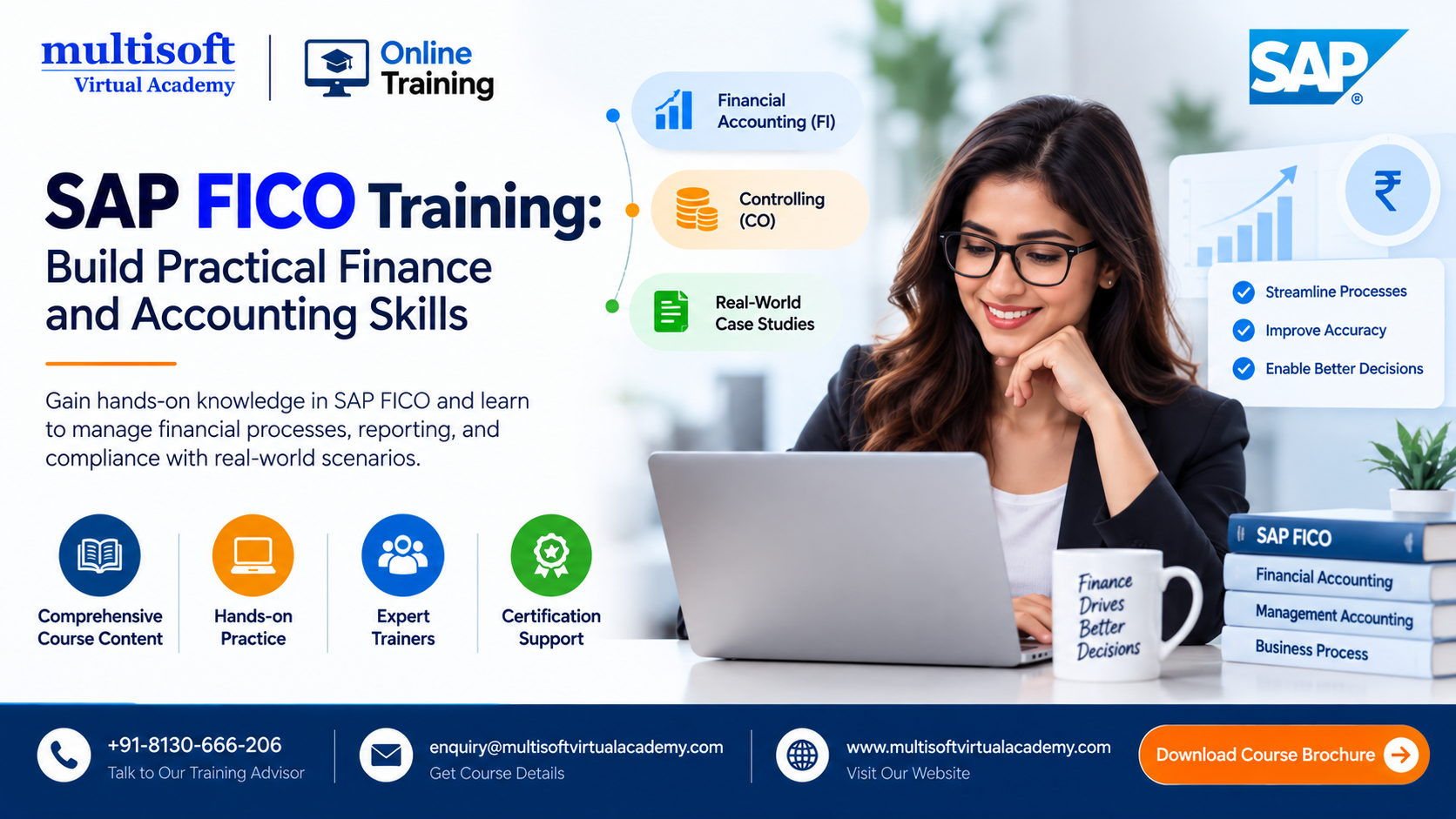
In today’s digital business environment, finance professionals need more than traditional accounting knowledge. Organizations increasingly rely on integrated enterprise systems to manage financial transactions, reporting, compliance, budgeting, and business performance. This shift has created strong demand for professionals who understand both accounting principles and enterprise resource planning technologies.
SAP FICO Training is designed to help learners develop practical knowledge of Financial Accounting (FI) and Controlling (CO), two important areas within SAP Finance. For accounting professionals, finance executives, consultants, and aspiring SAP professionals, learning SAP FICO can provide a structured path toward understanding how financial processes are managed in an integrated SAP environment.
As organizations continue adopting SAP S/4HANA, finance teams are also moving toward automated accounting, real-time reporting, streamlined financial closing, and data-driven decision-making. SAP's current learning paths cover areas such as General Ledger, Accounts Payable, Accounts Receivable, Asset Accounting, financial closing, reporting, and cost management.
SAP FICO Training stands for SAP Financial Accounting and Controlling. It brings together financial accounting processes and management accounting activities within an integrated ERP environment.
The Financial Accounting component focuses on recording and managing external financial transactions. It supports activities such as:
The Controlling component focuses more on internal management information. It helps organizations analyze costs, profitability, budgets, and operational performance.
Together, FI and CO provide finance teams with a connected view of financial information, allowing business transactions and management reporting to work together more effectively.
Finance departments are becoming increasingly technology-driven. Manual spreadsheets and disconnected accounting applications can make it difficult to maintain consistent information across departments.
SAP provides an integrated environment in which financial processes can connect with other business functions. As a result, professionals who understand SAP Finance can contribute to implementation, support, configuration, reporting, and finance transformation projects.
A structured SAP FICO course can help learners understand how accounting processes operate inside an enterprise system rather than studying financial concepts in isolation.
For professionals already working in finance, SAP FICO training can also help bridge the gap between accounting expertise and enterprise technology skills.
A comprehensive SAP FICO Training program should cover both foundational concepts and practical business processes.
The FI component provides the foundation for recording and reporting financial transactions.
Learners typically explore organizational structures, master data, financial documents, posting processes, and reporting requirements.
General Ledger is central to financial accounting. It records financial transactions and provides information required for financial statements.
SAP Finance learning paths currently include General Ledger as one of the core areas for Financial Accounting implementation.
Training may cover:
Understanding these concepts is essential for anyone pursuing an SAP FICO certification or SAP Finance consulting role.
Accounts Payable manages financial obligations toward suppliers and vendors.
An SAP FICO course may explain vendor master data, invoice processing, outgoing payments, clearing, payment differences, and related reporting.
These skills are particularly useful for finance professionals involved in procure-to-pay processes.
Accounts Receivable focuses on customer-related financial transactions.
Professionals can learn how organizations manage customer invoices, incoming payments, open items, clearing, and receivables reporting.
SAP's Financial Accounting learning content identifies Receivables Management as an important finance business process.
Asset Accounting helps organizations manage financial information related to fixed assets.
Training can introduce concepts such as:
Understanding Asset Accounting is particularly valuable for finance professionals working with organizations that manage significant fixed-asset portfolios.
Bank-related financial activities are another important part of SAP Finance.
Learners can explore bank accounts, incoming and outgoing transactions, payment processes, reconciliation, and related accounting activities.
The CO component supports internal management accounting and performance analysis.
A good SAP FICO Training course should introduce concepts such as:
These capabilities help organizations understand not only what financial transactions occurred but also where costs were generated and how different business areas performed.
One of the most important developments for SAP finance professionals is the transition toward SAP S/4HANA.
Modern SAP Finance learning increasingly focuses on SAP S/4HANA Finance and its cloud editions. SAP's current learning journeys include implementation-focused Financial Accounting training for both SAP S/4HANA Cloud Public Edition and Private Edition.
This means professionals searching for SAP FICO Training should consider whether their learning path includes SAP S/4HANA Finance concepts.
SAP's current course catalog includes training around General Ledger, Accounts Payable, Accounts Receivable, Asset Accounting, financial closing, and Business AI applications in finance.
Beginners do not necessarily need extensive SAP experience to start learning the fundamentals. However, a basic understanding of accounting can make the learning process easier.
A beginner-friendly SAP FICO learning path should gradually introduce:
SAP itself lists accounting knowledge as an essential prerequisite for some Financial Accounting academy programs.
This makes accounting fundamentals an important starting point for learners who are completely new to SAP Finance.
SAP FICO Training can be useful for a wide range of professionals, including:
Existing accounting professionals can use SAP training to strengthen their technology skills, while IT professionals can learn finance processes to move toward functional consulting roles.
SAP remains an important enterprise technology platform across many industries. Learning SAP Finance can help professionals understand how large organizations manage financial operations through integrated systems.
Instead of learning individual accounting activities separately, learners can understand how processes such as payables, receivables, general ledger, asset accounting, and closing work together.
A strong knowledge base can support career paths such as:
Actual responsibilities vary by organization, project, and experience level, but a solid understanding of finance processes and SAP configuration provides a useful foundation.
SAP FICO is not simply about learning transaction codes or system screens. Effective professionals need to understand the business reason behind each process.
Practical training can therefore help learners connect accounting requirements with SAP workflows, configuration, reporting, and controls.
Choosing the right SAP FICO course is important because training quality can significantly influence practical understanding.
A strong program should include:
Learners should get opportunities to understand realistic business scenarios rather than relying exclusively on theoretical explanations.
Because SAP Finance learning increasingly includes S/4HANA environments, learners should consider training that addresses current S/4HANA Finance concepts.
For aspiring consultants, configuration knowledge is particularly important. SAP's current training catalog includes configuration topics for General Ledger, Accounts Payable, and Accounts Receivable.
Closing activities are an essential part of corporate finance. Current SAP training includes month-end and year-end closing, financial statements, closing operations, and inter-company reconciliation.
Modern finance professionals increasingly need to interpret financial data rather than simply record transactions. Training should therefore include relevant reporting concepts and business analysis.
An SAP FICO certification can demonstrate structured learning and knowledge of SAP Finance concepts. However, certification should ideally be supported by practical knowledge and an understanding of real business processes.
Learners should avoid preparing only through memorization. Instead, they should understand why a particular process is configured or performed in a certain way.
SAP's current Financial Accounting learning journeys are explicitly structured around implementation knowledge and certification preparation for relevant SAP S/4HANA environments.
Therefore, professionals planning certification should review the current official exam requirements and learning objectives rather than relying on outdated preparation material.
The combination of finance knowledge and SAP expertise can open several career directions.
A beginner may initially pursue support or junior functional roles and gradually move toward implementation and consulting responsibilities. Experienced finance professionals may also use SAP expertise to transition toward functional consulting or digital finance transformation.
Career progression commonly depends on several factors, including:
As SAP Finance continues evolving, professionals should also pay attention to automation, analytics, cloud ERP, and AI-enabled finance capabilities. SAP currently provides learning content focused on Business AI applications in finance, including SAP Joule and AI-driven finance use cases.
A practical learning roadmap can make the journey easier.
Understand debit and credit, financial statements, accounts payable, accounts receivable, assets, liabilities, expenses, and revenue.
Become familiar with ERP concepts, SAP terminology, organizational structures, master data, and business processes.
Focus on General Ledger, Accounts Payable, Accounts Receivable, Asset Accounting, Bank Accounting, and financial reporting.
Explore cost centers, profit centers, internal orders, allocations, planning, and profitability analysis.
Understand how financial processes operate in the S/4HANA environment and explore current implementation concepts.
Work through realistic accounting and finance scenarios to connect theory with practical application.
Once the fundamentals and practical concepts are clear, review the current certification syllabus and prepare according to the official learning objectives.
Finance technology is moving toward greater automation, real-time information, cloud-based ERP, advanced analytics, and AI-assisted business processes.
SAP's current finance learning resources increasingly address intelligent automation and Business AI, showing how finance professionals may need to combine traditional accounting knowledge with digital capabilities.
For this reason, learning SAP FICO should not be treated as a one-time activity. Professionals can benefit from continuously developing their knowledge of S/4HANA, cloud finance, analytics, automation, integration, and emerging AI capabilities.
The most valuable professionals will increasingly be those who can understand both finance requirements and technology-enabled business processes.
Choosing the right learning path can make a significant difference when developing SAP Finance expertise. Multisoft Virtual Academy acts as a best service provider for professionals looking to strengthen their knowledge through structured SAP FICO Training, covering essential Financial Accounting and Controlling concepts while supporting learners in building practical, career-oriented skills. Whether you are an accounting professional, an aspiring SAP consultant, or an experienced ERP professional planning to upgrade your capabilities, focused SAP FICO learning can help you build a stronger foundation for opportunities in modern finance and SAP S/4HANA environments.
| Start Date | Time (IST) | Day | |||
|---|---|---|---|---|---|
| 26 Sep 2026 | 06:00 PM - 10:00 AM | Sat, Sun | |||
| 27 Sep 2026 | 06:00 PM - 10:00 AM | Sat, Sun | |||
| 03 Oct 2026 | 06:00 PM - 10:00 AM | Sat, Sun | |||
| 04 Oct 2026 | 06:00 PM - 10:00 AM | Sat, Sun | |||
|
Schedule does not suit you, Schedule Now! | Want to take one-on-one training, Enquiry Now! |
|||||






 Join our Live Instructor-Led online classes delivered by industry experts
 Let's Get Started