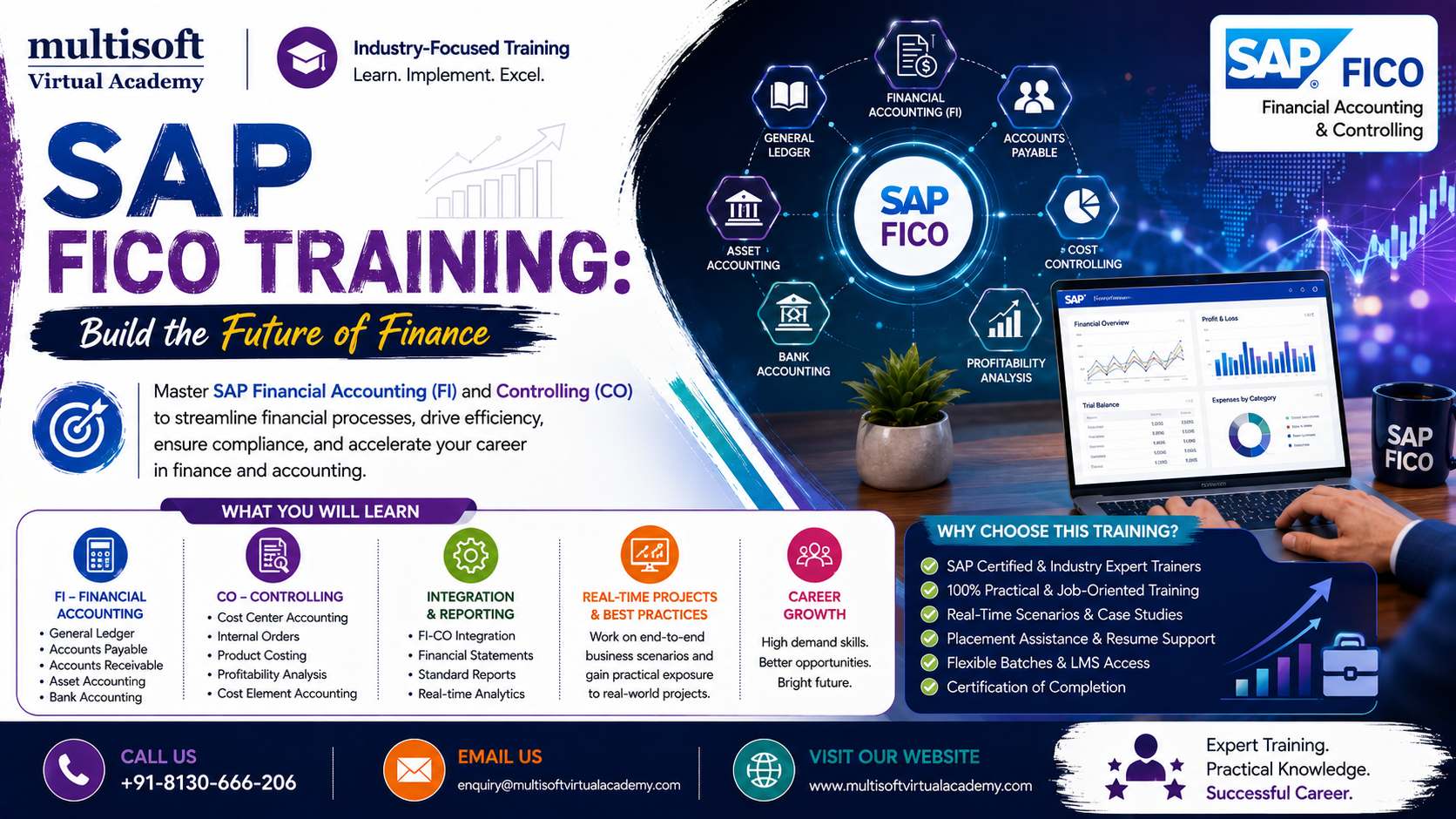
Finance is changing rapidly as businesses move toward cloud ERP, real-time reporting, automation, analytics and artificial intelligence. In this environment, SAP FICO remains a valuable specialization for professionals who want to connect accounting knowledge with enterprise technology. SAP FICO Training helps learners understand how financial accounting and controlling processes work within SAP environments while building practical knowledge for modern finance transformation.
For professionals planning a career in SAP, SAP S/4HANA Finance Training is relevant. SAP’s current finance capabilities emphasize real-time financial information, automated processes, planning, forecasting, compliance and AI-supported decision-making. This shift means finance professionals need more than traditional accounting knowledge: they need ERP skills, process understanding and the ability to work with integrated financial data.
SAP FICO Training refers to Financial Accounting (FI) and Controlling (CO), two closely connected areas used to manage financial transactions, reporting and management accounting. FI focuses on external financial reporting and areas such as the general ledger, accounts payable, accounts receivable, asset accounting and financial statements. CO supports internal management activities such as cost center accounting, profit center accounting, internal orders, profitability analysis and planning.
A strong SAP FICO professional understands not only individual transactions but also the complete business process behind them. For example, a purchase can create financial consequences that connect procurement, inventory and accounting. Similarly, a sales transaction can affect revenue, receivables, tax and profitability. This process-oriented perspective is an important outcome of SAP FICO Training.
The finance function is becoming increasingly digital. SAP describes modern finance as a combination of real-time data, automation, predictive analytics, AI and stronger compliance capabilities. SAP S/4HANA Cloud also brings finance transactions, analytics and planning together in an integrated environment.
This evolution is creating demand for professionals who can understand both finance and technology. Organizations need people who can support SAP implementation, configuration, testing, migration, reporting, integration and ongoing application support. For learners, SAP FICO certification, SAP S/4HANA Finance skills and hands-on project exposure can strengthen a professional profile.
Strong career preparation is not based on memorizing transaction codes. It combines accounting fundamentals, SAP configuration concepts, business-process knowledge, troubleshooting ability and practical project experience.
A comprehensive SAP FICO course should build knowledge progressively, beginning with enterprise structure and moving toward integrated finance processes.
Financial Accounting is the foundation of SAP finance. Training generally introduces company structures, company codes, chart of accounts, fiscal years, posting periods, document types, number ranges and general ledger accounting.
Learners should understand how master data and configuration influence financial postings. They should also become comfortable with journal entries, document processing, account balances and financial reporting.
Accounts Payable manages transactions involving suppliers. Training typically covers vendor-related master data, invoice processing, credit memos, payment terms, outgoing payments and payment-related processes.
Understanding the procure-to-pay cycle is essential because finance does not operate independently. A professional should know how procurement activities eventually create accounting documents and affect liabilities and cash.
Accounts Receivable focuses on customer transactions. Important concepts include customer master data, billing-related accounting, incoming payments, credit management basics, open items and dunning.
The order-to-cash process is particularly important because it demonstrates how operational transactions flow into financial accounting and ultimately influence revenue, receivables and profitability.
Fixed assets represent significant investments for many organizations. SAP Asset Accounting training introduces asset master data, asset classes, depreciation, acquisitions, transfers, retirements and asset-related reporting.
Professionals should understand how asset transactions affect the general ledger and financial statements. This knowledge becomes particularly useful during implementation and month-end activities.
Controlling, or SAP CO, helps organizations monitor internal costs and profitability. Key areas include cost centers, profit centers, internal orders, activity-based concepts, planning and profitability analysis.
The objective is not simply to learn configuration screens. Learners should understand why an organization tracks costs, how management uses controlling information and how financial and management accounting interact.
For new learners, traditional SAP FICO concepts provide a strong foundation, but modern career preparation should also include SAP S/4HANA Finance. SAP S/4HANA Finance supports integrated finance processes and provides capabilities for real-time reporting, financial planning, accounting, compliance and analytics.
One important concept is the Universal Journal, which brings financial and controlling information together in a common data foundation. Understanding this integrated approach helps professionals move beyond older, transaction-focused learning and develop a better understanding of how modern SAP finance operates.
Training should also introduce topics such as business partner concepts, new asset accounting, parallel ledgers, document splitting, financial closing, group reporting and embedded analytics where relevant to the learner’s career path.
SAP FICO does not exist in isolation. Its value becomes clearer when professionals understand how finance connects with other enterprise functions.
Integration with SAP MM helps connect procurement and inventory processes with accounting. SAP SD integration links sales and billing activities with revenue, receivables and financial postings. Integration with production processes can influence inventory valuation and manufacturing costs. Human capital processes can also create financial impacts through payroll and organizational data.
Professionals who understand these connections can analyze requirements effectively and communicate with functional teams during SAP implementation projects.
ERP transformation has increased the importance of implementation and migration knowledge. Organizations moving from SAP ECC to SAP S/4HANA need professionals who understand business-process redesign, data migration, testing, configuration and change management.
A practical SAP FICO training program should expose learners to implementation stages such as requirement gathering, business blueprinting or fit-to-standard analysis, configuration, unit testing, integration testing, user acceptance testing, documentation and go-live support.
Migration projects also require careful attention to master data, open items, asset balances, financial structures and reconciliation. Professionals who can combine functional finance knowledge with migration awareness can contribute more effectively to transformation projects.
Cloud adoption is becoming an important part of enterprise finance strategy. SAP’s current finance direction includes cloud ERP, automation, AI-supported workflows, predictive insights and real-time reporting. This means future-ready SAP finance professionals should understand the fundamentals of cloud-based ERP and how finance processes are delivered in modern environments.
AI is also influencing finance operations. SAP highlights applications such as automated reconciliation, forecasting, risk management and decision support. Professionals do not necessarily need to become AI developers, but they should understand how automation and intelligent tools can improve finance processes while maintaining governance and human oversight.
SAP FICO knowledge can support several career paths depending on experience and specialization. Potential roles include SAP FICO Consultant, SAP Finance Consultant, SAP S/4HANA Finance Consultant, SAP Functional Analyst, SAP Support Consultant, Finance Transformation Consultant and Business Process Analyst.
Freshers can focus on building accounting fundamentals, SAP concepts, configuration knowledge and practical scenarios. Experienced accounting and finance professionals can leverage their domain expertise while developing SAP skills. Existing SAP professionals can expand into S/4HANA Finance, migration, integration, analytics or specialized finance areas.
Career progression depends on more than certification. Employers value practical problem-solving, communication, business-process understanding, documentation and project experience. Therefore, learners should use training to build demonstrable skills rather than treating certification as the final objective.
Choosing an SAP FICO course requires careful evaluation. Look for a curriculum that covers FI and CO fundamentals, SAP S/4HANA Finance, integration, configuration concepts and realistic business scenarios.
Practical exposure is especially important. Learners should have opportunities to work through transactions, configuration exercises, process flows, troubleshooting scenarios and project-based assignments. Interview preparation can also help candidates explain concepts clearly and demonstrate business understanding.
Another factor is whether the course reflects current SAP developments. A modern curriculum should not focus exclusively on older ECC concepts. It should help learners understand the transition toward SAP S/4HANA, cloud ERP, automation, analytics and intelligent finance.
SAP certification can validate structured knowledge, but certification alone does not guarantee employment or project success. The most effective approach is to combine certification preparation with practical learning.
Candidates should be able to explain core finance processes, describe configuration decisions, trace accounting documents, understand integration points and discuss common implementation challenges. They should also practice scenario-based interview questions rather than relying only on definitions.
Building a project portfolio, documenting practical exercises and improving communication skills can further strengthen career readiness.
SAP finance is moving toward connected, automated and intelligent processes. Real-time reporting, predictive planning, cloud ERP, AI-assisted workflows and integrated compliance are becoming increasingly important in enterprise finance.
This does not make accounting knowledge less important. Instead, it increases the value of professionals who can combine finance expertise with technology. The future SAP FICO professional is likely to work across business processes, data, automation, analytics and transformation rather than focusing only on individual accounting transactions.
As SAP continues expanding cloud and AI capabilities, professionals who continuously update their skills can remain better prepared for changing project requirements. Learning should therefore be treated as an ongoing process involving S/4HANA updates, implementation practices, integration concepts and emerging finance technologies.
SAP FICO Training is a practical pathway for professionals who want to build expertise at the intersection of finance and enterprise technology. A strong learning journey should combine accounting fundamentals, FI and CO processes, SAP S/4HANA Finance, integration, implementation knowledge, cloud ERP, analytics and emerging AI capabilities. For learners seeking structured training, practical exposure and career-oriented SAP finance skills, Multisoft Virtual Academy provides SAP FICO learning designed to support modern professional goals and evolving industry requirements.
| Start Date | Time (IST) | Day | |||
|---|---|---|---|---|---|
| 26 Sep 2026 | 06:00 PM - 10:00 AM | Sat, Sun | |||
| 27 Sep 2026 | 06:00 PM - 10:00 AM | Sat, Sun | |||
| 03 Oct 2026 | 06:00 PM - 10:00 AM | Sat, Sun | |||
| 04 Oct 2026 | 06:00 PM - 10:00 AM | Sat, Sun | |||
|
Schedule does not suit you, Schedule Now! | Want to take one-on-one training, Enquiry Now! |
|||||






 Join our Live Instructor-Led online classes delivered by industry experts
 Let's Get Started