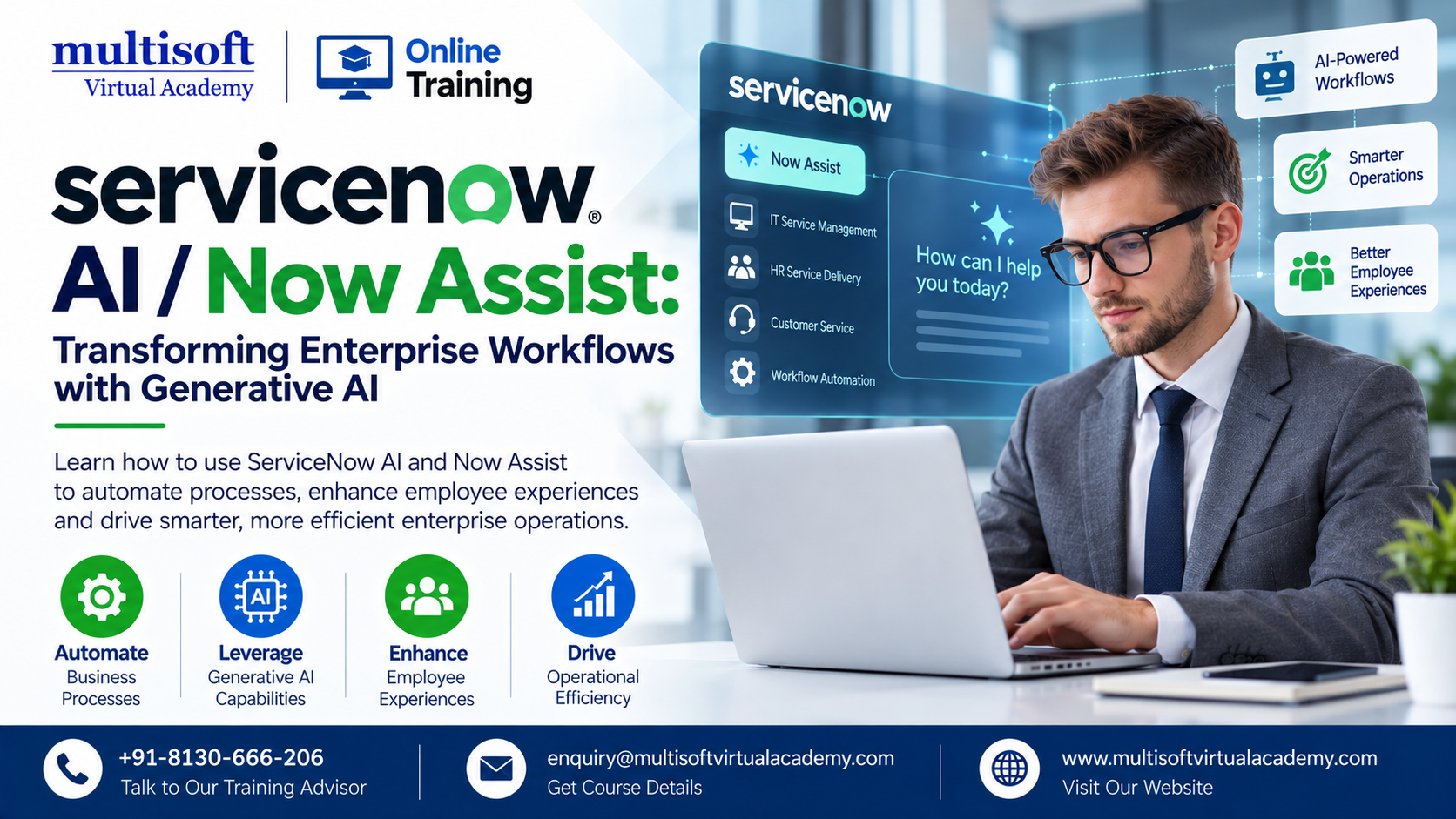
Artificial intelligence is rapidly changing how organizations manage IT services, employee support, customer operations, and business workflows. Among the technologies gaining strong attention, ServiceNow AI / Now Assist stands out by bringing generative AI capabilities directly into enterprise workflows.
ServiceNow describes Now Assist as a generative AI experience designed to improve productivity through conversational and proactive experiences. Its capabilities include generative AI skills, AI agents, agentic workflows, and integrations with large language models.
As organizations move beyond traditional automation toward intelligent and autonomous operations, professionals who understand ServiceNow AI, Now Assist, generative AI, AI agents, ServiceNow automation, and intelligent workflows can become increasingly valuable.
ServiceNow AI / Now Assist is a collection of generative AI capabilities within the ServiceNow ecosystem. It helps users interact with enterprise information, summarize records, generate content, support service operations, and automate tasks using natural-language interactions.
Unlike conventional rule-based automation, generative AI can understand context and produce useful responses or content. ServiceNow's current AI platform also includes AI agents and agentic workflows that can perform more sophisticated, multi-step activities.
This makes ServiceNow Now Assist particularly relevant for organizations looking to improve productivity without completely replacing their existing workflows.
Enterprise organizations generate enormous amounts of information through incidents, service requests, knowledge articles, employee interactions, customer cases, documents, and operational records.
Employees often spend considerable time searching for information, summarizing records, writing responses, creating documentation, and performing repetitive activities.
Now Assist can help reduce this burden by introducing AI directly into workflows.
Some common objectives include:
ServiceNow's AI platform now provides multiple capabilities covering AI skills, AI agents, AI governance, data, knowledge, and workflow execution.
One of the primary benefits of Now Assist is its ability to bring generative AI into everyday enterprise processes.
Instead of switching between separate AI tools and business applications, users can access AI capabilities within relevant ServiceNow workflows.
For example, teams can use AI to summarize records, generate content, retrieve information, or assist with service-related activities.
Large service records can contain extensive information. Reviewing every comment, update, attachment, and knowledge article can consume valuable time.
AI-powered summarization can help users quickly understand important information and focus on the next action.
This can be particularly useful for:
Natural-language interaction is another important part of the modern ServiceNow AI experience.
Employees can communicate with AI using conversational language rather than navigating multiple screens or remembering complicated commands.
This supports more accessible AI-powered employee service, IT service automation, and enterprise self-service.
ServiceNow has also positioned generative AI capabilities as a way to create more direct and conversational self-service experiences through its platform.
The evolution from assistive AI toward agentic AI is one of the most important developments in the ServiceNow ecosystem.
Traditional automation follows predefined rules. Generative AI can assist users within those processes. Agentic workflows can go further by coordinating multiple steps to achieve a defined outcome.
ServiceNow currently describes three major AI asset types: skills, AI agents, and agentic workflows.
AI agents can potentially handle more complex tasks, while agentic workflows can connect multiple activities and systems.
This creates opportunities for:
Organizations have different processes, data structures, and business requirements. A generic AI capability may therefore not be enough.
ServiceNow provides AI skills that can be designed around particular workflows and use cases. According to current ServiceNow documentation, generative AI skills can perform specific tasks using enterprise inputs and underlying large language models.
This opens the door to custom ServiceNow AI solutions.
Organizations can explore AI capabilities for areas such as:
ServiceNow also provides tools for creating custom skills and managing AI assets, allowing organizations to align AI capabilities with specific business requirements.
IT Service Management is one of the most obvious areas where generative AI can deliver value.
IT teams regularly handle incidents, requests, problems, changes, and knowledge management activities. Many of these processes involve repetitive documentation and information retrieval.
Now Assist can support these workflows by helping professionals:
The objective is not simply to add AI to an existing platform. The larger opportunity is to redesign workflows so that people and AI can work together more efficiently.
Customer expectations are increasing, while service teams need to manage growing volumes of requests.
Now Assist for Customer Service can help organizations introduce generative AI into customer-facing and agent-support workflows.
Potential applications include:
ServiceNow's 2026 knowledge-session material highlights grounded generative AI skills for customer-service personas, with an emphasis on trusted, scalable skills that can become foundations for agentic workflows.
Enterprise operations depend heavily on documents, forms, images, and structured and unstructured information.
Now Assist in Document Intelligence uses generative AI to analyze and extract information from documents and make that information available to automation workflows.
This can be useful in scenarios involving:
For organizations processing large volumes of documents, intelligent extraction can reduce manual data-entry requirements and help employees focus on higher-value activities.
The biggest opportunity may be the combination of AI + automation + enterprise data + workflows.
AI alone can generate information. Automation alone can execute predefined instructions. When these capabilities are connected with enterprise context, organizations can create more intelligent workflows.
For example:
Employee request → AI understands intent → relevant information retrieved → workflow initiated → required approvals obtained → task completed → employee receives response
This type of process can significantly reduce manual intervention while maintaining appropriate controls.
ServiceNow's 2026 enterprise AI research indicates that many organizations are still primarily using AI to make existing work faster, while more transformative autonomous workflows remain less common.
That gap creates an important opportunity for professionals who understand both ServiceNow workflows and AI technologies.
The growing importance of enterprise AI means professionals should look beyond basic platform knowledge.
A strong ServiceNow AI / Now Assist training path can include:
Understanding the ServiceNow platform, applications, tables, workflows, roles, and administration.
Understanding incidents, problems, changes, requests, knowledge management, and service operations.
Learning concepts such as large language models, prompts, grounding, AI skills, and responsible AI.
Understanding Now Assist capabilities, configuration, use cases, administration, and adoption.
Learning how AI agents work and where they can be applied to enterprise processes.
Understanding when a conventional workflow, assistive AI capability, or agentic approach is appropriate.
Understanding data security, access control, monitoring, responsible AI, and governance requirements.
Learning how AI can interact with existing ServiceNow workflows and enterprise processes.
These skills can help administrators, developers, IT professionals, consultants, architects, and service-management specialists prepare for increasingly AI-driven environments.
Technology changes quickly, but implementation knowledge is what turns technology into business value.
Learning ServiceNow AI and Now Assist can help professionals understand how to move from theoretical AI concepts to practical enterprise use cases.
Training can provide exposure to:
This is particularly important because AI implementation requires more than simply activating an AI feature. Organizations need suitable processes, reliable data, appropriate governance, and measurable business objectives.
ServiceNow itself emphasizes readiness, AI governance, AI assets, and contextual enterprise data as important elements of an effective AI strategy.
The ServiceNow ecosystem is moving toward a broader AI-native enterprise model.
Several trends deserve attention.
AI agents are becoming increasingly important because they can move beyond generating responses toward completing tasks and coordinating activities.
AI is increasingly being applied to incident analysis, service operations, monitoring, and operational decision-making.
Organizations are using AI to make employee interactions with internal services more conversational and personalized.
As AI adoption increases, organizations need stronger mechanisms for controlling models, data, access, risks, and AI-generated outcomes.
The combination of generative AI and workflow automation is likely to remain a major enterprise technology trend.
AI systems need relevant enterprise context to provide useful results. ServiceNow's current strategy places significant emphasis on connected data and enterprise context for AI-driven decision-making.
This technology is relevant to a broad range of professionals, including:
It can also be useful for organizations that want to upskill existing ServiceNow teams instead of building completely separate AI teams.
ServiceNow's 2026 workforce research highlights increasing demand for both technical capabilities and human skills such as leadership and collaboration as AI changes workplace tasks.
Successful adoption requires more than technology deployment. Organizations should approach implementation strategically.
Start with a clear business problem. Identify a process where AI can create measurable value.
Evaluate data quality. AI performance depends heavily on the relevance and quality of available information.
Choose the appropriate AI capability. A focused AI skill may be sufficient for one task, while a more complex business process may require an agentic workflow.
Establish governance. Define access, security, monitoring, compliance, and responsible-AI practices.
Keep humans involved where necessary. AI should support appropriate human decisions, especially for sensitive or high-impact workflows.
Measure outcomes. Track productivity, resolution time, user satisfaction, automation rates, and other relevant KPIs.
The Future of ServiceNow AI
The future of ServiceNow AI is moving toward intelligent systems that do more than answer questions.
The broader direction is toward AI that understands enterprise context, collaborates with employees, executes workflow steps, and coordinates activities across business functions.
ServiceNow's current platform direction combines AI, data connectivity, workflow execution, security, and governance as interconnected parts of an enterprise AI strategy.
For professionals, this means ServiceNow expertise is increasingly intersecting with generative AI, automation, data, and agentic technology.
Learning these areas together can create a stronger foundation for modern digital transformation careers.
Multisoft Virtual Academy acts as a best service provider for professionals and organizations looking to develop practical knowledge of ServiceNow AI / Now Assist, generative AI, AI agents, agentic workflows, ServiceNow automation, ITSM, and intelligent enterprise workflows. As businesses continue adopting AI-powered operations, developing relevant ServiceNow AI skills can help professionals stay prepared for changing technology requirements and emerging career opportunities. The combination of ServiceNow expertise, AI knowledge, workflow automation, and practical implementation skills can provide a strong foundation for organizations seeking smarter and more efficient digital operations.
| Start Date | Time (IST) | Day | |||
|---|---|---|---|---|---|
| 03 Oct 2026 | 06:00 PM - 10:00 AM | Sat, Sun | |||
| 04 Oct 2026 | 06:00 PM - 10:00 AM | Sat, Sun | |||
| 10 Oct 2026 | 06:00 PM - 10:00 AM | Sat, Sun | |||
| 11 Oct 2026 | 06:00 PM - 10:00 AM | Sat, Sun | |||
|
Schedule does not suit you, Schedule Now! | Want to take one-on-one training, Enquiry Now! |
|||||






 Join our Live Instructor-Led online classes delivered by industry experts
 Let's Get Started