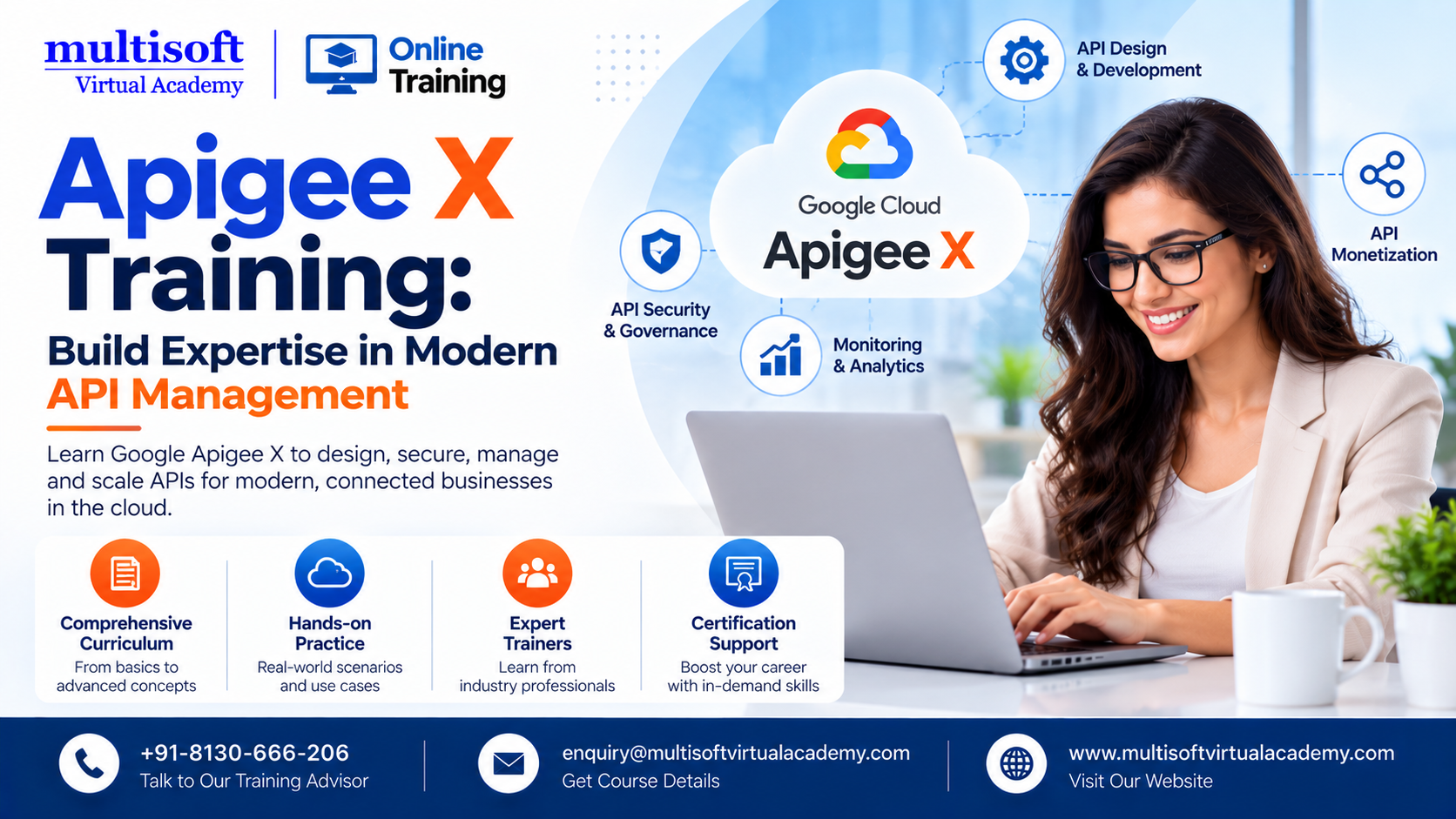
APIs are now central to digital products, cloud applications, mobile platforms, microservices, partner ecosystems, and AI-powered solutions. As organizations expose more services through APIs, they need professionals who can design, secure, deploy, monitor, and manage APIs efficiently. Apigee X Training provides a structured way to develop these capabilities using Google Cloud’s API management platform.
Google Cloud describes Apigee as a native API management platform for building, managing, and securing APIs at different scales. It provides an API proxy layer with capabilities such as security, traffic management, quotas, analytics, and API lifecycle management.
For developers, cloud professionals, integration specialists, solution architects, and API administrators, learning Apigee X can be a valuable step toward developing practical API management skills and working with modern cloud-native architectures.
Apigee X Training is Google Cloud's enterprise API management solution designed to help organizations create, secure, publish, monitor, and manage APIs. Rather than allowing applications and consumers to interact directly with backend systems, Apigee can provide an API proxy layer between clients and backend services.
This architecture allows organizations to introduce policies and controls without making extensive changes to underlying applications.
Apigee supports multiple API architectural styles, including REST, gRPC, SOAP, and GraphQL. Its capabilities cover areas such as API security, traffic management, analytics, monitoring, developer portals, and API publishing.
This makes Apigee API Management Training relevant for organizations adopting:
Simply creating an API is not enough for an enterprise environment. Organizations also need to control who can access APIs, how much traffic APIs can handle, how APIs are published, how developers consume them, and how API performance is monitored.
This is where structured Apigee X Training becomes useful.
A comprehensive learning program can help professionals understand the complete API lifecycle—from design and development to security, deployment, monitoring, and optimization.
Google's current Apigee learning resources similarly emphasize designing, building, securing, deploying, and managing APIs through a combination of learning modules and practical labs.
A well-designed Apigee X Course should go beyond theoretical concepts and introduce learners to practical API management workflows.
Learners begin by understanding:
Understanding these fundamentals makes it easier to work with Apigee in real-world enterprise environments.
API proxies are one of the important concepts in Apigee.
Learners can explore how API proxies act as an intermediary between applications and backend services. Training may cover proxy configuration, flows, route rules, target servers, environments, and policies.
Google's Apigee training specifically includes API proxy development, OpenAPI-based proxy creation, routing, environments, and troubleshooting. Google Cloud Storage
Security is a critical part of enterprise API management.
An Apigee X Certification Training program can introduce learners to concepts such as:
Google's current API security training covers OAuth, JWT, federated security, malicious request protection, and secure API communication.
High-traffic applications need mechanisms to control API consumption.
Apigee provides policies and controls that can help organizations manage traffic, quotas, spike protection, and other API consumption requirements.
Learning these capabilities helps professionals design APIs that are more predictable and manageable under different traffic conditions.
Organizations often expose APIs to internal developers, partners, or external customers.
An Apigee training program can explain how APIs can be packaged into API products and made available through developer portals.
Developer portals provide a centralized experience where developers can discover APIs, access documentation, register applications, and consume published services. Google Cloud identifies API discoverability and developer-focused portals as important parts of Apigee's API management capabilities.
API management doesn't stop after deployment.
Professionals need to understand:
Apigee provides analytics dashboards and monitoring capabilities that can help teams investigate API traffic and identify performance or operational problems.
Organizations increasingly build applications across cloud services, containers, databases, SaaS platforms, and legacy systems.
Apigee can provide a consistent management layer across these services.
For example, an organization could expose services from an existing backend through APIs while applying authentication, traffic policies, analytics, and monitoring through Apigee.
Apigee can also work with Google Cloud services. Current Google training material includes examples involving services such as Pub/Sub and Cloud Logging, while practical Apigee X learning covers API products, developer portals, authentication, and Google Cloud integrations.
This makes Google Cloud Apigee Training particularly relevant for professionals already working with Google Cloud technologies.
API-first development focuses on designing APIs as important products rather than treating them simply as technical interfaces.
With this approach, teams can establish API specifications, define contracts, document services, and consider consumers before implementation.
OpenAPI is commonly used as part of this process. Google Cloud's Apigee API design training includes API-first concepts, OpenAPI specifications, API lifecycle management, API proxies, and API products.
Professionals who understand API-first principles can contribute more effectively to modern application development and integration projects.
Apigee X Online Training can be useful for several technology professionals.
Developers can learn how to create and manage API proxies, apply policies, connect backend services, and troubleshoot API flows.
Architects can explore API lifecycle management, API security, deployment approaches, governance, and integration patterns.
Cloud professionals can strengthen their understanding of API management within Google Cloud environments.
Integration specialists can use Apigee concepts to manage APIs connecting applications, services, and enterprise systems.
DevOps engineers can explore API deployment, automation, logging, monitoring, and CI/CD-related workflows.
Technology leaders can gain a better understanding of API governance, security, scalability, and operational requirements.
API management is a practical discipline, so theoretical learning alone may not provide enough experience.
A strong Apigee X Training Course should include hands-on activities involving API proxies, policies, authentication, traffic management, deployment, analytics, and troubleshooting.
Current Google Cloud learning paths use hands-on labs and practical exercises as part of Apigee learning. For example, the API development course includes API development, fault handling, traffic management, caching, developer portals, logging, analytics, CI/CD, and deployment models.
Practical training can therefore help learners move from understanding concepts to applying them.
The role of API management is also evolving as organizations adopt generative AI and AI agents.
Modern enterprise applications increasingly require controlled access to APIs, tools, and AI services. Apigee now includes AI gateway capabilities designed to help govern and optimize AI-related traffic and transform existing APIs into tools that can be used by agentic systems.
This creates an additional reason for cloud and API professionals to understand modern Apigee capabilities.
Professionals working toward AI API Management, API security, cloud integration, and agent-based architectures can benefit from understanding how traditional API management connects with emerging AI workloads.
Developing Apigee expertise can complement existing skills in:
Rather than viewing Apigee as an isolated technology, professionals can treat it as part of a broader cloud and API engineering skill set.
Google's current certification ecosystem also emphasizes keeping cloud skills aligned with evolving technology and in-demand roles.
Before selecting an Apigee X Online Course, learners should consider whether the program covers both fundamentals and practical implementation.
Look for training that includes:
Comprehensive curriculum:
The course should cover API design, proxies, policies, security, deployment, analytics, and lifecycle management.
Hands-on exercises:
Practical labs can provide valuable experience with real API management scenarios.
Security coverage:
OAuth, JWT, API keys, threat protection, and authentication should receive sufficient attention.
Monitoring and analytics:
Learners should understand how to investigate API behavior after deployment.
Cloud integration:
Training should explain how Apigee interacts with Google Cloud services and enterprise environments.
Real-world scenarios:
Projects and examples should connect technical concepts with business and integration requirements.
A structured learning path can make the subject easier to understand.
Step 1: Learn API fundamentals
Understand REST, HTTP, JSON, API lifecycle, and API-first principles.
Step 2: Understand Apigee architecture
Learn organizations, environments, instances, API proxies, target servers, flows, and related components.
Step 3: Build API proxies
Create proxies and connect them with backend services.
Step 4: Apply policies
Explore security, traffic management, transformation, caching, and fault-handling policies.
Step 5: Secure APIs
Work with API keys, OAuth, JWT, authentication, and threat protection.
Step 6: Publish APIs
Understand API products, developer applications, and developer portals.
Step 7: Monitor and analyze APIs
Use analytics, logging, tracing, and monitoring capabilities to evaluate API performance.
Step 8: Explore automation and integration
Understand CI/CD, Apigee APIs, Google Cloud integrations, and deployment practices.
Google's documentation notes that the Apigee API can also be used programmatically to manage API proxies and integrate API management into software development lifecycle processes. Google Cloud Documentation
After completing practical Apigee X Training, learners can apply their knowledge to scenarios such as:
The exact projects will depend on the learner's existing technical background and organizational requirements.
The difficulty depends on your existing knowledge of APIs, cloud computing, HTTP, JSON, and software development. Beginners can start with API fundamentals, while experienced developers and cloud engineers may progress more quickly.
Basic programming knowledge can be helpful, but Apigee also provides configuration and policy-based capabilities. Google Cloud's training material lists familiarity with HTTP, XML, JSON, and JavaScript as helpful prerequisites.
Developers, API engineers, cloud engineers, architects, integration specialists, DevOps professionals, and technical professionals responsible for API implementation or management can benefit from learning Apigee.
Yes. Security is a major part of Apigee's API management capabilities, including authentication, authorization, traffic protection, and other security controls.
Yes. Apigee now includes AI gateway capabilities intended to help organizations govern and optimize AI traffic and expose APIs as tools for agentic applications.
As businesses continue moving toward cloud-native applications, microservices, API-first development, and AI-enabled digital experiences, effective API management is becoming increasingly important. Apigee X Training can help professionals develop practical knowledge of API design, development, security, deployment, monitoring, analytics, and lifecycle management.
For professionals looking to strengthen their expertise in Apigee API Management Training, Google Cloud Apigee Training, Apigee X Online Training, API Security Training, API Gateway Training, and API Management, choosing a structured, practical learning program can provide a stronger foundation for real-world projects and career development. Multisoft Virtual Academy acts as a best service provider for professionals and organizations seeking structured technology training designed around practical learning and industry-relevant skills. A focused learning approach can help learners turn API concepts into usable technical capabilities and prepare for the evolving requirements of modern cloud and digital ecosystems.
| Start Date | Time (IST) | Day | |||
|---|---|---|---|---|---|
| 10 Oct 2026 | 06:00 PM - 10:00 AM | Sat, Sun | |||
| 11 Oct 2026 | 06:00 PM - 10:00 AM | Sat, Sun | |||
| 17 Oct 2026 | 06:00 PM - 10:00 AM | Sat, Sun | |||
| 18 Oct 2026 | 06:00 PM - 10:00 AM | Sat, Sun | |||
|
Schedule does not suit you, Schedule Now! | Want to take one-on-one training, Enquiry Now! |
|||||






 Join our Live Instructor-Led online classes delivered by industry experts
 Let's Get Started