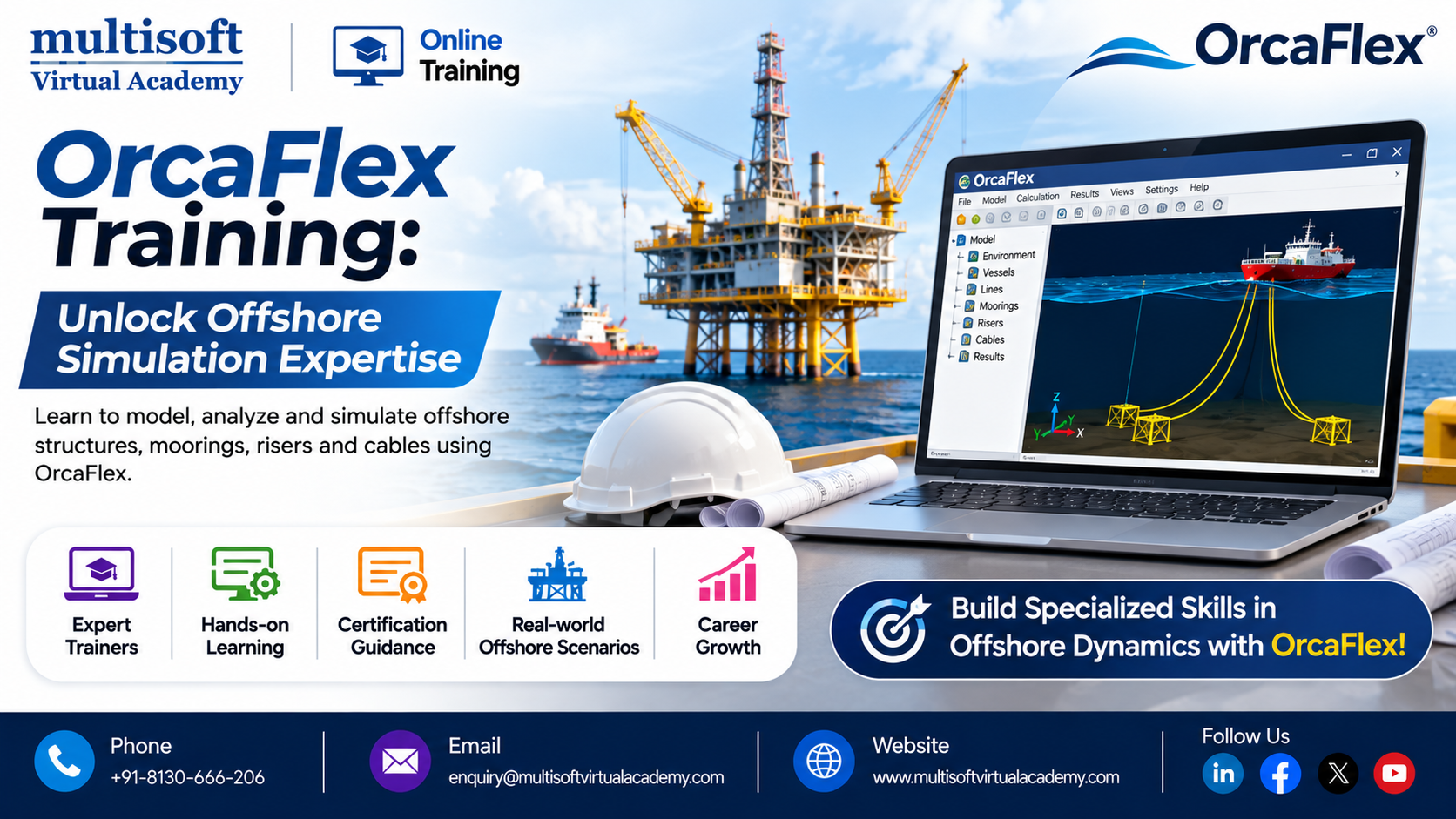
Offshore engineering projects demand precision, technical knowledge, and reliable analysis. Whether engineers are designing floating production systems, evaluating subsea infrastructure, or planning offshore installation activities, understanding how marine structures behave under environmental forces is essential. Advanced simulation software helps engineering teams examine these conditions and make informed technical decisions.
OrcaFlex Training introduces professionals to the modelling and analysis techniques used in offshore and marine engineering. The software enables engineers to represent vessels, mooring lines, risers, pipelines, subsea cables, and other marine components within a simulation environment. By learning its features, participants can develop an understanding of offshore system behaviour and the engineering calculations associated with different operating conditions.
As offshore developments expand into deeper waters and more demanding environments, the need for competent simulation professionals continues to be important. Practical OrcaFlex knowledge can help engineers strengthen their analytical abilities and understand the requirements of modern marine engineering projects.
Developed by Orcina, OrcaFlex is a specialist engineering application for modelling and analysing offshore marine systems. It supports the investigation of complex configurations involving floating structures, vessels, mooring arrangements, risers, flexible pipes, and subsea equipment.
The software helps engineers evaluate how marine systems respond to environmental conditions and operational activities. Its analysis capabilities can be applied to different engineering scenarios, from initial design studies to installation assessments.
Some important applications include:
Understanding the software requires knowledge of both its modelling environment and the engineering principles that influence simulation results.
Offshore systems contain several connected components, and their behaviour depends on environmental forces, structural properties, geometry, and operating conditions. A small change in model inputs can influence the results of an analysis.
Training helps professionals understand these relationships and develop a systematic approach to simulation.
Modelling is the starting point of most simulation activities. Engineers must represent the physical system correctly before performing calculations.
Through guided exercises, learners can understand object creation, line configuration, component connections, model properties, and simulation preparation.
Marine structures are affected by waves, currents, wind, and vessel movements. Understanding their dynamic response is important for assessing operational performance.
Training introduces learners to the analysis methods used to investigate changing loads, displacement, motion, and structural response.
Simulation software generates extensive engineering information. Professionals must understand how to interpret this information rather than simply produce reports.
Learning to examine line tension, curvature, vessel motion, displacement, and other outputs can improve the quality of engineering reviews.
Offshore projects involve design engineers, installation specialists, structural analysts, and subsea teams. Knowledge of OrcaFlex can help professionals understand modelling requirements and contribute to engineering discussions across these disciplines.
A professional OrcaFlex Training Course should include software fundamentals, modelling exercises, simulation techniques, and result interpretation. The following subjects are valuable for building practical knowledge.
Learners begin by understanding the working environment and how different objects are organized within a model.
Topics may include:
These fundamentals help participants develop a structured approach to creating offshore models.
Environmental conditions are essential inputs in offshore analysis. Engineers must consider the wave environment, current profiles, wind conditions, water depth, and other relevant project parameters.
Training may explain how these conditions are represented in a model and how different environmental inputs influence system response.
Learners should also understand the importance of selecting appropriate environmental data and checking that the model reflects the intended engineering scenario.
Static analysis establishes the equilibrium configuration of a model under defined conditions. It provides useful information about line geometry, tension, positioning, and initial system behaviour.
This module may cover static calculation settings, equilibrium conditions, line configurations, boundary conditions, convergence, and result evaluation.
Static analysis is an important foundation for understanding subsequent dynamic simulation activities.
Dynamic simulation investigates how a marine system behaves over time. It is particularly relevant when environmental loading and operational movement influence offshore structures.
A practical learning program may introduce:
These concepts help learners understand how offshore systems respond under changing conditions.
Mooring systems are designed to control the position and movement of floating offshore facilities. Their performance depends on line configuration, material properties, vessel characteristics, and environmental loading.
OrcaFlex is used to investigate different mooring arrangements and their response under defined conditions.
Important subjects include:
These skills are relevant to floating production systems, offshore platforms, and floating renewable energy projects.
Risers provide connections between offshore facilities and subsea systems. Their response can be influenced by water depth, vessel motion, current loading, buoyancy, and structural properties.
Training may introduce different riser configurations and the modelling of flexible pipes within an offshore environment.
Learners may explore effective tension, curvature, displacement, seabed contact, buoyancy modules, and other relevant response parameters.
This knowledge is useful for professionals involved in offshore production, subsea infrastructure, and pipeline engineering.
Subsea cables and umbilicals are important parts of offshore communication, control, and power systems. Their mechanical performance must be evaluated under suitable operating and environmental conditions.
Training may cover cable properties, line configuration, tension, curvature, and interaction with surrounding components.
These topics are especially relevant to offshore renewable energy and subsea engineering applications.
Installation operations can involve complex interactions between vessels, cranes, winches, lifting lines, and subsea structures.
Engineers may use OrcaFlex to investigate deployment configurations and assess the response of connected components during marine operations.
A course may introduce lifting arrangements, lowering operations, overboarding, vessel movement, installation line behaviour, and operational simulation.
Repeated environmental loading can contribute to fatigue damage in offshore structures. Engineers must understand how fatigue-related calculations and simulation results are evaluated.
Advanced training may cover fatigue analysis concepts, response statistics, time histories, extreme values, and engineering reporting.
The interpretation of fatigue results requires appropriate loading data, modelling assumptions, and project-specific acceptance criteria.
OrcaFlex supports engineering activities across different marine and offshore sectors.
Oil and gas engineering: Offshore production projects involve mooring systems, risers, flexible pipes, and floating structures that require engineering assessment.
Subsea infrastructure: Subsea cables, pipelines, and umbilicals may require modelling to investigate their response under environmental and operational conditions.
Offshore wind energy: Floating wind developments involve floating platforms, mooring arrangements, and dynamic cable systems. Simulation can support the evaluation of these configurations.
Marine construction: Offshore installation and construction projects may use modelling to examine vessel interactions, lifting arrangements, and deployment scenarios.
Naval architecture: Marine engineers and naval architects may use simulation tools to investigate vessel-related behaviour and connected offshore systems.
Engineering consultancy: Technical consulting organizations may use OrcaFlex for offshore design assessments, simulation studies, and engineering verification.
OrcaFlex learning can be relevant to professionals who work with marine structures, offshore systems, and engineering simulations.
A background in engineering mechanics, structural behaviour, and offshore systems can help learners understand the technical concepts covered during training.
Specialized simulation knowledge can complement engineering qualifications and project experience. Professionals who understand offshore modelling may explore opportunities in areas such as:
Job responsibilities vary between organizations. Employers may expect candidates to demonstrate engineering fundamentals, simulation experience, analytical skills, and familiarity with relevant offshore standards.
OrcaFlex training can contribute to professional development, but career progression also depends on practical experience and the ability to solve real engineering problems.
Choosing the right learning program can make a significant difference to the training experience. Before enrolling, review the following factors.
Course coverage: Check whether the curriculum includes model development, line properties, environmental conditions, static analysis, dynamic simulations, and engineering results.
Hands-on learning: Practical exercises are important for understanding how the software behaves under different model configurations.
Instructor experience: Trainers should be able to explain both software operations and the engineering principles behind offshore modelling.
Software access: Confirm whether the training includes access to the relevant software version and a suitable practice environment.
Advanced modules: Experienced learners may look for additional coverage of fatigue analysis, Python automation, advanced mooring studies, or offshore wind applications.
Learning support: Check whether learners receive guidance during exercises and assistance with understanding difficult modelling concepts.
OrcaFlex Training teaches professionals how to model and analyse offshore marine systems using OrcaFlex. It may include vessels, risers, mooring lines, subsea cables, environmental loading, and dynamic simulations.
Common applications include mooring system analysis, riser modelling, subsea cable assessment, offshore installation studies, vessel response analysis, and floating offshore wind applications.
Yes. Graduates can begin with introductory modelling concepts and gradually progress to more advanced simulation topics. Basic engineering mechanics knowledge is recommended.
Yes. OrcaFlex provides fatigue analysis capabilities for relevant offshore applications. The appropriate method and assessment criteria depend on the engineering problem.
Yes. It can support the modelling and analysis of floating offshore wind systems, including mooring arrangements and relevant dynamic cable configurations.
OrcaFlex provides automation capabilities, including an API that can be used with supported programming workflows. Python-based automation may be included in advanced learning programs.
Offshore engineering requires accurate modelling and reliable analysis to understand how marine structures behave under environmental and operational conditions. Developing OrcaFlex skills can help professionals work with mooring systems, risers, subsea cables, floating structures, and offshore installation scenarios. A structured learning program that combines engineering fundamentals with practical simulation exercises can provide a valuable foundation for professional development. Multisoft Virtual Academy offers OrcaFlex Training to help aspiring and experienced professionals strengthen their offshore modelling knowledge, understand dynamic analysis workflows, and develop practical skills relevant to marine and offshore engineering projects.
| Start Date | Time (IST) | Day | |||
|---|---|---|---|---|---|
| 21 Nov 2026 | 06:00 PM - 10:00 AM | Sat, Sun | |||
| 22 Nov 2026 | 06:00 PM - 10:00 AM | Sat, Sun | |||
| 28 Nov 2026 | 06:00 PM - 10:00 AM | Sat, Sun | |||
| 29 Nov 2026 | 06:00 PM - 10:00 AM | Sat, Sun | |||
|
Schedule does not suit you, Schedule Now! | Want to take one-on-one training, Enquiry Now! |
|||||





 Let's Get Started
