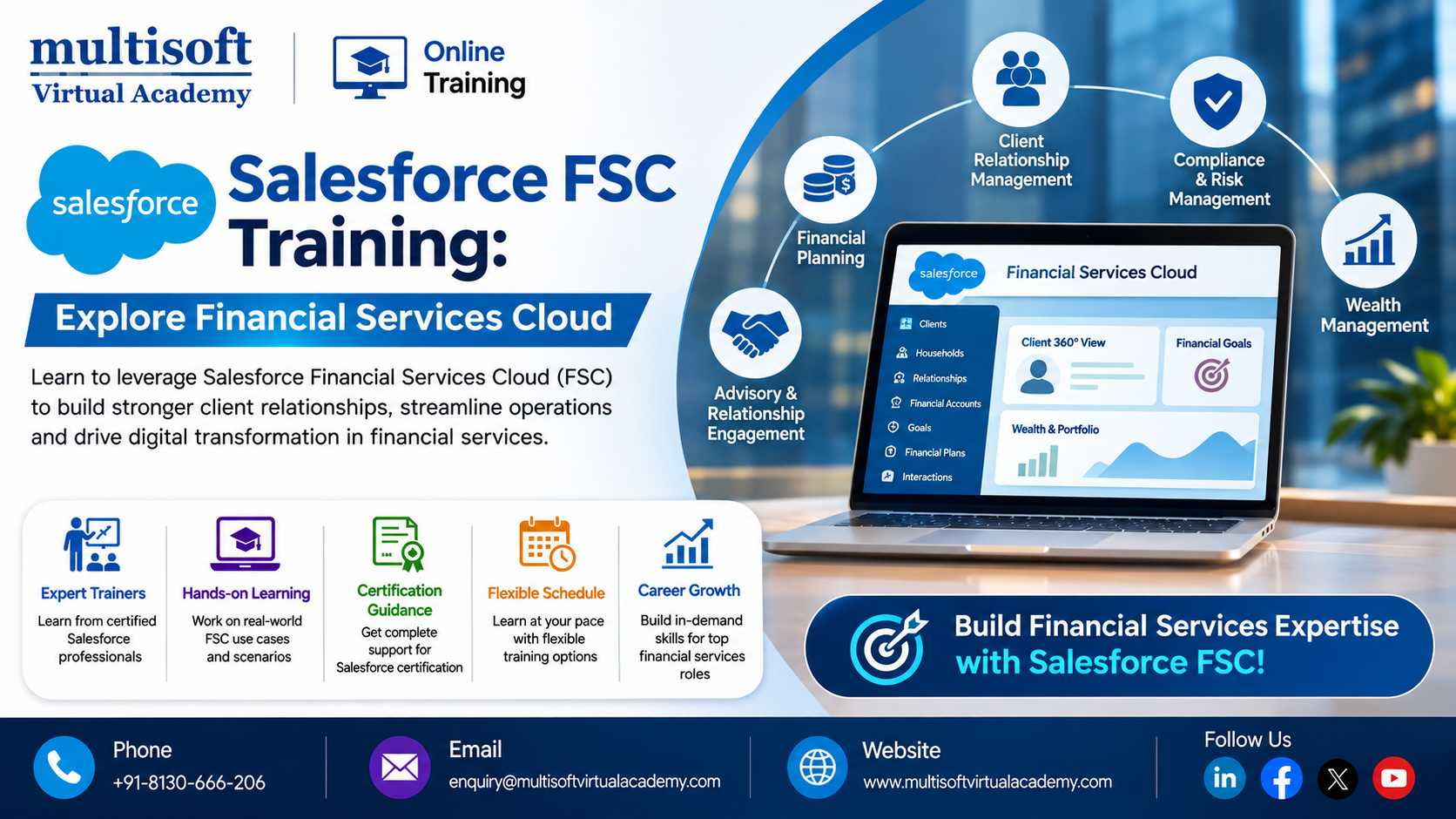
Financial institutions are increasingly using digital platforms to improve customer engagement, manage financial relationships, and deliver personalized services. Banks, insurance providers, and wealth management companies need more than traditional customer management tools. They require technology that connects customer information with financial activities and business processes.
Salesforce Financial Services Cloud (FSC) addresses these requirements through an industry-focused customer relationship management platform. It helps financial organizations organize customer data, understand relationships, manage interactions, and support business operations.
Salesforce FSC Training provides professionals with an opportunity to explore this specialized Salesforce environment. Participants learn about financial accounts, household management, customer relationships, referrals, action plans, automation, and reporting. These skills can be useful for Salesforce consultants, administrators, developers, and business analysts working with financial services organizations.
Salesforce Financial Services Cloud is an industry-specific CRM solution designed to support the needs of financial services businesses. It extends Salesforce CRM capabilities with features and data structures relevant to banking, insurance, wealth management, and related sectors.
The platform helps organizations build a connected view of their customers by bringing together relevant information about individuals, households, financial accounts, and business relationships.
For example, a financial advisor may need to understand a client's household details, financial goals, associated accounts, and previous interactions before recommending a service. FSC helps organize these details so authorized professionals can access relevant information within their CRM environment.
Similarly, banking teams can use customer relationship information to support onboarding and service activities, while insurance organizations can coordinate customer interactions and business opportunities.
Financial services organizations handle complex customer relationships and large volumes of business information. Managing this information across disconnected applications can make it difficult to maintain consistent customer experiences.
Salesforce FSC offers capabilities that help address several business requirements.
Financial professionals often work with information spread across different customer records and business processes. FSC helps establish connections between individuals, households, financial accounts, and related records.
This provides users with a more organized understanding of customer relationships.
Customers have different financial needs depending on their goals, circumstances, and relationships. FSC helps financial professionals maintain relevant customer information and coordinate interactions.
This can support more informed conversations and personalized service experiences.
Financial advisors and relationship managers need to understand connections between clients, family members, organizations, and financial accounts.
FSC offers relationship management capabilities that help users visualize these connections and navigate related information.
Financial institutions manage referrals, customer requests, follow-up activities, and business opportunities. FSC capabilities can help organize these activities through structured records, action plans, and automation.
By connecting customer information with relevant business workflows, organizations can improve coordination between teams and support more consistent processes.
A well-planned Salesforce Financial Services Cloud Course should explain the platform's major capabilities and demonstrate how they support financial services workflows.
The learning process generally begins with an overview of Financial Services Cloud and its relationship with the Salesforce platform.
Important concepts include:
Understanding the foundation helps learners explore more advanced features with confidence.
Household management is particularly useful in wealth management and relationship-based financial services.
It allows organizations to understand relationships between individuals and their associated household records.
Training may cover household creation, member associations, relationship groups, account connections, and customer information management.
For example, a financial advisor may manage several members of the same family while maintaining separate financial goals and account information. Household management helps present these relationships in an organized way.
Financial account management helps organizations maintain information about customer financial accounts within their CRM environment.
Depending on the implementation, these records may represent banking, investment, or other financial relationships.
Training may introduce financial account creation, account relationships, record management, and relevant data structures.
Learners should understand how financial account information connects with customer profiles and other Salesforce records.
The Actionable Relationship Center is an important feature for visualizing connected customer and business relationships.
It helps users explore relationships between individuals, households, accounts, and other relevant records through configurable relationship views.
A training program may cover ARC fundamentals, relationship visualization, configuration concepts, and practical use cases.
This feature can be particularly useful for wealth management professionals who need to understand complex client relationships.
Referrals help financial organizations identify and track potential business opportunities originating from customer interactions or internal recommendations.
FSC supports referral-related workflows that can help teams manage referral information and coordinate follow-up activities.
Training may include referral creation, assignment, tracking, status management, and related opportunity processes.
Customer requirements can change as they experience important life events. Examples include retirement, education planning, marriage, property purchases, and business expansion.
Recording relevant life events and financial goals can help financial professionals understand customer priorities.
Training may introduce the management of these records and explain how they support relationship-based service processes.
Financial institutions often follow repeatable procedures for customer onboarding, financial reviews, and other service activities.
Action plans help organize tasks and activities associated with specific business scenarios.
Training may cover action plan templates, task assignments, workflow automation, and process management.
Learners can also explore how Salesforce Flow and other platform automation capabilities may support financial services operations.
Reports and dashboards help financial organizations review business information and monitor relevant activities.
A practical course may include:
These capabilities help users organize information and present relevant business insights.
Understanding implementation processes is valuable for professionals who want to work on Salesforce financial services projects.
A successful FSC implementation requires an understanding of business requirements, customer data, security, integrations, and operational workflows.
The implementation process generally involves the following stages.
Business requirement gathering: Identify the organization's needs across banking, insurance, wealth management, customer service, and relationship management.
Solution design: Determine which Financial Services Cloud capabilities are relevant to the business requirements.
Data model planning: Define how customer records, accounts, households, financial accounts, and relationships should be organized.
Configuration and customization: Configure relevant Salesforce objects, fields, layouts, permissions, and workflows.
Integration development: Connect FSC with external systems where required, such as banking platforms, insurance applications, financial systems, and enterprise databases.
Data migration: Prepare existing customer records and other business information for migration into the Salesforce environment.
Testing and validation: Validate business processes, user access, automation, integrations, and reporting.
Deployment and user adoption: Move the solution into production and help employees understand the new working environment.
Professionals should also understand data protection, privacy, and regulatory requirements when working with financial services information.
Financial Services Cloud can support a variety of business scenarios across the financial services industry.
Banks can use FSC to organize customer profiles, manage relationships, coordinate referrals, and support customer engagement.
Relationship managers can use connected customer information to understand client requirements and coordinate relevant business activities.
Wealth management organizations work with individuals, families, financial accounts, and long-term financial goals.
FSC's household management and relationship capabilities can help advisors maintain an organized view of their client relationships.
Insurance organizations may use Salesforce CRM capabilities to manage customer interactions, referrals, service activities, and business opportunities.
The exact insurance workflows depend on the Salesforce products and integrations used by the organization.
Mortgage and lending teams may use CRM workflows to organize customer information, manage potential business opportunities, and coordinate follow-up activities.
Fintech organizations may use Salesforce to manage customer engagement, service processes, and business relationships. FSC can be relevant where the organization's requirements align with its financial services capabilities.
Artificial intelligence is becoming an important part of modern CRM platforms. Financial organizations are exploring AI-assisted capabilities to improve employee productivity, customer engagement, and business process automation.
Salesforce continues to develop AI capabilities, including Agentforce experiences, that can support different business workflows.
Depending on the available products, configuration, and licensing, organizations may explore AI-assisted service interactions, information summaries, workflow support, and employee productivity tools.
Professionals pursuing Salesforce FSC Training should also develop an understanding of data quality, access controls, responsible AI usage, and automation.
These areas are important because financial services organizations must handle customer information carefully and maintain appropriate governance practices.
Salesforce FSC training is suitable for professionals interested in combining CRM technology with financial services business processes.
Basic Salesforce knowledge is useful, but beginners can also start with platform fundamentals before moving into specialized FSC topics.
Specialized Salesforce knowledge can help professionals explore opportunities in CRM implementation, administration, development, and consulting.
Some relevant career roles include:
Career progression depends on practical experience, technical skills, business process knowledge, and employer requirements.
Professionals who combine Salesforce expertise with banking, insurance, or wealth management experience may be better prepared to understand industry-specific project requirements.
Choosing the right training program requires more than comparing course durations. Learners should evaluate the syllabus, practical learning opportunities, and trainer expertise.
Review the curriculum: Make sure it includes platform fundamentals, household management, financial accounts, ARC, referrals, action plans, and reporting.
Check practical coverage: Choose training that includes guided exercises and realistic financial services scenarios.
Understand trainer experience: An instructor with relevant Salesforce and financial services knowledge can explain how platform features relate to actual business processes.
Confirm system access: Ask whether learners receive access to a Salesforce environment for practical exercises.
Explore implementation topics: If you want to work as a consultant, look for coverage of configuration, data migration, integration, security, testing, and deployment.
Verify certification preparation: Check whether the course supports preparation for a specific Salesforce credential or simply provides a training completion certificate.
Salesforce FSC Training teaches professionals how to use Financial Services Cloud for customer relationship management, financial account management, household relationships, referrals, and industry-specific workflows.
Important learning areas include FSC architecture, accounts and contacts, household management, financial accounts, Actionable Relationship Center, referrals, life events, action plans, automation, and reporting.
Yes. Financial Services Cloud builds on Salesforce CRM and provides industry-focused capabilities and data structures designed for financial services organizations.
Yes. Beginners can learn FSC by first understanding Salesforce fundamentals and then progressing to financial services-specific features and business workflows.
Implementation coverage depends on the course syllabus. A comprehensive program may introduce requirements analysis, configuration, data modeling, integration, testing, and deployment.
Banking, insurance, wealth management, lending, and other financial services organizations may use Financial Services Cloud according to their business and technology requirements.
Salesforce Financial Services Cloud provides industry-focused CRM capabilities that help organizations manage customer relationships, financial accounts, household information, referrals, and business workflows. Learning its features and implementation processes can help professionals develop relevant skills for banking, insurance, wealth management, and financial technology projects. As financial institutions continue investing in connected CRM platforms, automation, and AI-enabled business processes, specialized Salesforce knowledge can support long-term professional development. Multisoft Virtual Academy offers Salesforce FSC Training for learners who want to strengthen their understanding of Financial Services Cloud through structured learning and practical exposure to industry-related Salesforce processes.
| Start Date | Time (IST) | Day | |||
|---|---|---|---|---|---|
| 21 Nov 2026 | 06:00 PM - 10:00 AM | Sat, Sun | |||
| 22 Nov 2026 | 06:00 PM - 10:00 AM | Sat, Sun | |||
| 28 Nov 2026 | 06:00 PM - 10:00 AM | Sat, Sun | |||
| 29 Nov 2026 | 06:00 PM - 10:00 AM | Sat, Sun | |||
|
Schedule does not suit you, Schedule Now! | Want to take one-on-one training, Enquiry Now! |
|||||




 Join our Live Instructor-Led online classes delivered by industry experts
 Let's Get Started
