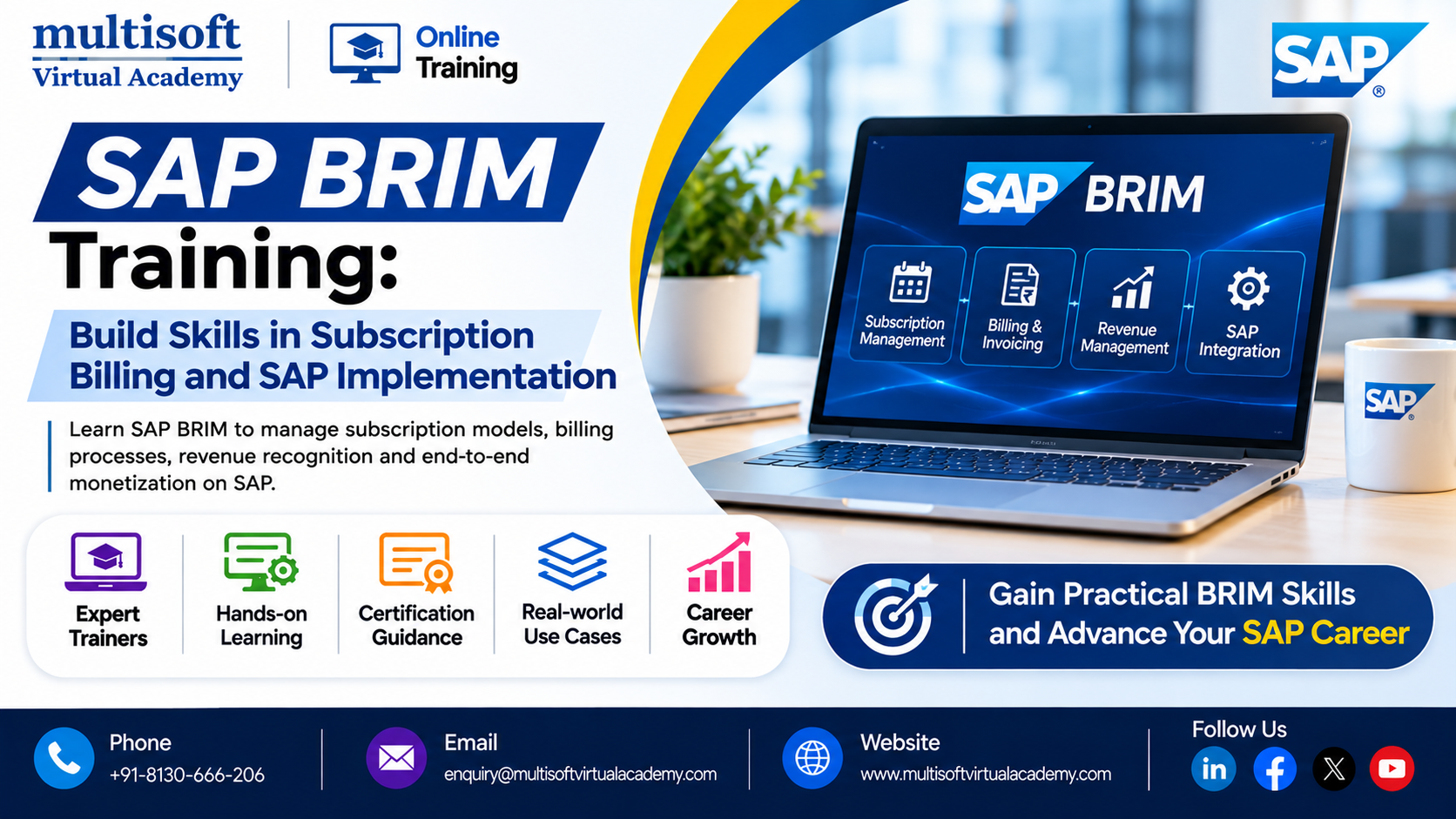
The way businesses generate revenue is changing. Many organizations are moving beyond traditional one-time sales and adopting subscription services, recurring payments, digital products, and consumption-based pricing. These business models require flexible systems that can manage customer subscriptions, usage records, pricing calculations, billing activities, and financial transactions. SAP Billing and Revenue Innovation Management (BRIM) helps organizations manage these complex revenue processes.
SAP BRIM Training provides professionals with an understanding of subscription management, usage-based charging, convergent invoicing, and financial contract accounting. It introduces the technology and business processes that support modern billing operations. For SAP consultants, finance professionals, business analysts, and implementation specialists, learning BRIM can be a valuable way to expand their knowledge of enterprise billing solutions.
SAP BRIM is designed to support businesses with large customer bases, recurring subscriptions, and high volumes of usage-based transactions. It helps organizations manage different revenue models through connected processes for subscription orders, charging, invoicing, and financial accounting.
Consider a cloud service provider offering three subscription packages. Customers pay a monthly fee for their selected package and additional charges when their usage exceeds certain limits. Managing these activities requires accurate product information, customer contracts, pricing rules, consumption records, and invoices.
SAP BRIM supports these requirements through specialized components that work together within an integrated solution environment.
Its capabilities can be relevant to telecommunications, software services, utilities, digital media, transportation, and other industries that operate subscription-based or pay-per-use business models.
Learning SAP BRIM can help professionals understand how complex billing environments are structured and managed. Instead of focusing only on individual transactions, a comprehensive course explains the relationship between business requirements and the software components that support them.
Subscription businesses must manage customer orders, product packages, contract creation, renewals, and contract changes. Training introduces learners to these activities and explains how subscription information is maintained throughout the customer lifecycle.
Usage-based billing calculates charges according to customer consumption. This model is common in cloud services, telecommunications, and other digital businesses.
Training helps learners understand how consumption information is collected, evaluated, priced, and transferred into billing processes.
Organizations need accurate billing processes to manage recurring fees, one-time charges, discounts, and consumption-related transactions. SAP BRIM training explains how billable information is processed and converted into invoices.
Billing activities must connect with financial operations. Learning FI-CA and its relationship with other BRIM components helps professionals understand payments, receivables, open items, clearing, and collections.
A structured SAP BRIM Training Course should explain the major solution components and demonstrate how they support the complete revenue process.
Subscription Order Management handles subscription-related order and contract processes. It supports product modeling, subscription order capture, contract creation, and changes throughout the subscription lifecycle.
Important learning areas include:
Understanding SOM helps learners follow how a customer's selected service becomes an active subscription within the business process.
Convergent Charging supports pricing, rating, and charging for subscription and consumption-based services.
For example, a telecommunications provider may charge a fixed monthly subscription fee and apply additional rates for data usage. The charging process evaluates the applicable pricing conditions and calculates the relevant charges.
Training may cover:
These concepts are useful for professionals working with flexible pricing structures and complex service charges.
Convergent Invoicing manages billing and invoicing processes for different types of billable transactions. It supports the consolidation of recurring charges, one-time fees, and usage-based items.
Key learning areas include billable item management, billing plans, billing execution, invoice creation, invoice corrections, and integration with FI-CA.
Professionals should understand how billable information is prepared, processed, and converted into financial documents. This knowledge is important for working with high-volume billing environments.
FI-CA is an important financial component within the SAP BRIM landscape. It supports high-volume financial processing for contract-based business models.
Training may introduce:
This component is particularly relevant to professionals with SAP Finance or financial operations experience.
Convergent Mediation supports the collection and processing of usage information before it enters subsequent charging and billing activities. It is particularly relevant to organizations receiving consumption data from multiple sources.
Learners can explore the role of usage records, data validation, mediation workflows, and reconciliation.
The exact mediation solution and integration approach depend on the organization's SAP architecture and selected products.
One of the most important learning outcomes is understanding how the different components work together. Consider a business that provides a subscription-based cloud platform.
The organization defines its service packages, subscription conditions, recurring charges, and applicable usage rates.
A customer selects a package and submits an order. Subscription Order Management supports the order and contract processes.
If additional charges depend on consumption, the relevant usage records are collected and processed through the configured data management workflow.
Convergent Charging evaluates the applicable pricing rules and calculates charges based on the subscription and usage information.
Convergent Invoicing processes billable information and supports invoice creation for the relevant charges.
FI-CA supports payment processing, receivables management, clearing, and other financial activities associated with customer accounts.
Understanding this process helps learners see how subscription operations connect with billing and financial management.
An SAP BRIM implementation involves business analysis, solution configuration, integration, testing, and deployment activities. Professionals working on these projects need to understand both the technical solution and the organization's commercial requirements.
Consultants must identify how an organization manages subscriptions, recurring payments, consumption charges, customer contracts, and financial transactions.
Understanding the relationship between product models, pricing conditions, charging rules, billing processes, and financial settings is important for developing a suitable solution.
SAP BRIM may connect with SAP S/4HANA and other enterprise applications. Professionals should understand the movement of information between subscription management, usage processing, charging, invoicing, and financial systems.
Implementation teams validate different business scenarios before deployment. Examples include subscription creation, contract changes, recurring charges, usage rating, invoice generation, and payment processing.
Organizations replacing existing billing platforms must plan the migration of customer records, subscription contracts, outstanding transactions, and other relevant information. Data validation and reconciliation are essential for maintaining accuracy.
SAP BRIM can support organizations that manage complex billing and subscription requirements.
These industries have different operational requirements, but they share the need for reliable billing and revenue management processes.
SAP BRIM training may be suitable for professionals who want to develop specialized knowledge in enterprise billing and subscription management.
Basic knowledge of SAP business processes, finance, billing, or order management can make the learning process easier. Beginners should select a course that explains the fundamentals before introducing advanced implementation concepts.
Developing SAP BRIM knowledge can complement several professional career paths. Potential opportunities include:
Career opportunities depend on technical knowledge, practical experience, educational qualifications, and employer requirements. Training can strengthen a candidate's foundation, but project exposure and problem-solving abilities remain important.
Choosing the right learning program can make a significant difference in how effectively you understand the solution.
Check the curriculum: Review whether the syllabus covers SOM, Convergent Charging, Convergent Invoicing, FI-CA, and the relevant integration processes.
Prioritize practical learning: Look for exercises that demonstrate subscription creation, contract changes, pricing, charging, billing, and financial processing.
Evaluate trainer experience: An experienced trainer should be able to explain business scenarios and connect software concepts with practical implementation requirements.
Confirm software access: Ask about the SAP version, deployment environment, and availability of practice systems.
Review the training format: Compare live instructor-led sessions, one-to-one learning, and self-paced resources according to your requirements.
Understand certification options: Confirm whether the program provides a course-completion certificate or prepares learners for a separate SAP certification examination.
What is SAP BRIM Training?
It is a learning program that introduces SAP Billing and Revenue Innovation Management, including subscription order management, usage-based charging, invoicing, and financial contract accounting.
Important components include Subscription Order Management, Convergent Charging, Convergent Invoicing, and FI-CA. Convergent Mediation may also be part of the wider solution landscape.
Yes. Beginners can start with subscription billing concepts and SAP fundamentals before progressing to component-level processes and implementation topics.
Yes. SAP BRIM supports usage-based pricing and charging alongside recurring and one-time charges, depending on the configured solution.
Training provides foundational knowledge of the solution and its processes. Real implementation responsibilities also require practical system experience, configuration skills, integration knowledge, and testing experience.
Subscription services and consumption-based business models are creating new requirements for enterprise billing and financial management. SAP BRIM provides an integrated approach to subscription order management, charging, invoicing, and contract accounting for organizations handling complex revenue processes. Developing knowledge of these components can help professionals strengthen their SAP expertise and prepare for relevant consulting and implementation responsibilities. Multisoft Virtual Academy offers SAP BRIM Training designed to help learners understand subscription billing, SAP BRIM components, and practical business workflows while building knowledge relevant to modern enterprise billing requirements.
| Start Date | Time (IST) | Day | |||
|---|---|---|---|---|---|
| 21 Nov 2026 | 06:00 PM - 10:00 AM | Sat, Sun | |||
| 22 Nov 2026 | 06:00 PM - 10:00 AM | Sat, Sun | |||
| 28 Nov 2026 | 06:00 PM - 10:00 AM | Sat, Sun | |||
| 29 Nov 2026 | 06:00 PM - 10:00 AM | Sat, Sun | |||
|
Schedule does not suit you, Schedule Now! | Want to take one-on-one training, Enquiry Now! |
|||||





 Let's Get Started
