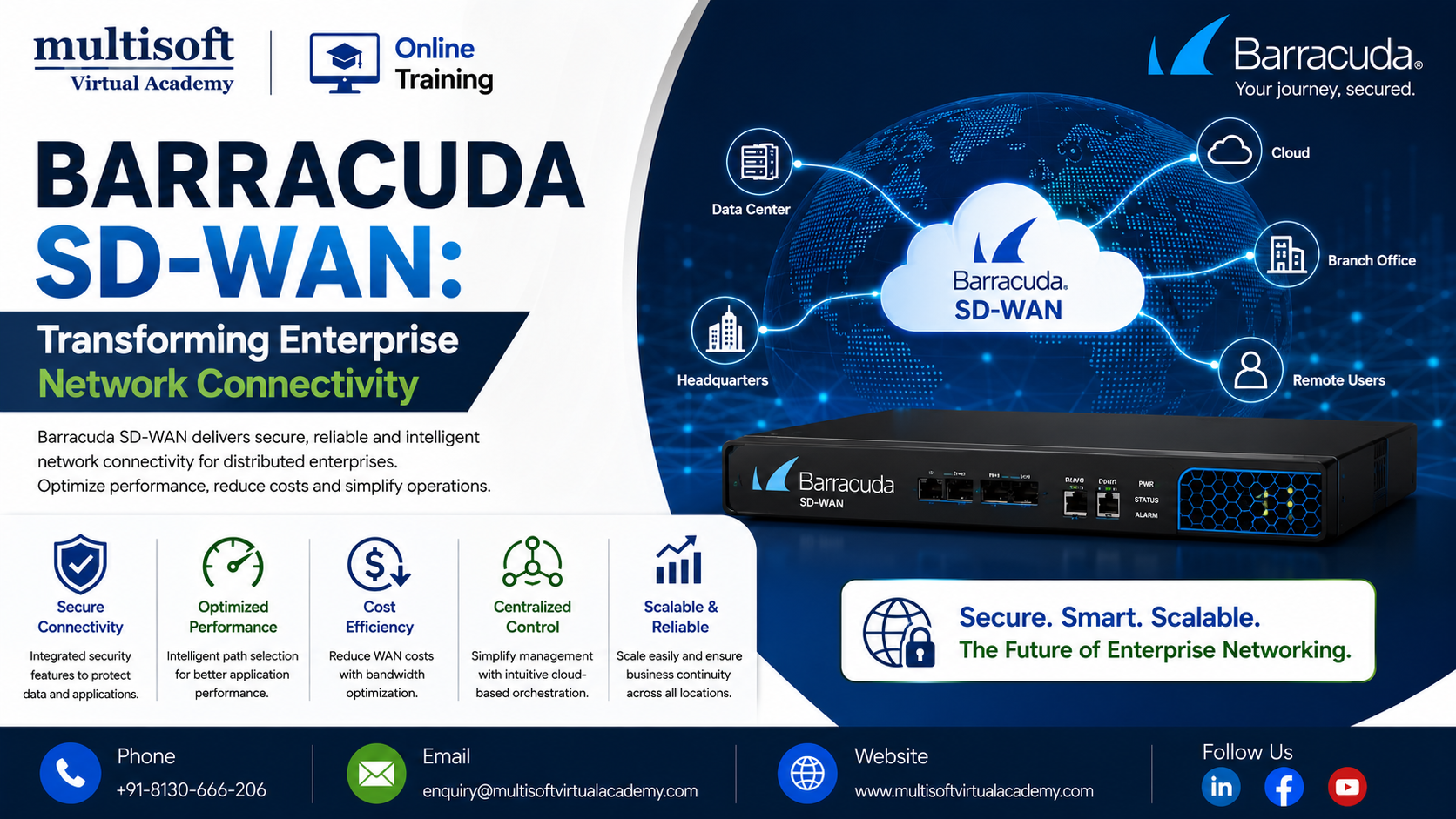
Modern organizations depend on reliable connectivity to cloud applications, SaaS platforms, remote users and distributed offices. Traditional WAN architectures can struggle to deliver the performance, flexibility and security required by today's digital businesses. Barracuda SD-WAN provides a modern approach to wide area networking by combining intelligent traffic management, multiple network connections, application-aware routing and security capabilities.
As enterprises increasingly adopt hybrid cloud, remote work, multi-cloud environments and AI-powered applications, SD-WAN is becoming an important component of modern network architecture. In 2026, networking strategies are also moving toward the convergence of SD-WAN, SASE, Zero Trust and AI-assisted network operations. Recent industry research indicates continued growth in SASE investment, while SD-WAN remains a major component of branch modernization.
For organizations looking to modernize their WAN infrastructure, understanding how Barracuda SD-WAN works and where it fits into a broader security strategy is increasingly important.
Barracuda SD-WAN is a software-defined networking approach designed to optimize connectivity across multiple WAN transports. Instead of depending on a single network connection, SD-WAN can intelligently use available links according to application requirements and network conditions.
Barracuda's SD-WAN capabilities support multi-path VPN connectivity, performance-based transport selection, bandwidth management, failover and traffic optimization. The technology can dynamically evaluate network characteristics such as bandwidth and round-trip time to make better routing decisions.
This approach can be particularly useful for businesses operating:
Rather than treating every connection equally, SD-WAN enables organizations to apply policies based on applications, performance requirements and business priorities.
The traditional enterprise WAN was largely designed around centralized data centers and private connectivity. Today's organizations have a very different traffic pattern. Employees access applications from offices, homes and mobile devices while business applications increasingly reside in public clouds and SaaS platforms.
This change creates several challenges.
Network teams need to provide reliable connectivity while controlling costs and maintaining strong security. They also need visibility into application performance and the ability to respond quickly when network conditions change.
SD-WAN solutions address these challenges by introducing centralized policy management and intelligent traffic steering. Instead of manually configuring every network path, administrators can establish policies that determine how traffic should be handled.
This makes enterprise SD-WAN, secure SD-WAN and cloud SD-WAN increasingly relevant to organizations modernizing their infrastructure.
One of the major advantages of Barracuda SD-WAN is its ability to work across multiple WAN transports. Organizations can combine different connectivity options and use them as part of a resilient network architecture.
Barracuda documentation describes SD-WAN as providing multi-path VPN tunnels across available providers, allowing connectivity to continue as long as at least one operational transport remains available.
This can help organizations reduce dependence on a single ISP and improve network resilience.
Network conditions can change continuously. Bandwidth, latency and packet loss may vary depending on the ISP, application and time of day.
Barracuda SD-WAN can use performance-based transport selection to help route traffic over appropriate network paths. Its capabilities include dynamic bandwidth and round-trip-time detection as well as adaptive bandwidth protection.
For businesses running latency-sensitive applications, intelligent traffic management can contribute to a more consistent user experience.
Not every application has the same business priority.
Video conferencing, voice communication, cloud applications and enterprise systems may require different network characteristics. With application-aware policies, organizations can determine how specific application traffic should be handled.
This allows network administrators to prioritize critical workloads while making efficient use of available bandwidth.
Network downtime can affect productivity, customer service and revenue. SD-WAN can provide additional resilience by supporting failover between available network transports.
Barracuda SecureEdge documentation identifies failover support and multi-provider load balancing among its SD-WAN capabilities.
This is particularly valuable for branch offices where maintaining continuous access to business applications is essential.
Managing a distributed WAN manually can become increasingly difficult as organizations add branches, cloud environments and remote users.
Modern SD-WAN architectures provide centralized control and policy management. Barracuda SecureEdge, for example, provides cloud-based management and automated connectivity capabilities designed for sites and industrial facilities.
Centralized management can simplify network administration while supporting consistent policies across multiple locations.
One of the most important networking trends in 2026 is the convergence of connectivity and security.
Secure Access Service Edge (SASE) combines networking capabilities such as SD-WAN with cloud-delivered security services. Industry analysts continue to identify SASE as a significant enterprise investment area, with SD-WAN remaining an important part of the branch-networking transition.
Barracuda's SecureEdge platform brings together capabilities including secure SD-WAN, Zero Trust Network Access, Secure Web Gateway and Firewall-as-a-Service.
This convergence is important because organizations no longer operate a simple perimeter-based network. Users, applications and devices can be distributed across offices, homes, public clouds and private infrastructure.
A SASE architecture can therefore help organizations apply security policies closer to users and applications while maintaining optimized connectivity.
Zero Trust has become another important component of modern enterprise networking.
The traditional security model often assumed that users inside a corporate network could be trusted. Zero Trust takes a different approach by continuously evaluating access based on identity, device posture, application requirements and security policies.
Barracuda SecureEdge supports Zero Trust access policies that can define which resources users or groups can access and what security conditions must be satisfied.
When SD-WAN and Zero Trust technologies are incorporated into a broader architecture, organizations can address both sides of the modern networking challenge:
Connectivity: How can users and applications communicate efficiently?
Security: How can that communication remain protected and policy-controlled?
Organizations evaluating Barracuda SD-WAN solutions can consider several potential benefits:
Barracuda documentation also highlights the ability to optimize cloud access, support Microsoft 365 performance and use SD-WAN as an on-ramp to Azure.
Cloud adoption has changed enterprise traffic patterns significantly. Instead of sending all traffic through a centralized data center, users increasingly connect directly to applications such as Microsoft 365, collaboration platforms, CRM systems and cloud-hosted business applications.
A modern cloud SD-WAN architecture can help organizations optimize these connections while applying appropriate security and routing policies.
Barracuda's secure networking portfolio is designed to connect users, sites and applications across cloud and on-premises environments. Its documentation specifically describes support for cloud and SaaS optimization and secure access to applications hosted in different environments.
Hybrid cloud environments combine private infrastructure with public cloud services, while multi-cloud strategies use services from multiple cloud providers.
Both architectures create networking complexity because applications and users may be distributed across different environments.
SD-WAN for hybrid cloud can provide centralized policies for managing connectivity between branches, data centers and cloud resources. It can also help organizations make better use of Internet-based connectivity instead of relying exclusively on expensive private WAN circuits.
For organizations pursuing cloud migration, SD-WAN can therefore become an important part of the network modernization roadmap.
Artificial intelligence is creating new requirements for enterprise networks. AI applications can generate unpredictable traffic patterns, require access to distributed data and place increased demands on bandwidth and latency.
Current networking trends indicate that SD-WAN is evolving toward policy-driven, adaptive networking that can respond to real-time network conditions. AI workloads particularly benefit from intelligent path selection and application-aware routing.
This makes AI networking, AI-driven network operations, network automation, network observability and intent-based networking increasingly relevant alongside SD-WAN.
Organizations should therefore consider not only today's connectivity requirements but also how their WAN architecture will support emerging AI workloads.
Successful SD-WAN implementation requires more than deploying appliances or configuring tunnels. Organizations should begin by understanding their existing WAN architecture, application requirements, security policies and business objectives.
A practical implementation approach can include:
Barracuda SD-WAN can be relevant to organizations with distributed offices, cloud-first applications or complex connectivity requirements.
Industries such as manufacturing, healthcare, financial services, retail, education, logistics, telecommunications and professional services can benefit from modern WAN architectures when they need reliable connectivity across multiple locations.
It can also be useful for organizations transitioning away from traditional MPLS-centric architectures toward Internet-based connectivity and cloud-oriented networking.
The future of enterprise networking is moving toward intelligent, secure and highly adaptable infrastructure. Barracuda SD-WAN can play an important role in this transformation by combining multi-transport connectivity, intelligent traffic management, resiliency and centralized network policies. Its relationship with SASE, Zero Trust, cloud networking and emerging AI-driven network operations makes SD-WAN particularly relevant as organizations modernize their digital infrastructure. For organizations seeking professional guidance, implementation support and practical expertise in modern networking technologies, Multisoft Virtual Academy provides specialized learning and service-oriented solutions designed to help professionals and enterprises understand and adopt technologies such as Barracuda SD-WAN, secure networking, SASE, Zero Trust and cloud connectivity effectively.
| Start Date | Time (IST) | Day | |||
|---|---|---|---|---|---|
| 10 Oct 2026 | 06:00 PM - 10:00 AM | Sat, Sun | |||
| 11 Oct 2026 | 06:00 PM - 10:00 AM | Sat, Sun | |||
| 17 Oct 2026 | 06:00 PM - 10:00 AM | Sat, Sun | |||
| 18 Oct 2026 | 06:00 PM - 10:00 AM | Sat, Sun | |||
|
Schedule does not suit you, Schedule Now! | Want to take one-on-one training, Enquiry Now! |
|||||






 Join our Live Instructor-Led online classes delivered by industry experts
 Let's Get Started