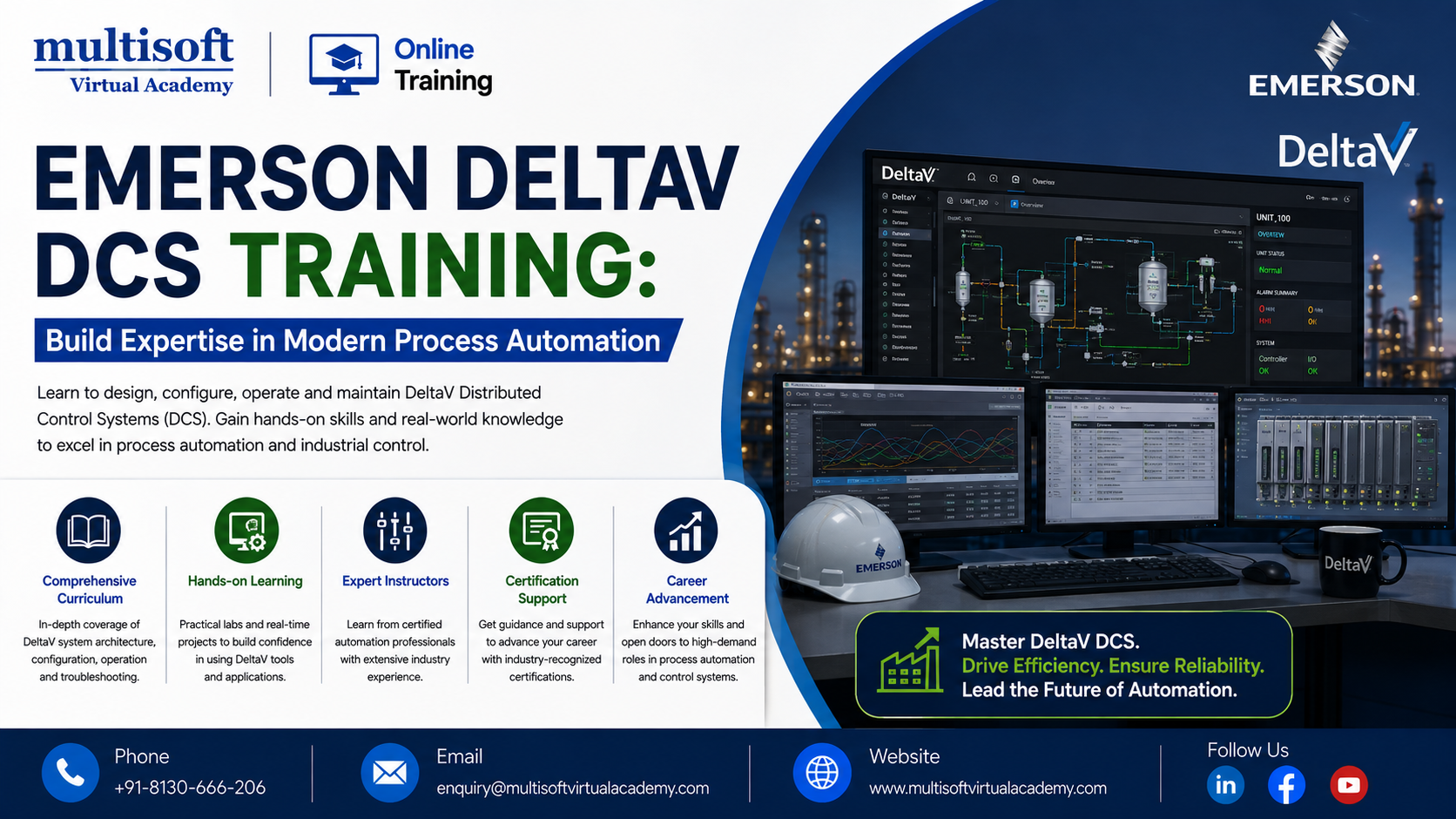
Industrial automation is evolving rapidly as manufacturers and process industries demand greater efficiency, reliability, safety and real-time visibility. Distributed Control Systems (DCS) have become a critical part of modern process automation because they enable organizations to monitor, control and optimize complex industrial operations.
Among the widely adopted process automation technologies, Emerson DeltaV DCS stands out as a modern platform designed for scalable control, engineering, operations management and plant-wide integration. Emerson describes DeltaV as a flexible automation platform that combines DCS capabilities with other technologies including safety systems, SCADA, operations management and analytics.
For engineers, automation professionals and control-system specialists, Emerson DeltaV DCS Training can provide a structured path to understanding DeltaV architecture, configuration, control strategies, operator interfaces and system integration.
Emerson DeltaV DCS Training is a distributed control system designed primarily for process industries. Unlike a conventional centralized control architecture, a DCS distributes control functions across interconnected controllers and systems while providing centralized visibility and management.
DeltaV supports applications across industries such as chemicals, life sciences, LNG, food and beverage, metals and mining and other process-intensive environments. Emerson also highlights its use in emerging applications such as data center infrastructure.
A typical DeltaV environment can involve controllers, I/O systems, engineering tools, operator interfaces, process control strategies, alarms, historians, safety systems and enterprise-level data integration.
This broad functionality makes DeltaV DCS Training valuable for professionals who want to develop practical knowledge of modern industrial automation.
Working with a DCS requires more than understanding basic automation concepts. Professionals need to know how control strategies are designed, configured, tested, monitored and maintained.
A structured Emerson DeltaV Training program can help learners develop knowledge in areas such as:
Emerson itself offers DeltaV education across different delivery methods, including online learning, virtual classrooms, blended learning, instructor-led training and onsite programs. Its training curriculum also includes pathways for roles such as control system engineers, control system administrators and operators.
A comprehensive DeltaV DCS Course should progress from fundamental concepts to practical engineering and operational skills.
The first step is understanding the overall architecture. Learners should become familiar with controllers, I/O, workstations, servers, communication networks and engineering environments.
Understanding how these components interact helps professionals troubleshoot systems more effectively and design scalable automation solutions.
Control modules form an important part of process control implementation. Training can introduce learners to module structures, parameters, control logic and reusable engineering approaches.
Practical exercises can help participants understand how control strategies are developed and tested before deployment.
A strong DeltaV Process Control Training program should cover fundamental control concepts such as feedback control, PID control, interlocks, sequences and process logic.
Participants can learn how control strategies translate process requirements into executable automation logic.
Industrial plants depend on reliable communication between field devices and control systems. Training should therefore explain I/O concepts, signal types, device integration and system configuration.
Emerson's current DeltaV ecosystem emphasizes seamless connectivity between sensors, controllers and applications, supporting real-time data availability across the automation environment.
Modern operators need clear and actionable information to respond quickly to changing process conditions.
DeltaV Live is Emerson's operator interface environment and uses HTML5-based graphics with tools designed to simplify configuration and improve operator interaction.
Training can introduce participants to graphic development, navigation, alarm displays, process visualization and operator-oriented design principles.
Effective alarm management is essential for maintaining safe and stable operations. Professionals should understand how alarms are configured, displayed and investigated.
Hands-on troubleshooting scenarios can help learners identify configuration issues, communication problems and abnormal process conditions.
A DeltaV Control System Training program should also address administration because automation environments require appropriate configuration, access management, backups and system maintenance.
Professionals working as control system administrators can benefit from understanding system architecture, workstation configuration, user management and operational support.
Industrial automation is increasingly moving toward connected, data-driven operations. Modern control systems are no longer isolated platforms. They increasingly connect plant-floor information with analytics, enterprise applications and operational decision-making.
Emerson's current DeltaV platform emphasizes this broader approach by integrating control, safety, operations management, SCADA and analytics capabilities.
This trend creates demand for professionals who understand both traditional process control principles and modern automation technologies.
Consequently, Industrial Automation Training and Distributed Control System Training are becoming increasingly relevant for engineers seeking to strengthen their technical profiles.
One of the notable developments in modern automation is the movement toward software-defined control. Emerson's DeltaV IQ Controller represents this direction by separating control software from traditional dedicated controller hardware and using server-based computing infrastructure.
This development highlights why continuous learning is important for automation professionals. Engineers increasingly need to understand virtualization, scalable architectures and software-centric automation environments.
Artificial intelligence and advanced analytics are also influencing industrial automation. DeltaV's current ecosystem includes AI-related capabilities intended to support productivity and intelligent operations.
Professionals who combine DCS knowledge with data analytics, AI and process optimization skills can be better prepared for the changing requirements of smart manufacturing.
Modern plants require integration between DCS, PLCs, safety systems, historians, SCADA platforms and other industrial technologies.
For example, Emerson documents DeltaV PLC integration with DeltaV DCS through OPC UA using the Ethernet I/O Card, demonstrating how modern automation architectures can connect different control technologies.
DeltaV DCS Training can be relevant to a wide range of technical professionals, including:
The ideal training level depends on the learner's existing experience. Beginners may start with DCS fundamentals and process control concepts, while experienced professionals may focus on configuration, administration, advanced control and troubleshooting.
Developing DeltaV skills can support career growth in several areas of industrial automation.
Professionals may pursue roles such as:
DeltaV DCS Engineer: Responsible for system configuration, control strategies, integration and technical support.
Process Control Engineer: Focuses on control strategies, optimization and process performance.
Automation Engineer: Works across DCS, PLC, instrumentation and industrial communication systems.
Control System Administrator: Supports system infrastructure, configuration, access management and maintenance.
Commissioning Engineer: Helps test, validate and commission automation systems at industrial facilities.
DCS Maintenance Engineer: Diagnoses system problems and supports reliable plant operation.
Because DeltaV is used across diverse process industries, the knowledge can be relevant to multiple industrial environments.
Not every DeltaV Training Online program offers the same learning experience. Before selecting a course, professionals should evaluate several factors.
Choose training that includes practical configuration exercises, troubleshooting scenarios and real-world process examples rather than only theoretical explanations.
The trainer should have relevant experience in DCS engineering, process control, commissioning or industrial automation.
The course should reflect current automation practices and address modern DeltaV capabilities where appropriate.
Online instructor-led, virtual classroom, blended and onsite options can make training accessible to professionals working full time.
A control engineer may require different skills from an operator or system administrator. Role-specific learning paths can make training more relevant and effective.
The future of industrial automation will increasingly involve connected systems, advanced analytics, AI-assisted operations, cybersecurity, virtualization and integrated control environments.
At the same time, fundamental process control knowledge will remain essential. Automation professionals need to understand how processes behave, how control strategies work and how systems should be configured and maintained.
DeltaV's evolution toward scalable architectures, advanced operator experiences, integrated data connectivity and software-defined control demonstrates how modern DCS technology is expanding beyond conventional process control.
Therefore, learning DeltaV should not be viewed simply as acquiring knowledge of one software platform. It can also provide practical exposure to broader concepts in process automation and industrial control.
For professionals seeking to strengthen their capabilities in process automation, Emerson DeltaV DCS Training offers a structured way to build knowledge of DCS architecture, control strategies, configuration, operator interfaces, troubleshooting and modern automation practices. As industrial facilities continue moving toward connected, intelligent and scalable operations, these skills can become increasingly valuable. Multisoft Virtual Academy provides professional learning solutions designed to help learners develop practical and career-focused expertise in DeltaV DCS, industrial automation and process control through structured training delivered by experienced professionals.
| Start Date | Time (IST) | Day | |||
|---|---|---|---|---|---|
| 10 Oct 2026 | 06:00 PM - 10:00 AM | Sat, Sun | |||
| 11 Oct 2026 | 06:00 PM - 10:00 AM | Sat, Sun | |||
| 17 Oct 2026 | 06:00 PM - 10:00 AM | Sat, Sun | |||
| 18 Oct 2026 | 06:00 PM - 10:00 AM | Sat, Sun | |||
|
Schedule does not suit you, Schedule Now! | Want to take one-on-one training, Enquiry Now! |
|||||






 Join our Live Instructor-Led online classes delivered by industry experts
 Let's Get Started