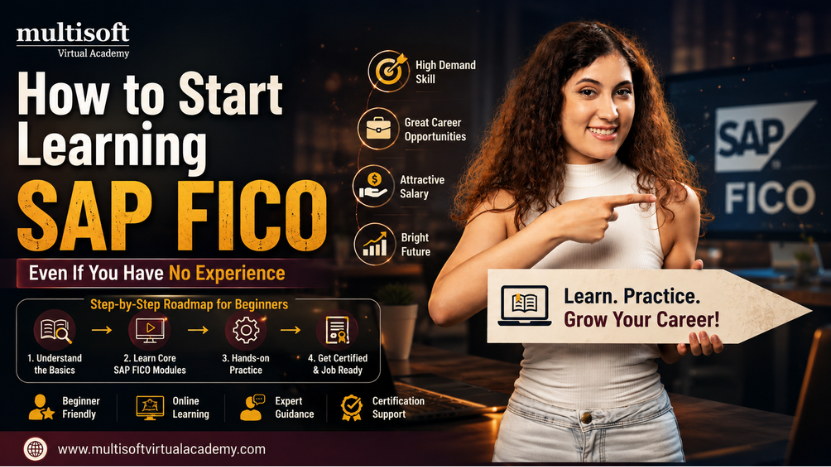
The demand for professionals with SAP skills continues to grow as organizations across industries adopt digital solutions to improve financial management and business operations. Among the various SAP modules, SAP FICO (Financial Accounting and Controlling) remains one of the most sought-after because it helps businesses manage accounting, financial reporting, cost control, and decision-making efficiently. If you are wondering whether you can learn SAP FICO without any prior experience, the answer is yes. Whether you are a student, a recent graduate, a finance professional, or someone planning a career change, learning SAP FICO is achievable with the right guidance and practical approach. You do not need years of experience to begin.
By understanding the fundamentals, following a structured learning path, and gaining hands-on practice, you can build the skills employers look for. This guide explains how to start learning SAP FICO from scratch and prepares you for a successful career in the SAP ecosystem.
SAP FICO is one of the core functional modules of SAP ERP that helps organizations manage their financial accounting and controlling processes. The term SAP FICO combines two important modules: Financial Accounting (FI) and Controlling (CO). The FI module records and manages financial transactions such as accounts payable, accounts receivable, general ledger, asset accounting, and financial reporting. The CO module focuses on internal cost management, budgeting, profitability analysis, and performance monitoring.
Businesses worldwide rely on SAP FICO to maintain accurate financial records, comply with accounting standards, and improve financial decision-making. Since SAP FICO integrates with other SAP modules such as SAP MM, SAP SD, SAP PP, and SAP HCM, professionals with SAP FICO knowledge play an important role in ensuring smooth business operations. Learning SAP FICO provides valuable knowledge of enterprise finance systems and opens opportunities across industries, including manufacturing, healthcare, banking, retail, IT services, and consulting.
Digital transformation continues to reshape the finance industry, and organizations are increasingly investing in intelligent ERP solutions such as SAP S/4HANA. As businesses modernize their financial operations, the need for skilled SAP FICO professionals continues to rise. Learning SAP FICO in 2026 equips you with practical skills that remain relevant in today's competitive job market while preparing you for future technological advancements.
A finance or accounting background is helpful but not mandatory for learning SAP FICO. Many successful SAP consultants have entered the field from technical, business, or management backgrounds. However, having a basic understanding of accounting concepts such as journal entries, balance sheets, profit and loss statements, assets, liabilities, and cost centers can make the learning process easier. Beginners without accounting knowledge can start by learning these fundamentals through online tutorials or introductory accounting courses before moving to SAP FICO. Most professional SAP FICO training programs include foundational accounting concepts to help learners understand how business transactions are processed within SAP. With consistent learning, practical exercises, and hands-on system practice, anyone can build the required knowledge and become proficient in SAP FICO regardless of their previous educational background.
Although no advanced technical expertise is required, developing the following skills can make your learning journey smoother:
Learning SAP FICO becomes much easier when you follow a structured roadmap instead of trying to learn everything at once. Start by building a strong understanding of accounting principles, including general ledger, accounts payable, accounts receivable, and financial reporting. Once your accounting foundation is clear, begin learning SAP navigation and understand how SAP ERP works. Next, study the SAP FI module, followed by the SAP CO module, while practicing each topic in a training environment. Learn how different SAP modules integrate with each other and understand real-world business scenarios. After completing the fundamentals, work on practical exercises, configuration examples, and mini-projects that simulate actual business processes. Once you gain confidence, prepare for SAP certification by reviewing important concepts, solving practice questions, and participating in mock interviews. Finally, build a professional resume highlighting your SAP skills and apply for internships, entry-level SAP consultant roles, or implementation projects to gain practical industry experience.
The quality of your learning resources significantly impacts your SAP FICO journey. Choose structured training programs that combine theoretical concepts with practical exercises and real-world business scenarios. Instructor-led live training allows learners to interact with experienced SAP consultants, ask questions, and understand complex topics more effectively. Official SAP documentation provides accurate technical information, while SAP Learning Hub, online tutorials, webinars, and community forums help reinforce concepts. Reading SAP books, following experienced consultants on professional networking platforms, and watching demonstrations of SAP business processes can also improve understanding. Most importantly, practice regularly in an SAP system to gain confidence. Consistent learning from trusted resources ensures better retention of concepts and prepares you for certification and real-world implementation projects.
SAP FI manages external financial reporting and accounting activities. It records all financial transactions and ensures compliance with accounting standards.
SAP CO focuses on internal financial planning, cost control, budgeting, and profitability analysis to help management make informed business decisions.
Major Components:
Practical experience is one of the most important factors in mastering SAP FICO. Simply reading theory is not enough because employers expect candidates to understand how financial transactions are processed within an SAP environment. Practice creating company codes, posting journal entries, managing vendor and customer transactions, configuring organizational structures, and generating financial reports. Work on sample implementation scenarios, complete mini-projects, and explore integration with modules such as SAP MM and SAP SD. Regular hands-on practice helps improve confidence, strengthens problem-solving skills, and prepares you for real implementation projects and technical interviews. The more business scenarios you practice, the easier it becomes to understand how SAP supports financial processes in large organizations.
Many beginners start learning SAP FICO by memorizing transaction codes without understanding the underlying business processes. This often creates confusion when dealing with practical scenarios. Another common mistake is ignoring basic accounting concepts and jumping directly into SAP configuration. Learners also tend to rely only on video tutorials without practicing in a live SAP environment. Skipping revision, avoiding practical assignments, and not learning module integration can limit career growth. Some candidates focus only on certification preparation instead of developing practical implementation skills. To succeed, maintain consistency, practice regularly, ask questions whenever concepts are unclear, and focus on understanding business processes rather than simply remembering system steps.
SAP FICO certification validates your knowledge of financial accounting and controlling processes within the SAP ecosystem. While certification is not mandatory for every SAP job, it significantly improves your credibility and increases your chances of getting shortlisted by employers. Before attempting certification, ensure you have a strong understanding of SAP FI and SAP CO concepts, organizational structure, master data, financial postings, reporting, and business processes. Enrolling in a professional SAP FICO training program that includes instructor-led sessions, practical exercises, mock tests, and interview preparation can greatly improve your readiness. Along with certification, practical implementation knowledge and project experience remain key factors in building a successful SAP career. Employers often value candidates who can confidently apply SAP FICO concepts to solve real business challenges.
SAP FICO professionals are in demand across industries because financial management is an essential function for every organization. After completing SAP FICO training and gaining practical knowledge, learners can explore opportunities with IT consulting firms, manufacturing companies, banking institutions, healthcare organizations, retail businesses, government enterprises, and multinational corporations. As businesses continue migrating to SAP S/4HANA, professionals with SAP FICO expertise can participate in implementation, support, migration, and optimization projects. With experience and certification, professionals can progress into senior consulting, solution architecture, project management, or finance transformation leadership roles.
Starting your SAP FICO learning journey without experience may seem challenging at first, but with the right approach, it is completely achievable. Focus on understanding accounting fundamentals, follow a structured learning roadmap, practice regularly in an SAP environment, and strengthen your knowledge through real-world business scenarios. Building practical skills alongside theoretical knowledge will help you gain confidence and improve your career prospects in the growing SAP ecosystem. As organizations continue adopting SAP S/4HANA for financial transformation, skilled SAP FICO professionals will remain in high demand across industries worldwide.
If you are ready to begin your SAP career, Multisoft Virtual Academy offers industry-focused SAP FICO Online Training with experienced instructors, live interactive sessions, hands-on projects, certification guidance, and placement support. Whether you are a beginner or a working professional, the comprehensive training program is designed to help you develop practical SAP FICO skills and prepare for real-world implementation projects with confidence.
| Start Date | Time (IST) | Day | |||
|---|---|---|---|---|---|
| 10 Oct 2026 | 06:00 PM - 10:00 AM | Sat, Sun | |||
| 11 Oct 2026 | 06:00 PM - 10:00 AM | Sat, Sun | |||
| 17 Oct 2026 | 06:00 PM - 10:00 AM | Sat, Sun | |||
| 18 Oct 2026 | 06:00 PM - 10:00 AM | Sat, Sun | |||
|
Schedule does not suit you, Schedule Now! | Want to take one-on-one training, Enquiry Now! |
|||||






 Join our Live Instructor-Led online classes delivered by industry experts
 Let's Get Started