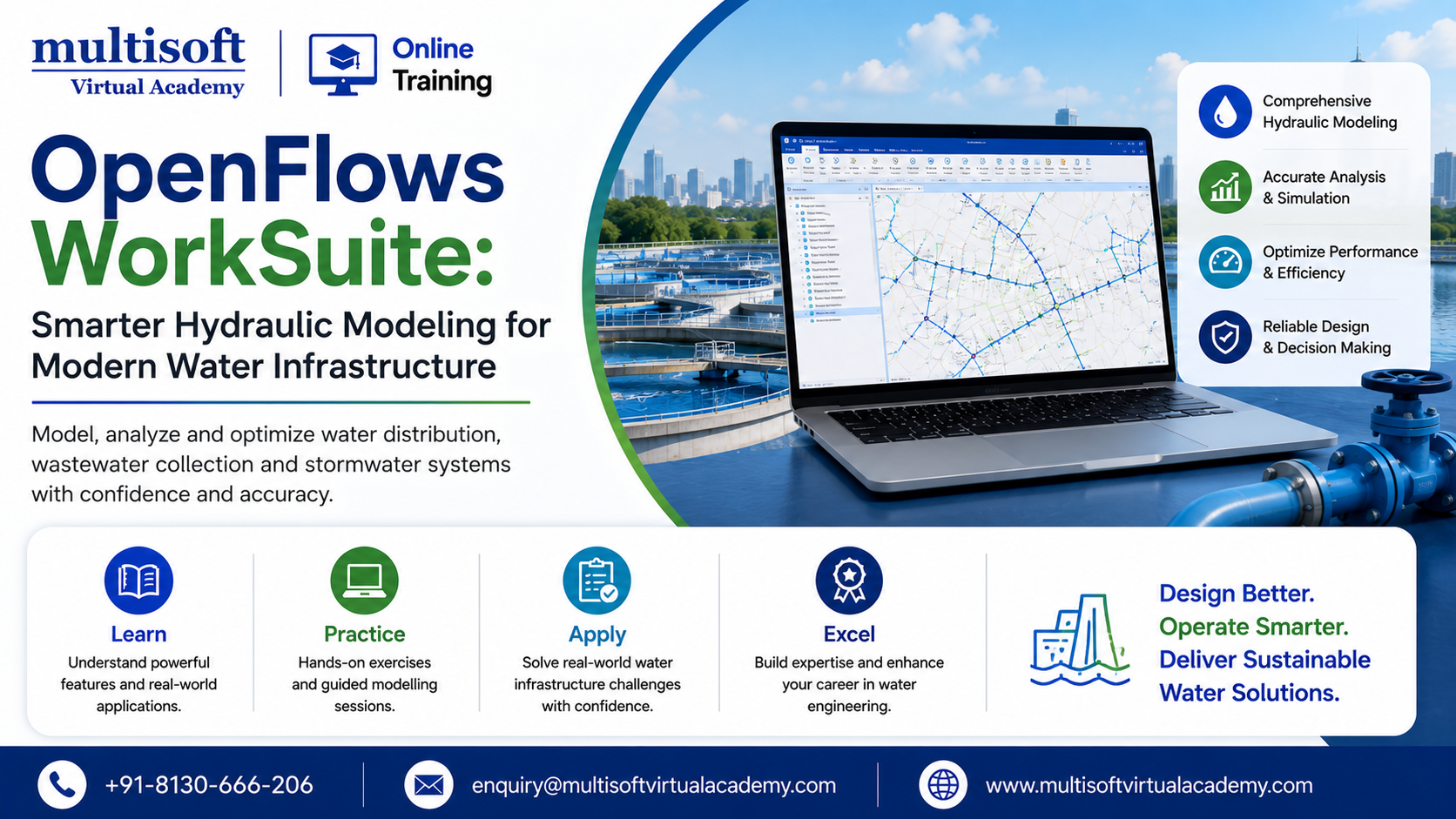
Water infrastructure projects are becoming more complex as cities expand, populations grow and environmental requirements become stricter. Engineers and utilities need reliable digital tools to plan, design, analyze and optimize water and wastewater networks with greater accuracy. OpenFlows WorkSuite brings together powerful hydraulic and hydrologic capabilities to support these demanding engineering workflows.
From water distribution network modeling to sanitary sewer analysis, hydraulic simulation and infrastructure planning, OpenFlows WorkSuite can help engineering teams make better-informed decisions. Bentley describes the suite as a solution for planning, designing and analyzing water distribution, sanitary and combined sewer systems.
OpenFlows WorkSuite is a Bentley infrastructure engineering software package designed for professionals working on water and wastewater systems. It combines OpenFlows Water and OpenFlows Sewer, allowing engineers to address water distribution and sewer modeling requirements within a broader hydraulic and hydrologic workflow.
The suite is available in three principal configurations:
The Standard configuration includes OpenFlows Water Standard with WaterCAD and HAMMER capabilities together with OpenFlows Sewer Standard using SewerCAD. Advanced and Ultimate configurations provide expanded OpenFlows Water and OpenFlows Sewer capabilities, including WaterGEMS, HAMMER and SewerGEMS.
Traditional calculations and spreadsheets can be useful for smaller engineering tasks, but modern water infrastructure projects often involve thousands of interconnected components. A change in one part of a network can affect pressure, flow, velocity and system performance elsewhere.
Hydraulic modeling software provides engineers with a structured environment for representing these systems digitally. Engineers can build network models, evaluate different scenarios and understand how infrastructure may perform under varying operating conditions.
This is particularly important when planning:
A well-developed hydraulic model can help engineering teams identify potential bottlenecks, evaluate capacity and compare alternative designs before costly physical changes are made.
One of the major strengths of OpenFlows WorkSuite is its ability to support multiple stages of water infrastructure engineering.
Water distribution modeling is essential for understanding how water moves through pipes, pumps, valves, tanks and other network components.
OpenFlows Water provides capabilities for analyzing and optimizing water distribution systems, including workflows involving fire flow, water quality, energy consumption and capital cost management. It also supports geospatial model development and interoperability with other engineering environments.
Engineers can use these capabilities to examine system behavior and assess whether a proposed network can satisfy operational requirements.
WaterGEMS is an important technology within the OpenFlows Water portfolio. It supports advanced water distribution modeling and can be used to investigate complex network conditions.
For engineering professionals, understanding WaterGEMS can be valuable when projects require more sophisticated analysis than basic network calculations. Areas of interest may include pressure management, network optimization, demand scenarios, system calibration and operational planning.
Pressure surges and transient events can create significant risks within water systems. Pump operations, valve closures and other changes can produce rapid pressure variations that need to be evaluated during system design.
HAMMER functionality within OpenFlows Water helps engineers analyze these transient conditions. Bentley's current product structure incorporates HAMMER capabilities into OpenFlows Water across its Standard, Advanced and Ultimate tiers.
This makes transient analysis an important topic for professionals working with pumping systems, long pipelines and complex water distribution infrastructure.
Wastewater collection systems require different modeling considerations from pressurized water distribution networks. Engineers need to understand flow conditions, network capacity, wet-weather behavior and potential flooding risks.
OpenFlows Sewer provides tools for analyzing, designing and operating sanitary and combined sewer systems. Bentley also highlights capabilities for wet-weather calibration, scenario analysis, SCADA integration and 1D/2D hydraulic analysis for understanding flood depth, velocity, hazard and inundation times.
These capabilities make SewerGEMS and SewerCAD relevant technologies for professionals involved in wastewater collection and sewer infrastructure projects.
Stormwater management is another critical component of resilient infrastructure planning. Heavy rainfall, changing development patterns and aging drainage systems can increase pressure on existing infrastructure.
While OpenFlows WorkSuite focuses on OpenFlows Water and OpenFlows Sewer, Bentley's wider OpenFlows portfolio also includes OpenFlows Storm and OpenFlows FLOOD for stormwater and flood-related analysis.
Understanding the broader OpenFlows ecosystem can therefore help engineering professionals select appropriate tools for water, wastewater, drainage and flood-related projects.
The value of OpenFlows WorkSuite extends beyond individual modeling functions. A structured digital modeling workflow can help engineering teams improve consistency and evaluate alternatives more effectively.
Engineers can compare different network configurations and operating scenarios before finalizing infrastructure designs. This can support more informed decisions around pipe sizing, system capacity and network improvements.
What-if analysis is particularly valuable in infrastructure planning. Teams can investigate potential changes in demand, network configuration, operating conditions or development requirements and compare the resulting outcomes.
A hydraulic model provides a digital representation of a physical system. This can help engineers understand relationships between network components and identify areas that may require additional investigation.
Water infrastructure requires long-term investment and maintenance. Bentley highlights asset management and capital cost management capabilities within its OpenFlows Water workflows, helping organizations consider both technical and financial factors during planning.
Modern engineering projects rarely exist inside a single software environment. OpenFlows WorkSuite can operate as a standalone application and within platforms including ArcGIS, ArcGIS Pro, MicroStation and AutoCAD, along with several Bentley design environments.
This interoperability can be particularly useful for organizations working with GIS, CAD and infrastructure design data.
Software is only as effective as the people using it. Engineers who understand hydraulic modeling principles and the capabilities of OpenFlows tools can build more reliable workflows and interpret model results more effectively.
An OpenFlows WorkSuite training program can be valuable for:
A well-structured learning program should combine software functionality with practical engineering concepts. Simply learning where tools are located is not enough. Professionals should understand how to create a model, define appropriate inputs, analyze results, validate assumptions and communicate engineering conclusions.
A comprehensive OpenFlows WorkSuite course can include several progressive learning areas.
Learners should first understand the fundamentals of hydraulic networks, including pipes, nodes, pumps, valves, tanks, reservoirs, demands, pressure and flow.
The next stage can focus on creating and analyzing water distribution models using OpenFlows Water and related capabilities.
Advanced learners can explore network analysis, model calibration, scenario management, optimization and other WaterGEMS-oriented workflows.
Training can introduce pressure surge concepts and demonstrate how HAMMER functionality can be applied to transient modeling.
Learners can develop sanitary and combined sewer models and understand the fundamental principles behind wastewater collection system analysis.
Model results should not simply be accepted without examination. Training should emphasize data quality, calibration, validation and engineering judgment.
Realistic exercises can help learners understand how hydraulic modeling is applied to actual engineering challenges rather than learning software commands in isolation.
The increasing importance of resilient water infrastructure is creating demand for professionals with specialized engineering and digital modeling skills.
Knowledge of OpenFlows WorkSuite, WaterGEMS, SewerGEMS, hydraulic modeling and water infrastructure design can strengthen the technical profile of professionals pursuing roles such as:
Professionals who combine domain knowledge with digital engineering capabilities can be better positioned to contribute to multidisciplinary infrastructure projects.
When selecting OpenFlows WorkSuite training online, professionals should evaluate more than course duration. The quality of the learning experience depends on the depth of practical coverage and the expertise of the trainer.
Look for training that provides:
Professionals should also consider whether the program matches their career objectives. Someone working primarily with municipal water distribution may require deeper WaterGEMS exposure, while a wastewater professional may need greater emphasis on SewerGEMS and sewer network analysis.
The water sector is increasingly moving toward connected, data-driven infrastructure management. Hydraulic models are becoming more than design tools - they can contribute to planning, operational decision-making and long-term infrastructure strategies.
Bentley's wider OpenFlows portfolio includes technologies such as OpenFlows WaterSight, which is positioned as a digital twin solution for bringing together different data sources to support smarter and more resilient water systems.
This broader direction shows why professionals should consider hydraulic modeling as part of a larger digital engineering skill set. Knowledge of network modeling, GIS integration, data interpretation and infrastructure analytics can become increasingly valuable as utilities modernize their operations.
OpenFlows WorkSuite offers a comprehensive environment for professionals involved in water distribution and wastewater infrastructure planning, design and analysis. Its combination of OpenFlows Water and OpenFlows Sewer provides a practical foundation for addressing diverse hydraulic and hydrologic engineering requirements, while related technologies such as WaterGEMS, HAMMER, SewerGEMS and broader OpenFlows solutions expand the possibilities for advanced analysis. For professionals who want to build practical expertise and organizations seeking specialized learning support, Multisoft Virtual Academy provides professional training services designed to help learners develop relevant software and engineering skills for modern infrastructure projects.
| Start Date | Time (IST) | Day | |||
|---|---|---|---|---|---|
| 10 Oct 2026 | 06:00 PM - 10:00 AM | Sat, Sun | |||
| 11 Oct 2026 | 06:00 PM - 10:00 AM | Sat, Sun | |||
| 17 Oct 2026 | 06:00 PM - 10:00 AM | Sat, Sun | |||
| 18 Oct 2026 | 06:00 PM - 10:00 AM | Sat, Sun | |||
|
Schedule does not suit you, Schedule Now! | Want to take one-on-one training, Enquiry Now! |
|||||






 Join our Live Instructor-Led online classes delivered by industry experts
 Let's Get Started