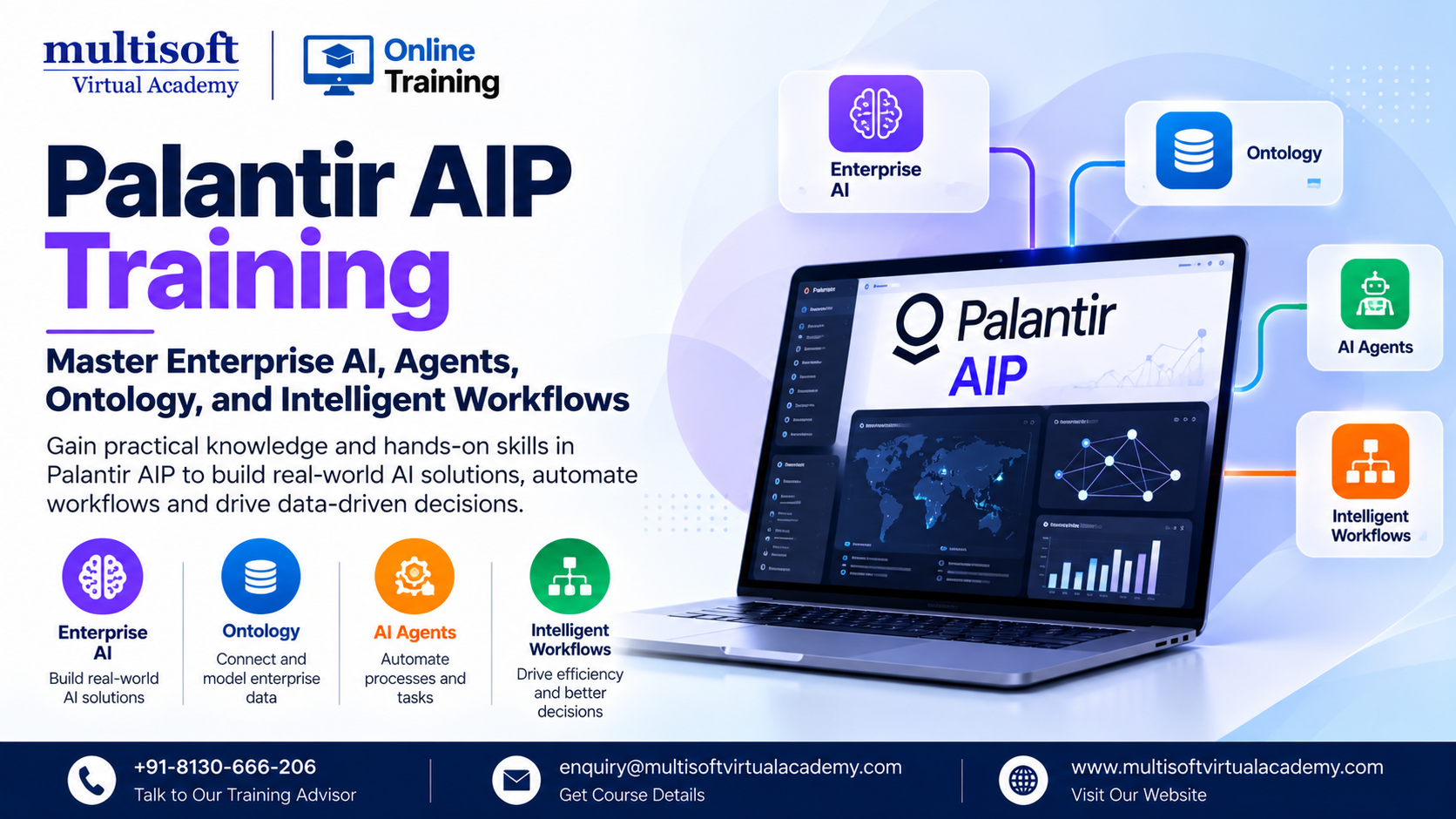
Artificial intelligence is moving beyond standalone chatbots and predictive models toward systems that can understand enterprise data, reason over business context, interact with applications, and support real-world decisions. This shift has increased interest in platforms that connect generative AI with governed enterprise data and operational workflows.
Palantir AIP Training is increasingly relevant for professionals who want to understand how enterprise AI applications, AI agents, large language models, data, and business processes can work together. Palantir describes AIP as its generative AI platform, providing capabilities for secure LLM connectivity, agent development, AI-enabled applications, and AI workflow governance.
For professionals working in artificial intelligence, data engineering, application development, analytics, or digital transformation, learning Palantir AIP can provide practical exposure to an enterprise-oriented approach to AI implementation.
Palantir Artificial Intelligence Platform, commonly called Palantir AIP, is designed to help organizations apply generative AI to operational and enterprise use cases.
Unlike a basic generative AI application that simply sends prompts to a language model, AIP connects AI capabilities with enterprise data, the Palantir Ontology, applications, workflows, and controlled actions.
This architecture makes it possible to develop AI solutions that are more closely connected to an organization's actual business environment.
AIP can support areas such as:
Palantir's current documentation also highlights AIP Analyst, which allows users to explore Ontology data conversationally, perform analysis, create visualizations, and work with files and enterprise information.
The enterprise AI landscape is changing rapidly. Organizations are no longer interested only in experimenting with generative AI; they increasingly want AI solutions that can operate within existing data, security, and business processes.
This is where Palantir AIP Training can become valuable.
A structured learning program can help professionals understand how to move from an AI idea to a practical enterprise workflow. Instead of studying AI concepts in isolation, learners can explore how models, data, agents, Ontology objects, applications, and business actions interact.
Palantir's own educational material recommends learning Foundry and AIP concepts before progressing into practical workflows. Its introductory learning path includes foundational material, use-case scoping, and a hands-on workflow for creating an AI assistant.
Professionals can use AIP-focused training to develop skills in:
These skills are particularly relevant as companies move toward AI-powered operations rather than isolated AI experiments.
One of the most important concepts to understand when learning Palantir AIP is the Ontology.
In simple terms, an enterprise may have large volumes of data distributed across databases, applications, documents, and operational systems. Raw data alone does not necessarily provide enough context for an AI system to understand how business entities relate to each other.
The Ontology provides a business-oriented representation of real-world objects, relationships, actions, and processes.
This can help connect enterprise information with operational workflows.
For example, a manufacturing organization could represent:
An AI application can then use these connected business concepts to provide more contextual answers and support operational decisions.
Palantir describes Foundry as providing an Ontology layer that maps data to real-world concepts, while AIP provides generative AI and agent capabilities on top of the broader platform architecture.
AI agents are becoming one of the most important areas in enterprise artificial intelligence.
Traditional software usually waits for explicit instructions from users. An AI agent can interpret a goal, reason about available information, use tools, and perform defined actions within permitted boundaries.
Palantir AIP Training can introduce learners to the concepts behind building and deploying such AI-powered workflows.
Current Palantir capabilities include tools for building, configuring, and shipping pro-code agents. These agents can work with Foundry data and tools, interact with Ontology resources, and authenticate through scoped permissions.
This makes agent development particularly relevant for professionals interested in:
A traditional chatbot may primarily generate text based on a user's prompt.
An enterprise AI agent can potentially do much more. Depending on its configuration and permissions, it can retrieve relevant information, interact with enterprise objects, invoke actions, and support business workflows.
This difference is important because organizations increasingly want AI that can do useful work, rather than simply generate responses.
Generative AI is another major component of the modern AIP ecosystem.
AIP provides access to different large language models and model providers, allowing organizations to use models according to their technical, operational, security, and performance requirements.
Recent AIP updates demonstrate how quickly this ecosystem is evolving. Palantir's 2026 documentation lists support for multiple model families and providers, including OpenAI, Anthropic, Google, xAI, and others depending on enrollment and configuration.
For learners, this highlights an important concept: enterprise AI is not necessarily about depending on one model. Instead, professionals need to understand how models can be selected, connected, evaluated, governed, and applied to specific business requirements.
A comprehensive Palantir AIP Training program should cover both conceptual knowledge and practical application.
Learners should first understand the relationship between Foundry and AIP, including the role of data, Ontology, applications, AI models, and workflows.
The curriculum can introduce:
Ontology fundamentals should form an important part of the learning journey.
Topics may include:
Learners should understand how AI capabilities can be incorporated into enterprise applications and workflows.
Practical learning can include agent configuration, tool usage, permissions, contextual information, workflow execution, and testing.
AIP Analyst is particularly relevant for professionals interested in conversational analytics. Palantir states that it can search the Ontology, transform and analyze object sets, execute SQL queries, create visualizations, analyze files, and support actions and functions.
Enterprise AI needs more than model capability. Learners should understand:
Hands-on projects can help learners understand how AIP concepts translate into business scenarios.
The potential applications of enterprise AI extend across multiple industries.
AIP-based solutions can help organizations analyze production information, identify operational issues, support maintenance workflows, and provide contextual insights.
AI applications can assist with information discovery, operational analysis, resource planning, and workflow support while operating within appropriate governance controls.
Organizations can use connected enterprise data to understand suppliers, inventory, logistics, demand, and operational risks.
AI can support areas such as risk analysis, customer operations, reporting, investigation, and decision support.
Enterprise AI can be applied to asset monitoring, maintenance planning, operational analysis, and resource management.
AI systems can help authorized users work with complex operational information and support mission-oriented workflows subject to strict security and governance requirements.
Another emerging area worth understanding is the relationship between AIP and the Model Context Protocol (MCP).
MCP provides a standardized way for AI agents to interact with external resources and tools. Palantir's Ontology MCP enables compatible AI agents and frameworks to interact with exposed Ontology resources, including objects, actions, and queries, according to configured permissions.
This is particularly important for developers building modern AI systems because enterprise AI increasingly involves connecting models and agents with trusted data and business tools.
Professionals interested in AI agent development, MCP, enterprise automation, and generative AI applications can therefore benefit from understanding how these technologies work together.
AIP-focused learning can be useful for several professional groups.
Data scientists can explore how AI models and enterprise data can be incorporated into operational applications.
Data engineers can strengthen their understanding of how integrated enterprise data supports AI applications and Ontology-driven workflows.
AI engineers can learn concepts related to agent development, LLM integration, AI applications, and enterprise workflows.
Developers can explore how applications can be built around enterprise objects, actions, APIs, and AI capabilities.
Business analysts can learn how natural-language interfaces and AI-powered analytics can support decision-making.
IT managers, architects, and digital transformation leaders can gain a better understanding of enterprise AI implementation and governance.
A strong learning program should combine platform knowledge with transferable AI skills.
Important capabilities include:
Enterprise AI: Understanding how generative AI fits into organizational systems.
AI Agents: Learning how agents can use context, tools, and enterprise resources.
LLM Applications: Understanding how large language models can support business processes.
Ontology: Learning how business concepts and relationships can be represented for AI-powered applications.
AI Automation: Identifying workflows where AI can reduce repetitive manual work.
Data Analysis: Using enterprise information to generate actionable insights.
AI Governance: Understanding security, permissions, evaluation, and responsible implementation.
Application Development: Connecting AI capabilities with operational interfaces and workflows.
As enterprise AI adoption grows, professionals with practical AI platform knowledge can explore opportunities across several technology roles.
Potential career paths include:
The exact role and compensation depend on professional experience, technical background, location, employer requirements, and practical project experience.
Importantly, Palantir's ecosystem is also placing greater emphasis on hands-on capabilities. In September 2026, Palantir announced Specialist Certification Exams focused on Data Engineer, Application Developer, and AI Engineer work in Foundry and AIP. The exams are hands-on and conducted in a real Foundry and AIP environment.
This reinforces the importance of practical skills rather than relying only on theoretical knowledge.
Before enrolling in a program, professionals should evaluate several factors.
A course should provide opportunities to work through realistic AI and enterprise use cases instead of focusing exclusively on definitions.
The curriculum should cover AIP, Ontology, AI agents, LLMs, enterprise AI workflows, applications, governance, and practical implementation.
Trainers with practical experience can explain not only how a feature works but also when and why it should be used.
Hands-on projects can help learners understand how different components work together.
A developer may need deeper technical content, while a business analyst may benefit from a more application- and workflow-oriented approach.
Enterprise AI platforms evolve quickly. Palantir's 2026 release notes show continuing additions across AIP, models, agents, MCP, analytics, and application development.
Continuous learning is therefore an important part of building long-term expertise.
The future of enterprise AI is likely to involve increasingly connected systems where AI models, enterprise data, business logic, applications, and automated actions work together.
The emergence of AI agents is an important part of this transition. Instead of simply asking an AI system for information, users may increasingly interact with AI systems that can investigate a situation, retrieve relevant data, recommend actions, and execute authorized workflows.
Recent developments around AIP agents, AIP Analyst, Ontology MCP, and AI-powered application development illustrate this direction.
For technology professionals, learning how these components fit together can provide a stronger foundation for working on enterprise AI projects.
Palantir AIP Training offers a practical path for professionals who want to understand enterprise generative AI, AI agents, Ontology-driven applications, LLM integration, intelligent automation, and modern AI workflows. As organizations continue moving from AI experimentation toward production-oriented solutions, professionals who can connect AI capabilities with real business data and operational processes can create meaningful value. For structured, practical learning and professional development in this area, Multisoft Virtual Academy can serve as a training provider for learners looking to strengthen their Palantir AIP and enterprise AI skills.
| Start Date | Time (IST) | Day | |||
|---|---|---|---|---|---|
| 10 Oct 2026 | 06:00 PM - 10:00 AM | Sat, Sun | |||
| 11 Oct 2026 | 06:00 PM - 10:00 AM | Sat, Sun | |||
| 17 Oct 2026 | 06:00 PM - 10:00 AM | Sat, Sun | |||
| 18 Oct 2026 | 06:00 PM - 10:00 AM | Sat, Sun | |||
|
Schedule does not suit you, Schedule Now! | Want to take one-on-one training, Enquiry Now! |
|||||






 Join our Live Instructor-Led online classes delivered by industry experts
 Let's Get Started