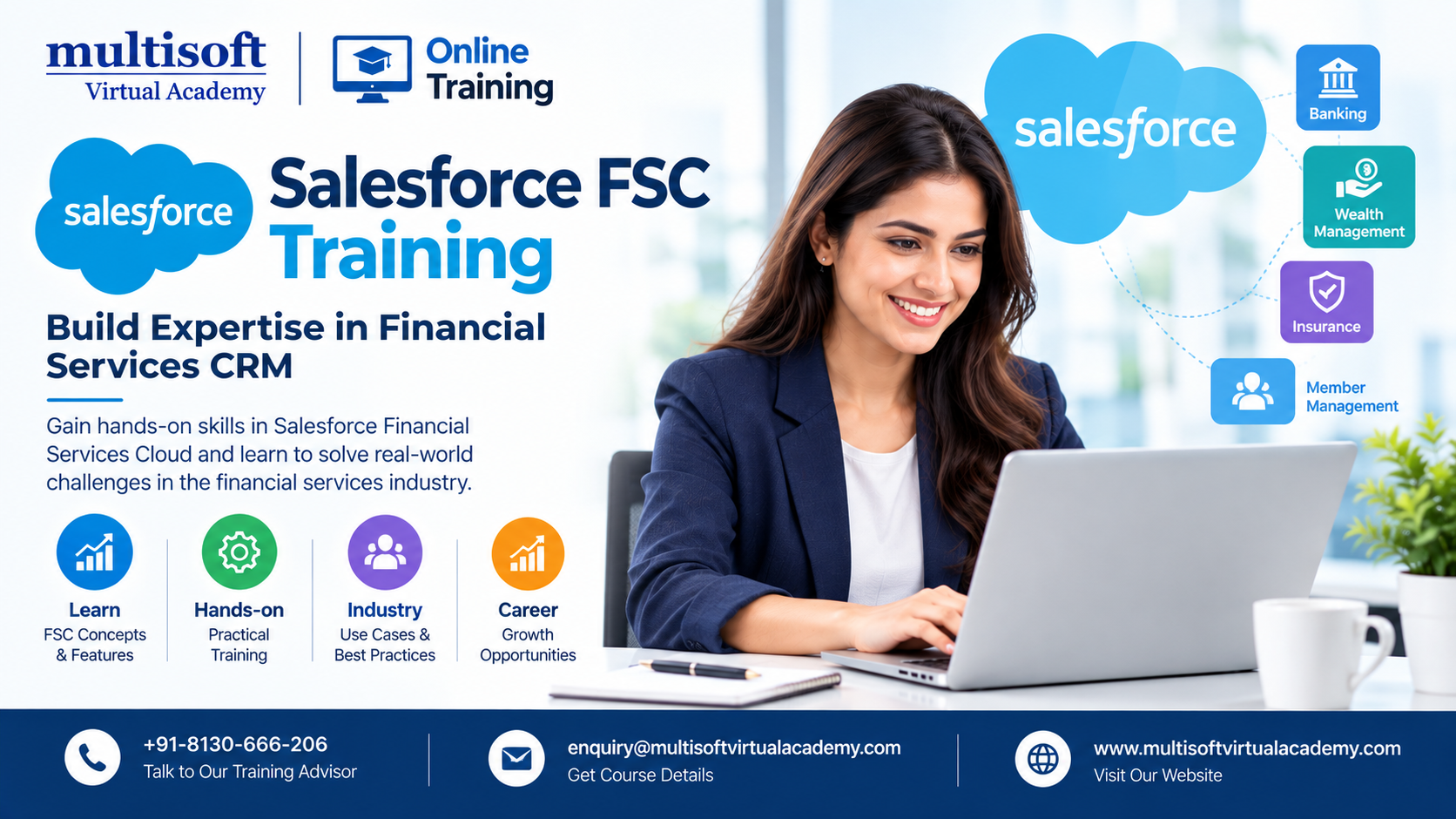
The financial services industry is rapidly moving toward connected, data-driven, and AI-enabled customer experiences. Banks, insurance companies, wealth management firms, lending organizations, and financial institutions increasingly need CRM platforms that understand the specific requirements of their industry. This is where Salesforce Financial Services Cloud, now positioned within Salesforce’s broader Financial Services and Agentforce strategy, becomes highly relevant.
Salesforce FSC Training helps professionals understand how to use industry-specific Salesforce capabilities for managing financial relationships, customer information, workflows, financial goals, service processes, and data-driven engagement. Salesforce describes Financial Services Cloud as a platform designed to unify customer experiences across banking, wealth management, insurance, and other financial services while supporting automation, AI, and connected data.
For professionals planning to develop expertise in financial services CRM, learning Salesforce FSC can provide a strong foundation for understanding how technology supports modern banking, insurance, investment, and wealth management operations.
Salesforce FSC Training is an industry-focused CRM solution designed to help financial organizations manage customer relationships and financial interactions through a connected platform.
Unlike a generic CRM approach, FSC provides capabilities tailored to financial services use cases. These include financial accounts, client relationships, household information, financial goals, relationship management, workflows, service processes, and industry-specific data models.
Salesforce also highlights the ability to connect information from banking, portfolio management, financial planning, insurance, and other systems, helping organizations create a more complete view of their customers.
This makes Salesforce Financial Services Cloud Training valuable for learners who want to understand how CRM technology can be adapted to complex financial environments.
Financial institutions handle large volumes of customer data, transactions, policies, financial products, service requests, and regulatory requirements. Traditional systems can create information silos that make it difficult for employees to access complete customer information.
Salesforce FSC addresses this challenge by bringing relevant information and workflows together.
A structured Salesforce FSC Training program can help professionals understand how to:
Salesforce's current Financial Services offering emphasizes unified data, industry-specific automation, AI-powered assistance, and purpose-built workflows for financial organizations.
A comprehensive Salesforce FSC Course should combine Salesforce fundamentals with financial-services-specific concepts. This helps learners move beyond theoretical CRM knowledge and understand how FSC can be applied in practical business environments.
Training generally begins with an introduction to Salesforce Financial Services Cloud, its architecture, terminology, applications, and role within financial organizations.
Learners can understand how FSC extends Salesforce capabilities for banking, insurance, wealth management, and related financial services operations.
Financial organizations need a consolidated understanding of their customers and their financial relationships.
Training can cover financial accounts, relationships, households, contacts, organizations, and other relevant data structures. Understanding these components is essential for building an effective customer-centric CRM environment.
Customer relationships in financial services are often more complex than conventional business relationships.
A single household may have multiple financial accounts, policies, investments, loans, and relationships with advisors or service representatives.
Salesforce FSC Training helps professionals understand how relationship information can be organized so financial professionals can work with a broader customer context.
Financial services organizations increasingly focus on customer objectives rather than individual products.
FSC supports financial goals and planning-related processes that help professionals understand customer objectives and deliver more personalized engagement.
This area is particularly relevant for wealth managers, financial advisors, relationship managers, and professionals working with investment or financial planning services.
Manual processes can reduce employee productivity and create inconsistent customer experiences.
FSC provides tools and workflows that can help financial organizations standardize recurring activities and automate parts of their service and relationship-management processes.
During Salesforce FSC Implementation Training, learners can benefit from understanding how business requirements are translated into workflows, automation, approvals, and user experiences.
Learning implementation concepts is one of the most valuable aspects of Salesforce Financial Services Cloud Training.
A successful implementation requires more than simply activating features. Organizations need to understand business processes, data structures, security requirements, integrations, user roles, automation, testing, and adoption.
Salesforce's current documentation recommends implementing most Financial Services capabilities directly on the core Salesforce platform, while managed packages may still be relevant for specific requirements.
A typical implementation approach may include:
Professionals who understand this complete lifecycle can contribute more effectively to Salesforce FSC projects.
Banking organizations manage multiple customer relationships, products, accounts, service interactions, and financial objectives.
Salesforce FSC can support a connected view of customers while enabling financial professionals to deliver more personalized engagement.
For banking professionals, Salesforce FSC Training can be useful for understanding areas such as:
Salesforce currently highlights banking-specific workflows, onboarding, relationship management, automation, and AI-enabled experiences as important parts of its financial services strategy.
Insurance organizations work with policyholders, producers, claims, policies, service requests, and multiple customer touchpoints.
A connected CRM can help employees access relevant customer information and coordinate service activities across different processes.
Salesforce Financial Services Cloud Training can help learners understand how Salesforce technologies can support insurance-related workflows, customer service, relationship management, and automation.
Salesforce's Financial Services platform also includes Digital Insurance capabilities covering areas such as digital quoting, policy management, claims management, and related insurance processes.
Wealth management requires strong relationship management because advisors often need a complete picture of a client's financial objectives, accounts, portfolio information, and interactions.
Professionals learning Salesforce FSC can explore how CRM capabilities support advisor productivity, client relationships, financial goals, and personalized engagement.
Current Salesforce capabilities also place greater emphasis on AI-powered advisor assistance, unified client information, and proactive insights for wealth management.
Artificial intelligence is changing how financial organizations interact with customers and employees.
Salesforce's current Financial Services strategy combines Financial Services Cloud with AI and Agentforce capabilities to support intelligent workflows, customer service, sales productivity, and financial-services-specific experiences.
This creates an important reason for professionals to understand both Salesforce FSC Training and emerging AI capabilities.
Future-focused FSC professionals may need knowledge of:
Salesforce's latest materials emphasize trusted AI, unified data, industry-specific workflows, and governance as important components of its financial services strategy.
A Salesforce FSC Course can be useful for professionals from different technical and business backgrounds.
It may be particularly relevant for:
Beginners can use structured training to build foundational knowledge, while experienced Salesforce professionals can use FSC training to specialize in the financial services domain.
The combination of Salesforce expertise and financial-services knowledge can open opportunities across CRM implementation, consulting, administration, development, and business analysis.
Depending on experience and technical background, learners may explore roles such as:
FSC administrators help configure and manage Salesforce environments according to organizational requirements.
Consultants analyze business requirements and help organizations design and implement Salesforce solutions for financial services.
Developers work on customization, integrations, automation, applications, and technical solutions within Salesforce environments.
Business analysts connect business requirements with Salesforce functionality and help teams design practical solutions.
Experienced professionals can progress toward architecture roles involving data, integration, security, scalability, and enterprise-level Salesforce strategy.
Not every training program provides the same depth of learning. Before selecting a Salesforce FSC Training program, learners should evaluate several factors.
The course should include practical examples and real-world financial services scenarios rather than relying entirely on theoretical explanations.
Review whether the program covers FSC fundamentals, data models, financial accounts, relationships, automation, security, implementation concepts, and current Salesforce capabilities.
Experienced trainers can explain not only how a feature works but also why and when organizations should use it.
Salesforce releases new capabilities regularly. Salesforce's documentation notes that financial-services features and changes can be released frequently, making ongoing learning important.
Professionals interested in career advancement should consider whether the training supports relevant Salesforce certification goals and practical skill development.
Salesforce FSC Training and certification preparation serve different but complementary purposes.
Training focuses on developing practical knowledge and understanding how Salesforce capabilities can be applied to financial services scenarios.
Certification, where applicable to a learner's Salesforce career path, provides a way to validate knowledge against a defined credential.
The strongest approach is to combine structured learning, hands-on practice, implementation scenarios, and certification preparation rather than relying only on exam-focused study.
To gain maximum value from Salesforce Financial Services Cloud Training, learners should follow a practical learning strategy.
Start with Salesforce fundamentals before moving into industry-specific capabilities. Understand the FSC data model and customer relationship structure before exploring advanced automation.
Practice configuration in a suitable Salesforce environment. Build sample banking, insurance, or wealth management scenarios and understand how different users interact with the system.
It is also important to learn data security, integration concepts, automation, and governance. These areas become increasingly important as organizations connect Salesforce with external financial systems and introduce AI-powered workflows.
Finally, continue learning after completing the course. Salesforce's financial services ecosystem is evolving rapidly, particularly around AI, Agentforce, unified data, and intelligent automation.
Financial services organizations are moving toward more personalized, automated, and connected customer experiences.
The future of financial services CRM is not simply about storing customer records. It involves connecting data, understanding customer needs, automating repetitive processes, improving employee productivity, and delivering trusted digital experiences.
Salesforce's current strategy demonstrates this shift by combining financial-services-specific CRM capabilities with AI agents, unified data, automation, analytics, and governance.
For professionals, this means that learning FSC can be more than an introduction to another Salesforce product. It can become a pathway toward specialization in one of the most technology-driven areas of the CRM ecosystem.
Salesforce FSC Training teaches professionals how Salesforce Financial Services capabilities can be configured and used for banking, insurance, wealth management, and other financial services scenarios.
Yes. Beginners can start with Salesforce fundamentals and gradually learn Financial Services Cloud concepts, while experienced Salesforce professionals can use FSC training to build industry specialization.
It is used to help financial organizations manage customer relationships, financial information, workflows, service processes, financial goals, data, and industry-specific engagement through Salesforce.
Yes. Salesforce positions its financial services capabilities for banking and other financial industries, with functionality supporting customer relationships, onboarding, service, automation, and personalized engagement.
Yes. FSC knowledge can complement Salesforce administration, consulting, development, business analysis, and architecture skills, particularly for professionals targeting financial-services projects.
The current Salesforce Financial Services strategy includes AI-powered capabilities and Agentforce for Financial Services, alongside unified data and industry-specific automation.
The demand for connected CRM, intelligent automation, trusted data, and personalized customer engagement is transforming the financial services technology landscape. Developing expertise through Salesforce FSC Training can help professionals understand the unique requirements of banking, insurance, wealth management, and related industries while building practical Salesforce capabilities. As Financial Services Cloud continues evolving alongside AI, Agentforce, Data 360, automation, and industry-specific workflows, professionals who combine Salesforce knowledge with financial-domain understanding can position themselves for long-term career opportunities. For learners seeking structured guidance, practical knowledge, and industry-focused Salesforce Financial Services Cloud Training, Multisoft Virtual Academy provides a focused learning pathway designed to help professionals develop relevant skills and advance their Salesforce careers.
| Start Date | Time (IST) | Day | |||
|---|---|---|---|---|---|
| 26 Sep 2026 | 06:00 PM - 10:00 AM | Sat, Sun | |||
| 27 Sep 2026 | 06:00 PM - 10:00 AM | Sat, Sun | |||
| 03 Oct 2026 | 06:00 PM - 10:00 AM | Sat, Sun | |||
| 04 Oct 2026 | 06:00 PM - 10:00 AM | Sat, Sun | |||
|
Schedule does not suit you, Schedule Now! | Want to take one-on-one training, Enquiry Now! |
|||||






 Join our Live Instructor-Led online classes delivered by industry experts
 Let's Get Started