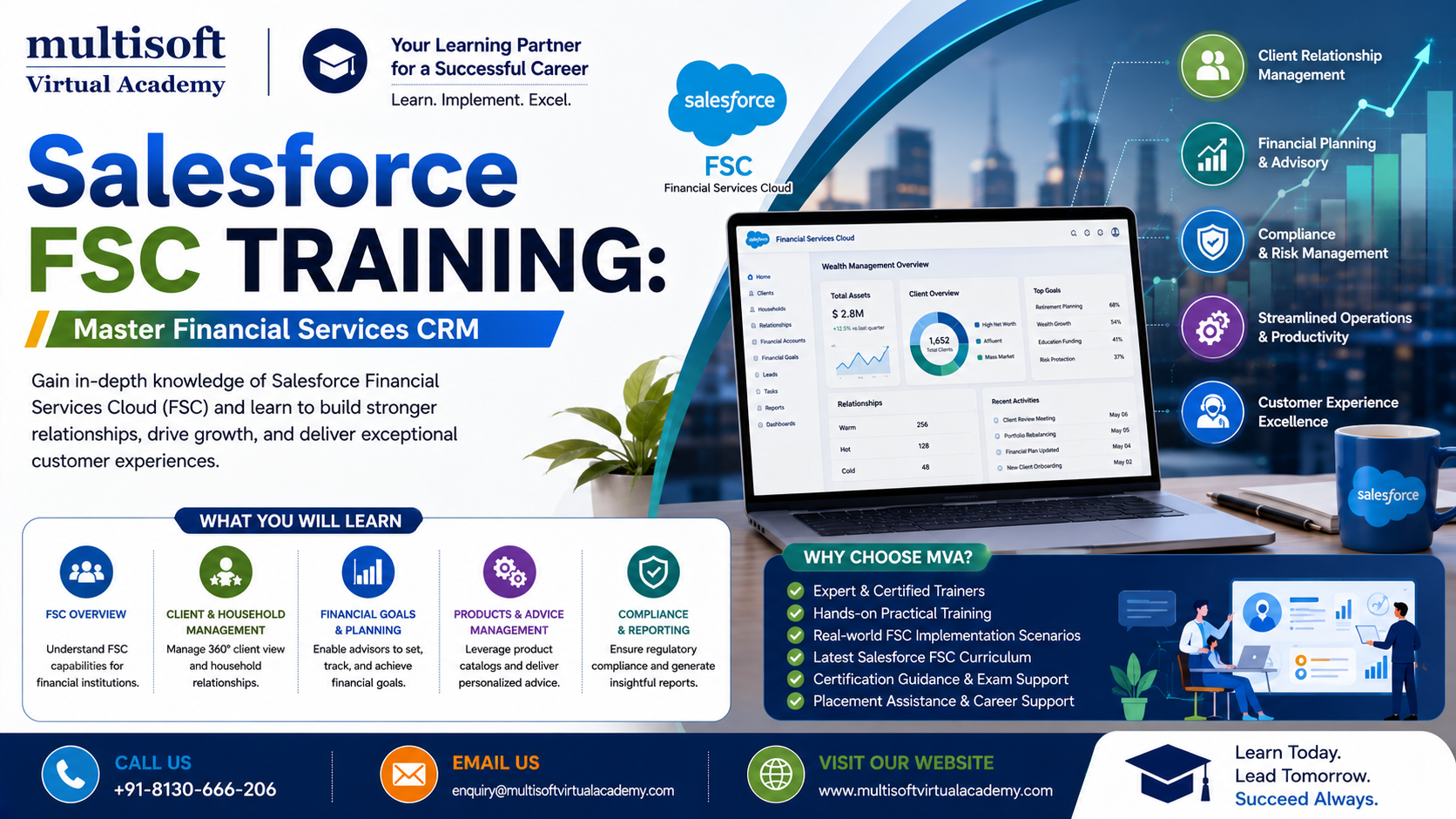
The financial services industry is undergoing a major digital transformation. Banks, insurance companies, wealth management firms, mortgage providers and other financial organizations increasingly need technology that can bring customer data, relationship management, automation and intelligent insights together in one connected environment. This is where Salesforce Financial Services Cloud (FSC) has become highly relevant.
Salesforce FSC Training helps professionals understand how Salesforce can be configured and applied to financial services use cases such as banking, insurance, wealth management, lending, financial planning and customer relationship management. Unlike a generic CRM implementation, FSC is designed around industry-specific processes, data relationships and customer needs.
Salesforce's current Financial Services offering combines industry-specific CRM capabilities with AI-driven functionality and supports areas including banking, wealth management and insurance. Salesforce documentation also indicates that the product is increasingly being presented under the Financial Services and Agentforce Financial Services terminology.
For professionals looking to strengthen their Salesforce careers, a structured Salesforce FSC Online Training Course can provide valuable knowledge of financial services processes, Salesforce configuration, relationship management, automation, data models and implementation concepts.
Salesforce Financial Services Cloud is an industry-focused CRM solution built to address the specialized requirements of financial organizations.
Traditional CRM platforms generally focus on contacts, leads, opportunities and customer service. Financial institutions, however, need to understand much more than a basic customer profile. They may need visibility into households, financial accounts, relationships, financial goals, interactions, policies, loans and other business-specific information.
Salesforce FSC brings these concepts into a connected CRM environment.
The platform is designed for several financial-services subverticals, including:
Salesforce documentation specifically identifies Commercial Banking, Insurance, Mortgage, Retail Banking and Wealth Management as supported subverticals.
This makes Salesforce Financial Services Cloud Training particularly useful for Salesforce administrators, consultants, business analysts, developers, solution architects and financial services professionals who want to understand industry-specific CRM implementation.
The value of FSC is not limited to learning another Salesforce application. Professionals need to understand how technology, financial-services workflows and customer relationships work together.
A comprehensive Salesforce FSC Training Course can help learners develop knowledge in areas such as:
Salesforce's official Accredited Professional exam guide describes the role as one involving the design and implementation of Financial Services Cloud solutions that meet business requirements while remaining maintainable and scalable.
This illustrates why FSC knowledge is valuable beyond simple platform administration.
A practical Salesforce FSC Online Training program should combine Salesforce fundamentals with financial-services scenarios.
One of the most important areas of FSC learning is understanding how financial information and customer relationships are represented within Salesforce.
Learners can explore concepts related to:
Understanding the data model helps professionals design solutions that accurately represent real-world financial relationships.
Financial institutions rarely deal with customers as isolated records.
A customer may belong to a family, own several financial accounts, have relationships with multiple advisors and share financial responsibilities with other individuals.
FSC helps organizations create a broader view of these relationships.
Training in householding and relationship management can help professionals understand how connected customer information can support relationship managers and financial advisors.
Retail banking is one of the important application areas for Financial Services Cloud.
A Salesforce FSC Training Course can introduce learners to use cases involving:
The objective is to help financial institutions create a more connected customer experience.
Wealth management professionals require a complete understanding of their clients' financial relationships and objectives.
Salesforce Financial Services solutions can support financial advisors by bringing relevant customer and financial information into a connected CRM environment.
Training can cover concepts such as:
This makes Salesforce FSC Training for Wealth Management a relevant learning path for professionals working with investment and advisory organizations.
Insurance organizations have different customer journeys and data requirements from traditional sales organizations.
FSC provides industry-specific functionality for insurance organizations, including a tailored insurance data model and Lightning-based capabilities.
Training can help learners understand how Salesforce can support:
As a result, Salesforce Insurance CRM Training can be valuable for professionals working on Salesforce-based insurance projects.
Commercial banking involves complex business relationships, lending activities and financial services.
Salesforce documentation highlights capabilities supporting areas such as commercial lending, treasury management, trade finance and business referrals.
Professionals taking Salesforce FSC Training can therefore gain an understanding of how Salesforce can be applied to business banking scenarios.
Learning FSC from an implementation perspective is particularly valuable for Salesforce consultants and solution professionals.
A good training program should explain the complete implementation lifecycle, including:
The goal is not simply to configure Salesforce features. Professionals should learn how to select an appropriate solution for a particular business requirement.
Salesforce's official exam guidance emphasizes scenario-based solution design, automation tools such as Flow and OmniStudio, Actionable Relationship Center, householding, rollups, lead configuration, queues and assignments.
Artificial intelligence is becoming an important part of modern financial-services technology.
Salesforce's current Financial Services offering includes AI-powered capabilities and Agentforce-related functionality intended to support financial organizations with personalized engagement, automation and intelligent assistance.
This makes it increasingly useful for professionals to understand the relationship between:
Professionals who combine Salesforce knowledge with financial-domain expertise can position themselves for emerging roles involving intelligent CRM, financial-services automation and AI-enabled customer experiences.
Online learning has become a practical option for professionals who cannot attend traditional classroom programs.
A well-designed Salesforce FSC Online Training Course can provide several benefits.
Professionals can learn from different locations without having to travel to a training center.
Learners can focus on financial-services scenarios rather than only studying generic Salesforce functionality.
Hands-on exercises, configuration demonstrations and implementation scenarios can make complex concepts easier to understand.
FSC expertise can complement Salesforce administration, consulting, business analysis and architecture skills.
Structured training can also support learners preparing for relevant Salesforce credentials and accreditation pathways.
One important distinction should be understood by learners searching for Salesforce FSC Certification.
Salesforce's Financial Services Cloud Accredited Professional pathway is designed to assess the ability to discover, design, plan and deliver Financial Services Cloud solutions. The official exam guide states that the assessment includes scenario-oriented knowledge involving solution design, automation, relationship management and other FSC capabilities.
Salesforce has also updated its terminology and currently lists an Accredited Agentforce Financial Services Professional examination focused on designing and implementing solutions for financial-services organizations.
Therefore, candidates should always verify the current Salesforce credential name, eligibility requirements and exam information before registering.
Salesforce FSC Training can benefit professionals from several backgrounds.
Administrators can expand their knowledge beyond standard CRM administration and learn financial-services-specific functionality.
Consultants can develop specialized skills for banking, insurance and wealth management implementations.
Business analysts can learn how to translate financial-services requirements into Salesforce solutions.
Developers can strengthen their understanding of the business processes and data structures behind FSC implementations.
Architects can benefit from understanding industry-specific data models, integrations, automation and scalable solution design.
Banking, insurance and wealth management professionals can gain technical knowledge that helps them collaborate more effectively with Salesforce teams.
A comprehensive learning program can help develop skills across several areas:
Financial Services CRM:
Customer relationships, financial accounts, households and industry workflows.
Automation:
Flow, business process automation and related Salesforce capabilities.
Data Management:
Understanding customer and financial information within the Salesforce ecosystem.
Reporting and Analytics:
Creating meaningful reports and dashboards for business users.
Solution Design:
Mapping business requirements to scalable Salesforce solutions.
Implementation:
Understanding configuration, testing, deployment and optimization.
Industry Knowledge:
Understanding banking, insurance, wealth management and related financial-services processes.
FSC expertise can complement a wide range of Salesforce career paths.
Depending on experience and existing qualifications, professionals may explore roles such as:
The strongest career advantage often comes from combining platform knowledge with real financial-services business understanding.
Not every course provides the same depth of knowledge.
Before selecting a Salesforce FSC Training Course, learners should evaluate several factors.
The course should address banking, insurance, wealth management and other applicable financial-services scenarios.
Hands-on learning can be more valuable than theory alone.
Look for training that explains how requirements are analyzed, designed and translated into Salesforce solutions.
Instructors with practical Salesforce and financial-services knowledge can provide valuable implementation insights.
Because Salesforce evolves continuously, course content should reflect current platform capabilities and terminology.
If certification or accreditation is a goal, the training should clearly explain the relevant current credential pathway.
Financial organizations increasingly need CRM platforms that can connect customer relationships, operational workflows and intelligent technology.
At the same time, customer expectations are changing. Clients want faster responses, personalized interactions and seamless digital experiences.
Salesforce's Financial Services offering is positioned around these requirements, combining CRM functionality with industry-specific processes and AI capabilities.
This creates opportunities for professionals who understand both Salesforce technology and financial-services operations.
The future of financial-services CRM is likely to involve greater integration between customer data, automation, analytics and AI. Professionals who start building these skills now can develop a strong foundation for evolving Salesforce roles.
Salesforce FSC Training teaches professionals how to use and implement Salesforce's Financial Services capabilities for banking, insurance, wealth management and related financial-services scenarios.
Yes. FSC supports financial-services use cases including retail banking and commercial banking. It can help professionals understand how customer relationships, financial information and service processes can be managed through Salesforce.
Yes. Wealth management is one of the financial-services areas supported by Salesforce. FSC learning can help professionals understand household relationships, financial goals, client engagement and advisor-oriented workflows.
Beginners can learn FSC, although having basic Salesforce CRM knowledge can make the learning journey easier. Learners with Salesforce administration or CRM experience may progress more quickly.
Training can support preparation for relevant Salesforce credentials or accreditation. However, candidates should check the current official Salesforce credential requirements because certification and accreditation programs can change over time.
Yes, particularly when the program includes instructor guidance, demonstrations, practical assignments and implementation-based scenarios.
The financial-services industry needs professionals who can understand both technology and business processes. Salesforce FSC Training offers a focused path for developing knowledge of financial-services CRM, banking, wealth management, insurance, automation, relationship management and emerging AI-enabled capabilities. As Salesforce continues evolving its Financial Services offering toward more connected data and Agentforce-powered experiences, building practical FSC expertise can help professionals stay relevant in a rapidly changing technology landscape. For learners and organizations seeking structured Salesforce Financial Services Cloud Training, Salesforce FSC Online Training, Salesforce FSC Certification preparation and industry-oriented Salesforce learning, Multisoft Virtual Academy provides a focused learning environment designed to help professionals build practical and career-oriented Salesforce skills.
| Start Date | End Date | No. of Hrs | Time (IST) | Day | |
|---|---|---|---|---|---|
| 26 Sep 2026 | 11 Oct 2026 | 18 | 06:00 PM - 09:00 PM | Sat, Sun | |
| 27 Sep 2026 | 12 Oct 2026 | 18 | 06:00 PM - 09:00 PM | Sat, Sun | |
| 03 Oct 2026 | 18 Oct 2026 | 18 | 06:00 PM - 09:00 PM | Sat, Sun | |
| 04 Oct 2026 | 19 Oct 2026 | 18 | 06:00 PM - 09:00 PM | Sat, Sun | |
Schedule does not suit you, Schedule Now! | Want to take one-on-one training, Enquiry Now! |
|||||






 Join our Live Instructor-Led online classes delivered by industry experts
 Let's Get Started