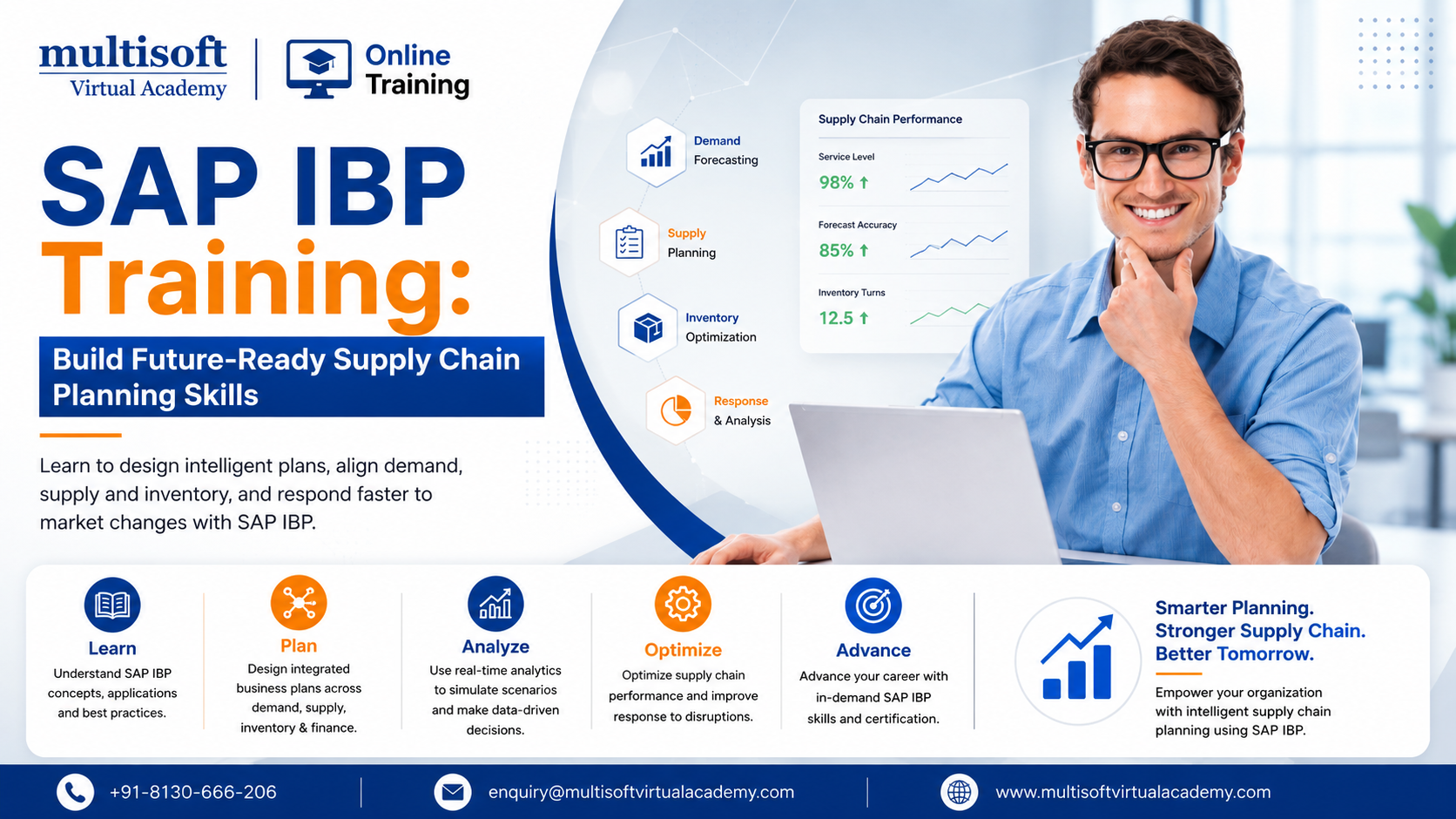
Supply chains are becoming increasingly complex due to changing customer demand, global disruptions, shorter product lifecycles and pressure to optimise inventory. Businesses therefore need planning professionals who can connect demand, supply, inventory and financial objectives through intelligent digital planning solutions. SAP Integrated Business Planning (SAP IBP) has emerged as a powerful cloud-based platform for organisations seeking more responsive and collaborative supply chain planning.
SAP IBP Training helps professionals understand how modern supply chain planning processes work and how SAP IBP can be used to support demand forecasting, supply planning, inventory optimisation and Sales and Operations Planning (S&OP). SAP describes IBP as a cloud-based solution that brings together S&OP, forecasting and demand, response and supply, demand-driven replenishment and inventory planning.
SAP Integrated Business Planning is a cloud-based supply chain planning solution designed to help organisations create connected, data-driven and responsive planning processes. It combines planning capabilities with analytics, simulations, alerts and advanced forecasting technologies.
Unlike traditional planning approaches that may operate across disconnected spreadsheets and systems, SAP IBP enables planners and business stakeholders to work with connected planning information. This can help organisations identify changes in demand, evaluate supply constraints and make more informed decisions.
SAP IBP supports several important planning areas, including:
These capabilities make SAP IBP for Supply Chain particularly relevant for organisations working to improve planning agility and supply chain resilience.
The role of supply chain professionals is changing. Organisations increasingly expect planners to do more than prepare forecasts or monitor inventory. They need professionals who can interpret data, evaluate scenarios, understand planning constraints and support faster business decisions.
This is where SAP IBP Training can provide valuable knowledge.
A structured learning program can help participants understand both the functional concepts and practical application of integrated supply chain planning. SAP's own training pathway includes introductory learning, platform and time-series planning, advanced configuration and specialised response and supply planning courses.
For professionals working with SAP, supply chain management, demand planning or business transformation, knowledge of SAP IBP can therefore complement existing ERP and SCM expertise.
A comprehensive SAP IBP Online Training program should provide an understanding of the complete planning environment rather than focusing on a single functionality.
Training generally begins with the fundamentals of Integrated Business Planning. Participants learn the purpose of SAP IBP, its major components and how different planning processes connect with one another.
SAP's foundational IBP100 course, for example, introduces the solution, its components and associated supply chain business processes.
Accurate demand planning is essential for balancing customer requirements with available supply. SAP IBP provides capabilities for statistical forecasting, demand sensing, time-series analysis and related planning processes.
Professionals learning SAP IBP Demand Planning can explore how historical information and demand signals can support better forecasts.
SAP highlights automated statistical forecasting, machine learning algorithms, demand sensing and time-series analysis as important capabilities within its forecasting and demand management functionality.
Demand forecasts are only useful when organisations can translate them into feasible supply plans.
SAP IBP Supply Planning helps planners evaluate supply requirements across locations and supply networks. SAP supports multilevel supply planning and provides algorithm options for developing feasible and constrained supply plans.
Training can help participants understand concepts such as:
Maintaining excessive inventory can increase costs while insufficient inventory can affect customer service. Inventory planning therefore requires a careful balance.
SAP IBP Inventory Optimization focuses on establishing appropriate inventory targets while considering service requirements and business objectives.
Training in this area can help supply chain professionals understand how inventory planning fits into the wider integrated planning process.
Sales and Operations Planning connects business strategy with operational planning.
With SAP IBP S&OP, organisations can bring demand, supply, financial and operational perspectives together and evaluate different scenarios before making decisions.
SAP identifies collaboration, scenario simulation, performance monitoring and real-time planning among the capabilities supporting S&OP.
For functional consultants and implementation professionals, configuration knowledge is especially important.
SAP IBP Configuration Training can cover areas such as master data objects, planning areas, key figures, units of measure, currencies and advanced configuration concepts.
SAP's IBP300 advanced configuration training specifically covers configuration of master data objects and planning areas, key figures, currency and unit-of-measure conversion and advanced configuration functions.
One of the most important developments in modern supply chain planning is the growing use of artificial intelligence and machine learning.
SAP IBP incorporates advanced forecasting and planning capabilities designed to help organisations analyse demand patterns and make more informed planning decisions. SAP highlights AI-powered algorithms, statistical modelling, demand sensing and automated outlier correction as capabilities supporting demand forecasting.
For professionals, this means SAP IBP with AI is an increasingly relevant area of knowledge. Understanding how intelligent forecasting works alongside conventional planning processes can help planners make better use of available data.
Supply chains rarely operate exactly according to plan. Demand may increase unexpectedly, a supplier may experience a disruption or production capacity may change.
Scenario planning allows organisations to evaluate alternative possibilities before committing to a particular course of action.
SAP IBP supports what-if simulations and scenario comparisons, enabling planners to assess potential changes and collaborate around their findings.
For learners, this makes SAP IBP scenario planning an important concept because it demonstrates how planning technology can support proactive rather than purely reactive decision-making.
Integrated planning depends on reliable data flows between planning and execution systems.
SAP IBP can work alongside SAP solutions such as SAP S/4HANA. SAP describes standard integration capabilities that support data transfer between SAP S/4HANA and SAP IBP for synchronised planning processes.
For this reason, professionals involved in SAP implementation, SCM consulting or supply chain transformation can benefit from understanding the broader SAP ecosystem and how IBP participates in an end-to-end planning architecture.
SAP IBP Certification Training or structured SAP IBP learning can be relevant for a broad range of professionals, including:
SAP's own foundational IBP training identifies application consultants, business process architects, business process owners, team leads and power users among its target audiences.
A practical SAP IBP Course can help learners develop a combination of functional, analytical and planning skills.
These may include:
Supply Chain Planning: Understanding how demand, supply and inventory planning interact.
Forecasting: Learning concepts related to statistical forecasting, demand sensing and time-series analysis.
Planning Configuration: Understanding planning areas, master data and key figures.
Scenario Analysis: Evaluating alternative supply and demand situations.
S&OP: Connecting operational planning with strategic and financial objectives.
Supply Network Planning: Understanding constraints, capacity and multilevel supply relationships.
Data-Driven Decision Making: Using planning information and analytics to support business decisions.
Beginners should ideally start with SAP IBP fundamentals before moving into advanced configuration or specialised planning topics.
SAP's training structure reflects this progression. Its foundational IBP100 course provides an introduction to SAP IBP, while IBP200 moves into platform features and time-series-based heuristics planning. Advanced configuration is addressed through IBP300.
Experienced SAP professionals may choose specialised learning paths depending on their career objectives. For example, professionals interested in supply planning can explore response and supply planning while configuration-focused consultants may progress toward advanced configuration topics.
SAP IBP Online Training can provide flexibility for working professionals who cannot attend conventional classroom sessions.
Online learning can allow participants to:
The availability of virtual SAP IBP training also demonstrates that IBP learning is increasingly accessible to professionals working across different locations. SAP currently lists virtual instructor-led IBP offerings covering foundational and specialised topics.
As organisations continue to modernise their supply chain planning processes, professionals with SAP IBP expertise can pursue opportunities in areas such as supply chain consulting, demand planning, supply planning, S&OP, inventory planning and SAP implementation.
Potential job roles may include:
However, career growth depends on more than completing a training program. Practical exposure, supply chain knowledge, SAP ecosystem understanding and the ability to solve real business problems are equally important.
When selecting an SAP IBP Training Course, professionals should look beyond the course title. A strong program should ideally include fundamentals, practical planning scenarios, relevant configuration concepts and current SAP IBP capabilities.
Consider whether the program provides:
This approach can make learning more meaningful and help professionals connect SAP IBP functionality with actual business requirements.
The future of supply chain planning is moving toward greater automation, intelligence, collaboration and responsiveness. AI-assisted forecasting, connected planning environments, scenario simulation and advanced analytics are becoming increasingly important as companies seek to respond to uncertainty faster.
SAP's current IBP capabilities already include AI-supported forecasting, advanced demand sensing, multilevel supply planning, scenario simulation and integrated planning processes.
As these capabilities evolve, professionals who understand both supply chain fundamentals and digital planning technologies can be better positioned to contribute to transformation projects.
SAP IBP Training is more than learning another SAP application. It provides an opportunity to understand how modern organisations can connect demand, supply, inventory, S&OP and business decision-making through an integrated planning environment. Whether you are beginning your SAP journey, strengthening your supply chain expertise or preparing for a consulting role, learning SAP IBP can provide valuable knowledge for today's increasingly data-driven supply chain landscape. For professionals seeking structured learning, practical guidance and career-focused SAP IBP Training, Multisoft Virtual Academy acts as a trusted service provider with training designed to help learners build relevant SAP and digital business skills.
| Start Date | Time (IST) | Day | |||
|---|---|---|---|---|---|
| 10 Oct 2026 | 06:00 PM - 10:00 AM | Sat, Sun | |||
| 11 Oct 2026 | 06:00 PM - 10:00 AM | Sat, Sun | |||
| 17 Oct 2026 | 06:00 PM - 10:00 AM | Sat, Sun | |||
| 18 Oct 2026 | 06:00 PM - 10:00 AM | Sat, Sun | |||
|
Schedule does not suit you, Schedule Now! | Want to take one-on-one training, Enquiry Now! |
|||||






 Join our Live Instructor-Led online classes delivered by industry experts
 Let's Get Started