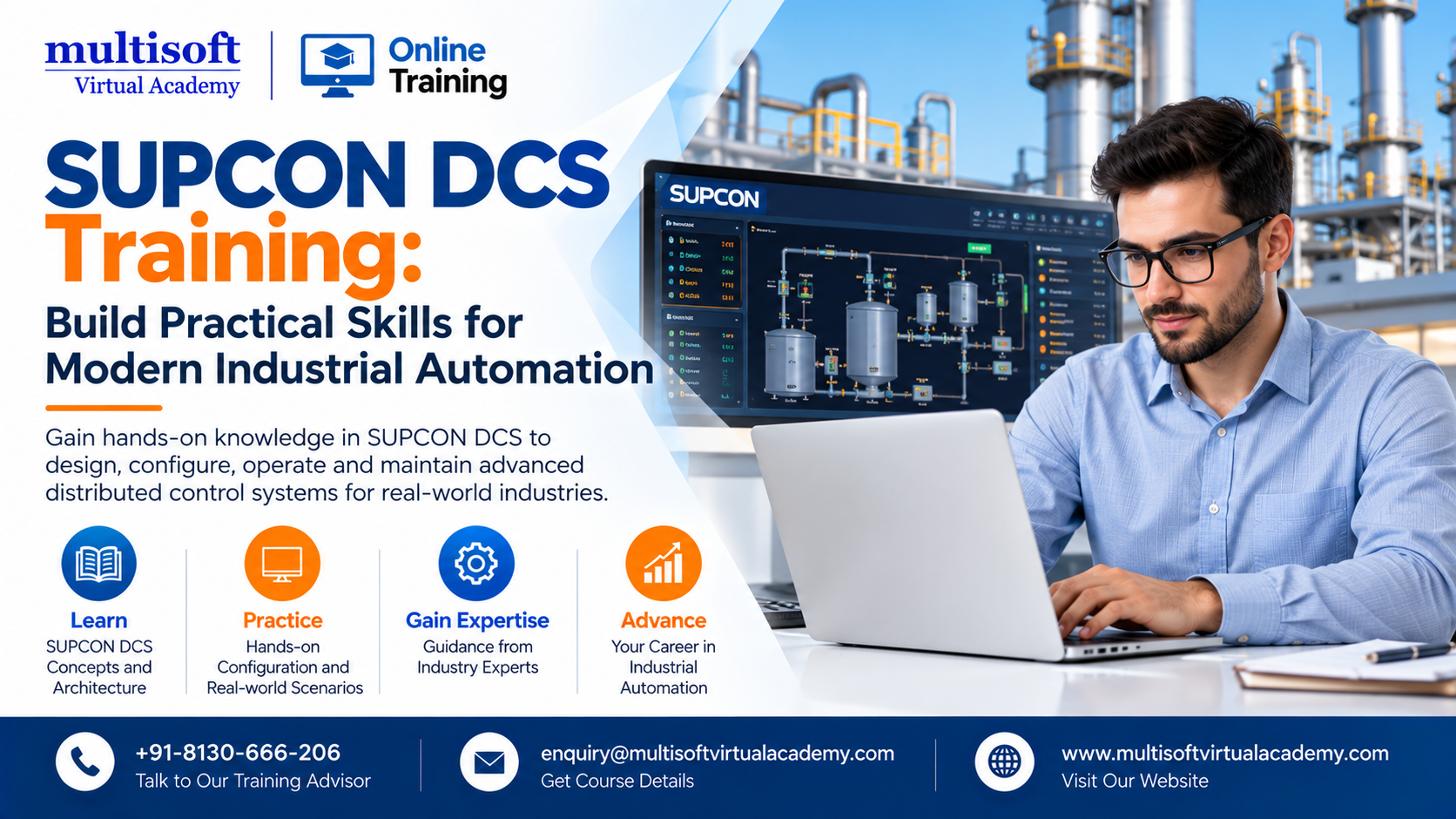
Industrial plants are becoming more connected, automated, and data-driven, creating a growing need for professionals who understand modern Distributed Control Systems (DCS). From oil and gas and petrochemicals to power generation, pharmaceuticals, chemicals, and utilities, DCS technology plays an important role in monitoring processes, controlling equipment, managing alarms, and supporting safe plant operations.
Among the technologies used in process automation, SUPCON DCS is an important platform for professionals involved in control engineering, instrumentation, commissioning, operations, and plant automation. A well-structured SUPCON DCS Training program can help learners develop practical knowledge of DCS architecture, engineering configuration, process control, HMI development, communication, troubleshooting, and system maintenance.
As industrial organizations continue to adopt smart manufacturing and digital transformation, professionals with practical DCS training and industrial automation skills can strengthen their technical capabilities and prepare for more demanding engineering responsibilities.
A Distributed Control System is designed to control and supervise industrial processes through distributed controllers, input/output systems, operator stations, engineering stations, communication networks, and field devices.
SUPCON provides DCS solutions designed for process industries and supports applications ranging from complex production facilities to continuous and batch operations. Its DCS ecosystem can connect operator and engineering stations, controllers, I/O networks, historians, field devices, and third-party systems.
The technology is particularly relevant in industries where continuous monitoring and reliable process control are essential. Professionals working with such systems need more than theoretical knowledge. They must understand how control strategies are configured, how process graphics are developed, how alarms are managed, and how faults are diagnosed.
This is where SUPCON DCS Training becomes valuable.
Industrial automation is no longer limited to basic control loops. Modern plants require engineers and operators to work with integrated control architectures, industrial communication, field instruments, alarm systems, historians, safety systems, and optimization technologies.
SUPCON's current DCS solutions emphasize reliability, scalability, integration, and communication with different industrial systems and devices.
Professional training helps learners understand these technologies in a structured manner rather than trying to learn individual components separately.
A practical SUPCON DCS course can help professionals:
A comprehensive SUPCON DCS Training program should combine fundamental concepts with practical engineering scenarios. The exact curriculum can vary depending on the learner's role and project requirements, but the following topics are highly relevant.
The first step is understanding how a Distributed Control System works.
Learners explore controllers, I/O modules, operator stations, engineering stations, servers, communication networks, field devices, and other components. Understanding the relationship between these layers provides a foundation for configuration, operation, and troubleshooting.
Engineering configuration is an important skill for DCS engineers. Training can introduce learners to the principles involved in configuring controllers, I/O channels, tags, control strategies, databases, and system parameters.
This knowledge is particularly useful for engineers involved in project engineering, system modification, and plant expansion.
Process automation depends heavily on effective control strategies.
A SUPCON DCS course can introduce participants to control loops, PID concepts, interlocks, sequences, logic functions, and process control strategies. Understanding how these elements work together helps engineers analyze plant behavior and implement appropriate control solutions.
Operators need clear and informative interfaces to monitor industrial processes.
SUPCON DCS training can cover HMI concepts, process graphics, displays, trends, alarms, status indicators, and operator interaction. Learners can understand how process information is presented so that operators can make timely decisions.
Alarm management is an essential part of plant operations.
Poorly configured alarms can make it difficult for operators to identify critical process conditions. Training helps professionals understand alarm concepts, priorities, events, acknowledgements, and response requirements.
This knowledge is useful for both control engineers and plant operators.
Modern DCS environments communicate with numerous field devices and external systems.
SUPCON's DCS solutions support integration with fieldbus, serial, Ethernet, and third-party systems, depending on the system configuration.
Therefore, industrial automation training should provide learners with an understanding of communication concepts, device integration, signal handling, and system connectivity.
DCS engineers frequently need to identify the source of communication, controller, I/O, configuration, or process-related problems.
A practical SUPCON DCS training course should include troubleshooting scenarios that help learners approach problems systematically. Instead of simply identifying an error, professionals should learn how to analyze symptoms, check system conditions, isolate the cause, and apply corrective actions.
Commissioning is one of the most important stages of an industrial automation project.
Professionals may need to verify I/O signals, controllers, communication, graphics, alarms, logic, interlocks, and process sequences before a system becomes fully operational.
Therefore, DCS commissioning training can be particularly valuable for engineers working on project execution and plant startup activities.
SUPCON DCS Training can be useful for professionals at different stages of their automation careers.
Engineers involved in process control can strengthen their understanding of DCS engineering, configuration, logic development, and troubleshooting.
Instrumentation professionals can benefit from learning how field instruments and control systems interact within an industrial automation architecture.
Professionals from related engineering disciplines can develop a stronger understanding of how automated control systems support plant operations.
Operators can improve their understanding of process graphics, alarms, trends, control loops, and abnormal operating conditions.
Professionals involved in testing and commissioning can develop practical knowledge relevant to DCS verification and startup activities.
Experienced automation professionals can use specialized training to expand their knowledge of process control and strengthen their capabilities for future projects.
Industrial automation is evolving as companies invest in smarter, more connected, and more efficient production environments. Professionals who understand DCS technologies can work across several stages of an automation project, including engineering, configuration, testing, commissioning, operation, maintenance, and troubleshooting.
A strong SUPCON DCS certification training program can also provide structured learning for professionals who want to demonstrate their knowledge of the technology.
However, certification alone should not be the primary objective. Employers typically value professionals who can apply technical concepts to real industrial situations.
For this reason, practical exercises, project-based learning, troubleshooting scenarios, and case studies can make SUPCON DCS online training more useful than theory-only learning.
Online learning has become a practical option for engineers and working professionals who cannot attend classroom sessions regularly.
A well-designed SUPCON DCS online training program can combine live instructor-led sessions, demonstrations, technical discussions, assignments, case studies, and practical exercises.
The major advantage is flexibility. Professionals can learn without leaving their current job or travelling to a training center.
For working engineers, weekend or customized schedules can also make it easier to balance professional responsibilities with technical development.
Not every DCS course provides the same level of technical depth. Before selecting a program, professionals should evaluate several factors.
Choose a course that goes beyond definitions and presentations. Practical configuration, troubleshooting, control logic, HMI, communication, and commissioning concepts can provide more career value.
The curriculum should cover the areas relevant to your job role. An automation engineer may require deeper configuration and programming knowledge, while an operator may need greater emphasis on monitoring, alarms, process control, and operational procedures.
Industrial automation is highly practical. Trainers with real project or industry experience can often explain concepts through realistic scenarios and engineering examples.
Doubt-clearing sessions, assignments, project discussions, and post-training support can make the learning experience more effective.
Working professionals may benefit from live online sessions, weekend classes, or customized schedules.
The future of industrial automation is moving toward greater integration, intelligence, connectivity, and operational efficiency.
SUPCON is also developing technologies around intelligent automation and digital operations. Its broader portfolio includes DCS, PLC, SIS, industrial digital solutions, and newer control technologies.
Operator training and simulation are also becoming increasingly important. SUPCON's operator training simulator, for example, is designed to reproduce process and control behavior in a risk-free environment and can support operator training, procedure validation, interlock verification, and emergency-response scenarios.
This direction shows why modern automation professionals need to understand not only traditional DCS operation but also simulation, digitalization, advanced control, industrial networking, and intelligent operations.
Professionals looking to build a broader automation skill set can also consider learning related technologies and concepts such as:
Developing knowledge across these areas can help professionals understand how different technologies work together within modern industrial environments.
Professionals with relevant DCS and automation knowledge may explore roles such as:
The specific requirements for these roles vary by employer, industry, experience level, and project scope. Practical knowledge combined with engineering fundamentals and project experience can strengthen a professional profile.
SUPCON DCS Training can be a valuable learning path for engineers, operators, instrumentation professionals, commissioning specialists, and automation practitioners who want to strengthen their process-control capabilities. As industrial plants become more connected and intelligent, understanding DCS architecture, control logic, HMI, alarms, communication, troubleshooting, commissioning, and digital operations can help professionals stay relevant in a changing automation environment. Multisoft Virtual Academy provides SUPCON DCS Training designed around practical learning, instructor-led guidance, industrial concepts, and career-oriented technical development for professionals seeking to build stronger DCS and industrial automation skills.
| Start Date | Time (IST) | Day | |||
|---|---|---|---|---|---|
| 10 Oct 2026 | 06:00 PM - 10:00 AM | Sat, Sun | |||
| 11 Oct 2026 | 06:00 PM - 10:00 AM | Sat, Sun | |||
| 17 Oct 2026 | 06:00 PM - 10:00 AM | Sat, Sun | |||
| 18 Oct 2026 | 06:00 PM - 10:00 AM | Sat, Sun | |||
|
Schedule does not suit you, Schedule Now! | Want to take one-on-one training, Enquiry Now! |
|||||






 Join our Live Instructor-Led online classes delivered by industry experts
 Let's Get Started