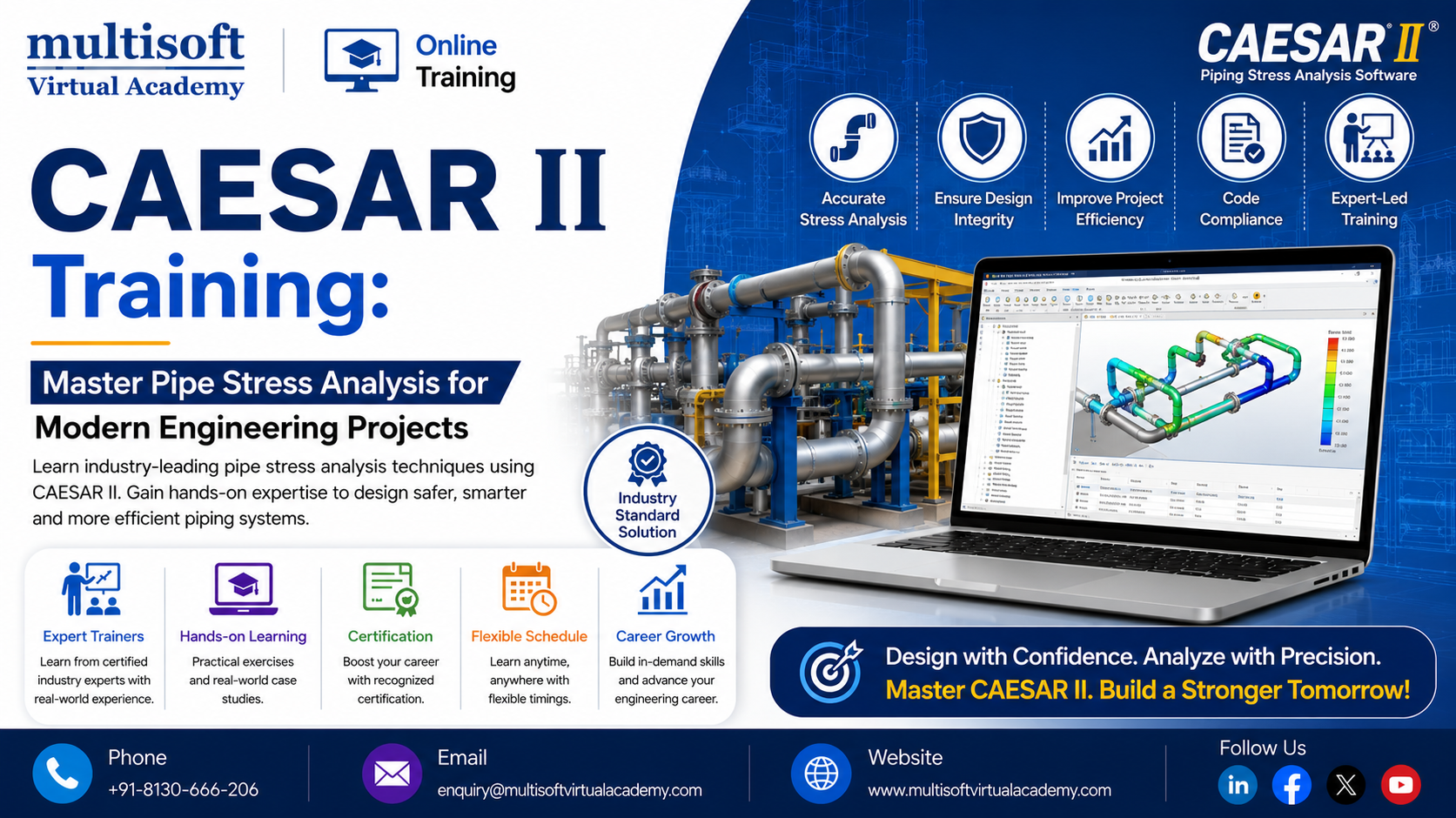
Pipe stress analysis is a critical part of safe and reliable piping design across oil and gas, petrochemical, power generation, chemical processing and other industrial projects. As piping systems become more complex, engineers need practical expertise in analyzing thermal expansion, sustained loads, occasional loads, equipment nozzle loads and dynamic effects.
CAESAR II helps engineers develop the technical knowledge required to model piping systems, evaluate stresses and displacements and interpret analysis results against applicable engineering codes. With growing demand for skilled piping stress professionals, learning CAESAR II Training can be a valuable step for engineers looking to strengthen their design and analysis capabilities.
CAESAR II is a specialized pipe stress analysis software used to model and evaluate piping systems under different operating and environmental conditions. It helps engineers understand how a piping system responds to pressure, temperature, weight, wind, seismic forces and other loads.
The software can be used for static and dynamic analysis and supports engineering workflows involving stress evaluation, support loads, equipment connections and reporting. Its capabilities make it an important tool in piping engineering and stress analysis projects. The technology is also evolving, with the product now positioned as Aspect Pipe Stress, formerly CAESAR II, while continuing to support advanced pipe stress analysis workflows.
Piping systems are exposed to multiple forces throughout their operating life. Temperature changes can cause thermal expansion, internal pressure can influence stresses and equipment connections can experience additional loads. If these effects are not properly evaluated, the piping system may experience excessive deformation, overstress or unwanted loads on connected equipment.
Pipe stress analysis helps engineers:
A published engineering case study demonstrates how CAESAR II can be used to analyze piping stresses, displacements and support-related parameters while checking results against allowable stresses.
Engineering projects increasingly require professionals who can combine piping design knowledge with practical stress analysis skills. Current job listings for piping stress engineers continue to mention CAESAR II alongside knowledge of piping codes, static and dynamic analysis, support design and equipment loads.
This makes CAESAR II Training relevant for professionals who want to move beyond basic piping design and develop specialized pipe stress engineering expertise.
Rather than learning only software commands, effective training should connect software operation with engineering principles. Understanding why a model produces a particular result is just as important as knowing how to generate that result.
A comprehensive CAESAR II Training Course generally combines fundamental pipe stress concepts with practical software workflows.
Before creating a model, engineers need to understand the fundamentals of piping stress analysis. This includes loads, boundary conditions, flexibility, restraints, stress categories and displacement behavior.
A strong foundation helps learners interpret CAESAR II results instead of simply accepting software-generated numbers.
Model accuracy is essential. Engineers need to understand how to represent pipes, elbows, reducers, rigid elements, restraints, equipment connections and other components within the analysis model.
Incorrect geometry, material properties or boundary conditions can produce misleading results, making model checking an essential part of the workflow.
Static analysis evaluates how piping systems behave under different combinations of loads.
Typical considerations include:
Engineers learn to create appropriate load cases and interpret stresses, reactions and displacements.
Thermal expansion is one of the most important considerations in piping stress analysis.
When a pipe heats up, it generally attempts to expand. If the system is restrained, forces and moments can develop. Engineers therefore need to evaluate flexibility and determine whether the piping arrangement provides sufficient movement.
CAESAR II helps engineers assess these effects and optimize routing or support arrangements when required.
Supports influence how loads are transferred through a piping system. A poorly positioned support can create excessive stresses or undesirable equipment loads.
Training can help engineers understand the application of:
Practical job requirements frequently include pipe support and spring hanger selection as part of CAESAR II-based stress engineering responsibilities.
Software expertise alone does not make someone a pipe stress engineer. Engineers must also understand the relevant design codes and project specifications.
ASME B31.3 is particularly important for process piping applications, while ASME B31.1 is commonly associated with power piping. Depending on the project, additional standards and equipment-specific requirements may also apply.
Current industry job descriptions frequently combine CAESAR II proficiency with knowledge of ASME B31.1, ASME B31.3 and other applicable engineering standards.
A good training program should therefore explain the relationship between:
Engineering principles → Code requirements → CAESAR II modeling → Analysis → Result interpretation
This approach produces more useful practical skills than software-only instruction.
One of the important areas of advanced CAESAR II Training is understanding the difference between static and dynamic analysis.
Static analysis considers loads that can be evaluated through relatively stable load conditions. Dynamic analysis addresses effects where time-dependent behavior, vibration or transient forces become important.
Depending on the application, engineers may need to consider events such as:
Advanced CAESAR II-focused training programs can include modal, harmonic and time-history analysis for dynamic piping problems.
Piping does not operate independently from connected equipment. Pumps, compressors, vessels, heat exchangers and other equipment can be affected by forces and moments transferred through piping connections.
Consequently, engineers often need to evaluate nozzle loads and compare them with applicable equipment allowable limits.
This is an important practical skill because a piping model may satisfy a stress code requirement while still creating unacceptable loads at connected equipment.
A complete pipe stress workflow therefore considers both piping stresses and equipment interaction.
A pipe stress engineer may be responsible for producing or reviewing several engineering deliverables, including:
Industry roles currently associate CAESAR II expertise with preparing stress reports, critical line information, support recommendations and engineering loads for multidisciplinary design teams.
CAESAR II Training can be useful for professionals and learners working toward roles such as:
Mechanical engineering graduates and professionals with piping design experience can particularly benefit from structured training because they can connect theoretical engineering knowledge with software-based analysis.
CAESAR II skills can complement careers in industries where complex piping systems are designed, analyzed and maintained.
These include:
Oil & Gas | Petrochemical | Power | Chemical | Pharmaceutical | LNG | Refining | Process Plants | EPC | Industrial Engineering
Current recruitment listings in India and internationally continue to show demand for piping stress professionals with CAESAR II experience. Requirements commonly include static and dynamic stress analysis, piping flexibility, support design, equipment loads and applicable engineering codes.
The value of training therefore extends beyond software familiarity. It can help professionals build a broader skill set around piping flexibility, stress evaluation and engineering decision-making.
When choosing a CAESAR II Online Training program, professionals should look beyond course duration and focus on the learning experience.
A quality program should ideally include:
For example, Multisoft Virtual Academy's published CAESAR II program currently describes instructor-led virtual training, a 30-hour duration, subject matter expert instruction, recorded sessions, assessments and practical curriculum areas covering basic and advanced stress analysis.
Learning CAESAR II is only one part of becoming a capable stress engineer. Professionals should continuously develop their understanding of piping systems.
A practical learning path can be:
Step 1: Learn piping engineering fundamentals
Step 2: Understand piping flexibility and stress concepts
Step 3: Study applicable ASME codes
Step 4: Learn CAESAR II modeling
Step 5: Practice static analysis
Step 6: Learn support and restraint evaluation
Step 7: Study equipment nozzle loads
Step 8: Progress to dynamic analysis
Step 9: Work on realistic case studies
Step 10: Develop professional stress reports and review skills
This progression helps transform software knowledge into practical engineering capability.
New users can make errors when they focus too heavily on entering data and running the analysis without validating the engineering model.
Some common issues include:
The best approach is to treat CAESAR II as an engineering analysis tool rather than a replacement for engineering judgment.
Digital engineering is changing how industrial projects are designed and analyzed. Modern engineering workflows increasingly connect piping models, analysis tools, design databases and multidisciplinary project information.
At the same time, the fundamentals remain important. Engineers still need to understand loads, flexibility, supports, stresses, displacement and code compliance.
The continued appearance of CAESAR II-related requirements in piping stress engineering vacancies indicates that practical software capability remains valuable for professionals pursuing specialized engineering careers.
As the technology evolves, professionals who combine piping engineering fundamentals + code knowledge + digital analysis skills + practical problem-solving can position themselves more effectively for modern engineering projects.
CAESAR II Training can provide a structured pathway for engineers who want to strengthen their capabilities in pipe stress analysis, piping flexibility, support evaluation and engineering reporting. The strongest results come from combining software practice with engineering fundamentals, applicable codes and realistic project scenarios. For professionals seeking specialized learning with practical, industry-oriented guidance, Multisoft Virtual Academy provides CAESAR II training designed to build relevant pipe stress analysis skills and support career development in modern engineering environments.
| Start Date | Time (IST) | Day | |||
|---|---|---|---|---|---|
| 10 Oct 2026 | 06:00 PM - 10:00 AM | Sat, Sun | |||
| 04 Oct 2026 | 06:00 PM - 10:00 AM | Sat, Sun | |||
| 17 Oct 2026 | 06:00 PM - 10:00 AM | Sat, Sun | |||
| 11 Oct 2026 | 06:00 PM - 10:00 AM | Sat, Sun | |||
|
Schedule does not suit you, Schedule Now! | Want to take one-on-one training, Enquiry Now! |
|||||






 Join our Live Instructor-Led online classes delivered by industry experts
 Let's Get Started