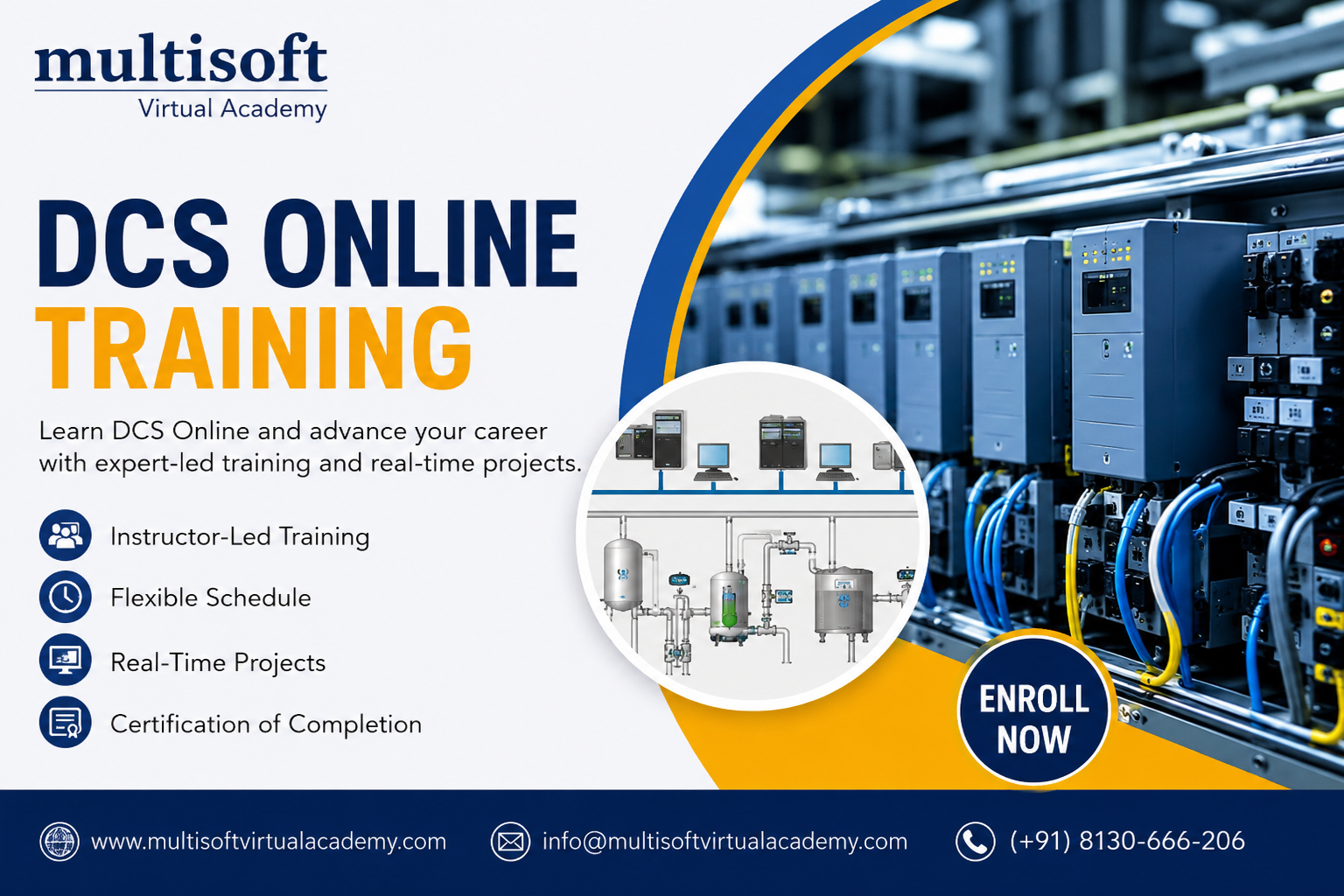
As industries continue to embrace automation, the demand for professionals with expertise in Distributed Control Systems (DCS) is growing rapidly. Industries such as oil and gas, power generation, pharmaceuticals, chemical manufacturing, food processing, and water treatment depend on DCS to monitor and control complex industrial processes. Learning this technology can open the door to exciting career opportunities in industrial automation.
A professional DCS Training program helps learners understand the architecture, operation, and maintenance of distributed control systems while providing practical knowledge that is directly applicable in real industrial environments. Whether you are a student, an engineer, or an experienced professional looking to upgrade your skills, DCS Training can significantly improve your career prospects.
A Distributed Control System (DCS) is an advanced industrial automation system used to control continuous manufacturing and production processes. Unlike conventional control systems that rely on a single controller, DCS distributes control functions across multiple controllers connected through a communication network. This design improves system reliability, enhances operational efficiency, and minimizes downtime.
Today, DCS is widely used in industries where continuous monitoring, process stability, and operational safety are essential.
Industrial automation is becoming smarter every year. Companies are investing in modern technologies that improve productivity while reducing operational risks. Because of this transformation, organizations actively seek professionals who understand DCS technology and can manage automated processes efficiently.
Learning DCS not only strengthens your technical knowledge but also increases your chances of securing better job opportunities in leading manufacturing and process industries. Employers value professionals who can configure, monitor, troubleshoot, and maintain industrial control systems with confidence.
A comprehensive DCS Training course introduces learners to the complete lifecycle of industrial control systems. The curriculum generally begins with the fundamentals of process automation before moving toward DCS architecture, control strategies, communication systems, and practical configuration techniques.
Students also learn about Human Machine Interface (HMI), industrial instrumentation, alarm management, process monitoring, troubleshooting, and industrial safety practices. Practical demonstrations and real-world case studies help learners understand how DCS operates in live production environments.
One of the biggest advantages of DCS Training is that it prepares professionals for real industrial challenges. The training improves problem-solving abilities, enhances automation knowledge, and develops practical skills that employers value. Learners also gain confidence in working with industrial control systems used by leading manufacturing companies.
Professional certification after training further strengthens your resume and demonstrates your commitment to continuous learning.
Industries across the globe require skilled automation professionals to manage critical production systems. After completing DCS Training, learners can explore career opportunities as DCS Engineers, Automation Engineers, Instrumentation Engineers, Process Control Engineers, Commissioning Engineers, Maintenance Engineers, and Control System Specialists.
These roles are available in sectors including oil and gas, petrochemicals, power plants, pharmaceuticals, food processing, water treatment, cement, steel, and renewable energy. As automation continues to evolve, experienced DCS professionals can also move into senior engineering, consulting, and project management positions.
Choosing the right training provider is an important step toward career success. A good DCS Training program should offer experienced instructors, practical demonstrations, live projects, updated course content, flexible online learning, and recognized certification. Learning from industry experts helps bridge the gap between theoretical concepts and real-world industrial applications.
The future of industrial automation is closely connected with smart manufacturing, Industry 4.0, and digital transformation. Organizations are investing heavily in automation systems to improve efficiency, safety, and productivity. As a result, professionals with DCS expertise will continue to remain in high demand across industries.
Engineers who combine DCS knowledge with skills in PLC, SCADA, Industrial IoT, and process instrumentation will have even greater career opportunities in the coming years.
DCS Training is an excellent investment for anyone who wants to build a successful career in industrial automation and process control. It provides the technical knowledge, practical skills, and industry exposure needed to work confidently with modern Distributed Control Systems. Whether you are beginning your career or looking to upgrade your professional skills, enrolling in a high-quality DCS Training program can help you stay competitive in today's automation-driven industries. With growing industrial demand and continuous technological advancement, DCS professionals are well-positioned for long-term career growth and rewarding job opportunities. Enroll by multisoft virtual academy!
| Start Date | Time (IST) | Day | |||
|---|---|---|---|---|---|
| 19 Sep 2026 | 06:00 PM - 10:00 AM | Sat, Sun | |||
| 20 Sep 2026 | 06:00 PM - 10:00 AM | Sat, Sun | |||
| 26 Sep 2026 | 06:00 PM - 10:00 AM | Sat, Sun | |||
| 27 Sep 2026 | 06:00 PM - 10:00 AM | Sat, Sun | |||
|
Schedule does not suit you, Schedule Now! | Want to take one-on-one training, Enquiry Now! |
|||||






 Join our Live Instructor-Led online classes delivered by industry experts
 Let's Get Started