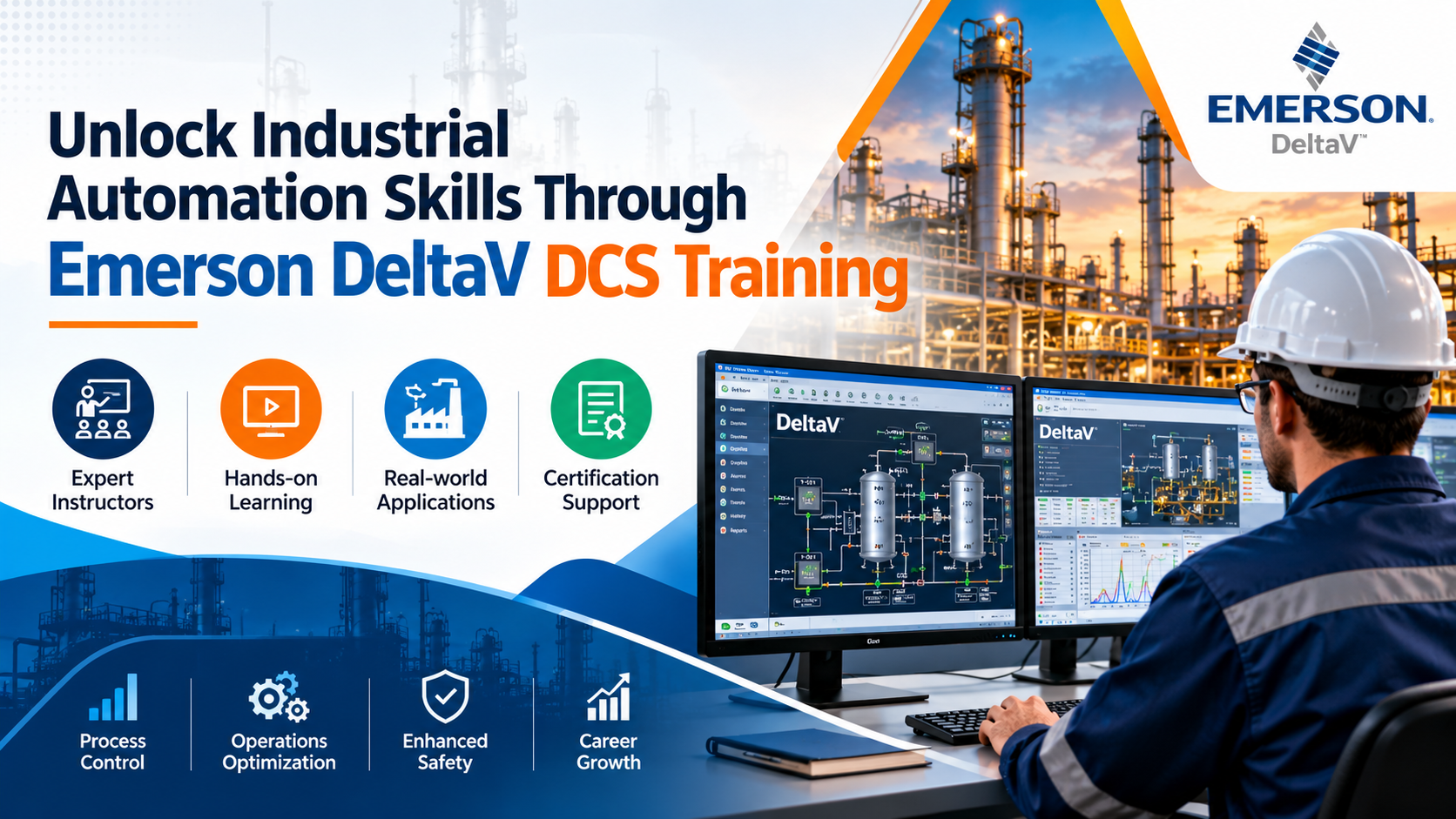
Industrial automation is transforming how modern facilities monitor processes, manage equipment, and maintain operational efficiency. From oil and gas refineries to pharmaceutical manufacturing plants, organizations depend on advanced control systems to maintain consistent production and reliable operations. One important technology in this field is the Emerson DeltaV Distributed Control System (DCS).
Emerson DeltaV DCS Training helps aspiring automation professionals and experienced engineers develop the knowledge required to understand process control, system configuration, operator interfaces, and industrial automation workflows. As industries continue investing in digital transformation, learning DCS technology can be a valuable step toward developing specialized technical skills.
Whether you are an instrumentation engineer, process control engineer, automation technician, or engineering graduate, understanding DeltaV DCS fundamentals can help you prepare for technical responsibilities in process industries.
Emerson DeltaV is a distributed control system designed to monitor and control industrial processes. It connects controllers, input/output devices, engineering applications, and operator interfaces to support coordinated plant operations.
Unlike traditional control approaches that concentrate control functions in a single location, a DCS distributes control responsibilities across interconnected components. This architecture supports flexibility, scalability, and continuous process monitoring.
The DeltaV platform offers capabilities for process control, batch management, system integration, operator visualization, and industrial cybersecurity. These capabilities make it relevant to facilities that require dependable and coordinated process automation.
Professionals pursuing DeltaV DCS training can learn how different system components communicate, how control strategies are implemented, and how operators interact with automated processes.
Industrial facilities require professionals who can understand control systems, interpret process information, and identify potential operational problems. Training provides a structured way to develop these competencies.
DeltaV training introduces learners to distributed control system architecture, controller configuration, process monitoring, and automation fundamentals. These concepts provide a foundation for understanding how industrial equipment operates within an integrated control environment.
Process control involves maintaining variables such as temperature, pressure, flow, and liquid level within defined operating limits. Training helps learners understand control loops, controller behavior, and feedback mechanisms used in industrial applications.
Industrial automation professionals must recognize abnormal conditions and investigate potential causes. Learning system diagnostics, alarm interpretation, and troubleshooting methods can help them approach technical problems systematically.
A structured learning program can support preparation for roles involving control system engineering, instrumentation, commissioning, operations, and maintenance. Actual job requirements depend on the employer, industry, and level of practical experience.
A well-structured Emerson DeltaV DCS training program should cover fundamental concepts before progressing to configuration and application-specific topics. The precise syllabus depends on the learner's experience and the software version being studied.
Understanding system architecture is an essential starting point. Learners explore the relationships between controllers, I/O subsystems, engineering workstations, operator stations, communication networks, and supporting infrastructure.
This knowledge helps professionals understand how process information travels from field instruments to controllers and operator displays.
Control modules organize the logic and parameters used to manage industrial processes. Training may introduce module structures, reusable control strategies, parameter configuration, and function blocks.
Learners can develop an understanding of how engineering configurations translate process requirements into control-system behavior.
Proportional-integral-derivative (PID) control is widely used in industrial process applications. Training can explain the purpose of proportional, integral, and derivative actions and how controller settings influence process stability.
Examples involving temperature, pressure, and flow control can help learners understand the relationship between process measurements, controller outputs, and final control elements.
The human-machine interface (HMI) allows operators to monitor process conditions and interact with control applications.
DeltaV training may introduce operator displays, process graphics, faceplates, trends, and alarm information. Learners can explore how clear visualization supports process awareness and informed operational decisions.
Alarms alert operators to abnormal conditions that require attention. Effective alarm handling involves understanding alarm priorities, acknowledging notifications, investigating causes, and following established operating procedures.
Training can also cover real-time and historical trends to help professionals recognize changes in process behavior.
Batch processing is important in industries where production follows defined sequences or recipes. Examples include pharmaceuticals, specialty chemicals, and food manufacturing.
Depending on the selected course, learners may study batch concepts, equipment modules, recipe structures, phases, and procedural sequences.
System administration involves maintaining configuration integrity, managing user access, monitoring system health, and supporting reliable operation.
Advanced training may address backups, diagnostics, communication problems, software infrastructure, and cybersecurity practices. Administrative procedures should always follow site-specific policies and applicable system documentation.
The relevance of DeltaV DCS extends across several process-oriented industries. Understanding these applications helps learners connect technical concepts with operational requirements.
Refineries and processing facilities use distributed control systems to monitor process variables and coordinate equipment. Control-system knowledge can support work involving process monitoring, instrumentation, and automation maintenance.
Chemical processes often require precise control of temperature, pressure, flow, and reaction conditions. Automation helps maintain repeatable operating conditions and supports consistent production.
Pharmaceutical manufacturing requires controlled production environments, documented procedures, and consistent process execution. Depending on the application, automation systems can support process control, batch operations, and operational visibility.
Food processing facilities use automation to coordinate production stages, monitor equipment, and maintain repeatable manufacturing conditions. Batch control and process monitoring can be particularly relevant to these operations.
Industrial facilities use automation to improve process coordination, monitor equipment performance, and support reliable operations. The specific control-system requirements vary according to the application and facility design.
DeltaV DCS training can benefit professionals who want to develop or strengthen their industrial automation knowledge.
Instrumentation and control engineers: Learn about control-system configuration, process variables, and automation applications.
Automation engineers: Develop knowledge of DCS architecture, control strategies, and system integration.
Electrical and instrumentation technicians: Understand system components, process monitoring, diagnostics, and maintenance concepts.
Process control engineers: Explore controller configuration, control-loop behavior, and process optimization principles.
Plant operators and supervisors: Improve familiarity with operator interfaces, alarm handling, and process monitoring.
Engineering graduates and beginners: Build foundational knowledge of distributed control systems before pursuing more specialized technical responsibilities.
Prior knowledge of instrumentation, industrial processes, and control fundamentals can make advanced topics easier to understand. Beginners should select a program that introduces these concepts before moving into complex configuration exercises.
Online training offers a convenient way to develop technical knowledge without necessarily traveling to a training location. Depending on the provider and course format, learners may access live instruction, demonstrations, practical exercises, or recorded learning resources.
Online sessions can make it easier for working professionals to balance training with existing responsibilities. Live instructor-led classes also provide opportunities to ask questions and discuss technical concepts.
Demonstrations can help learners understand system navigation, configuration workflows, and troubleshooting approaches. Where a suitable training environment is available, practical exercises can reinforce theoretical knowledge.
Learning DCS fundamentals can strengthen a professional's technical foundation when combined with relevant engineering education, industrial experience, and hands-on practice.
However, completing a training course does not automatically guarantee employment, professional certification, or authorization to work on a live industrial control system.
Selecting the right program requires more than comparing course duration or price. Consider the following factors before enrolling.
Review the syllabus: Confirm that the course covers your objectives, whether they involve operations, implementation, configuration, administration, or troubleshooting.
Check the trainer's experience: Look for instructors who understand industrial automation applications and can explain concepts through practical examples.
Evaluate hands-on opportunities: Ask whether the program includes software demonstrations, simulation exercises, or access to an appropriate training environment.
Confirm the software version: DeltaV capabilities and interfaces can vary across releases. Ensure that the course content aligns with your learning requirements and intended work environment.
Understand the delivery format: Check whether the program offers live online instruction, self-paced learning, classroom training, or a blended approach.
Verify certification details: Determine whether the certificate is a course-completion credential or an official vendor-issued certification. These credentials are not necessarily equivalent.
A careful comparison helps learners choose a program that matches their current experience and long-term professional goals.
Industrial automation is evolving alongside industrial data analytics, virtualization, cybersecurity, advanced process control, and artificial intelligence. Modern control environments increasingly combine operational technology with secure data integration and digital tools.
For DeltaV professionals, this creates opportunities to expand their knowledge beyond basic control configuration. Relevant areas include control-system cybersecurity, industrial networking, system virtualization, process analytics, and integration with manufacturing applications.
These technologies do not eliminate the importance of fundamental engineering knowledge. Understanding control loops, process behavior, instrumentation, and system architecture remains essential when evaluating advanced automation solutions.
Professionals who combine these fundamentals with practical experience and continuous learning can better prepare themselves for changing industrial requirements.
Emerson DeltaV DCS training teaches learners about distributed control system architecture, process monitoring, controller configuration, operator interfaces, and related industrial automation concepts. Advanced courses may cover implementation, batch control, administration, and troubleshooting.
Yes. Beginners can start with introductory courses covering industrial automation, instrumentation fundamentals, DCS architecture, and basic process control. Advanced configuration topics are easier to understand after establishing this foundation.
Depending on the syllabus, learners may develop knowledge of system architecture, control modules, PID control, operator displays, alarms, batch processing, diagnostics, and system administration.
Course duration varies according to the subject, learner experience, and delivery format. Individual operator, implementation, administration, and advanced control courses may have different durations. Review the specific syllabus to determine the time commitment required.
No training program can guarantee employment. However, relevant technical knowledge, practical experience, engineering qualifications, and strong problem-solving skills can help candidates prepare for suitable industrial automation roles.
No. A distributed control system and supervisory control and data acquisition system have different traditional architectures and application priorities, although their capabilities can overlap. DCS platforms commonly support integrated control in process plants, while SCADA systems are frequently used for supervisory monitoring across geographically distributed assets.
Developing expertise in distributed control systems can help professionals understand modern industrial processes, strengthen technical capabilities, and prepare for evolving automation requirements. Emerson DeltaV DCS Training provides a structured learning pathway for exploring system architecture, control strategies, operator interfaces, and troubleshooting fundamentals. Choosing the right program, practicing with appropriate training environments, and continuing to build practical knowledge are essential steps toward professional growth. For learners and organizations seeking structured technical training, Multisoft Virtual Academy offers industrial automation learning opportunities designed to support skill development and help professionals build a stronger foundation in process control and DCS technologies.
| Start Date | Time (IST) | Day | |||
|---|---|---|---|---|---|
| 17 Oct 2026 | 06:00 PM - 10:00 AM | Sat, Sun | |||
| 18 Oct 2026 | 06:00 PM - 10:00 AM | Sat, Sun | |||
| 24 Oct 2026 | 06:00 PM - 10:00 AM | Sat, Sun | |||
| 25 Oct 2026 | 06:00 PM - 10:00 AM | Sat, Sun | |||
|
Schedule does not suit you, Schedule Now! | Want to take one-on-one training, Enquiry Now! |
|||||






 Join our Live Instructor-Led online classes delivered by industry experts
 Let's Get Started