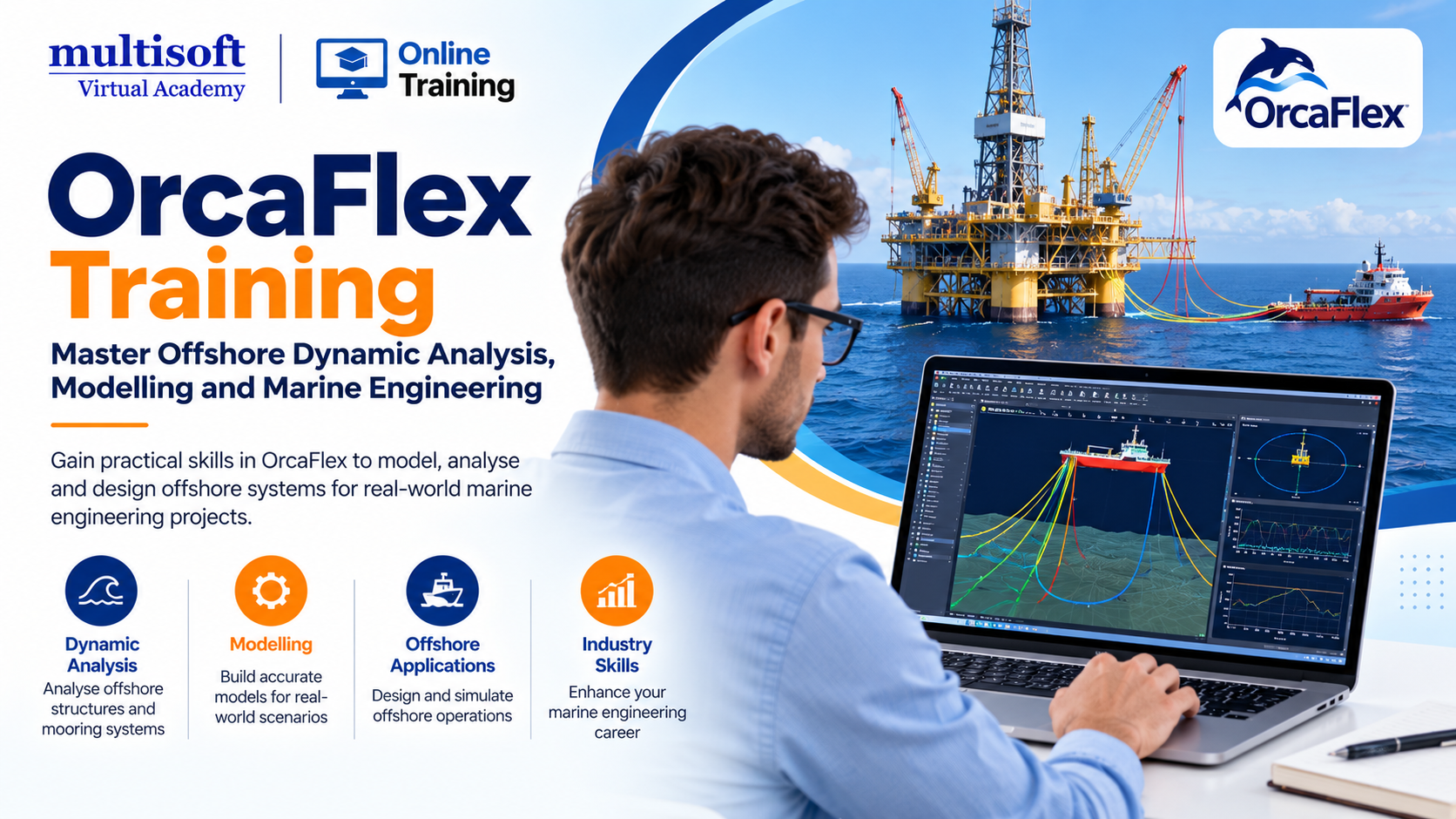
Offshore and marine engineering projects demand accurate analysis of complex systems exposed to waves, wind, currents, vessel motion, and changing environmental conditions. Engineers working with risers, mooring systems, pipelines, subsea equipment, cables, floating structures, and offshore renewable systems need reliable simulation skills to evaluate system behaviour before construction or deployment.
OrcaFlex Training provides an opportunity for engineers and technical professionals to develop practical knowledge of offshore system modelling and dynamic analysis using OrcaFlex. The software supports static and dynamic analysis of a wide range of marine systems and includes capabilities for time-domain and frequency-domain analysis, fatigue assessment, vessel modelling, contact analysis, automation, and more.
As offshore energy and marine infrastructure continue to evolve, knowledge of engineering simulation software is becoming increasingly valuable. A structured OrcaFlex course can help professionals understand how to create models, define environmental conditions, perform simulations, interpret results, and apply engineering judgement to analysis outcomes.
OrcaFlex is an engineering software package designed for the analysis and simulation of offshore marine systems. It is widely used for applications involving risers, moorings, pipelines, installation operations, towed systems, marine renewables, and other offshore engineering scenarios.
The software can perform three-dimensional nonlinear analysis involving large displacements and coupled tension, bending, and torsion. It also supports vessel and line coupling, hydrodynamic modelling, seabed interaction, fatigue analysis, modal analysis, and various automation interfaces.
For engineers, learning OrcaFlex is therefore not simply about understanding software menus. Effective OrcaFlex modelling training should connect software functionality with engineering principles, project requirements, modelling assumptions, and interpretation of simulation results.
Modern offshore projects involve highly dynamic environments. A small change in environmental loading, line configuration, water depth, vessel motion, or material property can influence the response of an offshore system.
Engineers need to understand how these variables affect structural and hydrodynamic behaviour.
A comprehensive OrcaFlex Training program can help professionals learn how to:
OrcaFlex supports several analysis approaches, including static, modal, time-domain dynamic, frequency-domain dynamic, restart, and fatigue analysis.
This makes practical software knowledge particularly useful for engineers involved in offshore design, installation, operations, and verification.
A well-structured OrcaFlex course should progress from fundamental concepts to application-based modelling. Beginners need to understand the interface and modelling workflow, while experienced engineers may require more advanced capabilities such as automation, fatigue analysis, coupled systems, or Python integration.
The first stage of learning normally involves understanding the OrcaFlex interface, model structure, objects, data forms, visualisation tools, and basic workflow.
Participants can learn how different model components interact and how to establish an organised simulation model.
This foundation is important because accurate results depend heavily on correctly defined model inputs.
Offshore systems operate under changing environmental conditions. Therefore, OrcaFlex modelling training should include waves, wind, current, seabed characteristics, vessel motion, and other relevant environmental parameters.
Engineers can learn how environmental inputs influence system response and how appropriate assumptions should be selected for a particular engineering scenario.
Static analysis establishes the equilibrium configuration of an offshore system before dynamic loading is considered.
Understanding static equilibrium is particularly important for risers, moorings, cables, and other flexible line systems because the initial configuration can influence subsequent dynamic behaviour.
Dynamic analysis is one of the most important components of OrcaFlex training.
The software provides nonlinear time-domain analysis and frequency-domain capabilities for evaluating offshore system response.
Training can introduce engineers to simulation setup, environmental loading, time histories, response interpretation, and analysis validation.
Professionals can learn to examine parameters such as displacement, velocity, acceleration, tension, curvature, and other relevant engineering results.
Riser systems are exposed to complex loading caused by vessel movement, waves, currents, buoyancy, internal contents, and structural characteristics.
OrcaFlex is used for analysing various riser configurations, including steel catenary risers, tensioned risers, flexible risers, hybrid systems, and umbilicals.
A specialised OrcaFlex riser analysis course can help professionals understand:
These skills can be valuable for engineers working in offshore oil and gas, subsea engineering, floating production systems, and marine infrastructure.
Mooring systems play a critical role in maintaining the position and stability of floating offshore structures.
OrcaFlex supports different mooring applications, including spread moorings, turret moorings, single-point moorings, jetty systems, and oceanographic moorings.
Through OrcaFlex mooring analysis training, engineers can learn how to model mooring lines, define line properties, establish environmental conditions, assess tensions, and examine system behaviour.
The ability to interpret mooring analysis results can support engineering decisions related to station keeping, line performance, and operational safety.
Offshore installation activities involve significant engineering challenges. Pipelines, risers, cables, anchors, and subsea equipment may experience changing loads during deployment.
OrcaFlex supports applications such as pipelay analysis, riser installation, cable lay dynamics, anchor and mooring deployment, through-splash-zone deployment, and deep-water installation scenarios.
Consequently, OrcaFlex installation analysis training can be useful for professionals involved in offshore construction and installation engineering.
Training can focus on model preparation, installation configuration, environmental conditions, operational scenarios, and interpretation of installation loads.
The offshore energy industry is expanding beyond conventional oil and gas applications. Floating offshore wind, subsea cables, marine renewable systems, and other emerging technologies require advanced engineering analysis.
OrcaFlex includes capabilities for modelling and analysing offshore renewable systems, including fully coupled wind turbine analysis.
This creates an opportunity for engineers to expand their skills through OrcaFlex offshore wind training and apply dynamic modelling concepts to floating renewable energy systems.
As offshore wind projects become increasingly complex, professionals who understand both offshore engineering principles and simulation workflows can strengthen their technical capabilities.
Engineering teams frequently need to perform large numbers of simulations. Manually preparing every model and extracting every result can consume considerable time.
OrcaFlex provides automation capabilities and interfaces for technologies including Python, MATLAB, and DLL-based integrations. It also supports batch processing and automated pre- and post-processing workflows.
This makes OrcaFlex Python training a valuable advanced skill for engineers who want to automate repetitive tasks.
For example, Python can be used to support workflows involving:
Dedicated OrcaFlex training resources also identify Python-based pre-processing and post-processing as advanced topics for users who already have experience with OrcaFlex.
Fatigue is an important consideration for offshore structures exposed to repeated loading.
OrcaFlex provides fatigue analysis capabilities, including different approaches for calculating fatigue damage and support for S-N and T-N curve-based assessments.
An OrcaFlex fatigue analysis course can introduce professionals to the relationship between dynamic response, stress or tension ranges, fatigue curves, and calculated damage.
Understanding the results is as important as producing them. Engineers should be able to recognise unrealistic outputs, review assumptions, and determine whether a model appropriately represents the engineering problem.
OrcaFlex Training can be useful for a broad range of engineering professionals, including:
It can also benefit engineering graduates who want to develop specialised skills in offshore dynamic analysis.
The appropriate training level depends on the learner's existing knowledge. Beginner-level programs can introduce fundamental modelling concepts, while advanced courses can focus on coupled analysis, automation, fatigue, Python, offshore wind, or project-specific applications.
When selecting an OrcaFlex online training program, learners should look beyond the course title.
A useful program should combine software demonstrations with practical exercises and engineering examples.
Consider the following factors:
The course should provide opportunities to create and modify actual OrcaFlex models rather than focusing only on theoretical explanations.
Look for training that covers applications relevant to your career, such as risers, moorings, pipelines, installation, offshore wind, or subsea systems.
The curriculum should explain how to configure and interpret dynamic simulations.
Generating simulation results is only one part of engineering analysis. Learners should understand how to review graphs, statistics, time histories, and other outputs.
For experienced users, Python and other automation capabilities can significantly improve productivity.
Training delivered by professionals with practical engineering and software experience can make complex topics easier to understand and apply.
Developing OrcaFlex skills can complement an existing offshore or marine engineering career.
Professionals may apply these capabilities in roles involving:
However, software training should be considered one component of professional development. Strong fundamentals in mechanics, hydrodynamics, offshore engineering, structural behaviour, and numerical analysis remain important for producing meaningful engineering results.
A practical learning strategy can make the training experience more effective.
Start with simple models before moving into complicated offshore systems. Learn how each modelling parameter affects the result instead of changing multiple inputs at the same time.
Next, practise static analysis and then progress to dynamic simulations. Once the fundamentals are clear, explore specialised areas such as riser analysis, mooring systems, fatigue, installation analysis, or offshore wind.
Finally, introduce automation. Python-based workflows can help experienced users handle repetitive analysis tasks and large datasets.
Most importantly, always validate assumptions. A technically correct software operation does not automatically guarantee an engineering-correct model.
Offshore engineering is becoming increasingly data-driven and simulation-oriented. Floating wind farms, complex subsea infrastructure, deep-water developments, advanced mooring configurations, and challenging installation projects require engineers to evaluate multiple scenarios efficiently.
Software platforms such as OrcaFlex provide capabilities for nonlinear modelling, dynamic analysis, fatigue assessment, hydrodynamic interaction, automation, and complex offshore applications.
At the same time, engineering teams are increasingly interested in automation and programmatic workflows. Combining OrcaFlex training with Python, data analysis, and engineering fundamentals can therefore provide a valuable technical skill set for modern offshore professionals.
OrcaFlex Training can be a valuable step for professionals who want to strengthen their capabilities in offshore dynamic analysis, marine system modelling, riser analysis, mooring analysis, pipelay, installation engineering, fatigue assessment, offshore wind, and engineering automation. The right learning approach should combine software knowledge with practical engineering concepts, realistic modelling exercises, result interpretation, and project-oriented problem solving. For professionals seeking structured learning and industry-focused skill development, Multisoft Virtual Academy acts as a service provider offering training support designed to help learners develop practical OrcaFlex knowledge and apply it more confidently in offshore and marine engineering environments.
| Start Date | Time (IST) | Day | |||
|---|---|---|---|---|---|
| 10 Oct 2026 | 06:00 PM - 10:00 AM | Sat, Sun | |||
| 11 Oct 2026 | 06:00 PM - 10:00 AM | Sat, Sun | |||
| 17 Oct 2026 | 06:00 PM - 10:00 AM | Sat, Sun | |||
| 18 Oct 2026 | 06:00 PM - 10:00 AM | Sat, Sun | |||
|
Schedule does not suit you, Schedule Now! | Want to take one-on-one training, Enquiry Now! |
|||||






 Join our Live Instructor-Led online classes delivered by industry experts
 Let's Get Started