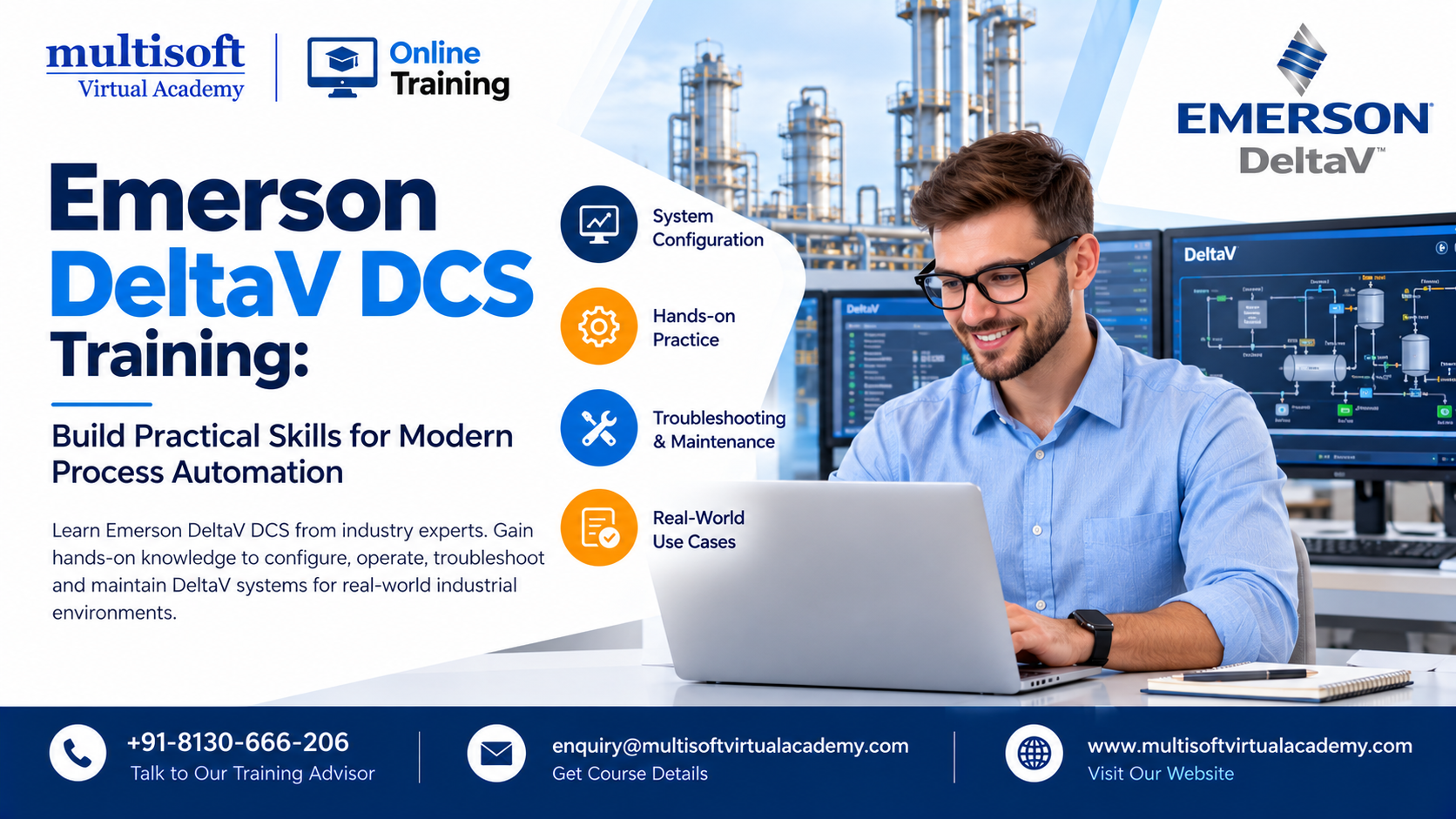
Industrial automation is evolving rapidly as process industries demand safer operations, better productivity, stronger cybersecurity, and more reliable control systems. Among the technologies supporting these requirements, Emerson DeltaV DCS remains an important platform for process control, plant operations, safety, and automation.
Emerson DeltaV DCS Training can help engineers and automation professionals understand how a distributed control system is designed, configured, operated, maintained, and troubleshot in industrial environments. Modern DeltaV learning can also extend into areas such as batch control, advanced control, virtualization, cybersecurity, SIS, communication interfaces, and newer controller and I/O technologies.
Emerson itself provides DeltaV education across DCS, SIS, and MES, with learning options that include instructor-led, virtual classroom, eLearning, and blended formats.
A Distributed Control System, or DCS, is designed to monitor and control complex industrial processes through interconnected controllers, engineering stations, operator workstations, I/O systems, and communication networks.
Emerson DeltaV is a modern DCS platform used for process automation and control. It supports applications across process industries where continuous monitoring, control, safety, data visibility, and operational reliability are essential. Emerson describes DeltaV as a scalable process-control platform designed to improve productivity and operational performance.
For professionals, understanding DeltaV is not simply about learning software menus. Effective training should explain how engineering concepts translate into real control-system implementation.
Industrial plants depend on automation engineers and control professionals to configure systems correctly and respond quickly when problems occur. A strong DeltaV DCS course therefore needs to combine theoretical concepts with practical engineering knowledge.
A structured Emerson DeltaV training course can help learners understand:
Emerson's training curriculum itself includes role-oriented learning for control system engineers, administrators, operators, technicians, and other plant personnel. Emerson.com
The first step in mastering DeltaV is understanding its architecture. Learners need to know how controllers, workstations, servers, I/O subsystems, engineering stations, operator stations, and networks interact.
Understanding architecture provides the foundation for configuration, troubleshooting, system administration, and maintenance.
System configuration is a core competency for DeltaV professionals. Training can introduce learners to the engineering environment, system hierarchy, nodes, controllers, modules, users, and security settings.
This knowledge becomes particularly valuable for engineers involved in new implementations, plant expansions, migrations, and system modifications.
Control strategy development is one of the most important areas of DeltaV DCS training.
Learners can explore control modules, function blocks, parameters, process variables, interlocks, logic, and control strategies. Practical exercises can help engineers understand how a control requirement is transformed into a functional DeltaV configuration.
Operators require clear and meaningful information to monitor plant conditions and respond to process changes.
DeltaV training can cover operator graphics, process displays, trends, alarms, faceplates, and other visualization concepts. Effective HMI design helps operators understand process conditions quickly and make informed decisions.
Poorly managed alarms can create unnecessary workload for operators and make critical events harder to recognize.
A comprehensive Emerson DeltaV DCS Training program should introduce alarm configuration, priorities, notifications, event handling, and alarm-management practices. Learners can gain a better understanding of how alarm information supports safe and efficient plant operations.
Many industries rely on batch manufacturing, including pharmaceuticals, chemicals, food processing, and specialty manufacturing.
DeltaV provides capabilities for batch applications, and training can help professionals understand recipes, equipment modules, phases, procedures, and batch-related configuration.
Emerson's published DeltaV training curriculum includes dedicated batch implementation and operator training pathways.
Software expertise alone is not enough for a DCS engineer. Professionals also need to understand the hardware that connects control strategies with field equipment.
Current DeltaV technologies include controllers and different I/O options, including CHARMs and newer controller technologies. Emerson's current portfolio highlights flexible I/O, Electronic Marshalling, Ethernet-based connectivity, and modern controller architectures.
The DeltaV PK Controller is an important modern topic for professionals keeping their skills aligned with current DeltaV developments.
According to Emerson, the PK Controller can operate as a standalone solution or integrate into a larger DeltaV system. It supports flexible I/O options, including traditional I/O, CHARMs I/O, and wireless I/O.
Learning about these technologies can help engineers understand how modern control architectures are designed and expanded.
Process automation and process safety increasingly overlap in modern industrial facilities. DeltaV therefore connects with safety-related technologies and Safety Instrumented Systems (SIS).
Professionals working in process automation can benefit from understanding the relationship between the DCS and SIS, including safety logic, shutdown functions, safety instrumentation, and system integration.
Emerson's DeltaV portfolio includes integrated DCS and SIS capabilities, while its training offerings provide dedicated SIS learning pathways.
Cybersecurity has become a major consideration for industrial control systems. Modern DCS environments are increasingly connected to enterprise networks, remote services, data platforms, and other operational technologies.
A DeltaV cybersecurity course can help professionals understand access management, system security, network considerations, secure configuration, and cybersecurity practices relevant to control-system environments.
Emerson's DeltaV training catalog includes dedicated cybersecurity learning, demonstrating the growing importance of this area within DCS education.
Simulation can provide an effective way to test control configurations before commissioning.
DeltaV Simulate supports configuration, display development, application simulation, and testing without requiring the complete physical control-system environment. Emerson also describes simulation capabilities for operator training and SIS testing. Emerson.com
This makes DeltaV simulation training particularly useful for engineers who want to understand configuration validation, testing, and commissioning workflows.
This training can be valuable for professionals working in:
It can also be useful for engineering graduates who want to develop specialized skills in DCS automation training and process-control technologies.
Rather than focusing only on theoretical definitions, practical learning helps professionals understand how control systems operate in real industrial scenarios.
DCS engineers frequently need to identify configuration, communication, hardware, or control-logic problems. Structured troubleshooting practice can improve diagnostic confidence.
From system configuration and control strategy development to testing, commissioning, operation, and maintenance, DeltaV knowledge can provide a broader view of the automation lifecycle.
Current DeltaV developments include newer controllers, flexible I/O, cybersecurity, virtualization, advanced control, and digital technologies. Keeping up with these areas can help professionals maintain relevant technical skills. Emerson currently highlights DeltaV Version 16.LTS as a major evolution of its DCS platform.
Not every DeltaV training online program provides the same depth. Before selecting a course, learners should evaluate the curriculum carefully.
Look for a program that includes:
Practical configuration: Training should explain how to configure and modify a DeltaV environment.
Hands-on exercises: Practical tasks are particularly valuable for technical subjects such as DCS engineering.
Real-world scenarios: Case studies can help connect concepts with industrial applications.
Troubleshooting: The course should address common configuration, communication, hardware, and operational problems.
Modern technologies: Look for topics such as cybersecurity, virtualization, simulation, SIS, controllers, and modern I/O.
Flexible learning: Online, instructor-led, virtual classroom, or blended options can make professional development easier alongside work.
Emerson itself offers multiple learning formats, including virtual classroom, eLearning, classroom, and blended approaches.
Specialized DCS expertise can be valuable for professionals building careers in industrial automation and process control. Employers working with chemical plants, oil and gas facilities, pharmaceuticals, power generation, manufacturing, and other process industries require professionals who understand automation systems and plant operations.
However, completing a course alone does not guarantee employment or certification. Career growth generally depends on a combination of technical knowledge, practical project experience, engineering fundamentals, problem-solving ability, and continuous learning.
Professionals can strengthen their profiles by combining DeltaV DCS training with related knowledge in instrumentation, PLC, SCADA, process control, industrial networking, SIS, cybersecurity, and automation engineering.
The industrial automation landscape is moving toward more connected and intelligent operations. Professionals should therefore consider expanding their learning beyond traditional DCS configuration.
Relevant areas include:
These areas complement DCS knowledge and can help professionals understand the broader automation ecosystem.
Emerson DeltaV DCS Training is a technical learning program focused on the architecture, configuration, operation, maintenance, troubleshooting, and engineering of DeltaV Distributed Control Systems.
The difficulty depends on your previous knowledge of instrumentation, process control, automation, and control systems. Beginners can start with fundamental DCS concepts before progressing into configuration and advanced engineering topics.
Automation engineers, instrumentation engineers, process-control professionals, DCS engineers, maintenance personnel, commissioning engineers, operators, system administrators, and engineering graduates can benefit from DeltaV training.
A strong program should include practical exercises, demonstrations, simulations, configuration tasks, and real-world scenarios. These activities help learners translate theoretical knowledge into engineering skills.
Yes. Online and virtual learning can provide flexibility for working professionals. The effectiveness depends on the quality of instruction, practical exercises, curriculum depth, and access to appropriate learning resources.
As industrial facilities continue adopting smarter, safer, and more connected automation technologies, expertise in distributed control systems is becoming increasingly valuable. Emerson DeltaV DCS Training can provide professionals with a structured path to understand DCS architecture, configuration, process control, troubleshooting, simulation, cybersecurity, SIS, and modern automation technologies. For learners seeking practical, career-oriented DeltaV DCS training, Multisoft Virtual Academy can serve as a training provider focused on developing relevant technical knowledge through structured learning and industry-oriented training. The right combination of technical education, hands-on practice, and continuous skill development can help professionals build stronger capabilities for modern process automation environments.
| Start Date | Time (IST) | Day | |||
|---|---|---|---|---|---|
| 03 Oct 2026 | 06:00 PM - 10:00 AM | Sat, Sun | |||
| 04 Oct 2026 | 06:00 PM - 10:00 AM | Sat, Sun | |||
| 10 Oct 2026 | 06:00 PM - 10:00 AM | Sat, Sun | |||
| 11 Oct 2026 | 06:00 PM - 10:00 AM | Sat, Sun | |||
|
Schedule does not suit you, Schedule Now! | Want to take one-on-one training, Enquiry Now! |
|||||






 Join our Live Instructor-Led online classes delivered by industry experts
 Let's Get Started