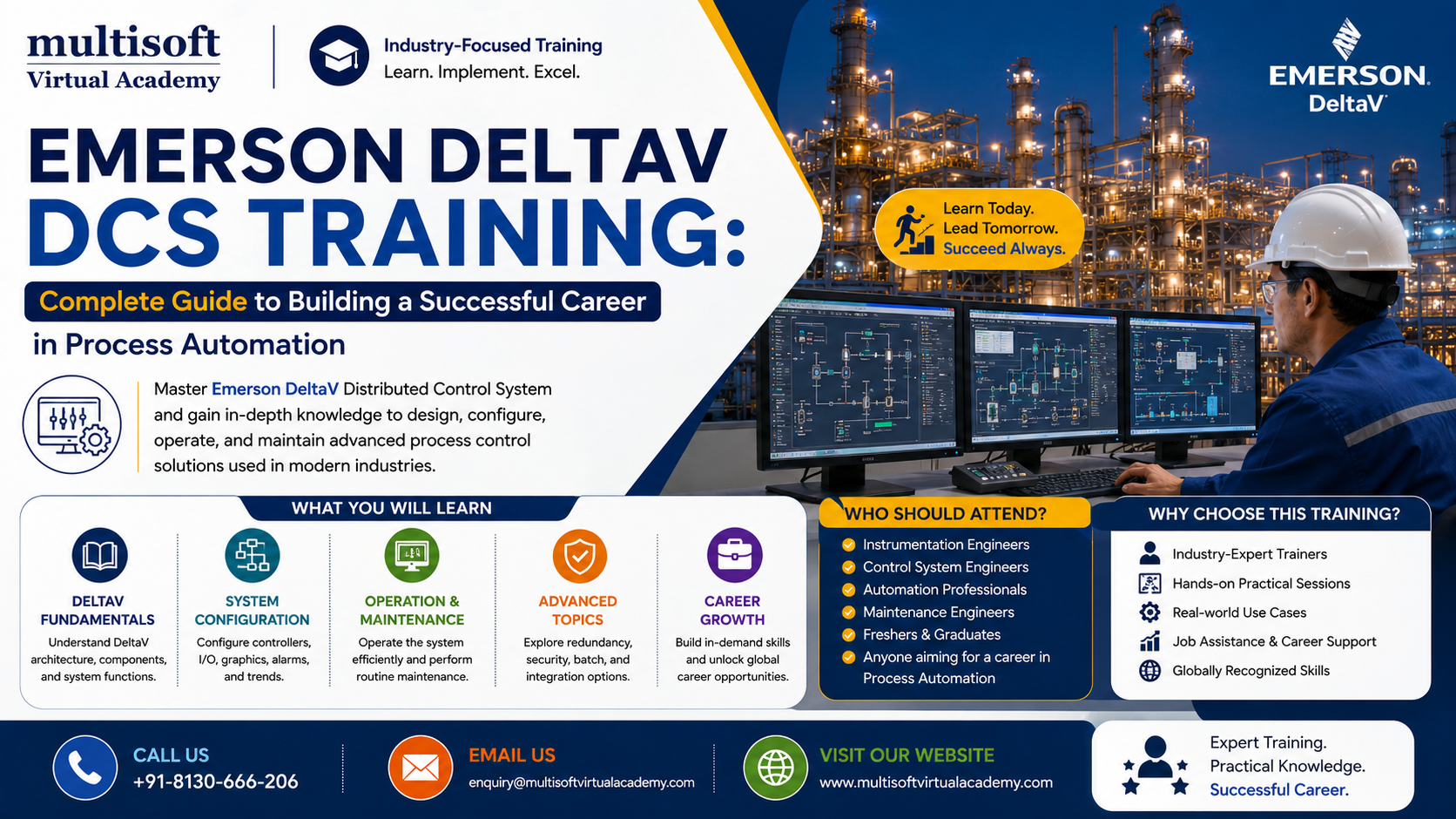
Industrial automation has become the backbone of modern manufacturing, enabling organizations to improve productivity, reduce operational costs and maintain consistent product quality. Among the leading automation platforms used worldwide, Emerson DeltaV DCS Training has gained significant recognition for preparing professionals to manage sophisticated process control systems across various industries. Whether you are an engineering student, automation professional or plant operator, mastering the DeltaV Distributed Control System (DCS) can significantly enhance your career prospects in today's competitive industrial landscape.
As industries embrace digital transformation, the demand for skilled automation engineers continues to rise. Learning the Emerson DeltaV platform equips professionals with practical knowledge of process automation, distributed control systems, process instrumentation and industrial communication networks. This comprehensive guide explores everything you need to know about Emerson DeltaV DCS Training, its applications, career opportunities and why obtaining professional training can make a remarkable difference in your professional journey.
Emerson DeltaV Distributed Control System (DCS) is an advanced automation platform developed to monitor, control and optimize industrial processes in real time. It integrates hardware, software and intelligent field devices into a single automation ecosystem that helps industries improve efficiency, reliability and safety.
Unlike conventional control systems, DeltaV offers centralized monitoring, intuitive engineering tools and seamless communication between field instruments and control stations. This enables engineers to manage complex industrial operations with greater accuracy while minimizing downtime and operational risks.
Today, DeltaV is widely deployed across numerous industries including:
Its scalable architecture allows organizations of every size to automate both simple and highly complex manufacturing operations.
The rapid adoption of Industry 4.0 technologies has significantly increased the need for professionals skilled in process automation. Organizations are investing in intelligent manufacturing systems that require engineers capable of configuring, maintaining and optimizing DeltaV environments.
Professionals who complete Emerson DeltaV DCS Training develop expertise in:
These practical skills make professionals valuable assets for manufacturing companies worldwide.
A Distributed Control System is an industrial automation system designed to control multiple interconnected processes from centralized control stations.
Instead of relying on one centralized controller, DCS distributes intelligence across various controllers located throughout the plant. This architecture provides:
The DeltaV platform is considered one of the most user-friendly DCS solutions available today because of its intuitive engineering environment and flexible configuration capabilities.
DeltaV simplifies engineering tasks through drag-and-drop configuration tools, reducing engineering time while improving project accuracy.
The platform combines controllers, operator workstations, engineering stations, field devices and asset management into one unified environment.
Its redundant architecture ensures continuous plant operation even if one controller or communication path experiences failure.
Operators receive prioritized alarms that help them quickly identify abnormal conditions and take corrective action before problems escalate.
Engineers can continuously monitor process variables, equipment performance and production efficiency using graphical dashboards and trend analysis.
Whether implementing automation for a small production unit or a multi-site manufacturing facility, DeltaV easily scales according to business requirements.
Modern DeltaV systems include built-in security features that help protect industrial control systems from cyber threats while maintaining regulatory compliance.
Professional training generally introduces learners to every important module of the DeltaV ecosystem.
Used for creating plant hierarchy, assigning controllers and managing system configurations.
The engineering environment where automation logic, control modules and function blocks are configured.
Provides operators with graphical process displays, alarms, trends and real-time monitoring capabilities.
Stores historical plant data for performance analysis, troubleshooting and reporting.
Supports ISA-88 compliant batch process automation widely used in pharmaceutical and food manufacturing industries.
Helps engineers identify faults, communication issues and controller performance problems efficiently.
Allows intelligent field instruments to be monitored and maintained directly from the automation system.
A professionally designed training program focuses on both theoretical understanding and practical implementation.
After completing the course, learners typically gain expertise in:
These competencies prepare professionals for real-world industrial automation projects.
The growing need for automation has created numerous employment opportunities across multiple sectors.
Professionals trained in DeltaV are commonly recruited by:
Many multinational organizations actively seek engineers with hands-on DeltaV expertise because of the platform's widespread adoption.
Learning DeltaV opens doors to various technical and managerial roles within industrial automation.
Popular career paths include:
As industries continue investing in smart manufacturing and digital transformation, the demand for these roles is expected to remain strong across global markets.
The industrial sector is undergoing a major transformation driven by automation, artificial intelligence, Industrial Internet of Things (IIoT) and smart manufacturing. Organizations are modernizing their production facilities to achieve higher productivity, reduce downtime and improve operational efficiency. As a result, professionals with expertise in Emerson DeltaV DCS Training are becoming increasingly valuable across industries.
DeltaV is continuously evolving to support advanced technologies such as cloud connectivity, predictive maintenance, advanced analytics and digital twins. Engineers who understand these technologies will be better positioned to contribute to future-ready manufacturing environments.
In the coming years, DeltaV professionals are expected to play a significant role in:
With industries investing heavily in automation, the demand for trained DeltaV professionals is expected to remain strong for years to come.
Professionals with DeltaV expertise often begin their careers in entry-level engineering roles and gradually move into senior technical or managerial positions. As they gain experience with plant operations, commissioning, maintenance and process optimization, they become eligible for more strategic responsibilities.
A typical career progression may include:
Professionals with additional knowledge of PLC, SCADA, Industrial Networking, Safety Instrumented Systems (SIS) and process instrumentation can further strengthen their career prospects.
The adoption of Emerson DeltaV continues to expand across multiple industrial sectors due to its reliability, scalability and advanced process control capabilities. Organizations investing in modern automation technologies often seek professionals with hands-on DeltaV knowledge.
Major industries include:
Automation is essential for upstream, midstream and downstream operations. DeltaV helps improve process safety, production efficiency and asset reliability.
Complex chemical processes require accurate monitoring and control. DeltaV enables stable operations, minimizes process variations and enhances plant performance.
The pharmaceutical industry depends on DeltaV for batch automation, regulatory compliance, cleanroom operations and validated manufacturing processes.
Manufacturers use DeltaV to automate production lines, maintain consistent product quality and comply with food safety standards.
Power plants rely on DeltaV to monitor turbines, boilers, cooling systems and electrical distribution networks.
DeltaV improves process stability, minimizes waste and supports safe handling of hazardous materials.
Automation helps optimize chemical dosing, filtration, pumping systems and environmental compliance.
Industrial automation is highly application-oriented. Employers often prefer professionals who have practical exposure to DeltaV engineering rather than only theoretical knowledge.
Hands-on training helps learners understand how to:
Practical experience enhances confidence and prepares learners to work effectively in live industrial environments.
In addition to Emerson DeltaV expertise, automation professionals should continuously develop complementary technical skills.
Recommended areas include:
Combining these skills with DeltaV expertise can significantly improve employability and long-term career growth.
To maximize learning outcomes, aspiring automation engineers should:
Continuous learning is essential because industrial automation technologies evolve rapidly.
Yes. Emerson DeltaV is implemented by organizations across the globe in industries such as oil and gas, pharmaceuticals, chemicals, food processing, power generation and water treatment.
Basic programming knowledge is helpful but not mandatory. Most DeltaV engineering tasks involve graphical configuration tools and function block programming rather than traditional software coding.
Absolutely. Engineering graduates from electrical, electronics, instrumentation, mechanical, chemical and related disciplines can begin learning DeltaV with foundational automation concepts.
A PLC is generally used for machine-level control and discrete automation, while a Distributed Control System like DeltaV is designed for large-scale continuous process industries that require centralized monitoring, redundancy and advanced process control.
Professionals can enhance their expertise by learning:
Choosing the right training provider plays a vital role in building practical expertise and achieving long-term career success. Multisoft Virtual Academy is recognized for delivering industry-focused online training programs designed by experienced professionals. Through instructor-led sessions, real-world projects, hands-on learning and comprehensive course content, Multisoft Virtual Academy helps learners develop the technical competencies required to excel in industrial automation and process control. If you are looking to build a successful career in automation engineering, enrolling in a structured Emerson DeltaV DCS Training program with Multisoft Virtual Academy can be a valuable step toward achieving your professional goals.
| Start Date | End Date | No. of Hrs | Time (IST) | Day | |
|---|---|---|---|---|---|
| 26 Sep 2026 | 18 Oct 2026 | 24 | 06:00 PM - 09:00 PM | Sat, Sun | |
| 27 Sep 2026 | 19 Oct 2026 | 24 | 06:00 PM - 09:00 PM | Sat, Sun | |
| 03 Oct 2026 | 25 Oct 2026 | 24 | 06:00 PM - 09:00 PM | Sat, Sun | |
| 04 Oct 2026 | 26 Oct 2026 | 24 | 06:00 PM - 09:00 PM | Sat, Sun | |
Schedule does not suit you, Schedule Now! | Want to take one-on-one training, Enquiry Now! |
|||||






 Join our Live Instructor-Led online classes delivered by industry experts
 Let's Get Started