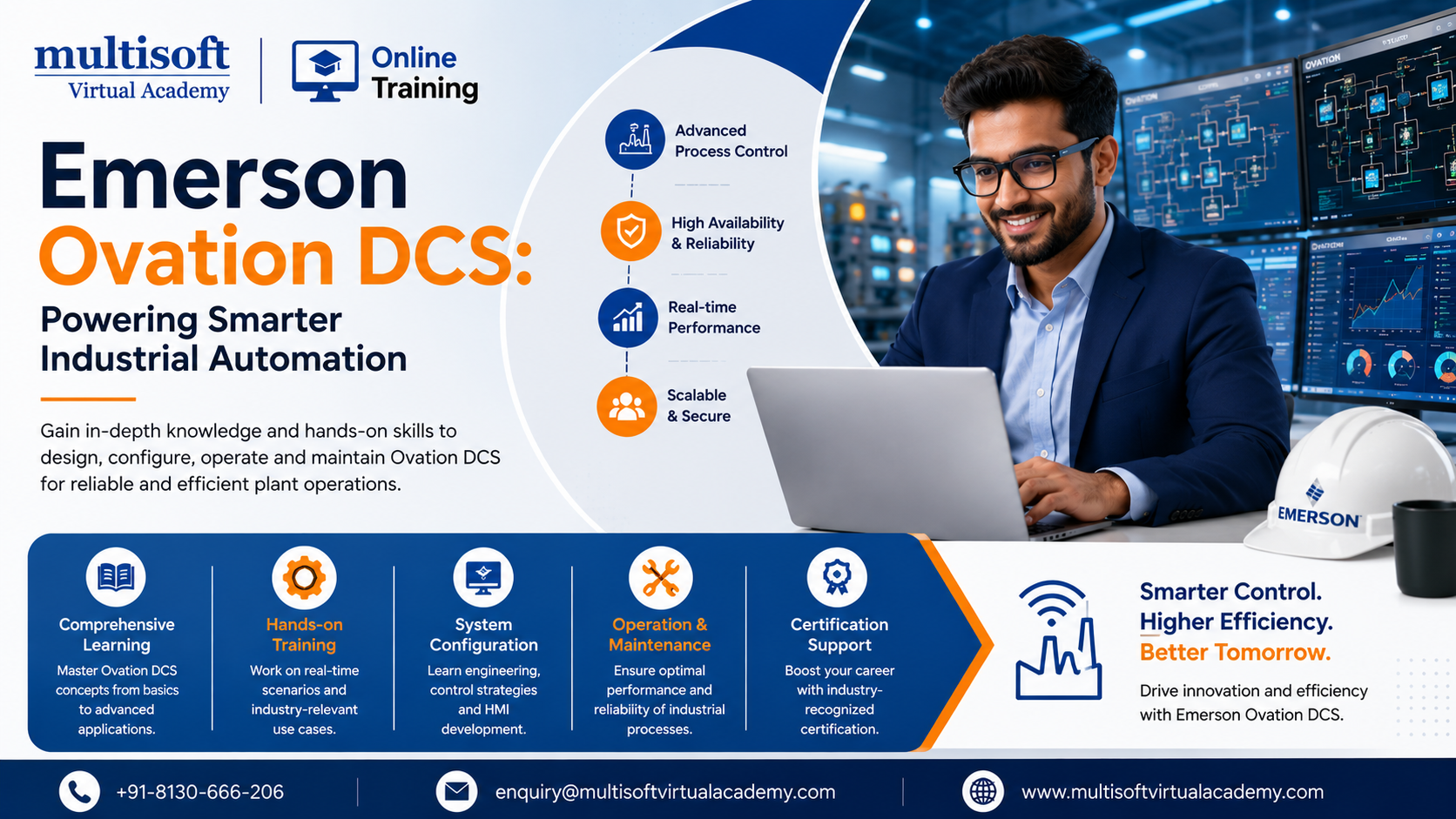
Industrial operations are entering a new era where reliability, cybersecurity, energy efficiency and intelligent automation are becoming essential for long-term performance. Power generation and water infrastructure facilities, in particular, require control systems that can manage complex processes while supporting operational flexibility and modernization.
Emerson Ovation DCS is designed specifically for demanding power generation and water and wastewater applications. It combines distributed control, advanced applications, data management, cybersecurity and digital capabilities to help organizations improve plant performance and make faster operational decisions. Emerson describes Ovation as a purpose-built control platform for critical power and water infrastructure and highlights its scalability and lifecycle-oriented architecture.
Emerson Ovation DCS is a distributed control system developed for industries where continuous operation, process reliability and precise control are critical. Unlike general-purpose automation platforms, Ovation is particularly focused on power generation, renewable energy, water treatment and wastewater operations.
A modern DCS connects field instrumentation, controllers, operator workstations, engineering tools and plant information systems into an integrated automation environment. This enables operators to monitor plant conditions in real time, respond to abnormal situations and control equipment from a centralized operational environment.
Ovation supports applications ranging from conventional power plants to hydroelectric facilities, renewable energy assets, microgrids and water treatment plants. Emerson also positions the platform for modernization projects where facilities need to upgrade control capabilities without necessarily replacing their entire infrastructure.
Power plants are facing increasingly complex operational requirements. Renewable integration, changing load profiles, aging infrastructure, regulatory requirements and workforce challenges are pushing operators to modernize their automation environments.
A capable power plant control system needs to do more than basic process control. It must help operators understand plant conditions, maintain equipment availability and respond efficiently to changing operating requirements.
Ovation addresses these needs through integrated control and advanced applications for areas such as:
Emerson states that its Ovation platform has thousands of installations spanning more than 60 countries and representing more than 1.8 million megawatts of generating capacity.
The foundation of Ovation is its distributed control architecture. Controllers and I/O systems acquire field information and execute control strategies while operators receive real-time information through visualization and monitoring tools.
This architecture supports complex automation requirements while helping operators maintain visibility over critical plant processes.
Modern power facilities need precise control of turbines, boilers, generators and auxiliary systems. Advanced control strategies can help plants respond to changing operating conditions while maintaining process stability.
Ovation includes advanced power applications intended to improve unit operation and performance. Its capabilities can also be adapted to specific applications such as renewable energy and water treatment.
Plant data has become increasingly valuable for operational decision-making. Engineers and management teams need access to both current and historical information to identify performance trends and investigate abnormal conditions.
Ovation Enterprise Data Solutions can aggregate real-time and historical information from Ovation and other systems, supporting plant-wide visibility and data-driven decision-making.
Industrial control systems operate in environments where unexpected downtime can have significant financial and operational consequences.
Ovation is designed around the reliability requirements of critical power and water infrastructure. Its controllers, I/O technologies, diagnostics and system architecture support long-term operational requirements and system expandability.
For organizations managing aging infrastructure, this can make DCS modernization an important strategy for improving reliability without abandoning valuable existing assets.
Power plant automation requires coordination between multiple systems and processes. A control platform must continuously manage variables such as temperature, pressure, flow, steam conditions, electrical parameters and equipment status.
Ovation supports control applications across turbines, boilers and balance-of-plant systems. Emerson also offers dedicated solutions for fossil fuel generation, hydroelectric power and renewable energy operations.
For hydroelectric facilities, for example, Ovation can integrate turbine control, energy management, equipment protection and related automation functions. Emerson reports Ovation installations at more than 1,500 hydroelectric sites across approximately 40 countries.
The transition toward renewable energy is changing how power infrastructure is controlled and managed.
Solar, wind, battery energy storage and distributed generation introduce operational variables that traditional centralized generation models may not have encountered at the same scale. Modern microgrid control systems therefore need to coordinate generation, storage and loads while maintaining electrical stability.
Ovation provides microgrid control capabilities that monitor distributed energy resources, loads and electrical infrastructure. Its architecture can coordinate generation, energy storage and power consumption according to defined operational objectives.
This makes Ovation DCS for renewable energy and Ovation microgrid control increasingly relevant keywords for organizations researching modern power automation technologies.
The value of Ovation extends beyond electricity generation. Water and wastewater facilities also require continuous monitoring, process control and reliable automation.
Water utilities need to manage processes such as treatment, filtration, pumping, chemical dosing and reservoir operations while maintaining quality and controlling energy consumption.
Emerson positions Ovation as a scalable control and monitoring platform for water and wastewater operations. Its solutions can help utilities centralize operational information, optimize processes and improve asset reliability.
Consequently, businesses researching water treatment automation, wastewater automation systems, Ovation DCS for water treatment and industrial process control systems may find Ovation particularly relevant.
Many industrial facilities continue to operate control systems that were installed decades ago. While these systems may still perform their basic functions, aging hardware can create challenges involving spare parts, maintenance, cybersecurity, engineering support and integration with newer technologies.
A complete replacement is not always the only modernization strategy.
Modern DCS platforms can support phased upgrades that allow facilities to modernize selected components while maintaining critical plant operations. Emerson specifically notes that modern control systems such as Ovation can support phased modernization involving components such as HMIs, controllers and I/O.
This makes Emerson Ovation modernization, Ovation DCS migration and power plant DCS upgrade important considerations for organizations planning long-term automation investments.
As industrial control systems become more connected, cybersecurity has become an essential part of automation strategy.
A cybersecurity program for a DCS environment should address endpoint protection, application control, device management, patching, configuration management, vulnerability assessment, monitoring and recovery.
Emerson's Power and Water Cybersecurity Suite is designed for DCS and SCADA environments and includes capabilities such as antivirus protection, application control, configuration management, patch management, rogue system detection, security event management and system backup and recovery.
For critical infrastructure operators, DCS cybersecurity, industrial control system security, SCADA cybersecurity and power plant cybersecurity are therefore increasingly important areas of focus.
Artificial intelligence is becoming one of the most important developments in industrial automation. However, industrial AI must operate within environments where reliability, cybersecurity, operational context and human oversight are critical.
Emerson's newer Ovation capabilities include AI-enabled applications and the Ovation Virtual Advisor, an AI-enabled assistant integrated into the Ovation Automation Platform 4.0. Emerson says the Virtual Advisor provides contextual troubleshooting, operational guidance and decision support for power generation and water/wastewater operations.
This development reflects a broader movement toward AI in industrial automation, AI-powered DCS, predictive analytics for power plants and intelligent process control.
Rather than simply adding generic AI tools to existing workflows, the emerging approach is to connect AI with trusted operational information and engineering knowledge. This can help operators identify problems faster, support troubleshooting and preserve valuable institutional knowledge.
Another important trend in industrial automation is the use of digital twins and simulation.
A power plant digital twin can provide a simulated representation of plant behavior that can be used for operator training, control logic validation and process analysis. This is particularly valuable when plants need to test operational scenarios without disturbing live production.
Emerson's Ovation digital twin technology integrates high-fidelity simulation with the control system and can support operator training and control logic validation.
For organizations dealing with workforce transitions, this capability can also support knowledge transfer and help new operators develop familiarity with complex plant processes.
Choosing a DCS should always depend on the industry's requirements, plant architecture, lifecycle expectations and application objectives.
Emerson itself differentiates its two major DCS platforms based on their target industries. DeltaV is primarily positioned for process industries such as chemicals, refining, life sciences, LNG and other manufacturing environments, while Ovation is focused on power generation, water, renewable energy and related infrastructure applications.
Therefore, organizations searching for the best DCS for power generation should evaluate platforms based on application suitability rather than simply comparing feature lists.
Important evaluation criteria include:
Several trends are influencing the future of distributed control systems.
AI-enabled automation is becoming more prominent as industrial organizations look for better decision support and predictive capabilities.
DCS modernization is also accelerating as aging control infrastructure creates maintenance and cybersecurity challenges.
Renewable energy integration is increasing demand for sophisticated control systems capable of managing variable generation and energy storage.
Microgrid automation is gaining importance as organizations seek greater energy resilience and operational flexibility.
Industrial cybersecurity is becoming inseparable from control system modernization as critical infrastructure faces increasingly complex cyber risks.
Finally, digital twins and remote operations are expanding the ability of engineers and operators to monitor, simulate and optimize industrial assets.
These trends indicate that the next generation of DCS technology will not be limited to traditional process control. It will increasingly combine automation, data, analytics, AI, cybersecurity and lifecycle management within a unified operational environment.
Selecting an experienced service provider is an important step when implementing, upgrading or supporting an industrial automation platform.
Organizations should evaluate a provider's technical understanding, project experience, engineering capabilities and ability to work with the specific requirements of power and water facilities.
A capable provider should understand areas such as Ovation DCS engineering, system configuration, control logic, operator interfaces, I/O architecture, DCS migration, system modernization, troubleshooting, cybersecurity and operator training.
It is also important to consider post-implementation support. A DCS is a long-term operational investment, so engineering assistance, maintenance support, upgrades and workforce competency can have a major impact on the value achieved from the system.
Emerson Ovation DCS represents an important approach to modern automation for power generation, renewable energy, water and wastewater infrastructure. Its combination of distributed control, advanced applications, data management, cybersecurity, simulation and emerging AI capabilities makes it relevant to organizations pursuing reliability, efficiency and long-term digital transformation. As plants modernize aging infrastructure and adapt to increasingly dynamic energy and operational requirements, choosing the right technology and implementation expertise becomes essential. Multisoft Virtual Academy acts as a professional service provider, helping organizations and professionals build practical knowledge around industrial automation technologies and develop the skills needed to understand, implement and support modern DCS environments.
| Start Date | Time (IST) | Day | |||
|---|---|---|---|---|---|
| 10 Oct 2026 | 06:00 PM - 10:00 AM | Sat, Sun | |||
| 11 Oct 2026 | 06:00 PM - 10:00 AM | Sat, Sun | |||
| 17 Oct 2026 | 06:00 PM - 10:00 AM | Sat, Sun | |||
| 18 Oct 2026 | 06:00 PM - 10:00 AM | Sat, Sun | |||
|
Schedule does not suit you, Schedule Now! | Want to take one-on-one training, Enquiry Now! |
|||||






 Join our Live Instructor-Led online classes delivered by industry experts
 Let's Get Started