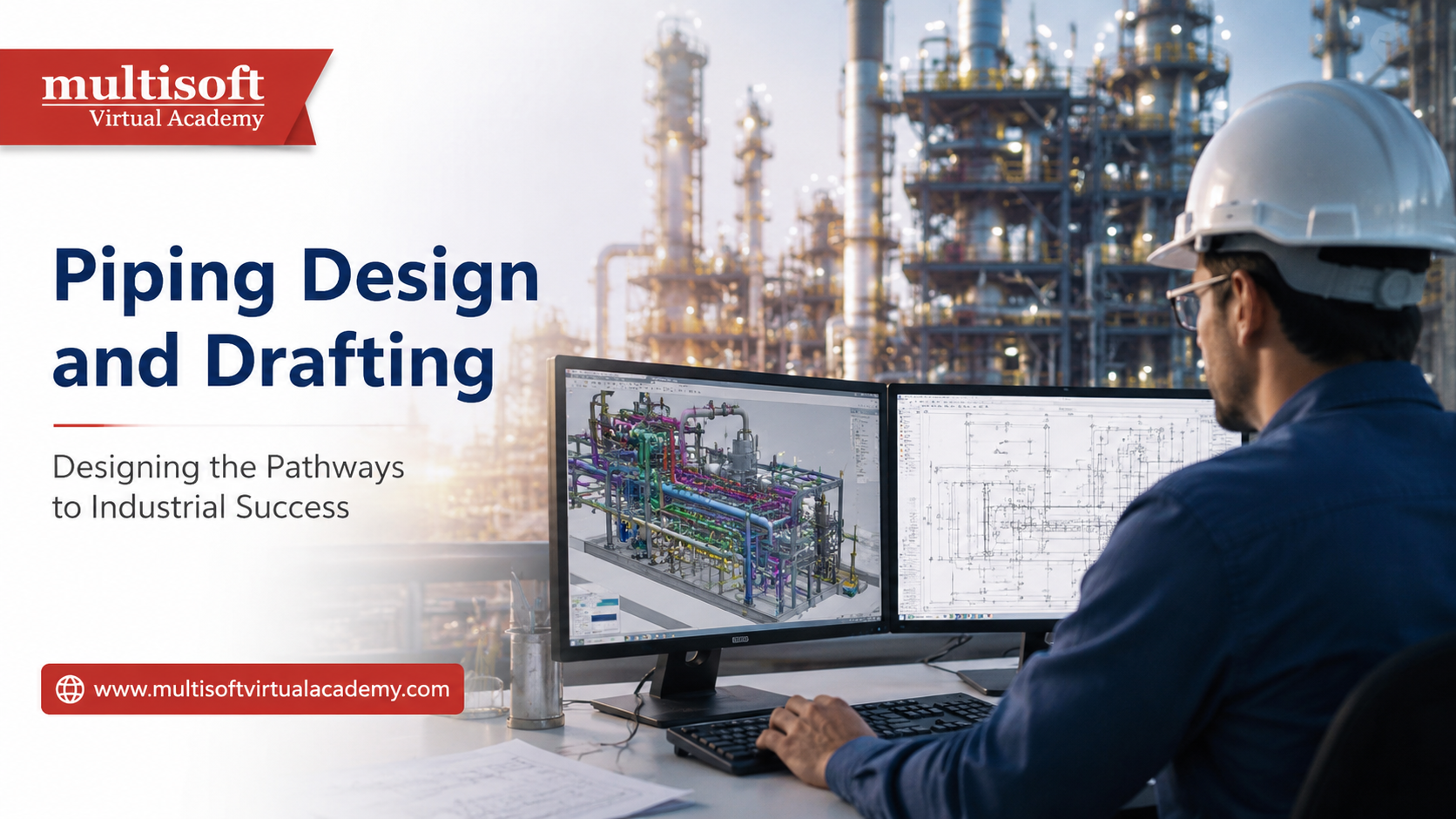
Piping Design and Drafting is a specialized branch of mechanical engineering that deals with the design, layout, routing, and documentation of piping systems used in industrial facilities. A piping system is responsible for transporting liquids, gases, steam, slurries, and chemicals from one location to another within a plant or infrastructure setup. Proper piping design ensures safety, operational efficiency, reliability, and compliance with industrial standards.
Piping systems are commonly used in industries such as oil and gas, petrochemical plants, thermal and nuclear power stations, water treatment plants, pharmaceutical industries, chemical processing plants, marine industries, and HVAC systems. Since these industries handle hazardous materials and operate under high pressure and temperature conditions, piping design becomes a critical engineering activity. Piping drafting involves preparing technical drawings and detailed layouts that represent the physical arrangement of pipes, valves, fittings, supports, instruments, and equipment. These drawings help engineers, fabricators, and construction teams understand how the piping system should be manufactured and installed at the site.
Modern piping engineering uses advanced CAD and 3D modeling software such as AutoCAD Plant 3D, AVEVA E3D, SmartPlant 3D, PDMS, CADWorx, and SolidWorks. These tools help engineers visualize plant layouts, detect clashes, generate isometric drawings, and improve project accuracy. Piping Design and Drafting online training combines engineering principles, industrial codes, safety standards, and practical installation techniques to create efficient and cost-effective piping systems.
Piping systems are considered the lifeline of industrial plants because they carry process fluids essential for plant operations. A poorly designed piping system can lead to leakage, pressure loss, operational failure, equipment damage, or even hazardous accidents. Therefore, piping design plays a major role in maintaining plant safety and efficiency.
Industries today demand highly accurate and intelligent piping systems. As plants become more automated and complex, advanced piping design methods continue to evolve using digital engineering and 3D modeling technologies.
A piping system consists of multiple interconnected components that work together to transport fluids safely and efficiently. Understanding these components is essential for piping designers and drafters.
1. Pipes
Pipes are cylindrical tubes used to carry fluids from one point to another. They are available in different materials, diameters, wall thicknesses, and pressure ratings. Common materials include carbon steel, stainless steel, alloy steel, PVC, copper, and fiberglass.
2. Fittings
Pipe fittings are used to connect pipes and change the direction or diameter of the piping system. Common fittings include elbows, tees, reducers, couplings, caps, and unions.
3. Valves
Valves control the flow, pressure, and direction of fluids within the piping system. Various valve types include gate valves, globe valves, ball valves, butterfly valves, and check valves.
4. Flanges
Flanges provide detachable joints between pipes, valves, and equipment. They simplify maintenance and allow easy assembly or disassembly of piping systems.
5. Supports and Hangers
Pipe supports prevent sagging, vibration, and thermal stress. Common supports include shoe supports, spring hangers, guides, and anchors.
6. Instruments
Instruments measure process parameters such as pressure, temperature, flow rate, and level. These devices help monitor and control industrial operations.
7. Gaskets and Fasteners
Gaskets provide sealing between flange joints, while bolts and nuts ensure proper fastening and leak prevention.
Each component must be selected carefully according to operating conditions, fluid properties, temperature, and pressure requirements.
The piping design process is a systematic engineering procedure used to develop safe, efficient, and cost-effective piping systems for industrial plants. The process begins with understanding the project requirements and reviewing important engineering documents such as Process Flow Diagrams (PFDs) and Piping and Instrumentation Diagrams (P&IDs). These documents help piping engineers understand fluid flow, operating pressure, temperature, equipment connections, and control systems within the plant. After studying the process requirements, engineers prepare equipment layouts that define the position of pumps, vessels, heat exchangers, storage tanks, and other machinery. Proper equipment arrangement is essential because it directly affects pipe routing, maintenance accessibility, and operational safety.
Once the equipment layout is finalized, the pipe routing process begins. Engineers determine the most suitable path for pipes while considering factors such as space availability, safety clearances, thermal expansion, maintenance access, and structural support requirements. During this stage, designers also select appropriate piping materials, fittings, valves, and flanges according to process conditions and industrial standards. Pipe sizing calculations are performed to maintain the required flow rate and pressure conditions while minimizing pressure losses. Stress analysis is then carried out to evaluate the effects of thermal expansion, vibration, weight loads, and external forces on the piping system. This ensures the long-term reliability and stability of the plant.
After completing the design calculations and routing activities, detailed engineering drawings are prepared using software such as AutoCAD Plant 3D, AVEVA E3D, or SmartPlant 3D. These drawings include general arrangement drawings, isometric drawings, support drawings, and spool drawings required for fabrication and construction. Finally, the design undergoes technical reviews, safety checks, and quality verification before approval and project execution.
Piping drafting involves several types of engineering drawings that serve different project purposes.
Each drawing type plays a critical role during engineering, fabrication, installation, and maintenance activities.
Codes and Standards in Piping Design
Codes and standards play a crucial role in piping design because they ensure the safety, reliability, quality, and efficiency of industrial piping systems. Piping engineers must follow internationally recognized standards while designing systems that handle liquids, gases, steam, chemicals, and other process fluids under varying temperature and pressure conditions. These standards define requirements related to material selection, pipe dimensions, wall thickness, pressure ratings, fabrication methods, welding procedures, testing, inspection, and maintenance practices. One of the most widely used standards in piping engineering is the ASME B31 series developed by the American Society of Mechanical Engineers. ASME B31.1 is mainly used for power piping systems, while ASME B31.3 is commonly used for process piping in industries such as oil and gas, petrochemical, and chemical processing plants. ANSI standards provide dimensional and pressure-rating guidelines for flanges, fittings, and valves to ensure compatibility between components.
API standards developed by the American Petroleum Institute are extensively used in refineries, pipelines, and offshore facilities. ASTM standards specify material properties, chemical composition, and mechanical testing requirements for piping materials. In addition, ISO standards help maintain global consistency in piping engineering practices and manufacturing processes. Compliance with these codes and standards minimizes operational risks, prevents leakage and equipment failure, and ensures that the piping system can operate safely throughout its service life. Proper adherence to standards also supports regulatory approvals, improves construction quality, and enhances plant reliability in industrial projects.
Modern piping engineering relies heavily on computer-aided design software for accurate modeling and documentation.
These software platforms improve project efficiency, reduce errors, and support digital engineering transformation.
Piping engineering involves multiple technical and operational challenges. One major challenge is space management in congested industrial plants. Designers must route pipes around equipment, structures, cable trays, and HVAC systems while maintaining safety clearances. Thermal expansion is another critical issue. High-temperature pipelines expand during operation, creating stress on supports and connected equipment. Proper flexibility analysis is required to prevent failures. Material selection can also become challenging when handling corrosive fluids or extreme operating conditions. Incorrect material choice may lead to leakage and equipment damage. Coordination between different engineering disciplines such as civil, structural, electrical, and instrumentation is essential for successful project execution. Poor coordination may cause clashes and construction delays. Project schedule pressure often forces engineering teams to complete designs quickly while maintaining quality and compliance standards.
Modern projects increasingly use digital engineering methods and Building Information Modeling (BIM) to overcome these challenges.
Piping Design and Drafting certification offers excellent career opportunities in industrial engineering sectors. Skilled piping professionals are highly demanded in oil and gas, petrochemical, power generation, marine, pharmaceutical, and infrastructure industries. Common job roles include:
Professionals with expertise in software such as AutoCAD Plant 3D, AVEVA E3D, PDMS, and SP3D often receive better career opportunities and higher salaries.
Many companies also seek engineers familiar with ASME standards, piping stress analysis, and industrial plant design practices. With the growth of industrial automation and energy sectors, piping engineering continues to remain a stable and rewarding career field.
The future of piping engineering is evolving rapidly with digital transformation and smart engineering technologies. 3D modeling and digital twin technology are becoming standard practices in industrial projects. These technologies help engineers visualize entire plants virtually before construction begins. Artificial intelligence and automation are also entering piping design workflows. AI-based tools can optimize routing, detect design clashes, and improve engineering productivity. Cloud collaboration platforms allow global engineering teams to work simultaneously on large projects in real time. Building Information Modeling (BIM) integration improves coordination among civil, structural, and mechanical disciplines. Laser scanning and reality capture technologies are increasingly used for plant modification projects and brownfield engineering. Sustainability and energy-efficient plant design are also gaining importance. Future piping systems will focus more on reduced energy consumption, lower emissions, and environmentally friendly materials. As industrial projects become smarter and more automated, piping engineers will need strong digital engineering and software skills to stay competitive.
Piping Design and Drafting is a vital engineering discipline that supports the safe and efficient operation of industrial facilities. It involves the planning, modeling, routing, analysis, and documentation of piping systems used to transport fluids in various industries. A successful piping system requires proper material selection, accurate calculations, compliance with international standards, and detailed drafting documentation. Modern software tools have significantly improved the accuracy and efficiency of piping engineering projects. With growing industrialization, energy demands, and digital transformation, the importance of skilled piping designers and drafters continues to increase globally. Professionals with strong technical knowledge, software expertise, and understanding of industrial standards can build successful careers in this field.
Piping engineering will continue evolving through intelligent automation, digital twins, AI integration, and sustainable engineering practices, making it one of the most dynamic and valuable domains in modern industrial engineering. Enroll in Multisoft Virtual Academy now!
| Start Date | Time (IST) | Day | |||
|---|---|---|---|---|---|
| 17 Oct 2026 | 06:00 PM - 10:00 AM | Sat, Sun | |||
| 18 Oct 2026 | 06:00 PM - 10:00 AM | Sat, Sun | |||
| 24 Oct 2026 | 06:00 PM - 10:00 AM | Sat, Sun | |||
| 25 Oct 2026 | 06:00 PM - 10:00 AM | Sat, Sun | |||
|
Schedule does not suit you, Schedule Now! | Want to take one-on-one training, Enquiry Now! |
|||||






 Join our Live Instructor-Led online classes delivered by industry experts
 Let's Get Started