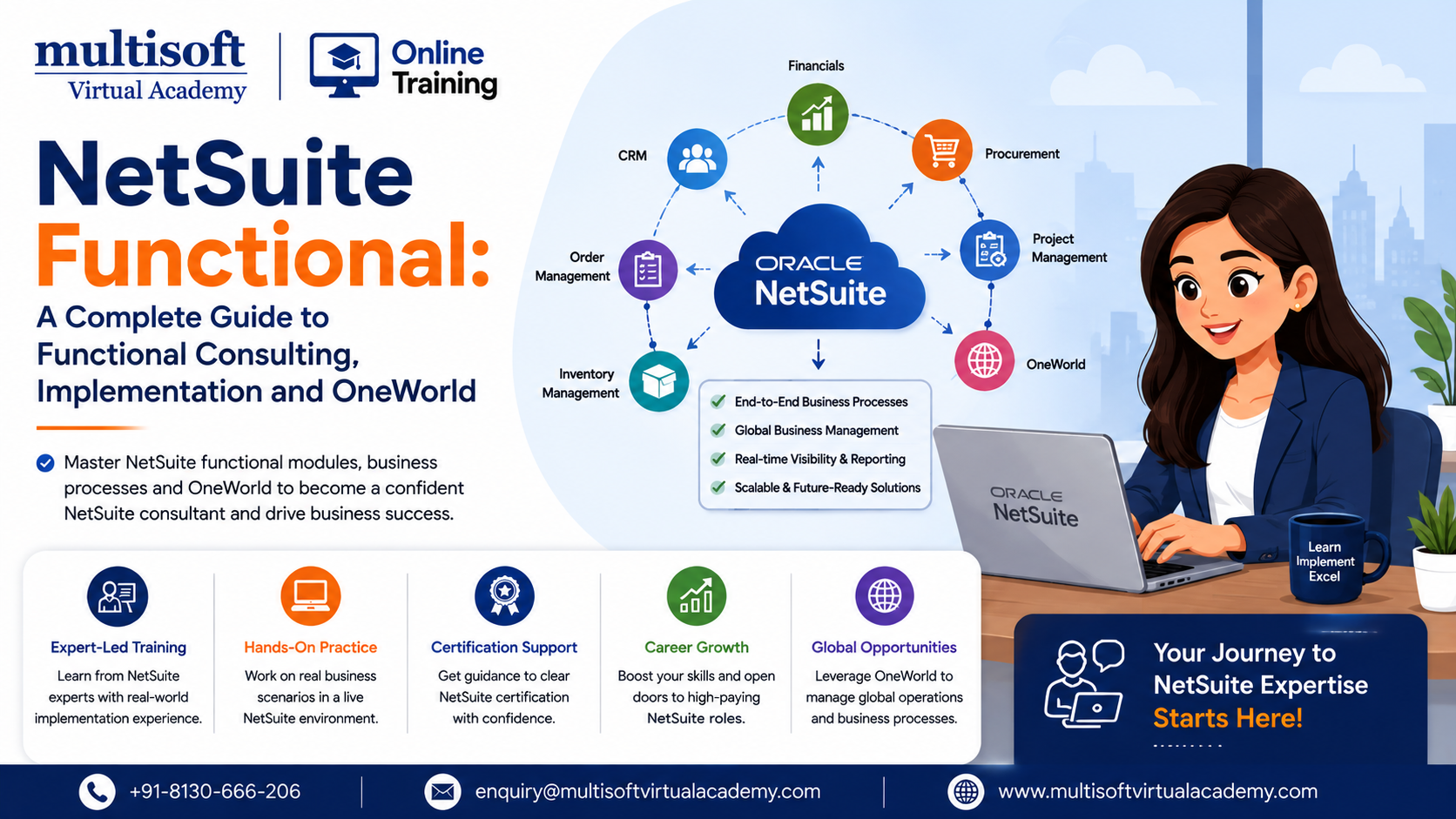
Businesses are increasingly moving toward cloud-based ERP platforms to simplify financial management, streamline operations and gain better visibility across departments. NetSuite Functional expertise has become especially valuable for organizations that want to configure, implement and optimize Oracle NetSuite according to their business requirements.
NetSuite functional professionals focus on business processes rather than only technical development. They translate business requirements into practical ERP configurations covering finance, accounting, order management, inventory, procurement, CRM, reporting and other operational areas. For organizations operating across countries or multiple legal entities, NetSuite OneWorld implementation and subsidiary management are particularly important.
Oracle describes NetSuite OneWorld as a platform designed to manage multiple subsidiaries, tax jurisdictions and currencies within a single NetSuite account.
NetSuite Functional refers to the business and process-oriented side of NetSuite ERP. A functional specialist studies how an organization operates and determines how NetSuite can be configured to support those processes.
Unlike a purely technical developer, a NetSuite Functional Consultant works closely with finance teams, business users, managers and stakeholders to understand requirements, document workflows and configure appropriate NetSuite functionality.
Typical responsibilities include:
The functional consultant therefore acts as a bridge between business teams and technical teams.
A successful ERP project is not simply about installing software. The system must reflect the organization's processes, controls, reporting requirements and operational structure.
A strong NetSuite implementation consultant evaluates existing processes before recommending configurations. This approach can reduce unnecessary customization and help businesses use standard NetSuite capabilities more effectively.
Functional expertise becomes even more important when a business has multiple subsidiaries, currencies, tax jurisdictions or complex intercompany transactions.
Oracle's current documentation explains that each OneWorld subsidiary represents a separate legal entity and can have its own base currency and tax nexus while participating in consolidated reporting.
One of the most important areas of NetSuite Functional consulting is NetSuite OneWorld.
OneWorld enables organizations to manage domestic and international subsidiaries through a hierarchical structure. The structure starts with a root or parent subsidiary and can include child and grandchild subsidiaries.
A well-planned NetSuite subsidiary implementation should consider:
The first step is defining how legal entities relate to one another. The hierarchy should reflect the organization's ownership and reporting structure.
Oracle recommends planning the subsidiary hierarchy before creating subsidiary records.
Each subsidiary may operate with its own base currency depending on its business location. Currency configuration is therefore an essential component of OneWorld implementation.
Tax jurisdictions must be configured correctly for the relevant subsidiaries. Incorrect tax configuration can affect transactions, reporting and compliance.
Global organizations frequently purchase, sell, transfer inventory or provide services between subsidiaries. NetSuite OneWorld supports intercompany processes and elimination accounting to maintain accurate consolidated financials.
Management often needs both subsidiary-level reporting and consolidated financial visibility. A properly designed OneWorld structure makes it possible to analyze individual entities while rolling financial information into parent-level reports.
A NetSuite functional professional should have a broad understanding of the major ERP modules and their relationship with business processes.
Financial management is one of the core areas of NetSuite Functional consulting. It can include general ledger, accounts payable, accounts receivable, fixed assets, budgeting, financial reporting and period management.
Functional consultants help determine how accounting structures and financial processes should be configured according to business requirements.
Order management connects sales processes with fulfillment, inventory and financial transactions. Consultants analyze the complete order-to-cash lifecycle to identify process gaps and configuration requirements.
Inventory configuration is essential for organizations managing warehouses, locations, multiple items or complex fulfillment processes.
A functional consultant may work on inventory locations, item structures, purchasing processes, fulfillment workflows and inventory reporting.
The procure-to-pay process covers purchasing, receiving, vendor management and supplier payments. Functional professionals help configure workflows that support business approval structures and purchasing controls.
NetSuite CRM supports customer-related processes including sales, marketing and customer service. Functional consulting helps organizations align CRM functionality with their sales processes and reporting requirements.
Data-driven decision-making is increasingly important in ERP environments. Functional consultants work with business users to define dashboards, saved searches, KPIs and reporting requirements.
The roles often work together but have different responsibilities.
A NetSuite Functional Consultant concentrates on business requirements, configuration, process design, testing and user adoption.
A NetSuite Technical Consultant generally focuses on development and integration activities such as SuiteScript, APIs, customizations and technical architecture.
For complex projects, both skill sets are valuable. The functional consultant identifies what the business needs while the technical team determines how specialized requirements can be implemented.
A structured NetSuite ERP implementation generally follows several important stages.
The implementation begins with discussions involving stakeholders from finance, operations, sales, procurement, inventory and management.
The objective is to understand current processes, identify pain points and establish project goals.
Consultants document processes such as:
This process mapping helps determine which NetSuite features can address business requirements.
The next stage involves developing a functional solution based on business requirements. Consultants determine configuration options, workflows, roles, reporting requirements and integration dependencies.
The NetSuite environment is then configured according to the approved functional design. This can include accounting preferences, subsidiaries, currencies, tax settings, forms, roles, workflows and transaction settings.
Existing business data may need to be transferred into NetSuite. Functional consultants help define data requirements, mapping rules, validation processes and migration priorities.
Testing is essential before production deployment. Functional testing verifies that business processes work correctly from the user's perspective.
User acceptance testing allows business teams to confirm that the configured solution meets operational requirements.
Users need practical training on the processes they perform regularly. After successful testing and training, the organization can proceed toward production deployment and ongoing optimization.
NetSuite projects can face several challenges when business processes are not clearly defined.
Unclear requirements can result in unnecessary configuration changes or customization.
Organizations operating multiple legal entities need careful planning before implementing OneWorld. Oracle specifically recommends planning the hierarchy and understanding currencies and tax jurisdictions before subsidiary creation.
Customization may sometimes be necessary, but excessive customization can increase complexity and maintenance requirements. Functional consultants should first evaluate whether standard NetSuite functionality can meet the requirement.
Even a technically successful implementation can struggle if users do not understand new workflows. Training, documentation and change management are therefore important parts of functional implementation.
Testing should cover complete business scenarios rather than isolated transactions. For example, an order management test should ideally consider the connected fulfillment, inventory, invoicing and accounting processes.
The NetSuite ecosystem continues to evolve, making it useful for functional professionals to develop both traditional ERP knowledge and emerging digital skills.
Some valuable areas include:
These topics align with the broader direction of NetSuite's product development. Oracle's recent NetSuite releases have introduced continued enhancements across AI, accounting, analytics, automation and other ERP capabilities.
Artificial intelligence is becoming an increasingly important part of modern ERP systems.
Oracle has positioned newer NetSuite capabilities around AI-powered experiences, including conversational intelligence, natural-language interactions and agentic workflows.
This development means functional professionals increasingly need to understand how AI-enabled ERP capabilities can support business processes without compromising controls, data quality or governance.
The future NetSuite functional consultant will therefore need more than configuration knowledge. Understanding automation, analytics, AI-assisted workflows and business transformation can create additional value for organizations adopting cloud ERP.
Organizations evaluating a NetSuite service provider should consider several factors before starting an implementation.
Look for a provider with:
The right provider should focus on business outcomes rather than simply configuring screens and fields.
NetSuite Functional expertise has become an important component of successful cloud ERP transformation. From NetSuite implementation and financial management to NetSuite OneWorld, subsidiary configuration, intercompany accounting, reporting, automation and emerging AI capabilities, functional knowledge helps organizations turn ERP technology into practical business value. For organizations seeking structured guidance, implementation support and professional expertise, Multisoft Virtual Academy provides a strong service-oriented approach to building NetSuite functional capabilities and supporting organizations in their journey toward efficient, scalable and future-ready ERP operations.
| Start Date | Time (IST) | Day | |||
|---|---|---|---|---|---|
| 10 Oct 2026 | 06:00 PM - 10:00 AM | Sat, Sun | |||
| 11 Oct 2026 | 06:00 PM - 10:00 AM | Sat, Sun | |||
| 17 Oct 2026 | 06:00 PM - 10:00 AM | Sat, Sun | |||
| 18 Oct 2026 | 06:00 PM - 10:00 AM | Sat, Sun | |||
|
Schedule does not suit you, Schedule Now! | Want to take one-on-one training, Enquiry Now! |
|||||






 Join our Live Instructor-Led online classes delivered by industry experts
 Let's Get Started