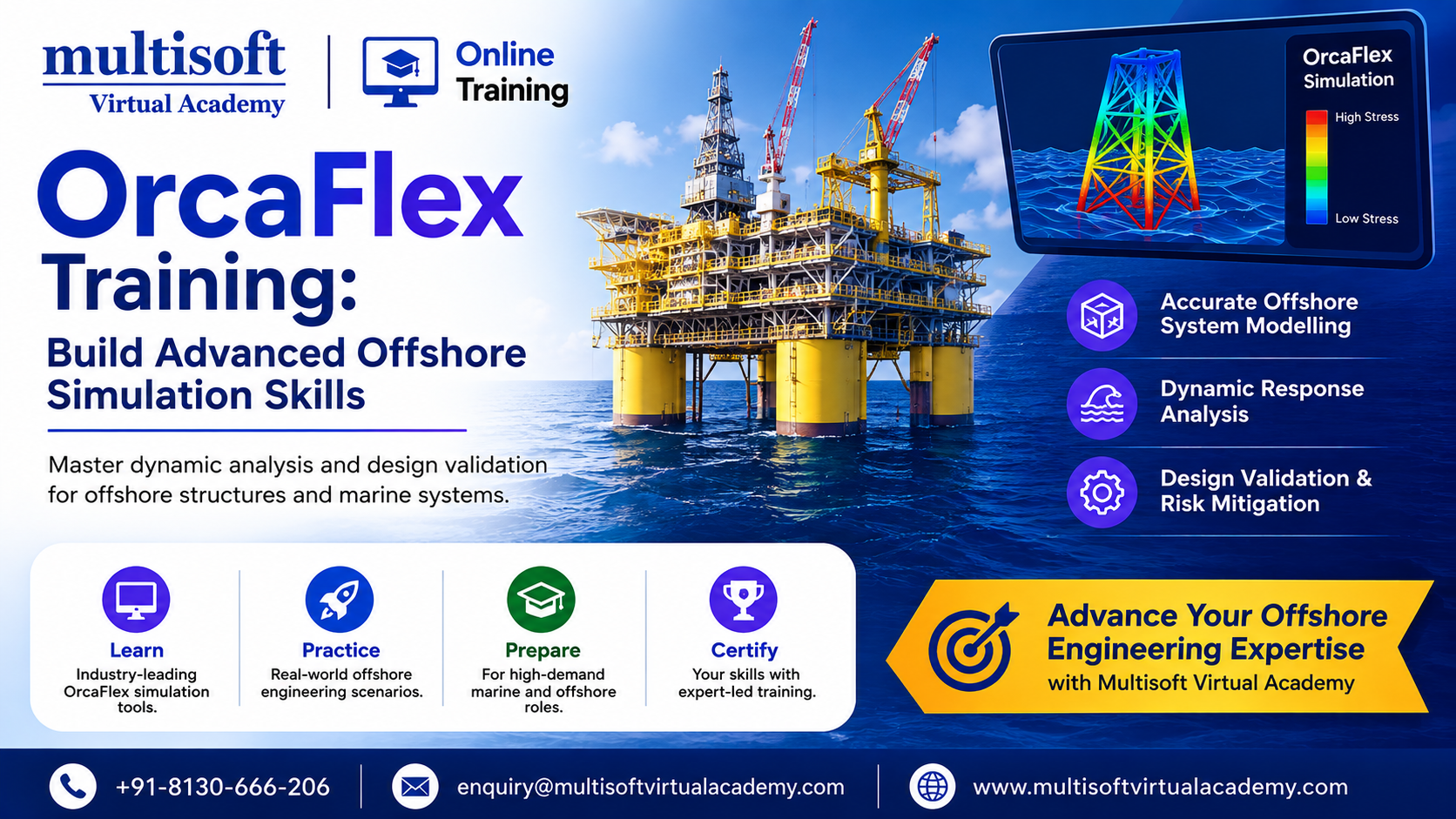
Offshore engineering projects demand accurate analysis, reliable simulation and a strong understanding of marine dynamics. As offshore oil and gas, subsea engineering and floating renewable energy projects become increasingly sophisticated, engineers need specialized tools to evaluate complex systems under realistic environmental conditions. OrcaFlex Training helps professionals develop practical knowledge of one of the leading software solutions used for the dynamic analysis of offshore marine systems.
OrcaFlex is widely used for applications involving risers, moorings, pipelines, cables, vessels, installation operations and renewable energy systems. The software supports both static and dynamic analysis and provides engineers with capabilities for modeling complex offshore systems and interpreting their behavior under environmental and operational loads.
For professionals planning to strengthen their offshore engineering capabilities, structured training can provide a valuable combination of theoretical understanding, software skills and practical simulation experience.
OrcaFlex Training is a marine dynamics simulation software package developed for analyzing offshore systems. It is used across applications such as riser analysis, mooring analysis, pipelay, pipelines, installation and decommissioning, towed systems and renewable energy projects.
The software enables engineers to create digital models of offshore systems and study how they respond to waves, currents, vessel motions and other environmental or operational conditions. This makes simulation an important part of engineering design, verification and decision-making.
However, learning the software interface alone is not enough. Engineers also need to understand modeling assumptions, boundary conditions, environmental inputs, line properties, convergence, dynamic behavior and result interpretation. This is where professional OrcaFlex Training becomes particularly valuable.
A structured OrcaFlex Training program can help learners move from basic software navigation to practical offshore simulation. Instead of simply learning individual commands, participants can understand how different modeling components interact within a complete engineering workflow.
Effective training can help professionals learn how to:
This practical approach can help learners apply their knowledge to engineering scenarios rather than relying solely on theoretical concepts.
Risers are critical components connecting subsea systems to floating or fixed offshore facilities. Their behavior can be influenced by waves, currents, vessel motion, buoyancy, tension and seabed interaction.
OrcaFlex Training can introduce professionals to riser modeling techniques and help them understand how to evaluate static and dynamic behavior. This knowledge is useful for professionals involved in flexible risers, steel catenary risers and other offshore line systems.
Mooring systems provide stability and station keeping for floating offshore structures. Engineers need to understand how mooring lines respond to environmental forces and vessel motions.
Training can cover mooring configuration, line properties, environmental loading, static equilibrium and dynamic response. These skills are increasingly relevant as floating offshore infrastructure expands.
Offshore pipelines, umbilicals and cables operate under demanding mechanical and environmental conditions. Their performance may depend on configuration, tension, curvature, seabed interaction and operational conditions.
Through practical OrcaFlex Training, engineers can learn how to build suitable models and examine the behavior of offshore lines under different scenarios.
Floating offshore wind is an emerging application that combines marine engineering, hydrodynamics, structural dynamics and renewable energy technology. Orcina currently provides dedicated OrcaFlex training for floating offshore wind applications, reflecting the growing relevance of this area.
Professionals working with floating wind systems can benefit from understanding how turbines, platforms, mooring systems and environmental loads interact within a simulation environment.
Offshore installation activities often involve complex vessel motions, line handling, winches, towing operations and changing configurations. Simulation can help engineers study planned operations before execution.
Training in installation analysis can therefore support professionals involved in marine construction, offshore installation and project engineering.
The value of OrcaFlex Training goes beyond learning software commands. A well-designed program should develop a combination of technical, analytical and practical skills.
Participants learn how to create offshore models using appropriate objects, geometries, line types and system configurations. Understanding how these elements interact is essential for building reliable simulations.
Offshore systems are exposed to waves, currents, wind and other environmental effects. Engineers need to know how to define appropriate environmental inputs and understand their influence on simulation results.
Static analysis helps establish equilibrium conditions while dynamic analysis evaluates system behavior over time. Understanding the relationship between these stages is fundamental to offshore simulation.
Generating results is only one part of engineering analysis. Professionals must be able to interpret tension, displacement, curvature, loads, motions and other relevant outputs and determine whether they are reasonable.
A technically sophisticated model can still produce misleading results if assumptions or inputs are incorrect. Training can therefore introduce model-checking and validation practices that help improve confidence in engineering conclusions.
OrcaFlex Training is particularly useful for professionals working in offshore and marine engineering disciplines.
It can be relevant for:
Professionals who already understand basic offshore engineering concepts may find it easier to connect theoretical knowledge with software-based simulation.
The offshore industry increasingly relies on simulation and engineering software to evaluate designs and operational scenarios before implementation. As projects become more complex, professionals who can combine engineering knowledge with simulation capabilities can bring additional value to project teams.
Learning OrcaFlex can support career development in areas such as offshore structural analysis, subsea engineering, riser design, mooring analysis, marine operations and floating renewable energy.
For organizations, employee training can also help standardize modeling practices and improve internal capabilities. Client-specific training is commonly tailored around application areas and project requirements, while online and instructor-led formats can provide flexibility for working professionals.
Not every software course provides the same level of practical value. The strongest training approach should connect software functionality with real engineering applications.
An effective program should ideally include:
Hands-on modeling: Learners should build models rather than only watch demonstrations.
Engineering fundamentals: Software functions should be explained alongside the engineering principles behind them.
Realistic scenarios: Practical exercises should reflect offshore conditions and project workflows.
Result interpretation: Participants should learn how to assess and understand simulation outputs.
Troubleshooting: Training should explain common modeling challenges and ways to identify potential errors.
Project-based learning: Exercises based on realistic engineering problems can improve confidence and retention.
This approach transforms training from simple software familiarization into practical professional development.
Automation is another important area for advanced OrcaFlex users. Orcina provides an interface that allows OrcaFlex to be used as a software library and integrated with third-party applications.
Python-based workflows can be useful when engineers need to execute repetitive simulations, process large quantities of results or create customized analysis workflows. Orcina also offers dedicated training related to the Python interface to OrcaFlex.
For experienced users, combining OrcaFlex Training with automation skills can open opportunities to improve productivity and streamline repetitive engineering tasks.
Learners can maximize the value of their training by preparing before the sessions begin. A basic understanding of offshore engineering concepts such as hydrodynamics, structural mechanics, mooring systems and environmental loading can make the learning process more effective.
During training, professionals should focus on understanding why a particular modeling approach is used rather than simply memorizing software steps.
It is also useful to practice by creating independent models after each module. Comparing expected engineering behavior with simulation results can help develop stronger analytical judgment.
Professionals should also document assumptions, inputs and modeling decisions. Good documentation is essential when simulation results are later reviewed by colleagues, clients or project stakeholders.
The offshore engineering landscape is evolving rapidly. Traditional oil and gas projects continue to require sophisticated analysis while floating wind, subsea infrastructure and marine renewable energy are creating new engineering applications.
OrcaFlex is already used across oil and gas, wet renewables, oceanographic applications, seismic analysis, defence and aquaculture, among other areas.
At the same time, automation and Python-based engineering workflows are becoming increasingly important for professionals who need to manage repetitive simulations and large datasets.
This creates a strong opportunity for engineers to develop combined skills in OrcaFlex simulation, offshore engineering, dynamic analysis, mooring analysis, riser analysis and engineering automation.
Before enrolling in an OrcaFlex Training program, professionals should evaluate several factors.
Look for training that provides:
The right program should match the learner's current experience and professional objectives. Beginners may benefit from fundamentals-first instruction while experienced engineers may prefer advanced topics such as automation, fatigue, installation analysis or specialized offshore applications.
OrcaFlex Training is more than a software-learning opportunity - it is a pathway toward stronger offshore simulation, analysis and engineering capabilities. As offshore oil and gas, subsea systems and floating renewable energy projects continue to demand accurate modeling and reliable engineering decisions, professionals with practical dynamic analysis skills can become valuable contributors to complex projects.
For learners and organizations seeking structured, practical and career-focused training, Multisoft Virtual Academy acts as a professional service provider offering training designed to help participants develop relevant technical knowledge and practical OrcaFlex capabilities. With a focus on industry-oriented learning, hands-on practice and application-based understanding, Multisoft Virtual Academy can support professionals looking to strengthen their expertise in OrcaFlex and advance their offshore engineering skill set.
| Start Date | Time (IST) | Day | |||
|---|---|---|---|---|---|
| 10 Oct 2026 | 06:00 PM - 10:00 AM | Sat, Sun | |||
| 11 Oct 2026 | 06:00 PM - 10:00 AM | Sat, Sun | |||
| 17 Oct 2026 | 06:00 PM - 10:00 AM | Sat, Sun | |||
| 18 Oct 2026 | 06:00 PM - 10:00 AM | Sat, Sun | |||
|
Schedule does not suit you, Schedule Now! | Want to take one-on-one training, Enquiry Now! |
|||||






 Join our Live Instructor-Led online classes delivered by industry experts
 Let's Get Started