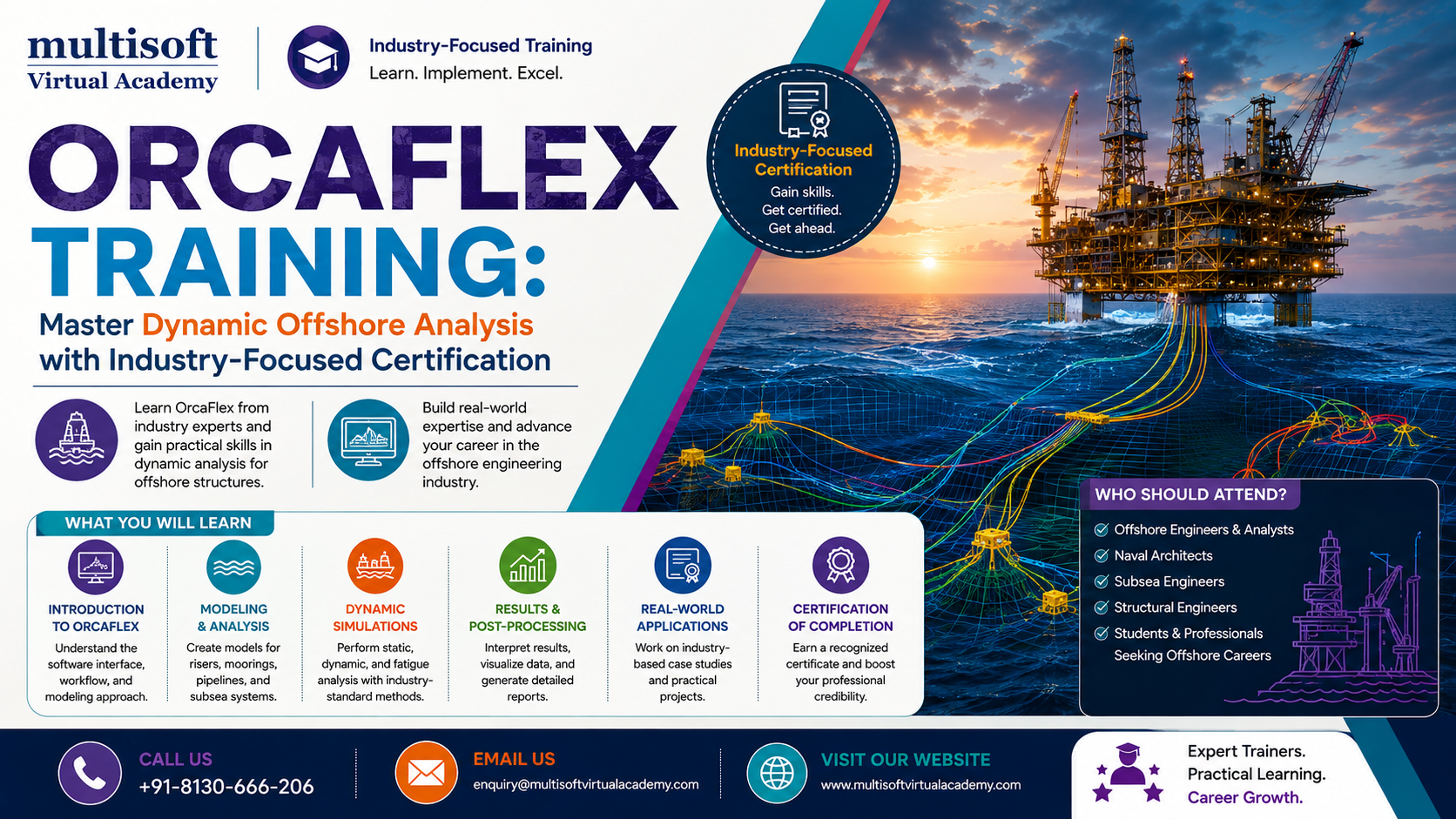
The offshore energy sector is evolving rapidly as organizations continue to invest in offshore oil and gas, floating wind farms, subsea infrastructure, marine renewable energy, and deepwater engineering projects. As these industries become more technologically advanced, engineers are expected to possess practical expertise in dynamic analysis software that can accurately simulate offshore systems under real-world environmental conditions.
One of the most trusted software applications in the offshore engineering industry is OrcaFlex. It is widely used for the dynamic analysis of offshore structures including mooring systems, risers, umbilicals, pipelines, cables, floating platforms, and subsea installations.
Professionals looking to build a successful career in offshore engineering are increasingly searching for Orcaflex Training, Orcaflex Online Training, Orcaflex Certification Course, and Offshore Engineering Training to gain industry-recognized expertise.
This comprehensive guide explains everything you need to know about Orcaflex Training, career opportunities, software applications, learning outcomes, and why mastering this powerful engineering tool is becoming essential across the global offshore industry.
OrcaFlex is an advanced engineering software developed for nonlinear dynamic analysis of offshore marine systems. It enables engineers to simulate the behavior of offshore structures subjected to environmental loads such as:
The software accurately predicts how offshore components respond throughout installation, operation, transportation, and maintenance phases.
Because of its exceptional simulation capabilities, OrcaFlex has become one of the most widely accepted analysis tools in offshore engineering.
Orcaflex Training is a professional learning program designed to teach engineers, designers, analysts, and offshore professionals how to use OrcaFlex software effectively for real engineering projects.
The training covers both theoretical concepts and practical implementation through industry-based case studies, enabling learners to build confidence in solving complex offshore engineering challenges.
A structured Orcaflex course typically combines engineering fundamentals with hands-on simulation exercises to prepare learners for real-world project environments.
The offshore engineering sector is expanding across several industries, creating strong demand for professionals skilled in dynamic analysis software.
Some major growth drivers include:
Organizations prefer engineers who already understand industry-standard simulation tools, making Orcaflex expertise a valuable career asset.
This training program is suitable for a wide range of engineering professionals, including:
Both beginners and experienced professionals can benefit from structured Orcaflex learning.
OrcaFlex offers numerous capabilities that make it a preferred engineering solution worldwide.
Perform nonlinear dynamic simulations of offshore systems operating under varying environmental conditions.
Design and evaluate mooring systems for floating offshore structures.
Analyze flexible risers subjected to vessel movement and ocean loading.
Simulate subsea cables and power transmission systems.
Evaluate offshore pipelines during installation and operational stages.
Predict vessel behavior during offshore installation activities.
Conduct highly accurate simulations based on real operational scenarios.
Generate detailed animations and graphical outputs for engineering presentations and project validation.
A professional Orcaflex course generally includes the following topics.
Learning OrcaFlex provides significant professional advantages.
OrcaFlex is accepted globally across offshore engineering organizations.
Many employers specifically seek engineers with OrcaFlex expertise.
Develop hands-on experience with industry-standard simulations.
Analyze complex offshore engineering scenarios efficiently.
Professionals with advanced simulation skills often qualify for higher-paying engineering roles.
OrcaFlex knowledge is valuable across international offshore projects.
Professionals trained in OrcaFlex work across numerous sectors.
Design and analysis of offshore production facilities.
Simulation of floating wind turbines and mooring systems.
Dynamic analysis of marine structures.
Wave energy and floating renewable platforms.
Engineering design and offshore project execution.
Marine system simulation and equipment analysis.
Pipeline, riser, cable, and installation analysis.
Completing Orcaflex Training opens opportunities such as:
These roles are available in engineering consultancies, EPC companies, offshore contractors, oil and gas organizations, renewable energy firms, and marine engineering companies worldwide.
After completing professional Orcaflex Training, learners can confidently:
Engineering software cannot be mastered through theory alone. Practical exercises expose learners to real-world scenarios, helping them understand how offshore systems behave under changing environmental conditions.
Hands-on projects also strengthen confidence in model creation, simulation setup, result interpretation, and technical reporting, making engineers better prepared for project execution.
Several industry trends are increasing the need for OrcaFlex expertise.
Governments and energy companies are investing heavily in floating wind farms, creating demand for engineers skilled in mooring and cable analysis.
As offshore exploration moves into deeper waters, dynamic simulation becomes increasingly critical.
Simulation-driven engineering is becoming the industry standard for improving design accuracy and reducing project risks.
Marine renewable energy projects require advanced offshore simulation tools to ensure operational reliability.
Existing offshore assets are being upgraded using advanced engineering analysis to improve safety and operational efficiency.
Online learning provides flexibility without compromising technical quality.
Benefits include:
To maximize your learning experience:
Consistent practice helps develop the confidence needed for complex offshore engineering assignments.
Countries investing heavily in offshore energy infrastructure—including the United States, the United Kingdom, Norway, the Netherlands, Australia, the United Arab Emirates, Saudi Arabia, Qatar, India, Singapore, and Brazil—continue to seek engineers with expertise in offshore simulation and structural analysis.
As offshore renewable energy and deepwater developments accelerate, proficiency in OrcaFlex enhances employability across international engineering projects and multidisciplinary teams.
Orcaflex Training is a professional course that teaches engineers how to use OrcaFlex software for the dynamic analysis of offshore and marine systems. The training covers modeling, simulation, analysis, and reporting for pipelines, risers, mooring systems, cables, and floating structures.
Orcaflex Training is suitable for mechanical engineers, marine engineers, offshore engineers, civil engineers, structural engineers, naval architects, pipeline engineers, subsea engineers, design engineers, engineering consultants, and students who want to build a career in offshore engineering.
A basic understanding of engineering principles and mechanics is helpful but not mandatory. Professionals with knowledge of offshore engineering, structural analysis, or marine systems can learn OrcaFlex more effectively.
Yes. Many training providers offer live online Orcaflex Training with instructor-led sessions, practical exercises, real-world case studies, project-based learning, and certification support, making it convenient for working professionals and students.
After completing the course, you will be able to create offshore models, perform dynamic simulations, analyze mooring systems, risers, pipelines, and subsea cables, interpret simulation results, and prepare engineering reports for offshore projects.
OrcaFlex is widely used in offshore oil and gas, offshore wind energy, marine engineering, renewable energy, EPC companies, subsea engineering, floating production systems, and offshore infrastructure projects.
Developing expertise in OrcaFlex is a strategic investment for engineers aiming to advance their careers in offshore engineering, marine infrastructure, subsea systems, and renewable energy. The software's powerful dynamic analysis capabilities help professionals design safer, more reliable, and more efficient offshore structures while meeting modern engineering standards. As the demand for simulation-driven engineering continues to grow, structured learning combined with practical project experience becomes increasingly valuable.
Multisoft Virtual Academy is a trusted name in professional technical training, offering industry-oriented Orcaflex Training designed to help engineers build practical skills through live online instructor-led sessions, real-world projects, hands-on software practice, and expert mentorship. With a focus on quality learning, flexible schedules, comprehensive course content, and career-oriented certification support, Multisoft Virtual Academy helps learners prepare confidently for opportunities in offshore oil and gas, marine engineering, offshore wind, subsea engineering, and other high-growth engineering sectors worldwide.
| Start Date | End Date | No. of Hrs | Time (IST) | Day | |
|---|---|---|---|---|---|
| 26 Sep 2026 | 18 Oct 2026 | 24 | 06:00 PM - 09:00 PM | Sat, Sun | |
| 27 Sep 2026 | 19 Oct 2026 | 24 | 06:00 PM - 09:00 PM | Sat, Sun | |
| 03 Oct 2026 | 25 Oct 2026 | 24 | 06:00 PM - 09:00 PM | Sat, Sun | |
| 04 Oct 2026 | 26 Oct 2026 | 24 | 06:00 PM - 09:00 PM | Sat, Sun | |
Schedule does not suit you, Schedule Now! | Want to take one-on-one training, Enquiry Now! |
|||||






 Join our Live Instructor-Led online classes delivered by industry experts
 Let's Get Started