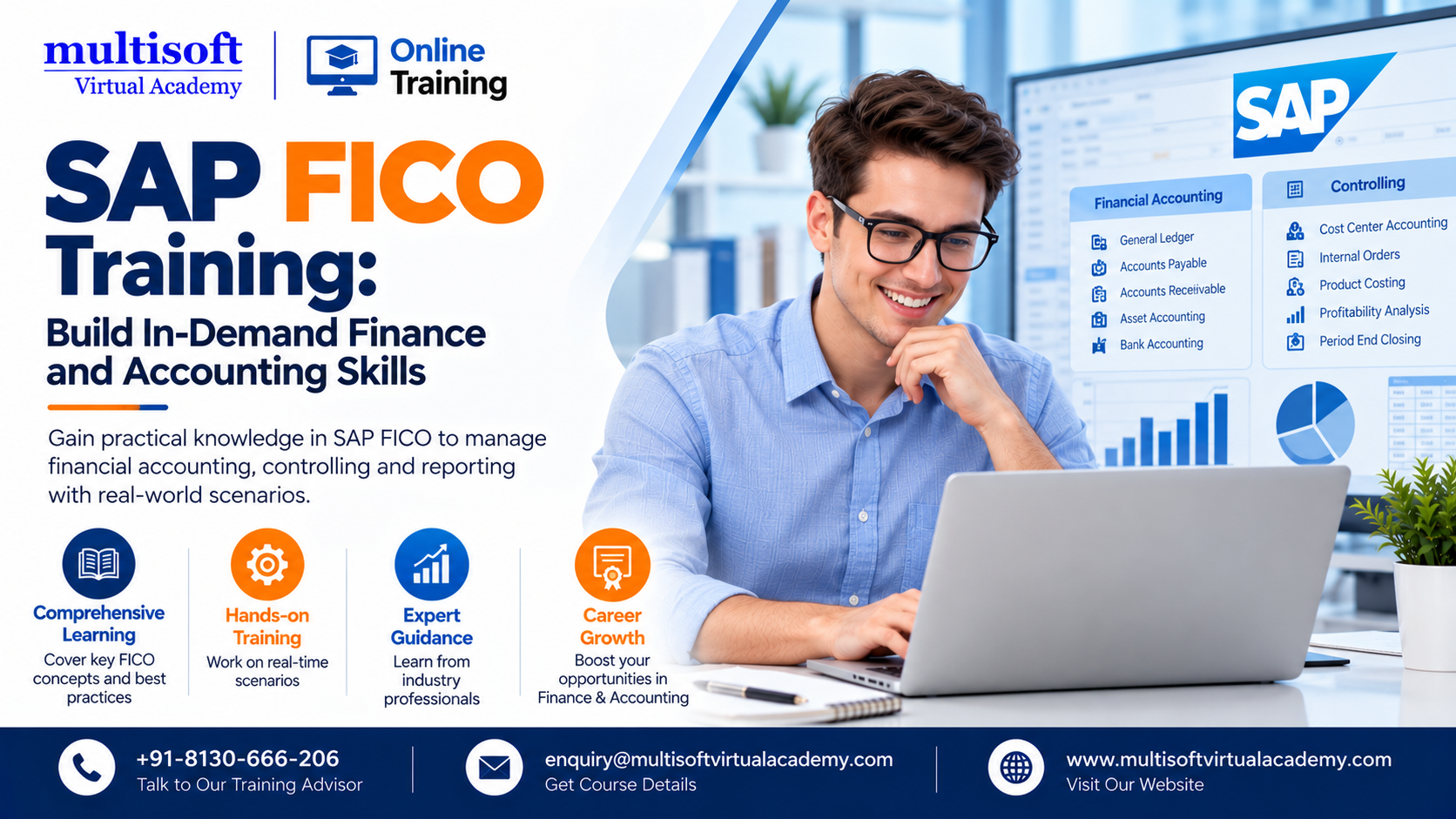
Finance and accounting are no longer limited to spreadsheets, manual reporting, and traditional enterprise systems. Modern organizations increasingly depend on integrated ERP platforms to manage financial transactions, reporting, compliance, budgeting, controlling, and business performance. This growing digital transformation has created strong demand for professionals with practical SAP FICO Training and SAP S/4HANA Finance skills.
SAP FICO combines Financial Accounting (FI) and Controlling (CO) to help organizations manage financial processes while gaining visibility into costs, profitability, and business performance. As companies modernize their ERP environments, professionals who understand SAP Finance processes, configuration, integration, and reporting can develop valuable career opportunities.
SAP's current learning ecosystem places significant emphasis on SAP S/4HANA Financial Accounting, Management Accounting, implementation, configuration, and certification-oriented learning.
SAP FICO is an important functional area within SAP ERP that connects financial accounting and management accounting processes.
The SAP FI module focuses on recording, processing, and reporting financial transactions. It supports areas such as:
The SAP CO module, meanwhile, supports internal management accounting and helps organizations understand how costs are incurred and where business value is generated. It includes areas such as:
Together, SAP FI and CO provide an integrated foundation for financial management and business decision-making.
The finance function is becoming increasingly integrated with procurement, sales, supply chain, manufacturing, analytics, and enterprise planning. This means finance professionals need more than accounting knowledge—they also need to understand how financial information moves through an ERP environment.
SAP FICO Training helps learners connect accounting concepts with enterprise business processes and SAP functionality.
A well-designed SAP FICO course can help professionals understand how transactions are recorded, how financial documents are generated, how costs are assigned, how financial statements are prepared, and how organizations monitor profitability.
SAP's current S/4HANA Finance learning paths specifically include skills related to implementing and customizing Financial Accounting, including General Ledger, Accounts Payable, Accounts Receivable, Asset Accounting, financial closing, and reporting.
One of the most important considerations for today's learners is the relationship between traditional SAP FICO and SAP S/4HANA Finance Training.
SAP FICO remains a widely recognized term because it describes the core Financial Accounting and Controlling disciplines. However, organizations adopting SAP S/4HANA increasingly require professionals who understand how these finance processes work within the modern S/4HANA environment.
SAP describes S/4HANA Finance learning around both Financial Accounting and Management Accounting, with implementation and configuration skills forming important parts of the learning journey.
Therefore, professionals should consider training that covers both fundamental SAP FI/CO concepts and relevant SAP S/4HANA Finance capabilities.
A comprehensive SAP FICO Course should combine conceptual knowledge with practical business scenarios.
SAP FI training generally begins with the fundamentals of enterprise financial accounting. Learners can explore organizational structures, financial transactions, master data, and financial reporting.
Important topics include:
These concepts create the foundation required for working with SAP financial processes.
General Ledger is central to financial accounting because it provides an organized view of financial transactions.
Training can cover account structures, journal entries, document types, posting keys, ledgers, clearing processes, and financial reporting.
Understanding General Ledger processes is particularly important for professionals targeting SAP Finance consultant and support roles.
Organizations process thousands of vendor and customer transactions. SAP FI helps automate and integrate these activities with broader business processes.
SAP FICO training can introduce learners to:
These skills are relevant to finance teams as well as SAP functional consultants.
Asset Accounting helps organizations manage the financial lifecycle of fixed assets.
Learners can explore asset master data, acquisitions, depreciation, transfers, retirements, and asset-related reporting.
This area becomes particularly important when finance professionals work with organizations that maintain large physical asset portfolios.
The CO component focuses on internal cost and profitability management.
A strong SAP CO Training component can introduce:
The objective is not simply to record costs but to help organizations understand and manage financial performance.
One of the biggest advantages of learning SAP Finance is understanding how financial processes interact with other enterprise functions.
For example, a procurement transaction can eventually affect accounts payable and financial accounting. Similarly, a sales transaction can generate accounting entries and influence revenue reporting.
This makes SAP Finance highly interconnected with areas such as:
Professionals who understand these relationships can better analyze business requirements and support integrated SAP implementations.
SAP FICO Certification can be valuable for professionals who want to demonstrate structured knowledge of SAP Financial Accounting and related business processes.
However, certification should not be treated as a replacement for practical understanding. Employers and project teams also value the ability to understand requirements, analyze business processes, troubleshoot issues, and work with SAP configurations.
Current SAP certification paths include Financial Accounting certifications for SAP S/4HANA environments. For example, SAP currently lists certification paths covering core Financial Accounting skills and implementation capabilities.
A sensible learning strategy is therefore:
Learn → Practice → Understand Business Processes → Prepare for Certification → Apply Skills
This approach can produce stronger long-term results than exam-focused preparation alone.
SAP FICO Training can be useful for a wide range of professionals, including:
Accounting knowledge can be beneficial, particularly for understanding financial processes, but learners should also develop an understanding of enterprise workflows and SAP functionality.
SAP Finance skills can support several professional career paths.
Depending on experience and specialization, learners may explore roles such as:
SAP FICO consultants help organizations analyze finance requirements and configure SAP solutions according to business processes.
Functional consultants work closely with business teams to understand financial processes, define requirements, support configuration, and participate in implementation or enhancement projects.
As organizations adopt S/4HANA, professionals with Financial Accounting and Management Accounting knowledge can pursue roles focused on modern SAP Finance environments.
Support professionals troubleshoot production issues, analyze business transactions, resolve configuration-related problems, and support end users.
Business analysts connect finance stakeholders with technology teams and help translate business requirements into practical ERP solutions.
Not every SAP FICO course provides the same learning experience. Before enrolling, evaluate the program based on practical relevance rather than course duration alone.
Look for training that includes:
Comprehensive FI and CO coverage: The course should address both financial and management accounting concepts.
SAP S/4HANA relevance: Since modern SAP environments increasingly involve S/4HANA, learners should understand current Finance functionality.
Practical scenarios: Realistic business cases can make theoretical concepts easier to understand.
Configuration exposure: Learners interested in consulting should understand how functional requirements translate into SAP configuration.
Integration concepts: The course should explain how Finance interacts with other SAP modules.
Certification preparation: If certification is a goal, the learning plan should align with the relevant certification objectives.
Experienced instructors: Trainers with practical implementation or consulting experience can provide valuable project-oriented insights.
SAP itself organizes Financial Accounting learning around implementation, configuration, business processes, and certification preparation, highlighting the importance of combining conceptual and practical knowledge.
Learning SAP FICO becomes easier when the learner follows a structured approach.
Start by strengthening basic accounting concepts. Then understand SAP organizational structures and core FI processes. After that, move into configuration, integration, reporting, and real-world scenarios.
Do not try to memorize every transaction code. Instead, focus on understanding why a business process works in a particular way and how SAP supports it.
Practice common scenarios such as vendor invoices, customer payments, journal postings, asset transactions, cost allocations, and period-end closing.
For professionals moving toward SAP S/4HANA Finance, it is also useful to understand how modern Finance functionality differs from traditional SAP ERP Financials.
SAP's current training catalog includes courses covering General Ledger, payables, receivables, asset accounting, financial closing, and other S/4HANA Financial Accounting topics.
The future of SAP Finance is closely connected with cloud ERP, automation, analytics, integration, and intelligent business processes.
Finance professionals are increasingly expected to work with systems that provide faster reporting, integrated data, improved process visibility, and better decision support.
This creates opportunities for professionals who combine:
Accounting knowledge + SAP expertise + S/4HANA skills + analytical thinking
Rather than viewing SAP FICO as a single technical skill, learners should consider it part of a broader enterprise finance career path.
Professionals can gradually expand their knowledge into SAP S/4HANA Finance, management accounting, financial planning, analytics, integration, and other related technologies.
SAP FICO Training can provide a strong foundation for professionals seeking to understand enterprise financial processes and build careers in SAP Finance. From General Ledger and Accounts Payable to Controlling, profitability analysis, financial closing, and S/4HANA Finance, the knowledge gained can be applied across multiple business scenarios.
The most effective learning journey combines accounting fundamentals, SAP configuration concepts, practical business cases, integration knowledge, and continuous upskilling. As SAP environments continue evolving toward modern S/4HANA and cloud-based finance capabilities, developing relevant and practical skills can help professionals remain prepared for changing business requirements.
For learners and organizations looking for structured SAP FICO Training, SAP S/4HANA Finance Training, SAP FI Training, SAP CO Training, and SAP FICO Certification preparation, Multisoft Virtual Academy acts as a service provider focused on helping professionals develop practical and career-oriented SAP Finance skills.
| Start Date | Time (IST) | Day | |||
|---|---|---|---|---|---|
| 10 Oct 2026 | 06:00 PM - 10:00 AM | Sat, Sun | |||
| 11 Oct 2026 | 06:00 PM - 10:00 AM | Sat, Sun | |||
| 17 Oct 2026 | 06:00 PM - 10:00 AM | Sat, Sun | |||
| 18 Oct 2026 | 06:00 PM - 10:00 AM | Sat, Sun | |||
|
Schedule does not suit you, Schedule Now! | Want to take one-on-one training, Enquiry Now! |
|||||






 Join our Live Instructor-Led online classes delivered by industry experts
 Let's Get Started