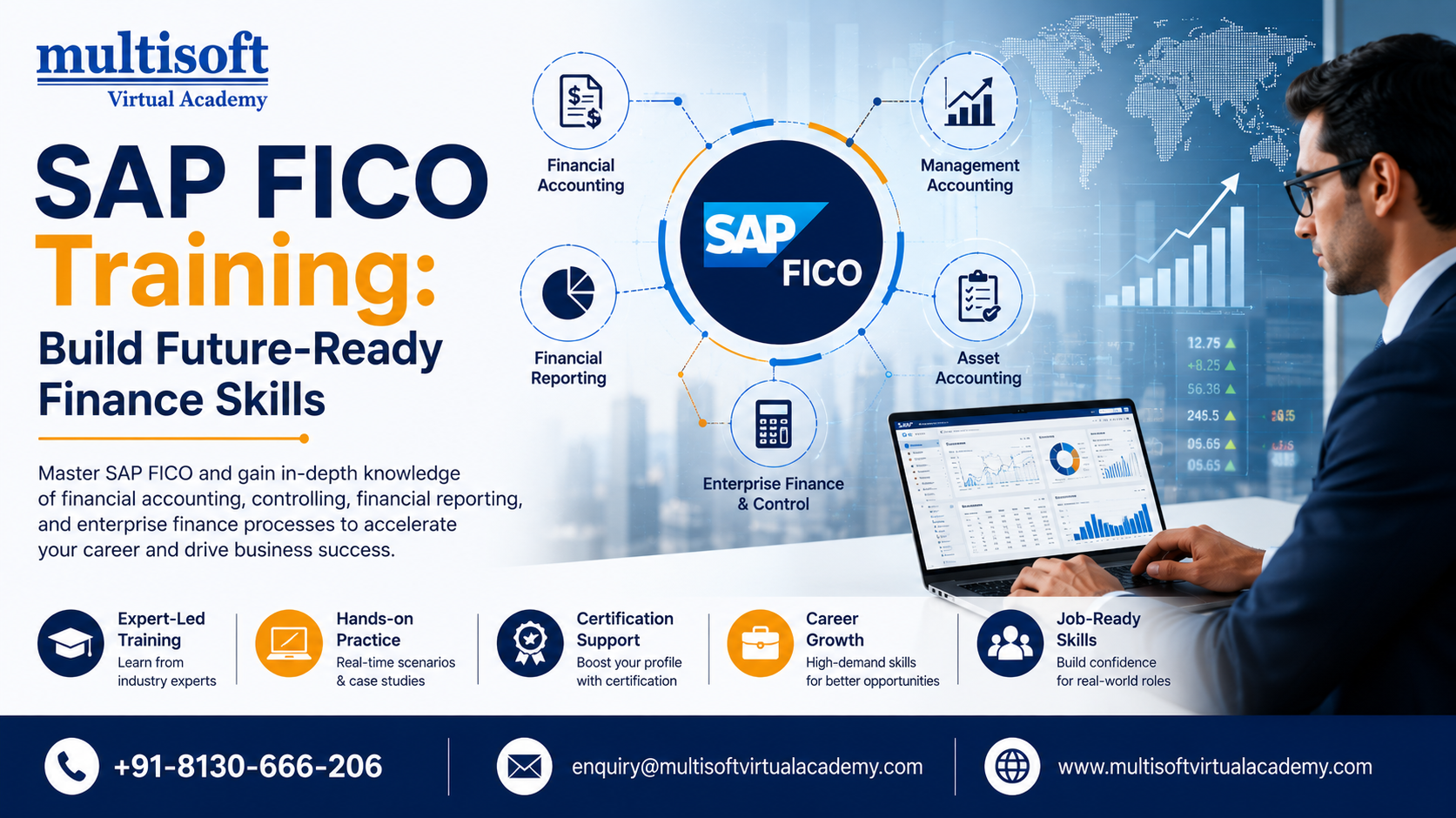
Finance departments are moving beyond traditional accounting toward integrated, real-time and data-driven financial management. As organizations modernize their enterprise systems, professionals with expertise in SAP Financial Accounting and Controlling continue to be valuable across implementation, support, consulting and transformation projects.
SAP FICO Training provides a structured pathway to understand how financial accounting and management accounting processes work within SAP environments. It can help finance professionals, accountants, consultants and aspiring SAP specialists develop practical knowledge of financial transactions, reporting, controlling and business process integration.
The demand for SAP finance expertise is also evolving with the adoption of SAP S/4HANA. SAP's current learning resources emphasize SAP S/4HANA Finance, cloud deployment, implementation skills and certification-oriented learning.
SAP FICO refers to two closely connected areas of enterprise finance:
SAP FI supports external financial reporting and accounting processes, while SAP CO focuses on internal cost management, profitability analysis and management reporting.
Together, these functions provide organizations with an integrated financial management framework. Professionals learning SAP FICO typically explore areas such as General Ledger, Accounts Payable, Accounts Receivable, Asset Accounting, Cost Center Accounting, Profit Center Accounting and financial reporting.
Modern SAP finance learning increasingly connects these fundamentals with SAP S/4HANA Finance Training, cloud-based processes and integrated analytics.
One of the most important developments for SAP finance professionals is the shift toward SAP S/4HANA.
Traditional SAP FICO knowledge remains valuable, but professionals increasingly need to understand how financial processes operate in SAP S/4HANA environments. SAP's official learning journey for Financial Accounting focuses on implementing and customizing financial accounting capabilities in SAP S/4HANA, including both on-premise and cloud scenarios.
This makes SAP S/4HANA Finance Training a highly relevant search and learning area for professionals planning to build long-term SAP finance expertise.
A modern learning path may therefore include:
SAP's current training ecosystem also lists dedicated learning paths for Financial Accounting and S/4HANA Finance, demonstrating the continuing importance of these skills.
A comprehensive SAP FICO Course should go beyond theoretical definitions. Learners should understand how finance processes are configured, executed and integrated with other business functions.
General Ledger is a central component of financial accounting. Learners can understand chart of accounts, company codes, posting processes, document types, journal entries, account determination and financial reporting.
These concepts establish the foundation for understanding how transactions are recorded and reflected in financial statements.
Accounts Payable manages transactions involving suppliers and vendors. SAP FICO learning commonly covers vendor-related accounting, invoice processing, outgoing payments, clearing and reporting.
Understanding this area helps learners connect procurement-related transactions with financial accounting.
Accounts Receivable focuses on customer-related financial transactions. Important concepts include customer accounting, incoming payments, clearing, credit-related processes and receivables reporting.
Because SAP integrates finance with other enterprise functions, learners can also understand how sales transactions influence financial accounting.
Asset Accounting manages the financial lifecycle of fixed assets. Training can introduce asset master data, acquisitions, depreciation, transfers, retirements and asset reporting.
Asset Accounting is particularly relevant in modern SAP S/4HANA Finance environments. SAP's current Financial Accounting learning resources include dedicated asset accounting content.
SAP CO helps organizations monitor and manage internal costs and profitability.
A strong SAP Controlling Training component may cover:
Understanding FI and CO together helps professionals see the relationship between external financial reporting and internal management accounting.
Certification can provide structured validation of technical knowledge and may help professionals demonstrate their understanding to employers and project teams.
The SAP ecosystem currently includes certification paths associated with SAP S/4HANA Financial Accounting. SAP lists the C_TS4FI certification among its S/4HANA associate certifications.
However, certification preparation should not be limited to memorizing examination questions. A strong learning strategy combines conceptual understanding, configuration knowledge, business scenarios and hands-on practice.
Professionals searching for SAP FICO Certification, SAP S/4HANA Finance Certification and related learning paths should therefore consider whether the training provides practical exposure in addition to theoretical preparation.
SAP is fundamentally a business process platform. Knowing transaction names without understanding the underlying financial process can make it difficult to handle real implementation or support scenarios.
Practical SAP FICO Online Training can help learners understand how business requirements translate into SAP processes.
For example, a practical exercise might begin with a business requirement involving a company code and chart of accounts. The learner can then explore master data, posting controls, document processing, clearing and financial reporting.
This approach helps connect individual configuration settings with the complete business process.
SAP's own S/4HANA Financial Accounting training emphasizes implementation and customization as well as areas such as General Ledger, Accounts Payable, Accounts Receivable and Asset Accounting.
SAP FICO Training for Beginners can be useful for graduates and professionals from accounting, finance, commerce or related backgrounds who want to understand enterprise financial systems.
Beginners can start with:
Working professionals may benefit from a more advanced approach that focuses on configuration, implementation methodology, business scenarios, troubleshooting and project-oriented learning.
One of the biggest advantages of learning SAP finance is understanding how financial accounting interacts with other enterprise functions.
For example, procurement activities can generate financial postings, while sales transactions can affect customer accounting and revenue-related processes.
Therefore, SAP FICO Integration with modules such as SAP MM and SAP SD is an important area for professionals who want to work on implementation or support projects.
A broader SAP professional profile can include knowledge of:
This integrated perspective is particularly important for consultants because real-world projects rarely operate within a single SAP module.
Cloud adoption is changing the way organizations deploy and manage enterprise applications. SAP's current Financial Accounting learning journey includes SAP S/4HANA Cloud Public Edition implementation and certification-oriented content.
Current SAP training offerings also include Financial Accounting in SAP S/4HANA Cloud based on SAP S/4HANA Cloud Public Edition 2602.
This creates opportunities for professionals to expand beyond traditional SAP FICO Training into areas such as:
Professionals who continuously update their skills are better positioned to adapt as organizations modernize their ERP landscapes.
Artificial intelligence is also becoming part of the broader SAP finance ecosystem. SAP's current finance training catalog includes learning around applying Business AI solutions and expertise in SAP Finance.
This means future-focused SAP finance professionals may increasingly need awareness of how automation, analytics and AI can support financial processes.
Rather than treating AI as a replacement for finance expertise, professionals can view it as an additional capability that complements accounting knowledge, SAP configuration and business process understanding.
A well-structured SAP FICO Training Course can help learners prepare for several career directions, depending on their previous experience and technical depth.
Potential roles include:
Experienced professionals may also progress toward senior consulting, solution architecture, project management or SAP finance transformation roles.
Career growth ultimately depends on practical expertise, project exposure, communication skills, domain knowledge and the ability to solve business problems - not simply on completing a training program.
Choosing an appropriate SAP FICO Course Online requires more than comparing course duration or training fees.
Learners should evaluate whether the program includes:
A course that combines finance fundamentals with modern SAP S/4HANA capabilities can provide a stronger foundation than a program focused exclusively on legacy concepts.
The future of SAP finance is increasingly connected with cloud ERP, automation, analytics, integrated business processes and AI-enabled capabilities.
Therefore, professionals should avoid viewing SAP FICO Training as a one-time learning activity. Continuous learning is increasingly important because SAP products, cloud releases, implementation practices and finance technologies continue to evolve.
A future-ready learning strategy can combine traditional FI and CO expertise with SAP S/4HANA Finance, cloud capabilities, analytics, integration and emerging Business AI concepts.
Choosing the right learning path can make a significant difference when building a career in enterprise finance technology. Multisoft Virtual Academy acts as a best service provider for professionals seeking structured learning in SAP FICO, SAP S/4HANA Finance and related enterprise technologies. By combining relevant concepts, practical learning and modern SAP finance skills, learners can build a stronger foundation for professional growth and prepare themselves for the evolving demands of digital finance.
| Start Date | End Date | No. of Hrs | Time (IST) | Day | |
|---|---|---|---|---|---|
| 03 Oct 2026 | 25 Oct 2026 | 24 | 06:00 PM - 09:00 PM | Sat, Sun | |
| 04 Oct 2026 | 26 Oct 2026 | 24 | 06:00 PM - 09:00 PM | Sat, Sun | |
| 10 Oct 2026 | 01 Nov 2026 | 24 | 06:00 PM - 09:00 PM | Sat, Sun | |
| 11 Oct 2026 | 02 Nov 2026 | 24 | 06:00 PM - 09:00 PM | Sat, Sun | |
Schedule does not suit you, Schedule Now! | Want to take one-on-one training, Enquiry Now! |
|||||






 Join our Live Instructor-Led online classes delivered by industry experts
 Let's Get Started