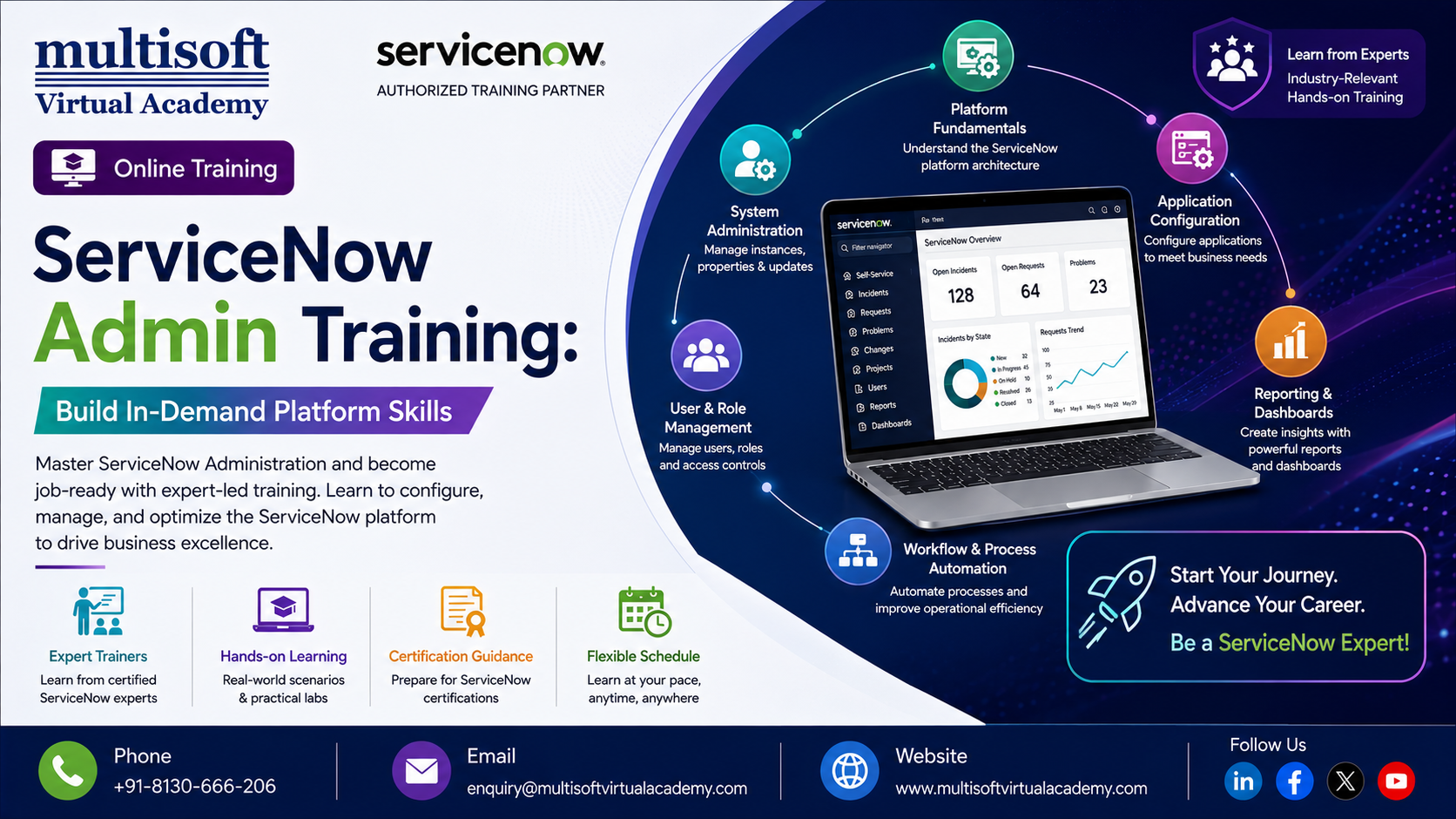
ServiceNow has become a critical platform for organizations looking to streamline IT operations, automate workflows and improve employee and customer experiences. As businesses increasingly adopt cloud-based service management and automation, professionals with strong ServiceNow administration skills are finding new opportunities across IT, operations, consulting and enterprise technology.
ServiceNow Admin Training is designed to help learners understand how to configure, manage and maintain the ServiceNow platform while developing practical skills that can be applied to real business environments. For professionals planning a career in ServiceNow, administration provides a strong foundation for progressing toward specialized roles such as ServiceNow Developer, ITSM Consultant, Implementation Specialist and Platform Owner.
ServiceNow administration involves managing the configuration, users, applications, data, security controls and workflows within a ServiceNow instance. A ServiceNow administrator helps ensure that the platform supports organizational processes efficiently while maintaining performance, security and usability.
The role is broader than simply managing users or updating records. Administrators may work with application configuration, access controls, notifications, dashboards, service catalogs, workflows, data imports, integrations and platform automation.
According to the current ServiceNow Certified System Administrator (CSA) blueprint, the certification evaluates skills across platform navigation, instance configuration, application collaboration, self-service and automation, database management, security, data migration, integration and scripting.
This makes ServiceNow Admin Training particularly valuable for learners who want practical platform knowledge rather than only theoretical understanding.
Organizations are under continuous pressure to automate repetitive processes, improve service delivery and provide employees with faster access to technology services. ServiceNow helps enterprises address these requirements through a centralized digital workflow platform.
A trained administrator can contribute by:
These capabilities make ServiceNow administration a practical career path for IT professionals and technology graduates.
One of the most important credentials for professionals beginning their ServiceNow journey is the ServiceNow Certified System Administrator (CSA) certification.
ServiceNow states that the CSA validates the knowledge and skills required to configure, implement and maintain a ServiceNow system. The certification also provides a foundation for pursuing additional ServiceNow credentials.
The current CSA exam blueprint covers six major areas:
The largest portion of the current blueprint focuses on database management and platform security, followed by application configuration and self-service and automation.
Therefore, learners preparing for ServiceNow CSA Training should develop practical knowledge across the complete platform rather than concentrating only on basic navigation.
A well-structured ServiceNow Administrator Training program should progress from platform fundamentals to advanced administration concepts.
Learners begin by understanding the ServiceNow ecosystem, instances, applications, navigation and platform architecture. This foundation makes it easier to understand how different ServiceNow modules interact.
Administration requires effective control over users and their access. Training typically covers users, groups, roles, permissions and access controls.
Understanding security is essential because improperly configured access can expose business data or prevent users from completing their responsibilities.
ServiceNow relies heavily on structured data. Administrators need to understand tables, fields, forms, lists, filters and relationships.
Practical training should demonstrate how configuration changes affect the user experience and underlying data.
The Service Catalog allows employees to request products and services through standardized processes. Administrators can configure catalog items, variables, approvals and fulfillment workflows.
Self-service capabilities are an important part of modern ServiceNow implementations because they reduce manual intervention and improve service accessibility.
Automation is one of the major reasons enterprises adopt ServiceNow. Administrators can configure workflows and automation to reduce repetitive manual tasks.
Current ServiceNow training paths also highlight Workflow Studio, Virtual Agent and automation-related capabilities as part of the platform learning journey.
The Configuration Management Database, or CMDB, plays a major role in understanding relationships between configuration items and services.
Training should introduce learners to CMDB concepts, data structures, relationships and the Common Service Data Model (CSDM). ServiceNow's learning recommendations include CMDB and CSDM fundamentals alongside the system administrator learning path.
Security knowledge is increasingly important for ServiceNow administrators. Training should cover roles, permissions, access controls and responsible configuration practices.
Administrators must understand not only how to provide access but also how to restrict access appropriately.
Enterprise ServiceNow implementations frequently require data to be imported from existing systems. Administrators therefore benefit from understanding import processes, data mapping and migration concepts.
Although administrators do not necessarily need to become full-time developers, basic scripting knowledge can significantly improve their ability to support advanced configurations.
ServiceNow's current CSA blueprint includes business rules, scripting and system update sets within the data migration and integration domain.
ServiceNow administration and development are closely connected but represent different skill areas.
A ServiceNow Administrator primarily focuses on configuration, platform management, security, users, applications, data and operational support.
A ServiceNow Developer generally works more deeply with application development, scripting, custom functionality, integrations and technical solutions.
For many professionals, administration is a logical starting point. Once the fundamentals are strong, learners can progress toward ServiceNow Developer Training, Application Development Fundamentals and the Certified Application Developer pathway.
ServiceNow's technical training portfolio currently includes Administration Fundamentals, Administration Advanced, Application Development Fundamentals, Scripting in ServiceNow Fundamentals and several product-specific learning paths.
ServiceNow skills can support multiple career directions.
Depending on experience and specialization, professionals may explore roles such as:
The exact responsibilities and requirements vary by organization. However, a strong understanding of platform administration can provide a valuable foundation for moving into more specialized ServiceNow positions.
ServiceNow is strongly associated with IT Service Management, making ITSM Training a useful complementary skill for administrators.
Professionals should understand concepts such as incident management, problem management, change management, request fulfillment, knowledge management and service catalogs.
When administrators understand the business process behind a configuration, they can make better platform decisions. Instead of simply changing a form or workflow, they can consider how the change affects users, approvals, reporting, compliance and downstream processes.
This combination of technical administration and process knowledge can make a ServiceNow professional more effective.
For beginners, learning ServiceNow can initially seem complex because the platform contains numerous applications and configuration options.
A structured learning approach can make the process easier.
Start with platform fundamentals and navigation. Then move into users, roles, tables, forms and lists. After that, study ITSM processes, service catalogs, workflows, automation, CMDB, security and data management.
Practical exercises should accompany every major concept. Creating configurations in a practice environment helps learners understand how the platform behaves and how different components interact.
ServiceNow's current guidance recommends hands-on experience with the platform before attempting the CSA examination and provides a dedicated system administrator learning path.
Effective preparation should combine structured learning with practical experience.
First, review the current CSA exam blueprint because certification objectives can change. ServiceNow's January 2026 blueprint identifies the domains and approximate weighting used for the current examination.
Next, practice configuration tasks rather than relying exclusively on memorization. Build sample workflows, configure forms, create users and roles, work with data and explore platform administration features.
It is also important to study official learning materials and documentation. ServiceNow specifically states that exam questions are based on official training materials and product documentation.
After gaining sufficient practical confidence, candidates can use practice assessments to identify knowledge gaps and focus their revision.
Reading documentation can explain what a ServiceNow feature does, but practical work demonstrates how it behaves.
For example, configuring an access control rule can reveal how roles, permissions and user access interact. Creating an approval workflow can demonstrate how automation influences a business process.
Hands-on learning therefore helps develop problem-solving skills that are useful beyond certification exams.
This is especially important for professionals who want to become effective ServiceNow Administrators rather than simply earn a credential.
ServiceNow continues to expand beyond traditional IT service management into areas such as customer service, HR, security, operations, analytics and AI-enabled workflows.
The current ServiceNow technical training portfolio includes areas such as IT Operations Management, Customer Service Management, Security Operations, Platform Analytics and ServiceNow AI Implementation.
AI is also becoming an increasingly important part of enterprise platform strategies. ServiceNow's learning recommendations include introductory Generative AI and Now Assist-related learning alongside the system administrator path.
For administrators, this means that long-term career growth may require more than traditional configuration skills. Professionals who understand automation, analytics, integrations and AI-enabled platform capabilities can be better positioned to support evolving enterprise requirements.
ServiceNow Admin Training can be suitable for:
Previous experience with IT processes, databases or system administration can be helpful, although the appropriate starting point depends on the learner's background.
ServiceNow administration offers a strong combination of technical configuration, IT service management, automation, data management and enterprise workflow skills. As organizations continue investing in digital transformation, professionals who can manage and optimize ServiceNow environments can build valuable and adaptable technology careers. A focused ServiceNow Admin Training program can provide the practical foundation needed to understand the platform, prepare for the ServiceNow CSA certification and progress toward advanced ServiceNow roles. For professionals and organizations seeking structured learning, practical guidance and industry-oriented ServiceNow education, Multisoft Virtual Academy is a trusted service provider offering professional training designed to support modern technology skill development.
| Start Date | Time (IST) | Day | |||
|---|---|---|---|---|---|
| 10 Oct 2026 | 06:00 PM - 10:00 AM | Sat, Sun | |||
| 04 Oct 2026 | 06:00 PM - 10:00 AM | Sat, Sun | |||
| 17 Oct 2026 | 06:00 PM - 10:00 AM | Sat, Sun | |||
| 11 Oct 2026 | 06:00 PM - 10:00 AM | Sat, Sun | |||
|
Schedule does not suit you, Schedule Now! | Want to take one-on-one training, Enquiry Now! |
|||||






 Join our Live Instructor-Led online classes delivered by industry experts
 Let's Get Started