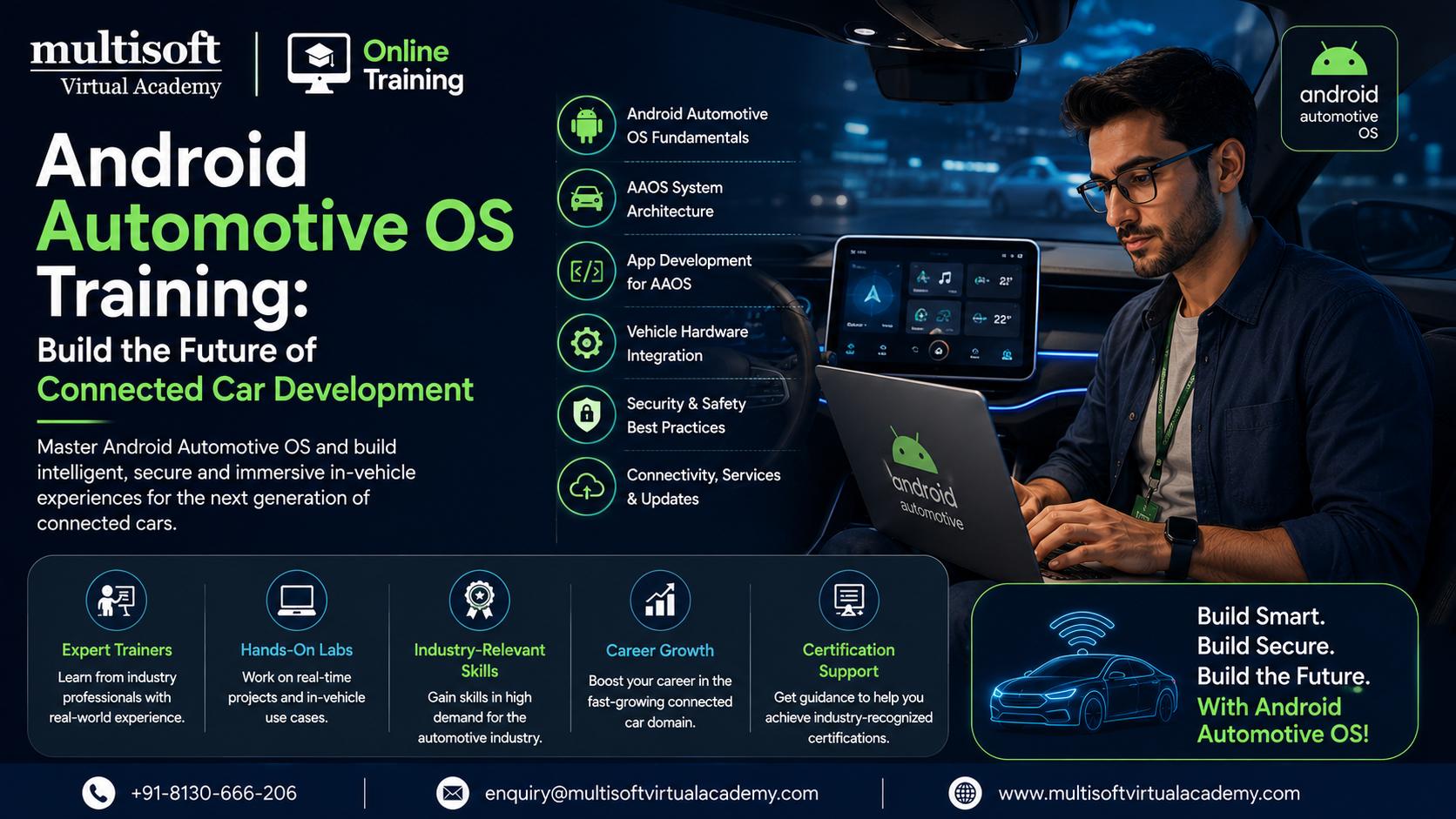
The automotive industry is moving rapidly toward software-defined vehicles, connected mobility and intelligent in-car experiences. As vehicles become increasingly dependent on sophisticated software, Android Automotive OS Training is becoming a valuable learning path for Android developers, automotive engineers, software professionals and technology teams seeking to build applications for next-generation vehicles.
Android Automotive OS (AAOS) is an Android-based operating system built directly into vehicles. Unlike Android Auto, where a smartphone provides the application experience, AAOS runs as a standalone Android-powered platform inside the car. This distinction creates new opportunities for developers to create native automotive applications for infotainment, navigation, media, communication and other supported vehicle experiences.
In 2026, the relevance of automotive software development is increasing further as the industry moves toward software-defined vehicles (SDVs), connected ecosystems, over-the-air updates, intelligent assistants and AI-powered driving experiences. Google has also announced its open-source AAOS SDV platform and continues to expand Android for Cars capabilities.
Android Automotive OS Training is an Android-based operating system designed specifically for vehicles. It operates directly on compatible automotive hardware rather than depending on a connected smartphone.
This makes AAOS fundamentally different from Android Auto. Android Auto extends compatible smartphone applications onto a vehicle display, while Android Automotive OS is integrated into the vehicle itself.
For developers, this means automotive application development requires an understanding of both Android development principles and the unique requirements of the vehicle environment.
A professional Android Automotive OS Training program can help learners understand:
The automotive industry is undergoing a major software transformation. Vehicles are increasingly becoming software-defined platforms where infotainment, navigation, connectivity, personalization and other non-safety functions depend heavily on software.
Google describes modern vehicles as software-defined and highlights AAOS as an open platform intended to help manufacturers reduce complexity while enabling faster innovation.
At the same time, Android for Cars continues to expand. Google reported strong growth and momentum in the Android Auto and cars-with-Google-built-in ecosystem and introduced new capabilities designed to enable richer in-car experiences.
This creates demand for professionals who understand how conventional Android development concepts translate into automotive environments.
Android Automotive OS Training can therefore be useful for professionals who want to move beyond traditional mobile application development and explore connected-car software, automotive infotainment and software-defined vehicle technologies.
Understanding the difference between Android Automotive OS and Android Auto is one of the first concepts developers should learn.
AAOS is installed directly in the vehicle. Applications can be installed onto the automotive system and operate without requiring the user's phone to provide the core application environment.
Android Auto provides a driver-optimized experience by connecting an Android phone to a compatible vehicle or aftermarket system. The phone remains the primary application platform.
For developers, this distinction affects application architecture, packaging, testing and deployment.
A good Android Automotive Training Course should explain both platforms so learners can understand when and how to develop for each environment.
Android Automotive OS supports several categories of applications designed for use in vehicles. Depending on the application category and applicable requirements, developers can build experiences around media, navigation, points of interest, weather, Internet of Things and other supported use cases.
Media applications can allow drivers and passengers to browse and play music, radio, audiobooks and other audio content.
Android's current documentation highlights technologies such as MediaLibraryService and MediaSession for automotive media experiences.
Navigation applications need to provide useful information while minimizing driver distraction. Developers must therefore understand automotive-specific interaction patterns and design constraints.
POI applications can help users discover relevant locations such as restaurants, charging stations, parking facilities and other destinations.
Weather applications can provide relevant information through interfaces designed for safe in-car interaction.
Connected-car ecosystems can also interact with supported Internet of Things experiences, creating opportunities for smart-home and vehicle-related use cases.
A comprehensive Android Automotive OS Development Training program should combine Android fundamentals with practical automotive development.
Learners should understand how AAOS fits into the broader automotive software ecosystem. This includes application layers, system services, automotive hardware and communication between different components.
Android Studio remains an important development environment. Developers need to understand project configuration, modules, Gradle configuration, debugging and emulator-based testing.
The Android for Cars App Library provides templates and APIs intended to help developers create experiences appropriate for vehicle environments.
Understanding templates, screens, navigation patterns and supported application categories is an important part of Android Automotive App Development Training.
Vehicle applications have different operating conditions from smartphone applications. Developers must understand lifecycle behavior, background operation, connectivity changes and other automotive-specific considerations.
Developers should learn how media browsing, playback controls, audio focus and voice interaction work within the automotive environment. Android's documentation emphasizes the importance of distraction safeguards for car applications.
An application that works well on a smartphone may not automatically be suitable for a vehicle.
Automotive applications must prioritize safe interaction. Developers should therefore understand:
Google maintains specific quality requirements for Android Auto and Android Automotive OS applications, including category-specific testing and compatibility criteria.
Successful automotive applications require more than technical functionality. They must deliver a reliable and safe user experience.
Developers should avoid unnecessary interaction complexity. Important information should be easy to understand and common actions should require minimal attention.
Voice interaction can reduce the need for manual interaction while driving. This is particularly useful for media, navigation and other supported applications.
Developers should follow Google's Android for Cars quality requirements before submitting applications for distribution. The current requirements include testing applicable criteria using the Android Automotive OS environment and keeping up with category-specific quality standards.
Testing only on a smartphone is insufficient. Developers should test applications in an automotive environment to identify issues related to screen dimensions, lifecycle behavior, input methods, performance and system integration.
Practical testing is a critical part of Android Automotive OS Training.
Developers can use automotive emulator environments to validate applications before deployment. Google's current car quality guidance specifically recommends using the Android Emulator for applicable Android Automotive OS checklist items.
A practical training program can introduce learners to:
Hands-on exercises can help developers understand how their applications behave under realistic automotive conditions.
Security is becoming increasingly important as vehicles become connected and software-driven.
Recent Android Automotive OS developments emphasize secure architecture, domain isolation and virtualization. Google's AAOS SDV security documentation discusses using virtualization to isolate co-hosted system instances and strengthen separation between different domains.
This is particularly relevant because connected vehicle systems can interact with networks, applications, services and external devices.
Professionals undertaking Android Automotive OS Certification Training should therefore understand fundamental security concepts such as:
Security should be treated as part of application design rather than as an afterthought.
Software-defined vehicles are changing the role of software in automotive engineering.
Traditional vehicles depended heavily on hardware-specific functionality. Modern SDVs increasingly rely on centralized computing, software platforms and updateable services.
AAOS is positioned within this transformation by providing an Android-based platform for automotive experiences. Google announced its AAOS SDV initiative in 2026 with an emphasis on open infrastructure for non-safety vehicle functions.
This development makes Android Automotive OS Development particularly relevant to professionals working in:
An Android Automotive OS Course can be valuable for a wide range of professionals.
Android developers can expand their skills from mobile applications into automotive application development.
Automotive professionals can strengthen their understanding of Android-based infotainment and connected vehicle platforms.
Embedded developers interested in automotive software can learn how Android technologies fit into modern vehicle systems.
Design professionals can learn how conventional mobile interfaces need to be adapted for safe and practical automotive experiences.
Testing professionals can develop knowledge of automotive application validation, compatibility and driver-distraction requirements.
Technical managers can gain a broader understanding of Android Automotive technologies when planning connected-car or digital cockpit projects.
As automotive companies increasingly integrate software into their products, professionals with combined Android and automotive knowledge can explore roles such as:
The exact opportunities depend on experience, programming skills and knowledge of automotive systems.
When evaluating an Android Automotive OS Training Course, look beyond the course title.
A useful program should provide a balance of theory and hands-on development. Important factors include:
Practical projects: Learners should have opportunities to develop automotive applications rather than only study concepts.
Current technology: Android for Cars evolves continuously, so training should reflect current platform documentation and development practices.
Automotive-specific learning: The program should explain how automotive requirements differ from conventional Android development.
Testing experience: Learners should practice emulator-based testing and application validation.
Experienced instructors: Trainers should be capable of connecting Android development concepts with real automotive use cases.
Application quality: The course should cover driver distraction, automotive UX and Google Play requirements.
The future of automotive software is moving toward more intelligent, connected and personalized experiences.
Several trends are particularly important:
AI assistants are becoming increasingly relevant to vehicle interfaces. Google's 2026 announcements highlighted new Gemini capabilities and richer Android experiences in cars.
Vehicles are increasingly being treated as software platforms that can receive new functionality and improvements over time.
Cars are becoming connected endpoints within broader digital ecosystems involving smartphones, cloud services, smart homes and other devices.
Large displays, personalized interfaces, multimedia and contextual information are creating new opportunities for automotive application developers.
As connected vehicle systems become more sophisticated, secure architecture and isolation will remain essential areas of development.
Android Automotive OS Training offers an opportunity to build skills at the intersection of Android development and the rapidly evolving automotive software industry. From Android Automotive app development and automotive UX to testing, security and software-defined vehicles, the technology is opening new possibilities for developers and organizations. For professionals seeking structured learning, practical development knowledge and industry-focused guidance, Multisoft Virtual Academy can serve as a training provider for building relevant Android Automotive OS skills and preparing for the changing demands of connected and software-defined vehicle development.
| Start Date | Time (IST) | Day | |||
|---|---|---|---|---|---|
| 10 Oct 2026 | 06:00 PM - 10:00 AM | Sat, Sun | |||
| 11 Oct 2026 | 06:00 PM - 10:00 AM | Sat, Sun | |||
| 17 Oct 2026 | 06:00 PM - 10:00 AM | Sat, Sun | |||
| 18 Oct 2026 | 06:00 PM - 10:00 AM | Sat, Sun | |||
|
Schedule does not suit you, Schedule Now! | Want to take one-on-one training, Enquiry Now! |
|||||






 Join our Live Instructor-Led online classes delivered by industry experts
 Let's Get Started