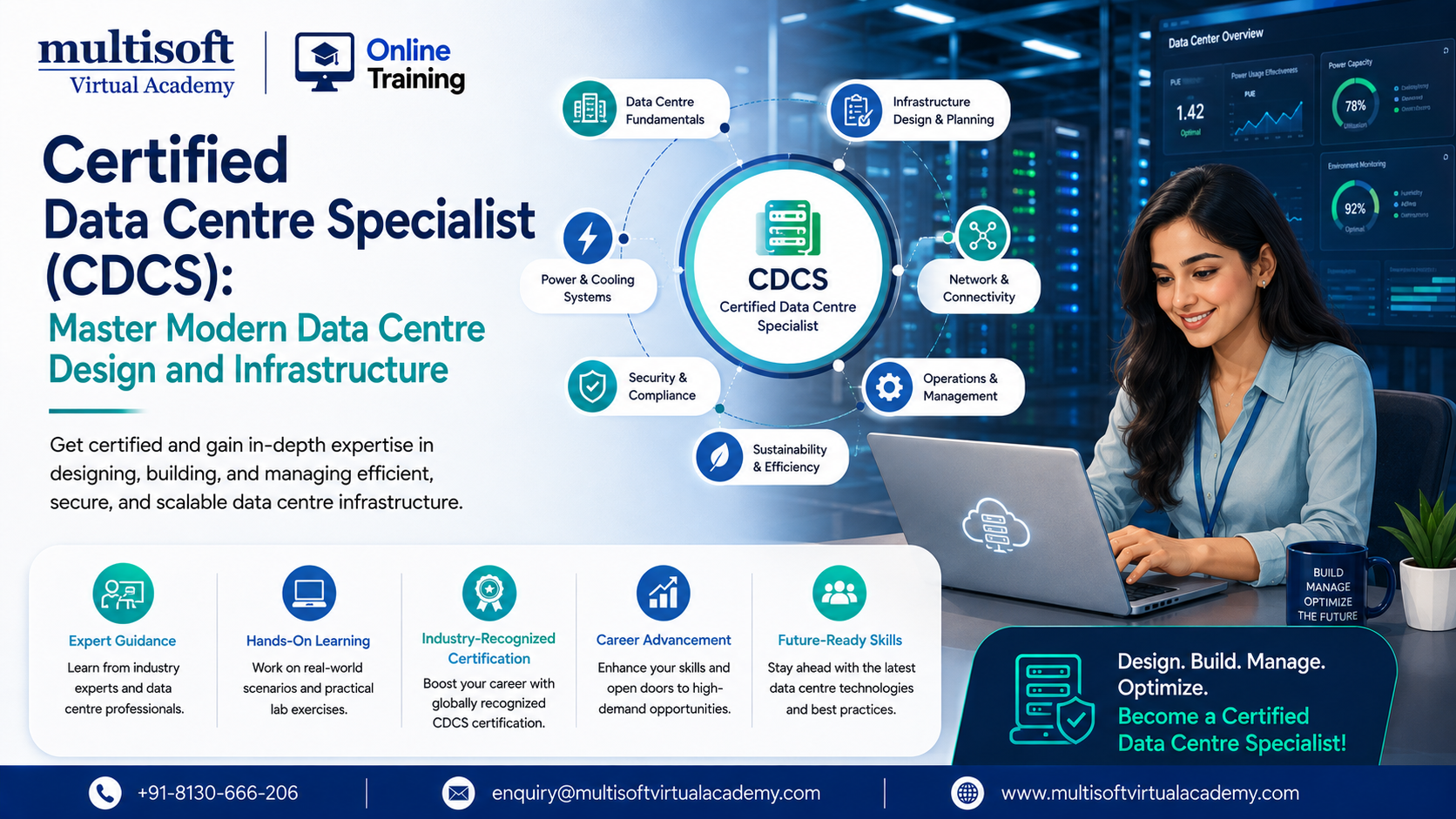
The rapid expansion of cloud computing, artificial intelligence, high-performance computing and digital services is transforming the way organizations design and operate data centres. Modern facilities must deliver high availability, scalability, security, energy efficiency and business continuity while supporting increasingly demanding workloads.
This is where Certified Data Centre Specialist (CDCS) training can provide valuable professional expertise. CDCS is an advanced-level certification focused on data centre design, infrastructure and operational considerations. The certification is particularly relevant to professionals responsible for improving the availability, manageability and efficiency of mission-critical data centre environments.
Certified Data Centre Specialist (CDCS) is an advanced data centre certification designed for professionals working in IT, facilities and data centre operations. The program builds knowledge around the planning, design and implementation of critical data centre infrastructure.
The CDCS certification is part of the EPI Data Centre Training Framework and sits within the Design and Build learning track. Candidates generally need a valid Certified Data Centre Professional (CDCP) certification or equivalent competencies before pursuing CDCS.
The certification helps professionals develop the technical understanding required to evaluate infrastructure proposals, communicate effectively with suppliers and assess whether proposed solutions are accurate, efficient and appropriate for organizational requirements.
Data centres are becoming more complex. AI and high-performance computing workloads are increasing power density and creating new challenges for cooling and thermal management. At the same time, organizations are under pressure to improve resilience and energy efficiency.
According to EPI, modern high-demand environments require attention to both electrical reliability and thermal performance, making advanced data centre knowledge increasingly important.
Professionals who understand the relationship between power, cooling, networking, security, capacity and operational resilience can contribute more effectively to infrastructure planning and decision-making.
For this reason, searches around data centre certification, data centre training, data centre infrastructure, data centre design, data centre management and data centre engineering are increasingly relevant to technology and infrastructure professionals.
A strong CDCS training program should help learners understand how different components of a data centre work together rather than treating power, cooling, networking and security as isolated subjects.
Professionals need to understand the complete data centre lifecycle, from initial planning through implementation, operation, optimization and continuous improvement.
This knowledge helps organizations make better infrastructure decisions while considering future capacity, availability and operational requirements.
Reliable power is fundamental to a mission-critical data centre. CDCS-related training addresses power infrastructure, redundancy concepts and design considerations that support high availability.
Understanding configurations such as N+1, 2N and 2(N+1) can help professionals evaluate redundancy strategies and understand their impact on resilience, capacity and cost.
As server densities increase, effective thermal management becomes increasingly important. Cooling systems must be designed to maintain appropriate operating conditions while supporting reliability and energy-efficiency objectives.
Professionals pursuing data centre specialist certification can benefit from understanding cooling infrastructure, redundancy and the relationship between IT load and thermal requirements.
Networking is another critical component of modern data centre infrastructure. High availability, low latency, scalability and connectivity requirements must be considered when planning network architecture.
Knowledge of network infrastructure enables professionals to communicate more effectively with networking teams, suppliers and technology stakeholders.
Data centre security extends beyond cybersecurity. Physical security measures are essential for protecting equipment, infrastructure and sensitive information.
A comprehensive data centre security strategy can involve access control, authentication mechanisms, monitoring, security procedures and physical protection.
Data centre professionals must understand the standards and guidelines that influence infrastructure planning and implementation.
CDCS-related programs introduce professionals to data centre standards and rating concepts and help them understand how different requirements influence design decisions.
One of the most important trends shaping the data centre industry is the rapid growth of AI infrastructure.
AI workloads can require significantly greater computing capacity and higher power density than conventional enterprise workloads. This creates additional requirements for electrical distribution, thermal management, rack infrastructure, network connectivity and capacity planning.
EPI specifically highlights AI, HPC and large-scale analytics as workloads that can place additional stress on traditional cooling systems.
This makes AI data centre infrastructure, data centre cooling, high-density data centre design, data centre power management and data centre sustainability important areas for professionals who want to remain competitive.
Energy efficiency is no longer simply an operational concern. It has become an important strategic consideration for organizations building or modernizing data centre facilities.
Professionals need to consider how infrastructure choices influence energy consumption, cooling requirements, equipment utilization and long-term operating costs.
A well-designed data centre can balance performance, availability and efficiency rather than focusing exclusively on maximum capacity.
This is also why data centre professionals increasingly need awareness of sustainable infrastructure, efficient cooling strategies and responsible resource utilization.
CDCS certification training can be valuable for professionals who already work with data centre infrastructure or are progressing toward advanced data centre design and management responsibilities.
Potential participants include:
The official certification information identifies IT, facilities and data centre operations professionals responsible for improving availability and manageability as a key audience.
For professionals following the EPI pathway, CDCS generally comes after Certified Data Centre Professional (CDCP). The CDCS course is positioned as the second certification in the Design and Build track and can subsequently support progression toward Certified Data Centre Expert (CDCE).
This creates a logical progression:
CDCP → CDCS → CDCE
The pathway allows professionals to gradually develop their knowledge from foundational data centre concepts to specialist-level capabilities and eventually expert-level design knowledge.
The official EPI information states that the CDCS examination consists of 60 multiple-choice questions and is completed in 90 minutes. A minimum score of 45 correct answers is required to pass. The certification is valid for three years and requires recertification afterward.
Training delivery can vary depending on the accredited provider and may include instructor-led classroom learning, virtual instructor-led training and training-on-demand formats.
Because course schedules, examination arrangements and certification policies can change, candidates should verify the latest requirements with the relevant certification or training provider before enrollment.
A Certified Data Centre Specialist qualification can strengthen the professional profile of individuals pursuing advanced infrastructure responsibilities.
Potential career directions include:
However, certification alone does not guarantee a specific job title or salary. Career outcomes also depend on practical experience, technical specialization, location, employer requirements and complementary skills.
Choosing the right CDCS training course is important because data centre concepts are highly practical and interconnected.
Before selecting a program, professionals should evaluate:
Look for trainers who can explain technical concepts through practical scenarios and real-world infrastructure examples.
The training should cover critical areas such as data centre design, power, cooling, networking, security, standards, redundancy and efficiency.
Virtual instructor-led training can be useful for professionals who need to continue working while developing advanced technical skills.
A quality training program should help participants understand the examination structure and prepare systematically for certification.
Case studies, engineering examples and scenario-based discussions can make complex data centre concepts easier to understand and apply.
The data centre industry is evolving rapidly. Professionals planning their long-term careers should consider developing knowledge beyond traditional infrastructure concepts.
Important areas include:
AI-ready data centres: Understanding infrastructure requirements for high-density AI workloads.
Advanced cooling: Learning about modern thermal management approaches for high-density computing.
Data centre sustainability: Understanding energy efficiency and environmentally responsible infrastructure.
Automation and monitoring: Using intelligent monitoring and automation to improve operational visibility.
Cloud and hybrid infrastructure: Understanding how physical data centres interact with cloud and distributed computing environments.
Data centre security: Combining physical security and broader infrastructure protection strategies.
These emerging areas complement traditional data centre design and management knowledge and can help professionals adapt to changing infrastructure requirements.
A certification demonstrates structured learning and professional development, but practical application remains essential.
Data centre environments involve complex decisions where power, cooling, network capacity, security, availability and cost can affect one another. Professionals who understand these relationships can contribute more effectively to infrastructure planning and operational improvement.
Therefore, the best CDCS certification training approach combines theoretical concepts with practical examples, case studies, technical discussions and examination preparation.
The growing demand for cloud services, AI infrastructure, high-performance computing and always-available digital applications is creating new opportunities for skilled data centre professionals. Certified Data Centre Specialist (CDCS) training can help experienced IT, facilities and infrastructure professionals strengthen their understanding of data centre design, power, cooling, networking, security, redundancy and efficiency. For professionals looking for structured CDCS training, data centre certification preparation and practical learning support, Multisoft Virtual Academy acts as a best service provider, helping learners build relevant technical knowledge and prepare for the evolving demands of modern data centre infrastructure.
The rapid expansion of cloud computing, artificial intelligence, high-performance computing and digital services is transforming the way organizations design and operate data centres. Modern facilities must deliver high availability, scalability, security, energy efficiency and business continuity while supporting increasingly demanding workloads.
This is where Certified Data Centre Specialist (CDCS) training can provide valuable professional expertise. CDCS is an advanced-level certification focused on data centre design, infrastructure and operational considerations. The certification is particularly relevant to professionals responsible for improving the availability, manageability and efficiency of mission-critical data centre environments.
| Start Date | Time (IST) | Day | |||
|---|---|---|---|---|---|
| 10 Oct 2026 | 06:00 PM - 10:00 AM | Sat, Sun | |||
| 11 Oct 2026 | 06:00 PM - 10:00 AM | Sat, Sun | |||
| 17 Oct 2026 | 06:00 PM - 10:00 AM | Sat, Sun | |||
| 18 Oct 2026 | 06:00 PM - 10:00 AM | Sat, Sun | |||
|
Schedule does not suit you, Schedule Now! | Want to take one-on-one training, Enquiry Now! |
|||||






 Join our Live Instructor-Led online classes delivered by industry experts
 Let's Get Started