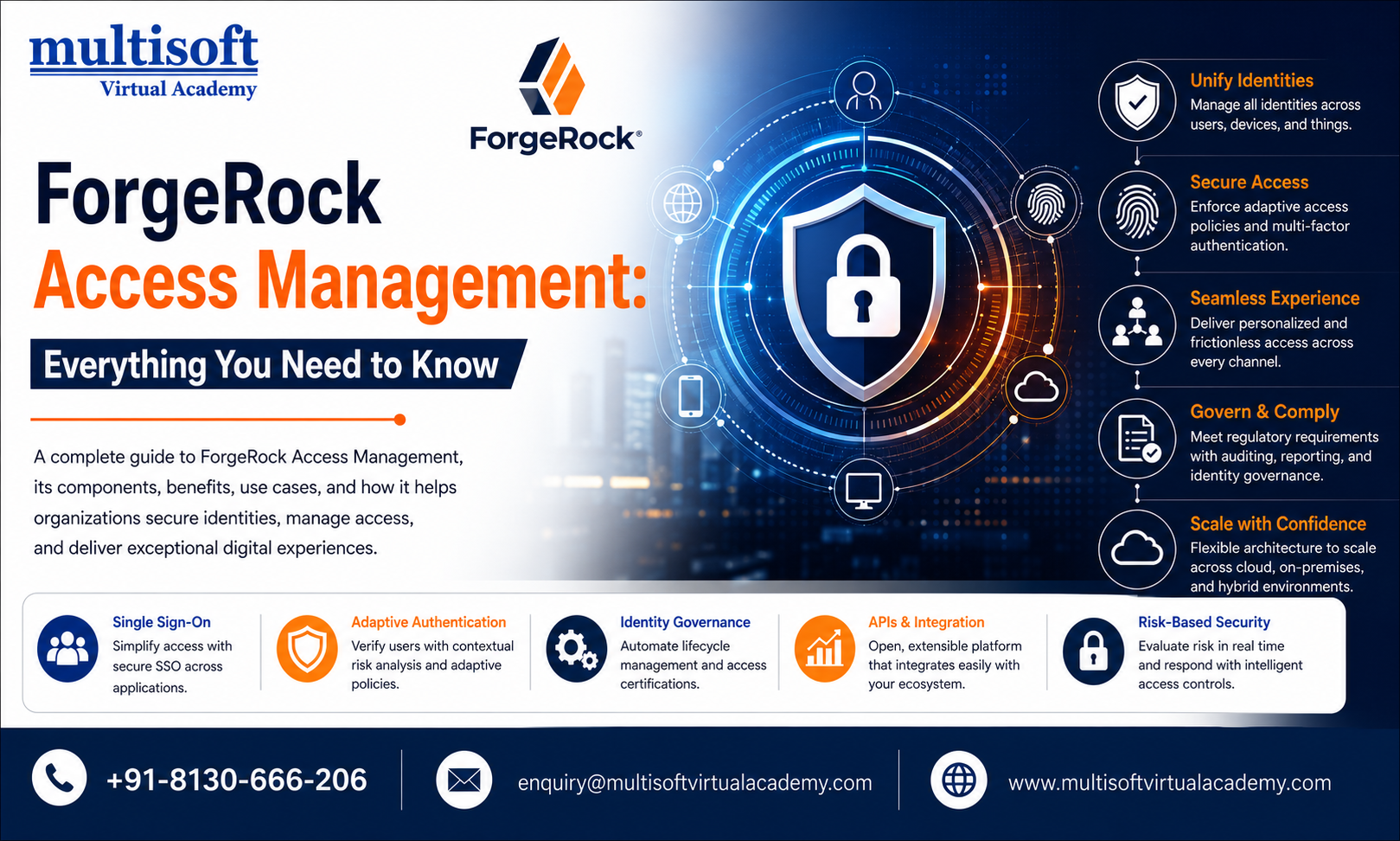
As businesses accelerate their digital transformation journey, protecting user identities has become one of the most critical aspects of cybersecurity. Employees, customers, partners, and vendors access enterprise applications from multiple devices and locations every day, making traditional username-and-password authentication insufficient. Organizations now require intelligent identity solutions that provide secure access without compromising the user experience.
This is where ForgeRock Access Management plays a vital role. It is a powerful Identity and Access Management (IAM) solution designed to authenticate users, authorize access, and protect digital assets across cloud, on-premises, and hybrid environments. By combining advanced authentication methods, Single Sign-On (SSO), Multi-Factor Authentication (MFA), adaptive security, and identity federation, ForgeRock helps organizations reduce security risks while improving operational efficiency.
With cyberattacks becoming increasingly sophisticated, enterprises across industries are investing in modern IAM platforms to secure sensitive data, meet regulatory compliance requirements, and deliver seamless digital experiences. Whether you manage a banking application, healthcare portal, government platform, or enterprise cloud infrastructure, ForgeRock Access Management offers a scalable and future-ready solution for identity security.
In this guide, you'll learn how ForgeRock Access Management works, its core features, business benefits, implementation approach, and why it remains one of the leading enterprise identity management solutions.
ForgeRock Access Management (AM) is an enterprise-grade Identity and Access Management platform that enables organizations to authenticate users, control access to applications, and enforce security policies across digital environments. It acts as a centralized authentication gateway that ensures only verified users can access protected resources.
Unlike traditional authentication systems that rely solely on passwords, ForgeRock supports modern identity standards and advanced security protocols, allowing organizations to implement secure and flexible authentication methods based on business needs.
The platform integrates with cloud applications, web portals, APIs, mobile applications, enterprise software, and legacy systems, making it suitable for organizations of every size.
Digital identities have become one of the most valuable assets within an organization. Every login attempt represents a potential security risk if it is not properly managed.
Without a centralized IAM solution, organizations often face challenges such as:
An effective access management solution eliminates these issues by applying consistent authentication and authorization policies across all systems.
Single Sign-On (SSO)
Single Sign-On allows users to log in once and securely access multiple enterprise applications without repeatedly entering their credentials.
This improves productivity while reducing password fatigue and help desk requests related to password resets.
Key advantages include:
Passwords alone are no longer sufficient to protect enterprise systems.
ForgeRock supports Multi-Factor Authentication using several verification methods, including:
Requiring multiple authentication factors significantly reduces the chances of unauthorized access.
Adaptive Authentication adds an intelligent security layer by analyzing contextual information before granting access.
The platform evaluates several factors, including:
If unusual activity is detected, additional authentication steps are automatically triggered.
Modern organizations rely on numerous third-party applications and cloud services.
ForgeRock supports identity federation using industry-standard protocols such as:
This enables users to securely access multiple external applications with a single identity while maintaining centralized security control.
Authentication verifies who the user is, while authorization determines what that user is allowed to access.
ForgeRock enables organizations to implement:
This ensures users only receive access to the resources required for their responsibilities.
Secure session management is another important capability.
ForgeRock helps organizations monitor and control user sessions through:
These features help minimize risks associated with abandoned or compromised sessions.
ForgeRock Access Management is part of a broader identity ecosystem that provides end-to-end identity services.
This component automates the complete identity lifecycle, including user provisioning, account management, password synchronization, and de-provisioning.
Directory Services provide a highly scalable identity repository capable of storing millions of user identities with high availability and exceptional performance.
Identity Gateway protects legacy and modern applications by enforcing authentication and authorization policies before users gain access.
Identity Cloud delivers IAM capabilities as a cloud-native service, reducing infrastructure complexity while enabling rapid deployment.
Together, these components create a comprehensive identity platform for enterprises.
Organizations that implement ForgeRock experience measurable improvements in both security and operational efficiency.
Advanced authentication methods protect against phishing attacks, credential theft, brute-force attacks, and unauthorized access.
Single Sign-On and passwordless authentication reduce login friction while providing secure access across multiple applications.
ForgeRock helps organizations satisfy compliance requirements for standards such as GDPR, HIPAA, PCI DSS, SOX, and ISO 27001 by enforcing consistent identity and access controls.
The platform is designed to support millions of users, making it suitable for global enterprises with rapidly growing user bases.
ForgeRock integrates seamlessly with cloud environments, on-premises infrastructure, and hybrid deployments, enabling organizations to modernize at their own pace.
Automated identity management, centralized authentication, and reduced password-related support requests contribute to lower IT operational expenses.
ForgeRock has earned the trust of enterprises worldwide because of its flexibility, scalability, and standards-based architecture. It supports modern authentication protocols, integrates with diverse enterprise applications, and provides a unified approach to identity security. Organizations can implement Zero Trust principles, secure customer and workforce identities, and simplify access management without disrupting existing business operations.
As cyber threats continue to evolve, investing in a comprehensive IAM solution like ForgeRock helps organizations strengthen security, improve compliance, and deliver seamless digital experiences across every touchpoint.
Understanding the architecture of ForgeRock Access Management helps organizations appreciate how it delivers secure, scalable, and centralized identity services.
A typical ForgeRock deployment consists of several integrated components that work together to authenticate users, authorize access, and protect enterprise resources.
This layer verifies a user's identity using one or more authentication methods. Depending on the organization's security requirements, users may log in with passwords, biometrics, hardware tokens, mobile authenticators, or passwordless authentication methods.
The policy engine evaluates predefined security rules and determines whether a user should be granted or denied access. It considers user roles, permissions, device information, network location, risk scores, and other contextual attributes before making an access decision.
All user identities, roles, groups, and authentication information are securely stored in the identity repository. This centralized directory ensures consistency across all enterprise applications.
Federation services enable secure identity sharing between organizations and third-party applications using industry standards such as SAML 2.0, OAuth 2.0, and OpenID Connect (OIDC). This simplifies secure access across multiple platforms without requiring separate credentials.
Every authentication request, policy evaluation, and user session is logged. These audit records help organizations monitor security events, investigate incidents, and demonstrate compliance with regulatory standards.
A successful ForgeRock implementation requires careful planning and execution. Following a structured approach minimizes deployment risks and ensures long-term success.
Identify the applications, users, security policies, compliance requirements, and authentication methods that need to be supported.
Develop an architecture that integrates cloud services, on-premises systems, APIs, mobile applications, and legacy platforms while ensuring scalability and high availability.
Create authentication journeys based on user types, device trust, geographic location, and business risk. Adaptive authentication can be configured to apply additional verification only when necessary.
Connect ForgeRock Access Management with business applications, cloud platforms, and APIs using standard protocols such as SAML, OAuth, and OpenID Connect.
Conduct functional, security, and performance testing to verify authentication workflows, authorization policies, and system resilience before moving into production.
Continuously review authentication logs, user behavior, policy performance, and security alerts to improve protection and user experience over time.
ForgeRock Access Management is widely adopted across industries where identity security and regulatory compliance are critical.
Banks use ForgeRock to secure digital banking platforms, online transactions, customer portals, and employee access while meeting stringent financial regulations.
Healthcare organizations protect electronic health records (EHRs), patient portals, and clinical applications through secure identity verification and role-based access.
Government agencies rely on ForgeRock to safeguard citizen services, internal systems, and confidential information while supporting digital transformation initiatives.
Retail businesses secure customer accounts, payment gateways, loyalty programs, and online shopping experiences without creating unnecessary login friction.
Universities and educational institutions use ForgeRock to provide secure access to learning management systems, student portals, and administrative applications.
Telecom providers manage secure authentication for customer self-service portals, billing systems, and employee applications.
Implementing ForgeRock is only the first step. Organizations should follow proven IAM best practices to maximize security and efficiency.
Protect all privileged accounts and sensitive applications with MFA to reduce the risk of credential-based attacks.
Users should receive only the permissions required to perform their job responsibilities. Regular access reviews help prevent privilege creep.
Never assume that any user or device is trustworthy. Continuously verify identities and enforce strict access controls for every request.
Analyze login attempts, unusual user behavior, and failed authentication events to identify potential threats before they escalate.
Review and refine authentication and authorization policies as business requirements, technologies, and threat landscapes evolve.
Provide regular security awareness training to help users recognize phishing attempts, protect credentials, and follow secure authentication practices.
The IAM landscape is evolving rapidly as organizations embrace cloud computing, artificial intelligence, and digital transformation.
Some of the most significant trends include:
Organizations that adopt these innovations will be better positioned to defend against modern cyber threats while delivering seamless digital experiences.
Yes. Although ForgeRock is widely used by large enterprises, it can also be implemented by organizations that require scalable and secure identity management as they grow.
Yes. ForgeRock integrates with public cloud, private cloud, hybrid cloud, and on-premises infrastructures, making it suitable for modern enterprise architectures.
ForgeRock supports widely adopted standards such as OAuth 2.0, OpenID Connect (OIDC), SAML 2.0, LDAP, and WS-Federation.
Absolutely. It helps organizations enforce consistent authentication, authorization, auditing, and access control policies required for standards such as GDPR, HIPAA, PCI DSS, and ISO 27001.
MFA significantly strengthens security by requiring users to verify their identity using two or more authentication factors, reducing the likelihood of unauthorized access even if passwords are compromised.
As organizations continue to embrace cloud computing, remote work, digital banking, e-commerce, and connected applications, securing digital identities has become a strategic business priority rather than just an IT function. ForgeRock Access Management empowers organizations to build a secure, scalable, and user-friendly identity ecosystem through advanced authentication, intelligent authorization, Single Sign-On, Multi-Factor Authentication, adaptive security, and identity federation. For organizations and professionals seeking expert guidance, implementation support, and industry-focused training, Multisoft Virtual Academy is a trusted service provider committed to delivering high-quality solutions that help enterprises maximize the value of ForgeRock Access Management and build a secure digital future.
| Start Date | Time (IST) | Day | |||
|---|---|---|---|---|---|
| 24 Oct 2026 | 06:00 PM - 10:00 AM | Sat, Sun | |||
| 25 Oct 2026 | 06:00 PM - 10:00 AM | Sat, Sun | |||
| 31 Oct 2026 | 06:00 PM - 10:00 AM | Sat, Sun | |||
| 01 Nov 2026 | 06:00 PM - 10:00 AM | Sat, Sun | |||
|
Schedule does not suit you, Schedule Now! | Want to take one-on-one training, Enquiry Now! |
|||||






 Join our Live Instructor-Led online classes delivered by industry experts
 Let's Get Started