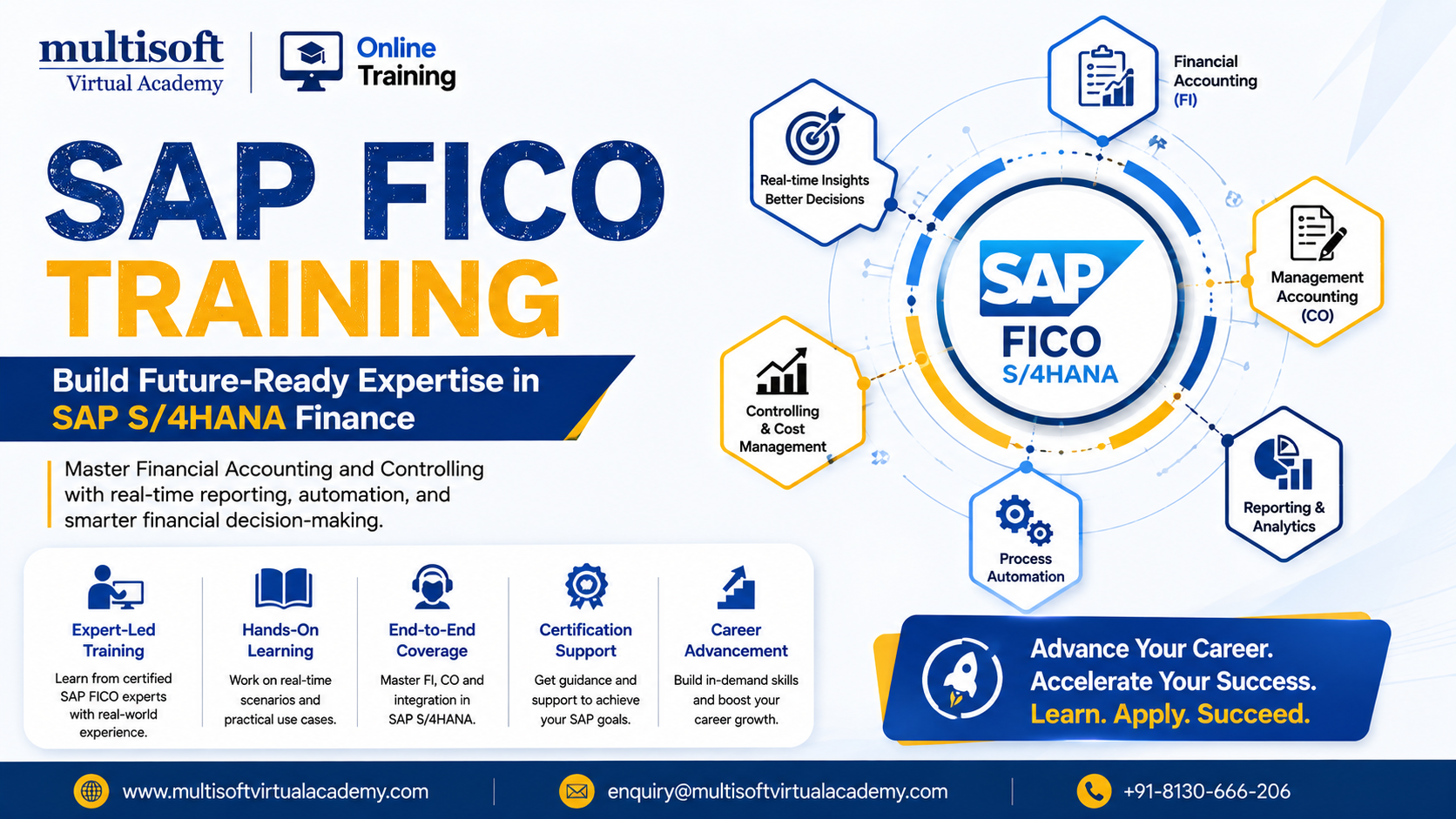
SAP FICO remains one of the most valuable career paths for finance professionals, accounting specialists and aspiring SAP consultants who want to combine financial expertise with enterprise technology. As organizations continue modernizing their ERP landscapes, knowledge of SAP FICO Training, SAP S/4HANA Finance and cloud-based financial processes is becoming increasingly relevant.
Modern SAP finance is no longer limited to traditional General Ledger, Accounts Payable or Accounts Receivable functions. Organizations increasingly expect professionals to understand integrated financial processes, automation, real-time reporting, financial closing, management accounting and the transition from SAP ERP to SAP S/4HANA.
For learners planning to enter the SAP ecosystem or professionals looking to upgrade their existing skills, structured SAP FICO learning can provide a practical foundation for working with today's finance transformation projects.
Finance departments are undergoing significant digital transformation. Businesses want faster reporting, improved financial visibility, automated processes and better integration between finance and other enterprise functions.
SAP S/4HANA Finance supports these objectives by bringing financial transactions, analytics and automation into an integrated environment. SAP's current learning paths cover implementation and configuration across areas such as General Ledger, Accounts Payable, Accounts Receivable, Asset Accounting, financial closing and reporting.
This evolution makes SAP FICO Training particularly relevant for:
The combination of accounting knowledge and SAP configuration skills can help learners understand not only how transactions are processed but also why particular business processes and configurations are required.
SAP FICO refers to Financial Accounting and Controlling, two closely connected areas within SAP's finance ecosystem.
SAP FI, or Financial Accounting, focuses on external financial reporting and accounting processes. It includes functions such as:
SAP CO, or Controlling, focuses more heavily on internal management accounting and profitability analysis. It helps organizations monitor costs, analyze profitability and support management decision-making.
A strong SAP FICO professional therefore needs both accounting knowledge and an understanding of how financial and controlling processes operate within an integrated ERP environment.
One of the biggest developments influencing SAP finance careers is the continued transition toward SAP S/4HANA and cloud-based ERP environments.
Modern SAP S/4HANA Finance Training introduces learners to concepts that differ from traditional SAP ECC environments. These include the Universal Journal, simplified data structures, SAP Fiori user experiences, integrated analytics and modern financial processes.
SAP's official learning content describes SAP S/4HANA Finance learning as covering implementation and customization capabilities for Financial Accounting across on-premise and cloud environments.
For professionals with previous SAP ECC experience, learning S/4HANA Finance can therefore be an important step toward remaining relevant in contemporary SAP projects.
A comprehensive SAP FICO Course should combine theoretical concepts with practical business scenarios.
General Ledger is at the center of financial accounting. Learners typically explore company codes, charts of accounts, posting periods, document types, posting keys, journal entries and financial reporting.
Understanding GL processes helps professionals see how business transactions ultimately affect an organization's financial statements.
Accounts Payable manages transactions associated with suppliers and vendors. Training can cover vendor-related master data, invoice processing, payments, clearing, credit memos and payment-related processes.
These skills are particularly important for consultants supporting procure-to-pay processes.
Accounts Receivable focuses on customer-related financial transactions. Key learning areas can include customer master data, billing-related postings, incoming payments, clearing, credit management and dunning.
A practical understanding of AR helps learners connect accounting activities with broader order-to-cash processes.
Asset Accounting is essential for organizations managing fixed assets. Learners can explore asset masters, acquisitions, transfers, retirements, depreciation and asset reporting.
SAP S/4HANA Finance implementation learning continues to include Asset Accounting as an important component of financial accounting.
Controlling enables organizations to analyze internal costs and profitability. Important areas can include:
Understanding FI and CO together can help professionals analyze how financial postings influence management accounting and business performance.
Certification can provide a structured learning target for professionals pursuing SAP careers. However, learners should understand that the SAP certification landscape evolves with product releases and cloud editions.
SAP currently offers learning journeys focused on implementing Financial Accounting in SAP S/4HANA Cloud Public Edition and Private Edition. These paths address implementation activities, financial master data, General Ledger, Accounts Payable, Accounts Receivable, Asset Accounting, period and year-end closing and financial reporting.
This means aspiring consultants should select certification preparation based on the current SAP product and certification version rather than relying solely on older SAP FICO terminology.
Knowing accounting concepts is important, but SAP consulting requires the ability to apply those concepts to business situations.
A practical SAP FICO Online Training program can help learners understand scenarios such as:
SAP's current training resources also emphasize financial closing, reporting, payables, receivables, assets and related implementation activities.
Practical exercises can make these concepts easier to understand because learners can connect configuration decisions with real business outcomes.
Beginners often wonder whether they need extensive technical experience before starting SAP FICO.
The answer depends on the training level and individual background. A learner with accounting or finance knowledge already has a useful foundation. However, professionals from IT or ERP backgrounds can also learn SAP FICO by gradually developing their finance concepts.
A structured SAP FICO Training for Beginners should ideally begin with:
Starting with fundamentals can make advanced configuration concepts considerably easier to understand.
Online learning has become a convenient option for professionals who cannot attend traditional classroom programs.
A well-designed SAP FICO Online Course can provide flexibility while allowing learners to study concepts, attend instructor-led sessions, review practical demonstrations and work through implementation scenarios.
Working professionals can particularly benefit from learning paths that connect SAP concepts with real finance processes rather than focusing exclusively on transaction codes or theoretical definitions.
The objective should be to develop functional understanding that can be applied during implementation, support, rollout and migration projects.
Professionals pursuing SAP FICO careers should consider developing a combination of functional, analytical and implementation skills.
Understand accounting processes, financial statements, business transactions, closing procedures and controlling concepts.
Learn how organizational structures, master data, document processing, payment processes, taxes and financial reporting are configured.
Understand how Finance interacts with procurement, sales, materials management, production and other SAP business processes.
Develop familiarity with Universal Journal, SAP Fiori, embedded analytics, Business Partner concepts and modern finance architecture.
SAP consultants frequently analyze business requirements and determine appropriate system solutions. Strong analytical thinking is therefore as important as technical knowledge.
SAP FICO skills can support several professional pathways, depending on experience and specialization.
Potential roles include:
Professionals may also work across implementation, migration, support, upgrade and rollout projects.
The growing focus on S/4HANA and cloud transformation makes it especially useful for SAP finance professionals to understand both traditional accounting processes and modern SAP finance capabilities. Independent 2026 industry analysis also identifies S/4HANA Finance among prominent SAP certification areas associated with the ongoing cloud and migration landscape.
Before enrolling in an SAP FICO program, learners should evaluate whether the course covers current SAP technologies and practical business processes.
Look for a program that provides:
It is also useful to verify whether the course is aligned with the specific SAP S/4HANA edition and certification path being targeted.
Yes. SAP Finance continues to evolve with SAP S/4HANA and cloud-based financial management. The terminology and technology are changing, but financial accounting and controlling remain fundamental enterprise functions.
Yes. Beginners can start with accounting and ERP fundamentals before progressing into SAP FI, CO and S/4HANA Finance concepts.
For new learners, it is useful to understand the traditional FICO concepts while focusing on current SAP S/4HANA Finance capabilities. This approach combines foundational knowledge with modern implementation skills.
SAP FICO is primarily a functional specialization. Basic technical awareness can be helpful, but programming is generally not the central requirement for a functional finance consultant.
Absolutely. Accounting and finance experience can provide a strong foundation because SAP Finance is closely connected to real-world financial processes.
The future of enterprise finance is increasingly connected to automation, cloud ERP, integrated analytics and intelligent financial processes. For professionals who want to strengthen their accounting technology expertise, SAP FICO Training can provide a valuable pathway toward understanding SAP Finance and modern SAP S/4HANA environments. The most effective learning approach combines financial fundamentals, practical configuration, business-process understanding and current S/4HANA knowledge. Multisoft Virtual Academy acts as a best service provider for professionals and organizations seeking structured SAP FICO learning designed around practical skills, modern SAP Finance concepts and career-oriented development.
| Start Date | Time (IST) | Day | |||
|---|---|---|---|---|---|
| 17 Oct 2026 | 06:00 PM - 10:00 AM | Sat, Sun | |||
| 11 Oct 2026 | 06:00 PM - 10:00 AM | Sat, Sun | |||
| 24 Oct 2026 | 06:00 PM - 10:00 AM | Sat, Sun | |||
| 18 Oct 2026 | 06:00 PM - 10:00 AM | Sat, Sun | |||
|
Schedule does not suit you, Schedule Now! | Want to take one-on-one training, Enquiry Now! |
|||||






 Join our Live Instructor-Led online classes delivered by industry experts
 Let's Get Started