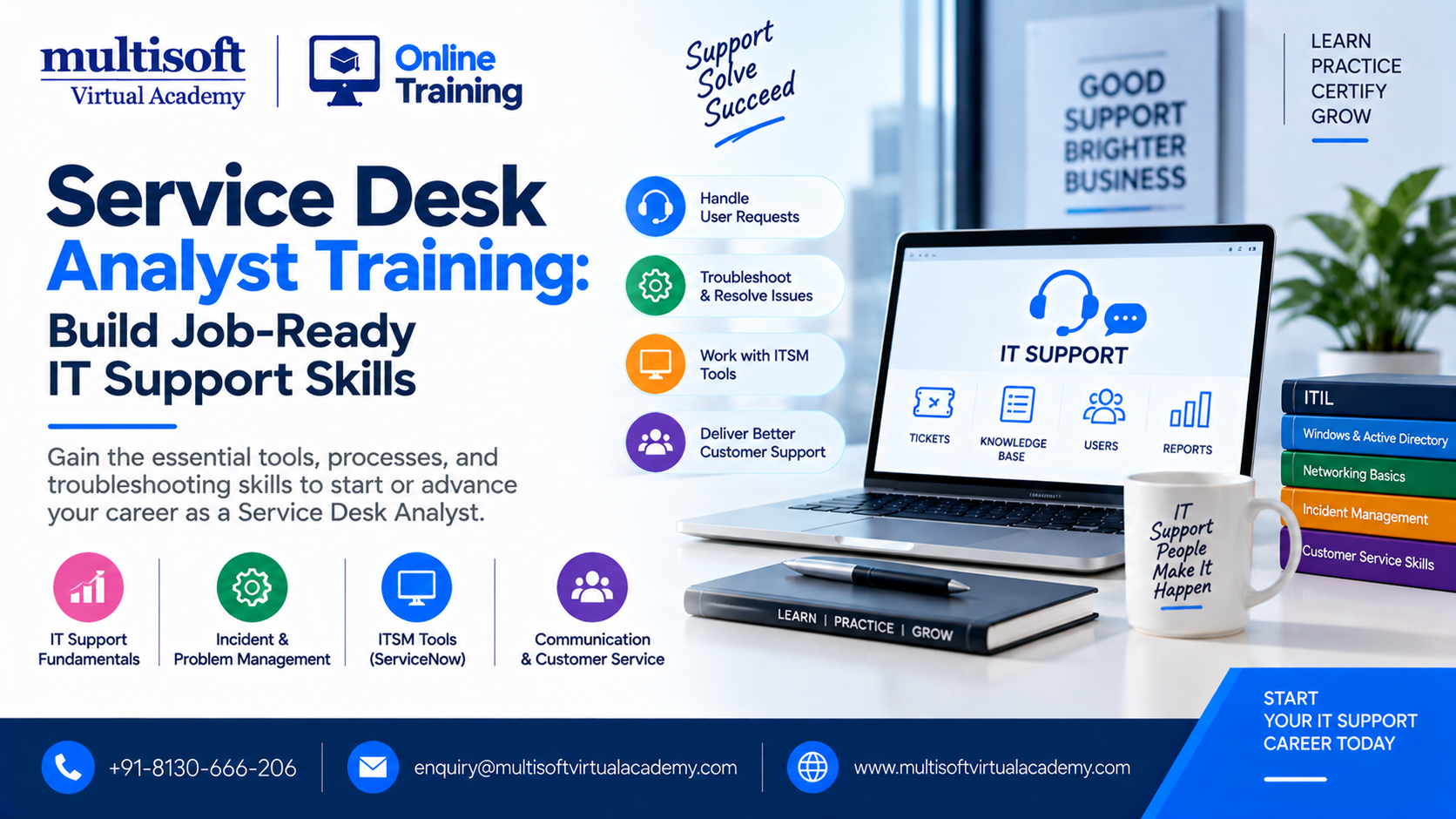
In today’s technology-driven workplace, businesses depend on reliable IT services to keep employees productive and customers satisfied. When technical problems occur, Service Desk Analysts are often the first professionals users contact for assistance. They troubleshoot issues, manage service requests, resolve incidents and help maintain a smooth IT environment. As organizations continue to adopt cloud platforms, remote work technologies, cybersecurity solutions and digital business applications, the demand for skilled IT support professionals is growing.
Service Desk Analyst (SDA) Training provides professionals and aspiring IT support specialists with the technical knowledge, troubleshooting capabilities and service management skills required to work effectively in modern service desk environments. The training can help learners understand incident management, problem resolution, ticket management, IT service management processes and customer support practices.
A service desk is more than a technical support function. It acts as an important communication point between users and an organization’s IT department. A Service Desk Analyst must understand both technology and customer service.
Effective analysts need to identify technical problems quickly, communicate clearly with users, document incidents accurately and follow established escalation procedures. These responsibilities require a combination of technical knowledge, analytical thinking and interpersonal skills.
Service Desk Analyst (SDA) Training helps learners develop these capabilities through structured learning and practical scenarios. It can be particularly valuable for candidates starting an IT support career as well as professionals looking to strengthen their existing service desk expertise.
A Service Desk Analyst typically handles the first level of support for employees, customers or other technology users. The exact responsibilities vary between organizations, but common duties include:
Because Service Desk Analysts interact directly with users, communication skills are just as important as technical abilities.
A comprehensive IT Service Desk Training program should cover the fundamental skills required in a real-world support environment. Learners can explore technical troubleshooting, service management concepts and customer-focused support practices.
Troubleshooting is one of the most important responsibilities of an IT support professional. Training helps learners understand how to approach technical issues systematically rather than relying on trial and error.
Common troubleshooting areas may include operating systems, applications, connectivity, user accounts, devices, printers and basic network problems.
Incident management focuses on restoring normal service as quickly as possible after an interruption or technical issue.
Through Service Desk Analyst Training, learners can understand how incidents are logged, categorized, prioritized, investigated, resolved and closed. They can also learn why accurate documentation is essential for future troubleshooting and reporting.
Not every user contact represents an incident. Users may request password resets, software installations, access permissions or information about IT services.
Understanding the difference between incidents and service requests helps analysts route and process tickets correctly.
Modern service desks rely heavily on ticketing systems to organize user issues and requests. Analysts need to know how to create tickets, assign categories, set priorities, update records and document resolutions.
Strong ticket management improves visibility and helps IT teams track workloads and service performance.
ITIL Service Desk Training is another valuable area for professionals interested in structured IT service management. ITIL concepts provide a framework for delivering and managing IT services effectively.
Service Desk Analysts can benefit from understanding concepts such as incident management, service request management, problem management, change management, service levels and continual improvement.
A working knowledge of IT service management can also help analysts communicate more effectively with service managers, infrastructure teams, application teams and other IT functions.
The terms help desk and service desk are sometimes used interchangeably, but they can represent different approaches.
Help desk support traditionally focuses on resolving technical problems and answering user questions. A modern service desk generally takes a broader service management approach that includes incident handling, service requests, communication, service improvement and coordination across IT functions.
For professionals seeking an IT support career, learning both help desk and service desk practices can provide a stronger foundation.
Technical knowledge becomes more valuable when learners know how to apply it in practical situations. Effective Service Desk Analyst Training should therefore incorporate realistic support scenarios.
Examples can include:
Working through scenarios like these helps learners understand how analysts investigate problems, communicate with users, prioritize tickets and determine when escalation is necessary.
Technical expertise alone does not make an excellent Service Desk Analyst. Support professionals frequently work with users who may have limited technical knowledge or may be frustrated because they cannot access an important system.
An effective analyst should be able to:
These communication skills can have a direct impact on user satisfaction and service desk performance.
Professionals often search for Service Desk Analyst Certification as they prepare for careers in IT support and service management. Certification-oriented learning can provide structured knowledge and demonstrate an individual's commitment to professional development.
Candidates can also explore related areas such as:
Combining service desk knowledge with technical certifications can help professionals build a broader IT career profile.
SDA Training can be useful for a wide range of learners. It may be suitable for:
The training can also benefit experienced IT professionals who want to improve their troubleshooting, ticket management and service delivery capabilities.
Service desk experience can provide a foundation for several technology career paths. After developing practical IT support skills, professionals may progress toward roles such as:
Service Desk Analyst: Provides first-line technical and service support to users.
IT Support Specialist: Handles broader technical support responsibilities across systems and applications.
Desktop Support Engineer: Focuses on endpoint devices, operating systems, applications and workplace technology.
Technical Support Engineer: Provides deeper technical troubleshooting and problem resolution.
Service Desk Team Lead: Coordinates service desk activities and supports analysts.
IT Service Manager: Oversees service delivery, performance and continual improvement.
IT Operations Specialist: Works with infrastructure, applications and operational processes.
This makes Service Desk Analyst Training a practical starting point for individuals planning a long-term IT career.
Online learning has become increasingly popular because it provides flexibility for working professionals and students. Service Desk Analyst Online Training can allow learners to study from different locations while following a structured learning plan.
Key advantages may include:
When selecting an online program, learners should evaluate the course curriculum, practical coverage, trainer expertise, learning support and relevance to current IT service desk environments.
Not every service desk course provides the same level of practical value. Before enrolling, learners should review the curriculum carefully.
Look for a program that covers service desk operations, incident management, service requests, ticketing systems, troubleshooting, escalation management, IT service management and customer communication.
It is also useful to consider whether the program includes practical exercises and real-world examples. A course that combines theory with application can help learners develop skills that are relevant beyond the classroom.
The service desk profession is evolving as organizations adopt automation, artificial intelligence, cloud computing and remote support technologies. Routine requests can increasingly be handled through self-service portals, automation and AI-powered tools.
However, human expertise remains important for complex incidents, user communication, problem analysis and situations that require judgment.
Future-ready Service Desk Analysts should therefore develop both traditional IT support capabilities and an understanding of emerging technologies. Knowledge of cloud services, cybersecurity awareness, automation, remote support tools and AI-assisted service management can strengthen an IT professional’s skill set.
A successful Service Desk Analyst combines technical knowledge, structured troubleshooting, service management awareness and excellent communication. Service Desk Analyst Training can help learners develop these capabilities in a systematic way while preparing them for practical IT support responsibilities.
As organizations continue to depend on technology for everyday operations, skilled support professionals remain essential. Developing expertise in incident management, ticket handling, troubleshooting and customer-focused service can create a strong foundation for career growth across IT support and service management.
Choosing the right Service Desk Analyst (SDA) Training can be an important step for anyone looking to develop practical IT support and service management capabilities. With relevant learning, hands-on practice and continuous skill development, professionals can prepare themselves for evolving service desk responsibilities and broader technology career opportunities. Multisoft Virtual Academy provides Service Desk Analyst training designed to help learners strengthen their technical support knowledge, understand service management practices and develop practical skills relevant to modern IT service environments.
| Start Date | Time (IST) | Day | |||
|---|---|---|---|---|---|
| 24 Oct 2026 | 06:00 PM - 10:00 AM | Sat, Sun | |||
| 25 Oct 2026 | 06:00 PM - 10:00 AM | Sat, Sun | |||
| 31 Oct 2026 | 06:00 PM - 10:00 AM | Sat, Sun | |||
| 01 Nov 2026 | 06:00 PM - 10:00 AM | Sat, Sun | |||
|
Schedule does not suit you, Schedule Now! | Want to take one-on-one training, Enquiry Now! |
|||||






 Join our Live Instructor-Led online classes delivered by industry experts
 Let's Get Started