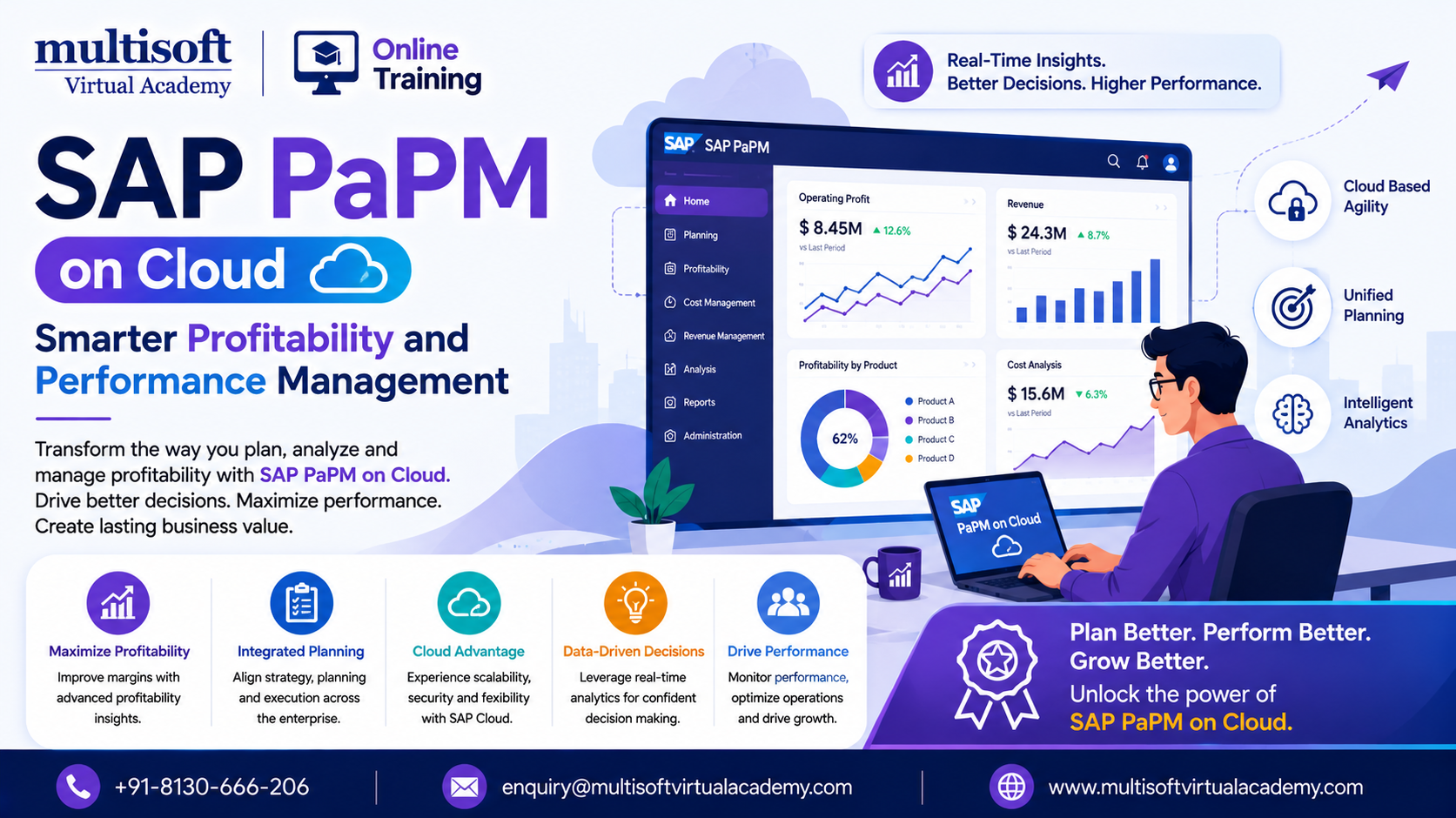
Modern enterprises are under constant pressure to improve profitability, control costs and make faster financial decisions. As business models become more complex, traditional spreadsheets and disconnected financial systems can make profitability analysis slow, inconsistent and difficult to scale. SAP PaPM on Cloud provides a modern approach to profitability and performance management by helping organizations create sophisticated financial models, perform allocations, analyze costs and generate actionable insights in a flexible cloud environment.
SAP Profitability and Performance Management Cloud is designed as an integrated calculation and modeling solution for SAP and non-SAP environments. It supports data-driven decision-making while reducing deployment complexity through a managed cloud approach. SAP also continues to enhance the platform with new capabilities across modeling, reporting, administration and AI-enabled experiences.
SAP PaPM on Cloud, formally known as SAP Profitability and Performance Management Cloud, is a cloud-based solution for modeling profitability, costs, revenues and complex business processes. It enables organizations to build calculation models and allocation logic that can support detailed financial analysis across products, customers, services, business units and other dimensions.
Instead of depending heavily on manually maintained spreadsheets, businesses can establish repeatable and transparent calculation processes. SAP describes the solution as an integrated, fully managed calculation engine that can work with SAP and non-SAP customers and integrate with SAP Business Technology Platform services, partner solutions and open-source technologies.
This makes SAP PaPM Cloud particularly relevant for organizations seeking scalable profitability management, financial modeling and analytical capabilities without unnecessarily increasing the complexity of their IT landscape.
Profitability management has become more demanding as organizations operate across multiple markets, currencies, products, subsidiaries and customer segments. Finance teams need to understand not only overall revenue and expenses but also the actual profitability of individual business dimensions.
SAP PaPM Cloud helps address these requirements through advanced business-centric modeling. SAP highlights capabilities for sophisticated profitability, cost and process use cases, real-time analysis and simulation. The platform can also help organizations move away from spreadsheet-based processes toward more flexible and repeatable models.
For finance and business teams, this can support questions such as:
These questions explain why SAP PaPM implementation is increasingly relevant to organizations looking for more structured profitability and performance management.
One of the major strengths of SAP PaPM Cloud is its ability to support complex financial and business models. Organizations can create calculation logic that reflects their specific business requirements rather than relying solely on rigid predefined processes.
The solution supports functions such as allocation, calculation, conversion, derivation and conditions. Functions can be connected through input-output relationships to create complex calculation processes.
This flexibility is valuable for organizations dealing with sophisticated cost structures, profitability calculations and management reporting requirements.
SAP cost allocation and SAP revenue allocation are important use cases for PaPM. Organizations frequently need to distribute shared costs and revenues across products, customers, departments, locations or business units.
With structured allocation models, finance teams can establish consistent rules and apply them repeatedly. This can improve transparency while reducing the manual effort associated with complex allocation calculations.
SAP's own training material identifies cost and revenue allocations as major areas within SAP Profitability and Performance Management Cloud.
Understanding profitability at a detailed level is essential for strategic decision-making. SAP PaPM Cloud can support multidimensional analysis so organizations can examine profitability from different business perspectives.
For example, a company could analyze profitability by customer, product, region, sales channel or organizational unit. This level of granularity can help decision-makers identify opportunities for improvement and understand where resources are generating the greatest value.
A major consideration in any SAP PaPM Cloud implementation is data integration. Organizations rarely operate with a single data source. Financial and operational information may exist across SAP S/4HANA, data warehouses, planning platforms and other enterprise applications.
SAP documentation explains that PaPM can integrate with SAP and non-SAP components and can leverage existing data and information models.
This makes SAP S/4HANA integration, SAP BTP integration and broader enterprise data integration important considerations when designing a PaPM Cloud architecture.
Organizations evaluating SAP PaPM Cloud may encounter two important approaches: the Standard Model and the Universal Model.
The Standard Model provides a structured environment for profitability and performance management use cases, while the Universal Model provides a broader modeling approach for organizations requiring flexible business modeling capabilities.
SAP's onboarding resources specifically indicate that customers with an SAP Profitability and Performance Management Cloud license can implement either the Standard Model or Universal Model.
The appropriate approach depends on business requirements, existing architecture, data strategy, modeling needs and implementation objectives. A detailed assessment before implementation can therefore help organizations select the most suitable model.
A successful SAP PaPM implementation requires more than simply configuring the software. Organizations should begin with a clear understanding of their business objectives and existing financial processes.
Start by identifying the profitability, allocation, costing and performance management challenges that need to be solved. Clearly defined objectives make it easier to determine the appropriate modeling approach.
Review where financial and operational data currently resides. This may include SAP S/4HANA, SAP BW, data warehouses, spreadsheets or third-party applications.
The next step is to define dimensions, calculations, allocation rules, hierarchies and outputs. The model should reflect actual business processes while remaining manageable and scalable.
Integration should be considered early rather than after the model has been created. Data quality, connectivity, master data and data transformation requirements can significantly influence the implementation architecture.
Financial models must produce reliable results. Testing should therefore include calculations, allocations, data reconciliation, performance and business validation.
Finance professionals, controllers, analysts and administrators need appropriate knowledge to use and maintain the solution effectively. SAP also provides learning resources covering modeling, administration and end-to-end accounting logic.
Organizations moving from legacy profitability applications, spreadsheets or on-premise environments may consider SAP PaPM Cloud migration as part of their modernization strategy.
Migration should not be treated as a simple technical transfer. Existing models should be reviewed to determine which processes remain relevant, which calculations can be simplified and which integrations need redesign.
A structured migration strategy can include:
This approach can help organizations modernize profitability processes while reducing unnecessary complexity.
Global organizations often face additional challenges because subsidiaries may use different processes, currencies, cost structures and reporting practices.
SAP PaPM Cloud for subsidiaries can support standardized profitability and allocation models while allowing organizations to accommodate business-specific requirements. A centralized modeling strategy can help corporate finance teams establish consistent calculation principles across multiple entities.
For organizations implementing PaPM across subsidiaries, governance is especially important. Standardized naming conventions, master data structures, allocation methodologies and model documentation can help maintain consistency as the environment grows.
The value of SAP profitability management goes beyond automating calculations. The objective is to provide decision-makers with better information at the right time.
By combining granular data with sophisticated modeling and allocation capabilities, organizations can evaluate different scenarios and understand the financial consequences of business decisions.
SAP also highlights simulation and real-time analysis as important capabilities for supporting faster decisions.
For example, management could evaluate the impact of a pricing change, revised cost allocation rule or organizational restructuring before implementing the change. This can turn profitability analysis from a retrospective reporting activity into a more proactive management capability.
The future of finance is increasingly connected with automation, cloud technology, advanced analytics and artificial intelligence. SAP's current product direction reflects this shift, with recent PaPM Cloud updates introducing enhancements to modeling and user experiences as well as AI-related capabilities.
For organizations, this means that SAP PaPM Cloud can become part of a broader transformation toward intelligent financial operations. Instead of maintaining isolated calculation processes, businesses can create reusable models that support ongoing analysis and decision-making.
The combination of cloud delivery, financial modeling, integration, granular profitability analysis and emerging AI capabilities makes PaPM relevant for enterprises seeking a more agile approach to performance management.
SAP PaPM Cloud can be valuable for a wide range of organizations and professionals, including:
It can be particularly useful where financial calculations involve large datasets, multiple allocation rules and detailed profitability dimensions.
Technology alone does not guarantee successful adoption. Teams need to understand how to translate business requirements into effective financial models.
SAP PaPM training can help professionals understand modeling concepts, calculation functions, allocation methods, integration scenarios and practical implementation approaches. SAP's official training for the cloud solution includes planning and building calculation models, planning and building allocation models, enriching allocation models with functions and understanding integration.
For organizations, investing in practical training can help reduce the learning curve and improve the ability of internal teams to maintain and enhance PaPM models after implementation.
SAP PaPM on Cloud represents a strategic approach to modern profitability and performance management. From advanced financial modeling and cost allocation to granular profitability analysis, SAP integration, cloud migration and subsidiary-level reporting, the platform can help organizations create more transparent and scalable financial processes.
As businesses increasingly demand faster insights, standardized calculations and data-driven decision-making, choosing the right implementation and training strategy becomes essential. Multisoft Virtual Academy provides professional SAP PaPM learning and service-oriented support designed to help organizations and professionals understand cloud-based profitability and performance management, develop practical modeling capabilities and prepare for successful SAP PaPM Cloud adoption.
| Start Date | Time (IST) | Day | |||
|---|---|---|---|---|---|
| 17 Oct 2026 | 06:00 PM - 10:00 AM | Sat, Sun | |||
| 18 Oct 2026 | 06:00 PM - 10:00 AM | Sat, Sun | |||
| 24 Oct 2026 | 06:00 PM - 10:00 AM | Sat, Sun | |||
| 25 Oct 2026 | 06:00 PM - 10:00 AM | Sat, Sun | |||
|
Schedule does not suit you, Schedule Now! | Want to take one-on-one training, Enquiry Now! |
|||||






 Join our Live Instructor-Led online classes delivered by industry experts
 Let's Get Started