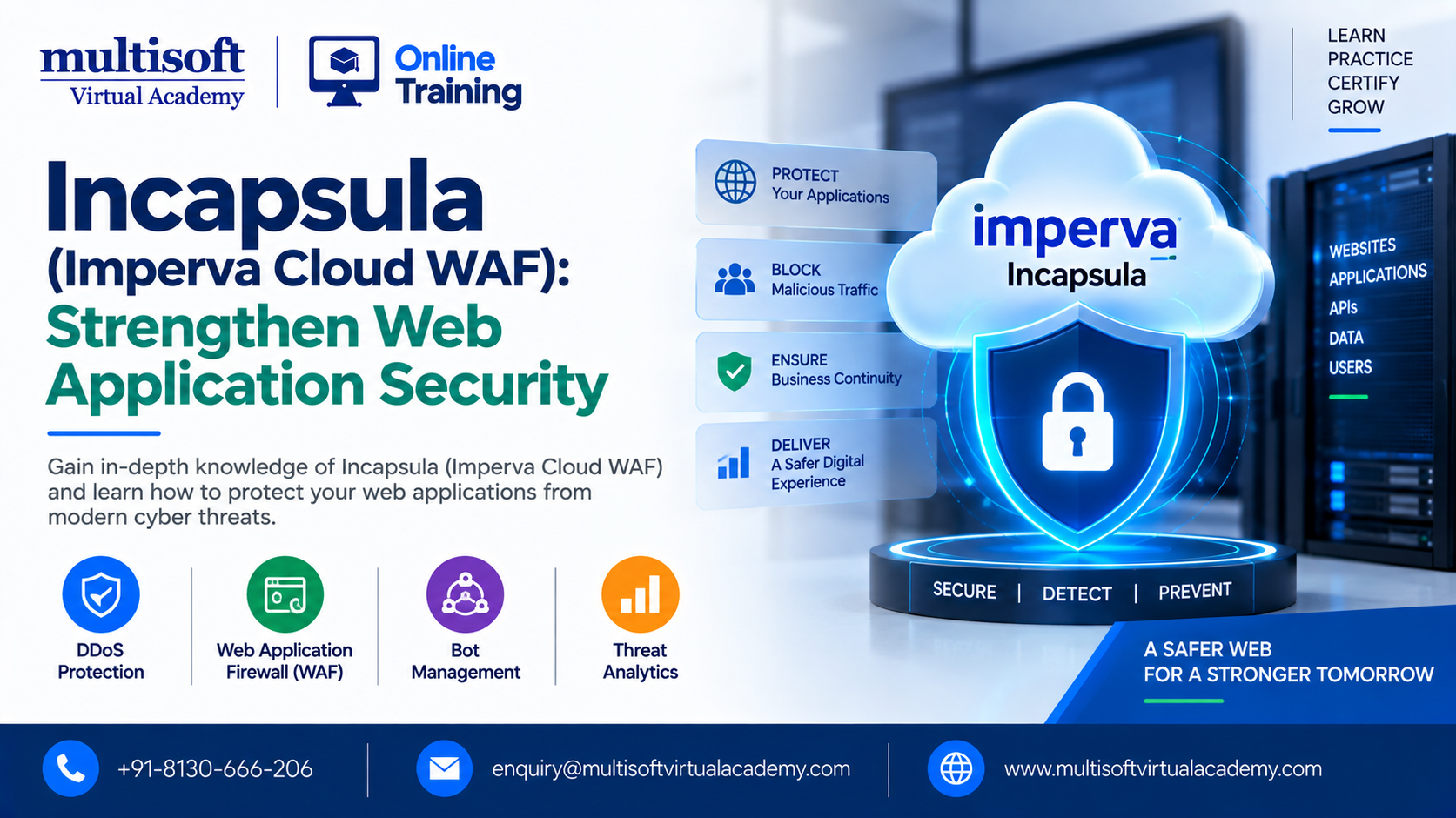
As cyber threats become more sophisticated, protecting websites, APIs, applications, and digital services requires more than traditional network security. Businesses need intelligent protection that can identify malicious traffic, block application-layer attacks and maintain availability without affecting legitimate users. This is where Incapsula (Imperva Cloud WAF) plays an important role.
Incapsula became widely recognized for cloud-based website security and application protection and is now associated with Imperva's Cloud WAF platform. The solution provides cloud-based protection for web applications and APIs while incorporating capabilities such as managed security rules, bot protection, DDoS mitigation and threat intelligence.
For organizations moving applications to cloud, hybrid or distributed environments, an Imperva Cloud WAF can provide an additional security layer between users and application infrastructure. It helps security teams identify suspicious requests before they reach critical application resources.
Incapsula (Imperva Cloud WAF), commonly associated with the Imperva Cloud WAF platform, is a cloud-based Web Application Firewall designed to protect applications and APIs from malicious traffic and application-layer attacks.
A WAF examines HTTP and HTTPS traffic and applies security policies to determine whether requests should be allowed, challenged or blocked. Imperva states that its Cloud WAF protects applications and APIs across public cloud, private cloud, hybrid and on-premises environments.
The platform is designed to address threats including:
This makes Imperva WAF relevant for organizations that require scalable web application security without relying exclusively on security controls within their application infrastructure.
Web applications have become central to e-commerce, banking, SaaS, healthcare, education, manufacturing and almost every other digital business. At the same time, attackers increasingly target application logic, APIs and automated workflows rather than simply attempting to overwhelm network infrastructure.
A traditional firewall can provide valuable network protection, but application security requires deeper inspection of web requests and application behavior.
A Cloud Web Application Firewall can help organizations:
Imperva's current Cloud WAF offering combines managed rules, machine learning, threat intelligence and security analytics to help organizations identify and respond to application threats.
The primary purpose of Imperva Cloud WAF is to protect web applications from malicious requests. Security policies can identify attack patterns and prevent harmful traffic from reaching backend applications.
Imperva specifically highlights protection against threats such as SQL injection, XSS and other OWASP Top 10 vulnerabilities.
Modern applications depend heavily on APIs. Mobile applications, SaaS platforms, payment systems and cloud services frequently communicate through APIs, making them an attractive target for attackers.
Imperva API Security helps organizations gain greater visibility into API traffic and protect APIs against abuse and malicious activity. This is particularly important as businesses expand their digital ecosystems.
API security should be considered alongside WAF protection rather than as a completely separate concern because an application can remain vulnerable even when its traditional web interface is protected.
Not every automated request is legitimate. Search engines, monitoring systems and business integrations may generate useful automated traffic, while malicious bots can perform scraping, credential abuse, account takeover attempts and other harmful activities.
Imperva identifies malicious automation as a major application-security challenge and incorporates bot protection into its broader application security capabilities.
An effective bot protection solution can help organizations distinguish legitimate automated activity from suspicious behavior.
Distributed denial-of-service attacks attempt to make applications or services unavailable by generating overwhelming amounts of traffic or requests.
Imperva DDoS protection addresses application-layer threats while supporting broader availability strategies. Imperva's platform includes Layer 7 DDoS protection alongside other application-security services.
For businesses that depend on continuous online availability, DDoS mitigation can be an important component of a broader web security strategy.
Security teams cannot always create and maintain rules for every emerging attack manually. Managed WAF rules can reduce this operational burden.
Imperva states that its threat research teams continuously identify threats and provide managed rules, including updates for newly emerging security risks.
This approach can help organizations maintain security protection while reducing the need for constant manual rule development.
Blocking an attack is only one part of application security. Security teams also need to understand what happened, where the traffic originated and which resources were targeted.
Imperva's Attack Analytics uses machine learning to correlate security alerts and provide contextual information about incidents.
This can help security teams prioritize serious incidents instead of spending excessive time investigating disconnected alerts.
The basic concept behind a cloud WAF is straightforward.
When a user sends a request to a protected application, traffic passes through the security layer before reaching the application infrastructure. The WAF analyzes the request against security policies and detection mechanisms.
A simplified flow looks like this:
User Request → Cloud WAF → Security Inspection → Allow / Block → Application
If the request appears legitimate, it can continue toward the application. If it matches malicious behavior or violates configured security policies, the WAF can prevent the request from reaching the origin.
This architecture can help organizations place security controls closer to the traffic entering their applications.
The OWASP Top 10 is widely used as a reference for understanding major web application security risks. Organizations developing or operating internet-facing applications should consider these risks during application development, testing and deployment.
A properly configured Imperva WAF can help mitigate application attacks associated with vulnerabilities such as SQL injection and cross-site scripting. Imperva specifically describes its WAF as protecting against OWASP Top 10 vulnerabilities.
However, a WAF should not be considered a replacement for secure software development. Application teams should continue using secure coding practices, vulnerability scanning, penetration testing, patch management and access controls.
Implementing a cloud-based WAF can provide several operational and security advantages.
Internet-facing applications are continuously exposed to potentially malicious traffic. A WAF creates an additional defensive layer designed specifically for application-level requests.
Managed rules and automated security capabilities can reduce repetitive manual security tasks and help security teams respond more efficiently.
As organizations increase their dependence on APIs, centralized API security and visibility become increasingly important.
Cloud-based protection can support applications across different environments without requiring organizations to build every security capability directly into their infrastructure.
Application-layer DDoS mitigation, bot management and web traffic filtering can contribute to maintaining application availability during malicious traffic events.
Modern enterprises rarely operate entirely within one infrastructure model. Applications may run across public cloud platforms, private infrastructure, data centers and hybrid environments.
Imperva states that its WAF supports public cloud, private cloud, hybrid and on-premises deployments.
This flexibility makes Imperva Cloud WAF implementation relevant for businesses undergoing cloud migration or managing multiple application environments.
For organizations using AWS, Imperva also provides a cloud application security offering that combines WAF, API security and bot protection and integrates with AWS architectures.
A successful WAF implementation involves more than simply activating a security service. Organizations should evaluate their applications, traffic patterns, APIs and existing security architecture before deployment.
Important considerations include:
A carefully planned implementation can help organizations balance strong protection with application performance and user experience.
Incapsula (Imperva Cloud WAF) can be considered for a wide range of application-security scenarios.
Online stores process customer accounts, payments and personal information. WAF protection can help reduce exposure to malicious web requests and automated abuse.
Financial services require strong application and API security because attackers frequently target authentication systems, APIs and sensitive transactions.
SaaS providers need to protect internet-facing applications while supporting large numbers of users and constantly changing application environments.
Large enterprises often operate multiple web applications and APIs. Centralized security policies can help simplify protection across these environments.
Organizations exposing APIs to partners, customers or mobile applications can benefit from combining API security with broader application protection.
Traditional security approaches often rely on multiple disconnected technologies. Organizations may use network firewalls, endpoint security, separate DDoS services and custom application controls.
A modern Cloud WAF solution can consolidate important application-security capabilities into a more centralized approach.
The objective is not necessarily to replace every existing security control. Instead, WAF protection can complement network security, secure development practices, identity management, vulnerability management and monitoring.
This layered approach is commonly referred to as defense in depth, where multiple controls work together to reduce overall risk.
Organizations implementing Imperva WAF security should follow several best practices:
The goal should be continuous improvement rather than treating WAF deployment as a one-time security project.
The application-security landscape is changing rapidly. Cloud adoption, APIs, microservices, automation and AI-enabled attacks are creating new challenges for security teams.
Imperva's current research highlights increasing malicious automation and continued growth in application-layer threats. Its 2026 Cyber Threat Index also provides ongoing analysis of application and DDoS threat activity based on data observed across its security network.
As applications become more distributed, organizations will increasingly need security solutions capable of protecting websites, APIs, bots and application infrastructure together.
This makes Cloud WAF, API security, bot protection, DDoS mitigation and application security important search and technology areas for organizations planning their future cybersecurity strategy.
Incapsula WAF refers to the cloud-based web application security technology historically associated with Incapsula and now offered within Imperva's application security portfolio. It is designed to protect websites and applications against malicious traffic and application-layer attacks.
Incapsula is historically associated with Imperva's cloud-based application security offering. Current Imperva product positioning refers to Imperva Cloud WAF, which provides cloud-based protection for web applications and APIs.
It is designed to help protect against threats such as SQL injection, XSS, malicious bots, application-layer DDoS attacks and other web application security threats.
No. A WAF is an additional security layer. Organizations should continue using secure development practices, vulnerability management, penetration testing, authentication controls and other cybersecurity measures.
APIs frequently provide direct access to application functionality and data. Protecting APIs helps organizations reduce exposure to unauthorized access, abuse and malicious automation.
As businesses increasingly depend on cloud applications, APIs and always-on digital services, Incapsula (Imperva Cloud WAF) remains a relevant technology area for organizations seeking stronger web application security. A well-planned WAF strategy can help protect applications against malicious requests, automated threats, DDoS attacks and common application vulnerabilities while improving security visibility and operational efficiency. For organizations looking for professional guidance in Imperva Cloud WAF, Incapsula WAF, WAF implementation, API security, DDoS protection, bot management and enterprise web application security, Multisoft Virtual Academy acts as a trusted service provider, helping businesses and professionals develop practical knowledge and implement effective application-security strategies aligned with modern cloud and cybersecurity requirements.
| Start Date | Time (IST) | Day | |||
|---|---|---|---|---|---|
| 24 Oct 2026 | 06:00 PM - 10:00 AM | Sat, Sun | |||
| 25 Oct 2026 | 06:00 PM - 10:00 AM | Sat, Sun | |||
| 31 Oct 2026 | 06:00 PM - 10:00 AM | Sat, Sun | |||
| 01 Nov 2026 | 06:00 PM - 10:00 AM | Sat, Sun | |||
|
Schedule does not suit you, Schedule Now! | Want to take one-on-one training, Enquiry Now! |
|||||






 Join our Live Instructor-Led online classes delivered by industry experts
 Let's Get Started