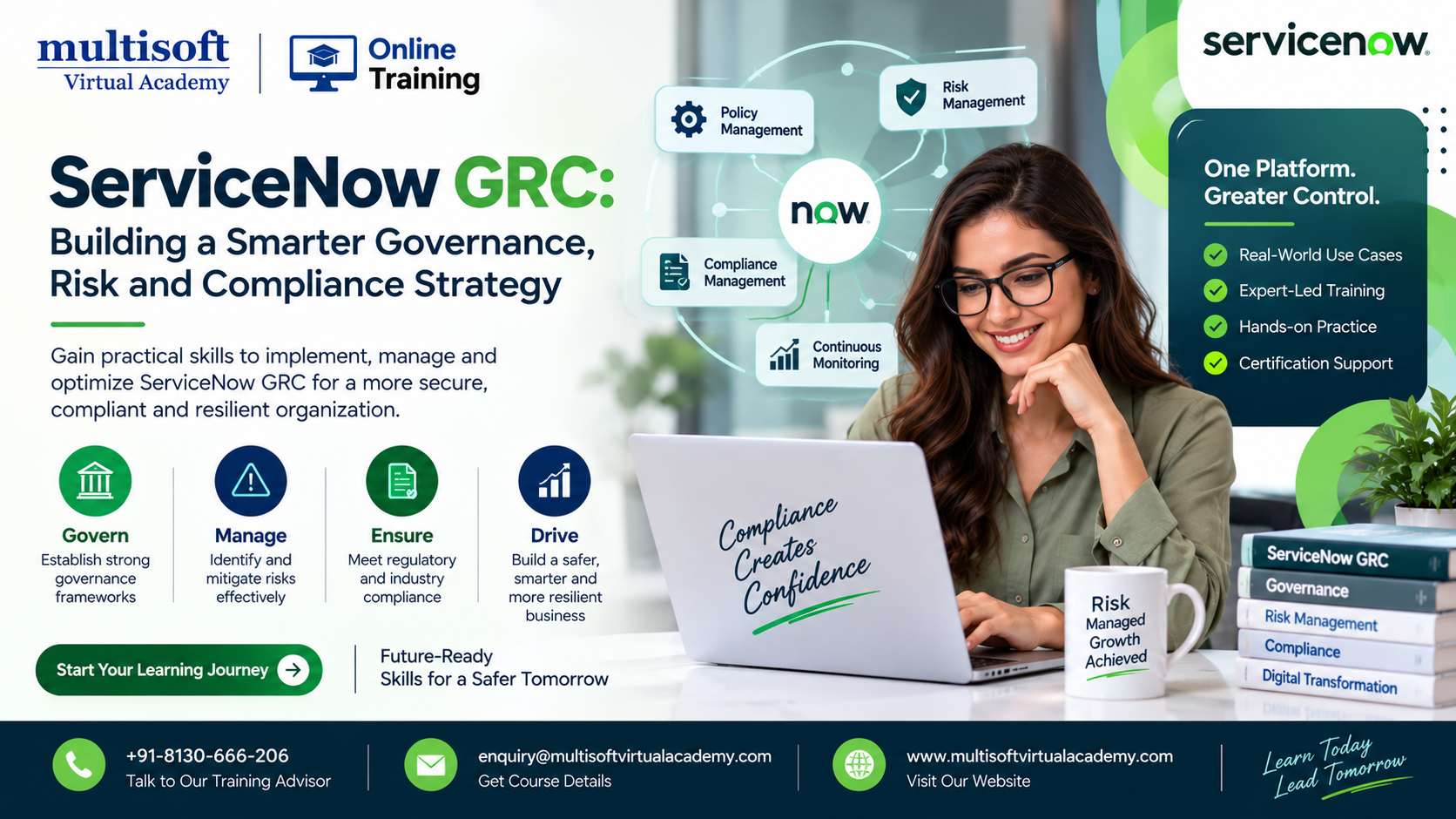
Organizations today operate in an environment where regulatory requirements, cybersecurity threats, third-party dependencies and digital transformation are constantly changing. Managing governance, risk and compliance through spreadsheets, disconnected applications and manual processes can make it difficult to identify risks early, maintain accurate evidence and respond to compliance requirements efficiently.
ServiceNow GRC provides an integrated approach to governance, risk and compliance by connecting risk, compliance, security and business processes through a centralized platform. It helps organizations move from reactive compliance activities toward continuous monitoring, automated workflows and risk-informed decision-making.
As enterprises increasingly adopt cloud platforms, artificial intelligence and interconnected digital ecosystems, ServiceNow GRC is becoming an important part of modern enterprise risk management and compliance strategies.
ServiceNow GRC, or Governance, Risk and Compliance, is a collection of capabilities designed to help organizations identify, assess, manage and monitor business risks while maintaining compliance with internal policies and external regulations.
ServiceNow describes GRC as an integrated approach that connects governance, assurance, risk and compliance activities rather than treating them as isolated functions. Its current GRC capabilities include risk management, policy and compliance management, audit management, privacy management, third-party risk management, regulatory change management and other related applications.
The objective is not simply to document compliance. A modern GRC strategy should help organizations understand:
ServiceNow GRC brings these activities into connected workflows so organizations can make faster and more informed decisions.
Traditional GRC processes often depend on spreadsheets, emails, shared folders and manually maintained reports. These approaches can create duplicated work, inconsistent information and limited visibility across departments.
Modern organizations need a more connected approach.
ServiceNow GRC can help integrate governance, risk and compliance processes with broader business and IT workflows. Its risk capabilities support structured workflows for risk assessments, risk indicators and risk issues, while continuous monitoring can help organizations identify important risks and prioritize responses.
Key benefits include:
This integrated model is particularly valuable for organizations operating across multiple business units, geographic regions, technologies and regulatory environments.
ServiceNow GRC is broader than a single risk management application. Organizations can use different capabilities according to their business requirements.
ServiceNow Risk Management helps organizations identify, assess, respond to and continuously monitor enterprise and IT risks.
Risk teams can establish structured processes for:
The platform can help teams prioritize activities according to business impact and risk severity rather than treating every risk equally.
Policies are an important component of any governance framework. However, creating a policy is only the beginning.
Organizations must also communicate policies, map them to requirements, assign controls and continuously monitor compliance.
ServiceNow Policy and Compliance Management supports policy lifecycle management and can connect policies, standards, controls and regulatory requirements through structured workflows.
This can reduce the administrative effort involved in maintaining compliance documentation.
Audits can become complicated when evidence is stored across different departments and systems.
ServiceNow Audit Management helps organizations use risk information to plan and prioritize audits while automating associated workflows.
A centralized approach can help audit teams improve visibility into:
Instead of preparing for audits only when an auditor arrives, organizations can work toward maintaining an audit-ready environment continuously.
Third-party relationships can introduce significant operational, cybersecurity, privacy and compliance risks.
ServiceNow Third Party Risk Management helps organizations assess and monitor risks associated with vendors, suppliers, partners and other external entities.
Important activities may include:
ServiceNow's GRC capabilities specifically include third-party risk management for continuously monitoring, assessing, mitigating and remediating risks across third-party ecosystems.
Regulatory requirements can change frequently. Organizations operating internationally may need to track requirements across multiple jurisdictions and regulatory frameworks.
Regulatory Change Management can help organizations identify relevant regulatory changes, evaluate their impact and coordinate appropriate responses.
This makes regulatory compliance more proactive instead of relying exclusively on manual research and periodic reviews.
Data privacy has become a critical component of enterprise governance.
Organizations must understand how personal and sensitive information is collected, processed, stored and shared.
ServiceNow Privacy Management can help organizations manage privacy risks and compliance requirements across the enterprise.
It can support structured processes for privacy assessments, requirements, issues and remediation activities.
One of the most important developments in modern GRC is the movement from periodic compliance checks toward continuous compliance monitoring.
Traditional compliance models may involve reviewing controls quarterly or annually. While periodic assessments remain useful, they may not provide sufficient visibility when business environments change rapidly.
Continuous monitoring can help organizations identify control failures, risk indicators and compliance issues earlier.
ServiceNow's current GRC approach emphasizes continuous monitoring and automation, while its newer security and risk capabilities are also focused on transforming compliance into a continuous operational signal.
This can help organizations move from:
Manual assessment → Automated monitoring → Continuous risk visibility
Artificial intelligence is introducing new governance challenges.
Organizations are increasingly using generative AI, AI agents and machine learning applications across business operations. These technologies can create risks involving data privacy, security, access control, model behavior, regulatory compliance and accountability.
Consequently, AI governance is becoming an important extension of enterprise GRC.
ServiceNow's current GRC capabilities include AI Risk and Compliance, while its broader 2026 AI Control Tower strategy focuses on discovering, observing, governing, securing and measuring AI systems and agents across enterprise environments.
An effective AI governance framework should address:
Organizations adopting AI at scale therefore need GRC processes capable of addressing both traditional enterprise risks and emerging AI-related risks.
Cybersecurity and GRC are increasingly interconnected.
A vulnerability may be a technical issue, but its actual business importance depends on the affected asset, business process and potential impact.
ServiceNow's integrated approach can connect risk information with IT and security data, helping organizations understand the business context behind technical issues. ServiceNow documentation describes integrations where security scan results can be connected with configuration information and business importance to help calculate and prioritize risk.
This allows organizations to move beyond simply asking:
What vulnerabilities exist?
toward:
That distinction can significantly improve risk prioritization.
Successful ServiceNow GRC implementation requires more than installing applications and configuring forms.
Organizations should begin by defining their business objectives and risk framework.
Important implementation considerations include:
Identify the organization's governance structure, risk appetite, regulatory requirements and compliance objectives.
Document existing risk, compliance, audit and policy processes before attempting to automate them.
A common control structure can reduce duplication and improve consistency across multiple compliance requirements.
Risk decisions become more valuable when they are connected to accurate information about assets, processes, vendors and business services.
Assessment distribution, evidence collection, task assignment, notifications and reporting are potential areas for workflow automation.
Every risk, control, issue and remediation activity should have clearly defined ownership and accountability.
Organizations should establish meaningful KPIs and KRIs to evaluate whether their GRC program is actually improving risk management.
GRC automation can reduce the administrative burden associated with repetitive compliance and risk processes.
Automation can support:
ServiceNow's integrated platform approach is designed to connect risk and compliance activities with cross-functional workflows, helping organizations reduce fragmented processes and improve operational efficiency.
The result is a GRC environment where employees can spend less time searching for information and more time analyzing and managing risk.
Organizations planning to improve their GRC strategy should consider the following best practices:
Start with business outcomes: Technology should support measurable governance, risk and compliance objectives.
Avoid unnecessary customization: Use standard platform capabilities wherever possible to improve maintainability.
Build a consistent control framework: Map controls to multiple regulations and requirements where appropriate.
Prioritize high-impact risks: Focus resources on risks that could materially affect business objectives.
Automate evidence collection: Reduce manual requests for documents and screenshots wherever reliable system evidence is available.
Connect GRC with security and IT: Risk information becomes more actionable when connected to operational data.
Monitor continuously: Don't rely only on annual or quarterly assessments.
Maintain executive visibility: Leadership should have access to clear and meaningful risk information.
Review the framework regularly: Business processes, regulations, technologies and risks change over time.
The future of GRC is moving toward greater automation, continuous monitoring and AI-assisted decision-making.
ServiceNow's 2026 developments demonstrate this direction. Its security and risk strategy increasingly connects AI, security, identity, assets, compliance and risk management, while newer capabilities focus on automating control evaluation and surfacing compliance issues more quickly.
This evolution suggests that future GRC programs will increasingly focus on:
Organizations that embrace these capabilities can build more proactive and adaptable risk management programs.
ServiceNow GRC can be valuable for organizations that need centralized governance, risk and compliance processes across complex environments.
It can be particularly relevant for:
The exact GRC architecture should be aligned with the organization's regulatory environment, risk profile, business processes and technology landscape.
ServiceNow GRC represents a shift from fragmented and reactive compliance management toward connected, automated and continuously monitored risk management. With capabilities covering risk management, policy and compliance, audit, privacy, third-party risk, regulatory change and emerging AI governance, it can help organizations create a more integrated approach to enterprise risk and compliance.
As organizations face increasingly complex regulatory requirements, cybersecurity threats, third-party dependencies and AI-related risks, choosing the right implementation strategy and developing the necessary expertise are essential. Multisoft Virtual Academy acts as a best service provider for organizations and professionals looking to strengthen their knowledge and capabilities around ServiceNow GRC, ServiceNow IRM, risk management, compliance management and related enterprise technologies. With structured learning and practical expertise, organizations can build stronger GRC capabilities and prepare their teams for the evolving future of governance, risk and compliance.
| Start Date | Time (IST) | Day | |||
|---|---|---|---|---|---|
| 19 Sep 2026 | 06:00 PM - 10:00 AM | Sat, Sun | |||
| 20 Sep 2026 | 06:00 PM - 10:00 AM | Sat, Sun | |||
| 26 Sep 2026 | 06:00 PM - 10:00 AM | Sat, Sun | |||
| 27 Sep 2026 | 06:00 PM - 10:00 AM | Sat, Sun | |||
|
Schedule does not suit you, Schedule Now! | Want to take one-on-one training, Enquiry Now! |
|||||






 Join our Live Instructor-Led online classes delivered by industry experts
 Let's Get Started