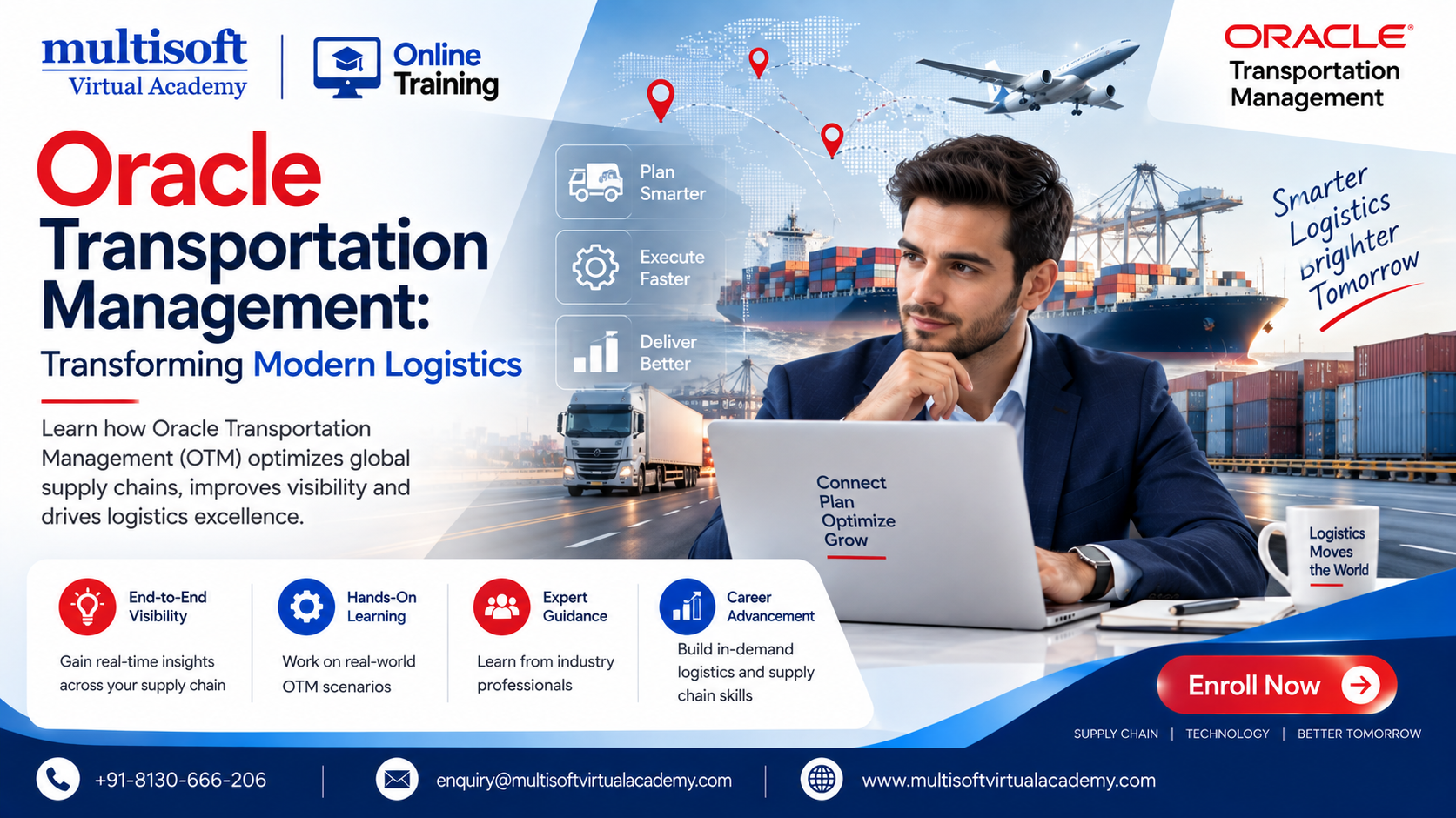
The transportation and logistics industry is changing rapidly as businesses face rising freight costs, complex supply chains, customer delivery expectations and growing demand for real-time visibility. Traditional transportation processes often struggle to manage these challenges efficiently. This is where Oracle Transportation Management (OTM) provides a powerful technology-driven approach to transportation planning, execution, optimization and visibility.
Oracle Transportation Management is designed to help organizations manage transportation operations across different modes, regions, carriers and business processes. As part of Oracle Transportation and Global Trade Management Cloud, OTM supports centralized transportation operations while helping organizations improve planning, execution, freight management and supply chain visibility.
Oracle Transportation Management (OTM) is a transportation management solution that helps businesses plan, execute and monitor the movement of goods. It can support transportation operations across road, rail, ocean and other logistics scenarios while providing tools for shipment planning, carrier management, freight costing, tendering, tracking and transportation analytics.
Modern OTM environments go beyond basic shipment management. Businesses can use transportation optimization capabilities to evaluate routes, consolidate shipments, compare transportation rates and improve resource utilization.
The platform also provides integration capabilities that allow transportation processes to connect with other enterprise applications and supply chain systems. Oracle documentation describes integrations with applications such as Oracle E-Business Suite and Global Trade Management, enabling transportation information to flow across connected business processes.
Transportation represents a significant operational and financial component of many supply chains. Inefficient routes, poor carrier selection, unused capacity, shipment delays and limited visibility can increase costs and affect customer satisfaction.
An advanced transportation management system helps organizations address these challenges by bringing transportation planning and execution into a centralized environment.
With Oracle OTM, businesses can work toward:
The result is a more connected approach to transportation management that supports both operational efficiency and long-term supply chain performance.
Transportation planning is one of the most important functions of OTM. Organizations can evaluate transportation requirements and create optimized shipment plans based on factors such as routes, rates, capacity, equipment and delivery requirements.
Effective transportation planning can help businesses reduce unnecessary transportation expenses while improving service levels.
OTM's current capabilities continue to evolve around transportation operational planning, multi-stop sequencing, flexible routing and optimization-related functionality.
Freight costs can vary significantly depending on transportation mode, carrier, lane, service level and other commercial factors.
OTM provides capabilities for managing transportation rates and evaluating transportation costs. This allows organizations to establish structured rate information and use it during transportation planning and execution.
Effective freight management can help companies understand transportation expenditure and make more informed carrier and routing decisions.
Managing multiple carriers can become complicated when organizations operate across different regions and transportation modes.
OTM supports service-provider and carrier processes, allowing transportation teams to manage information required for transportation execution.
Carrier management can contribute to better tendering, rate comparison, shipment assignment and transportation performance management.
Planning a shipment is only one part of transportation management. Organizations also need to monitor transportation execution and respond when conditions change.
OTM provides capabilities for shipment tracking, transportation events and operational visibility. This helps logistics teams identify potential issues and take corrective action.
Improved supply chain visibility can also help organizations communicate more effectively with internal teams, carriers and customers.
Organizations operating private or dedicated fleets require tools for managing drivers, vehicles, equipment and transportation assignments.
Oracle documentation describes OTM Fleet Management as supporting private fleet planning and execution, including resource management, driver assignments, equipment management and transportation activity monitoring.
This can help companies improve fleet utilization while managing transportation commitments more effectively.
Data-driven decision-making has become increasingly important for logistics organizations. OTM provides operational and analytical reporting capabilities based on transportation data. Oracle states that OTM uses Oracle Analytics Cloud for operational and historical transportation reporting and analytics.
Transportation analytics can help businesses examine:
These insights can support continuous improvement across transportation operations.
Transportation does not operate independently from the rest of the supply chain. Orders, inventory, procurement, warehousing, finance and global trade processes all influence transportation activities.
Therefore, OTM integration is an important consideration for organizations implementing transportation management technology.
OTM can integrate with other Oracle applications and enterprise systems. For example, Oracle provides documented integration between OTM and Global Trade Management, allowing information from transportation transactions to support related trade transactions.
Integration can help organizations establish a more connected information flow between transportation and other supply chain processes.
Artificial intelligence is becoming increasingly important in transportation and logistics.
Current Oracle Transportation and Global Trade Management capabilities include AI functionality designed to provide insights, automate routine activities and support users with recommendations. Oracle documentation specifically identifies GenAI assistants and AI Agent Studio capabilities within OTM and GTM.
Recent OTM updates also include AI-oriented capabilities such as shipment summaries, transportation-related assistants and AI agents for specific operational scenarios.
This evolution is significant because transportation teams increasingly need faster access to information without manually reviewing large amounts of operational data.
Cloud-based transportation management is becoming increasingly relevant for organizations looking to modernize logistics operations.
Oracle Transportation Management Cloud provides a centralized environment for transportation and global trade operations. Oracle's current documentation describes Transportation and Global Trade Management Cloud as a global system for managing transportation and trade operations across organizations and geographies.
Cloud deployment can support organizations that need scalable transportation capabilities while reducing dependence on fragmented transportation processes and disconnected systems.
Implementing an enterprise transportation management platform involves more than installing software. Organizations need to understand their transportation processes, business rules, carrier structures, rates, locations, shipment requirements, integrations and reporting needs.
A successful OTM implementation typically requires careful attention to:
Oracle itself provides implementation guides, API documentation, release information and other resources for organizations preparing to implement Transportation and Global Trade Management Cloud.
Professional OTM consulting can therefore help organizations align the technology with their actual transportation requirements rather than treating implementation as a purely technical exercise.
Organizations adopting an advanced transportation management solution can target several operational improvements.
Optimized transportation planning and improved carrier selection can help organizations control freight expenditure.
Centralized transportation information can provide logistics teams with greater visibility into shipments and transportation activities.
Transportation planning can help businesses make better use of vehicles, equipment and available capacity.
Analytics, dashboards and AI-enabled capabilities can provide useful transportation information more quickly.
Better transportation execution and visibility can help organizations improve delivery reliability and respond to exceptions.
A cloud-based transportation platform can support businesses as transportation networks, markets and operational requirements evolve.
Oracle Transportation Management can be valuable for organizations with complex transportation requirements, including:
The greatest value is often seen where transportation involves multiple carriers, locations, modes, shipment types or complex business rules.
Selecting the right OTM implementation partner can have a direct impact on project success.
Before selecting a service provider, organizations should evaluate:
A strong implementation partner should focus on business outcomes rather than configuration alone.
As organizations adopt sophisticated transportation technology, demand for professionals with OTM knowledge continues to grow.
Oracle Transportation Management training can help consultants, functional professionals, supply chain specialists and technology teams understand important concepts such as transportation planning, rate management, shipment execution, carrier management, configuration, integration and reporting.
Hands-on learning is particularly valuable because OTM involves complex business processes and configuration scenarios. Professionals who understand both transportation operations and the technology can contribute more effectively to implementation and optimization projects.
The future of transportation management is increasingly connected to automation, artificial intelligence, real-time visibility, analytics and digital supply chain transformation.
Current OTM development reflects this direction. Recent capabilities include AI agents, GenAI functionality, REST-enabled actions, transportation intelligence, enhanced planning capabilities, rate-shopping improvements and new user-interface experiences.
This indicates that modern transportation management is moving beyond traditional freight planning toward intelligent, data-driven logistics operations.
Businesses that invest in transportation technology should therefore consider not only today's requirements but also their future needs for automation, analytics, integration and intelligent decision support.
Oracle Transportation Management (OTM) has become an important technology for organizations seeking greater control over transportation planning, freight management, logistics optimization and supply chain visibility. From transportation planning and carrier management to analytics, integration, fleet management and emerging AI capabilities, OTM provides a broad foundation for modernizing transportation operations. However, achieving meaningful business results depends on appropriate configuration, integration, implementation strategy, user adoption and ongoing optimization. For organizations looking for professional guidance, implementation expertise, training and technology-focused transportation solutions, Multisoft Virtual Academy can serve as a capable service provider and knowledge partner for building practical expertise around Oracle Transportation Management and modern supply chain technology.
| Start Date | Time (IST) | Day | |||
|---|---|---|---|---|---|
| 19 Sep 2026 | 06:00 PM - 10:00 AM | Sat, Sun | |||
| 20 Sep 2026 | 06:00 PM - 10:00 AM | Sat, Sun | |||
| 26 Sep 2026 | 06:00 PM - 10:00 AM | Sat, Sun | |||
| 27 Sep 2026 | 06:00 PM - 10:00 AM | Sat, Sun | |||
|
Schedule does not suit you, Schedule Now! | Want to take one-on-one training, Enquiry Now! |
|||||






 Join our Live Instructor-Led online classes delivered by industry experts
 Let's Get Started