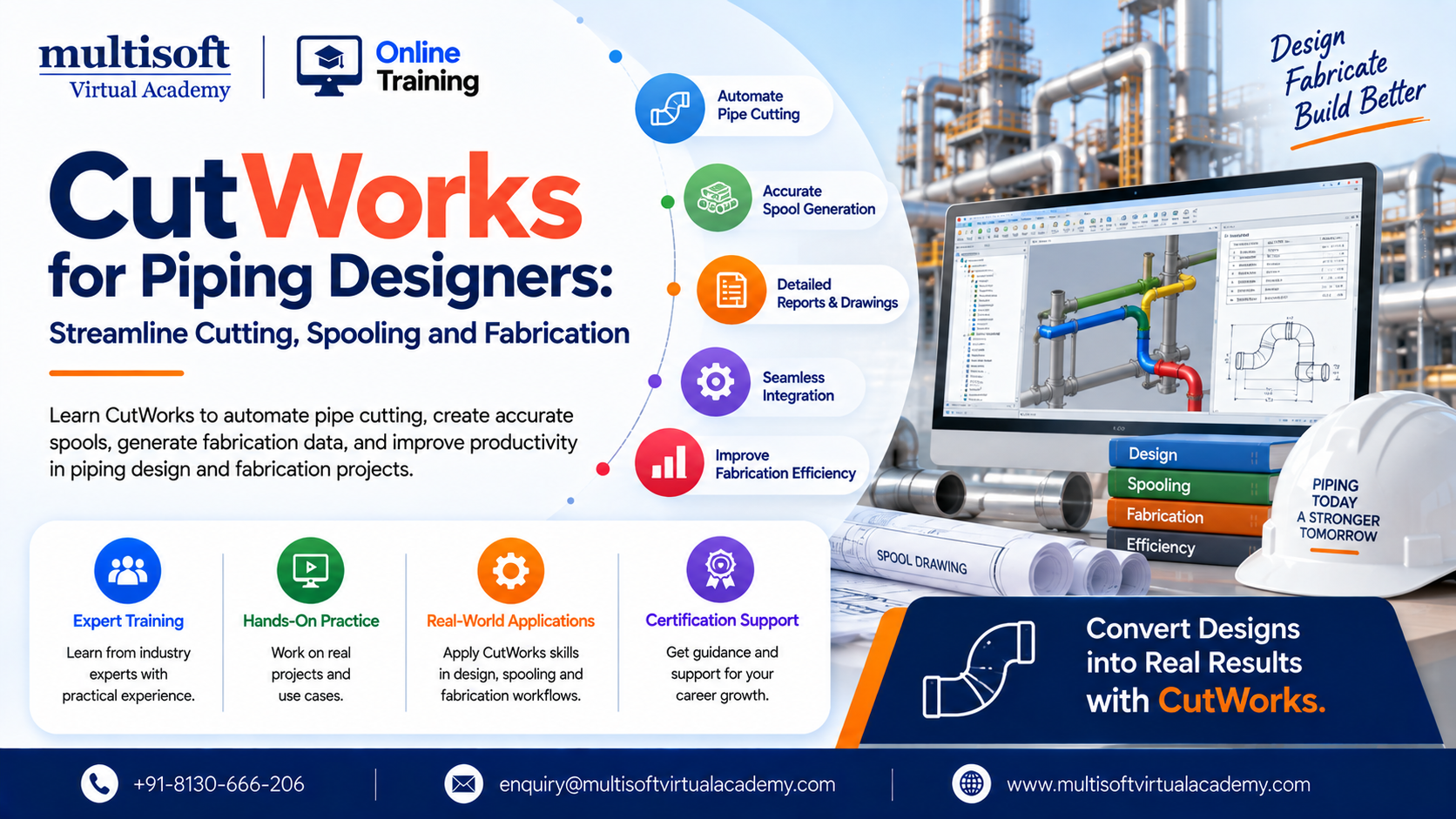
Piping fabrication projects depend on accurate engineering data, efficient material utilization and reliable fabrication documentation. CutWorks for Piping Designer is a specialized workflow that helps connect piping design information with practical fabrication requirements such as spool generation, pipe cutting, material management and production documentation.
For professionals working in EPC, oil and gas, petrochemical, power, offshore and process industries, understanding CutWorks can help improve design-to-fabrication coordination and reduce avoidable errors. Current CutWorks training programs commonly cover project setup, engineering-data import, spool generation, cutting optimization, fabrication documentation, material management, reporting and workflow integration.
CutWorks for Piping Designer supports the conversion of engineering and piping information into fabrication-ready outputs. Rather than treating piping design and fabrication as completely separate activities, the workflow helps teams use accurate model and drawing information to prepare pipe-cutting requirements and spool-related documentation.
A piping designer working with CutWorks needs more than software familiarity. The professional should understand piping components, dimensions, specifications, spool arrangements, material requirements and fabrication constraints.
This combination of piping design knowledge and fabrication awareness is particularly valuable when projects involve thousands of components and extensive piping networks.
Large industrial projects involve complex piping systems containing straight pipes, elbows, reducers, tees, flanges, valves and other components. Even a small dimensional or specification error can create problems further down the fabrication chain.
CutWorks can support:
Accurate cut information is especially important because fabrication teams rely on engineering data to prepare physical piping assemblies.
Becoming effective with CutWorks requires a combination of technical and practical skills.
A strong understanding of piping layouts, P&IDs, piping components, pipe specifications and plant design principles provides the foundation for effective CutWorks use.
Designers should understand how different components connect and how changes in one area can influence the overall spool or fabrication requirement.
Spools are prefabricated piping assemblies manufactured according to project requirements before installation at the construction site.
A designer should understand spool identification, component relationships, dimensions and fabrication documentation. Accurate spool information helps fabrication teams manufacture the correct assemblies and supports installation activities later.
Pipe cutting is one of the most important areas in fabrication planning. Cutting information needs to account for the required dimensions and applicable fabrication requirements.
Designers should distinguish between nominal design dimensions and fabrication cutting requirements. Weld preparation, trimming, connection details and project-specific allowances may influence the final cutting requirement.
Material availability directly affects fabrication efficiency. A CutWorks workflow can help organize information related to pipe sizes, specifications, quantities and material utilization.
Effective material management can support procurement planning, inventory control and fabrication scheduling.
One of the major benefits of an organized cutting workflow is the opportunity to improve material utilization.
Suppose a fabrication project requires several different pipe lengths from available stock. Poor planning may result in excessive offcuts. A more structured cutting strategy can group compatible requirements and make better use of available stock.
Cut optimization can therefore help organizations work toward:
However, optimization should always respect material grade, pipe specification, traceability requirements and project fabrication procedures.
Spool generation is an important stage between engineering design and physical fabrication.
The workflow generally requires designers to work with accurate engineering information and identify the components belonging to each fabrication assembly. Once the required information is prepared, fabrication teams can use spool documentation to understand what needs to be manufactured.
Good spool management should provide clear identification and maintain consistency between:
Design Model → Spool Information → Cut List → Fabrication → Installation
This traceability becomes increasingly important as project size and fabrication complexity increase.
Modern piping projects generate large quantities of engineering information. Manually transferring every piece of information between design and fabrication activities can introduce unnecessary errors.
A structured CutWorks workflow helps organize this transition.
Typical activities can include:
The exact workflow depends on project standards, software configuration and organizational procedures. Current CutWorks training curricula also emphasize project setup, engineering-data import, pipe spool generation, cutting optimization, documentation, material management and reporting.
CutWorks can improve fabrication workflows, but software alone cannot eliminate design errors. Several challenges require careful attention.
If the source model or drawing contains incorrect dimensions, specifications or component information, those errors may influence downstream fabrication documentation.
Industrial projects frequently experience design changes. When fabrication information has already been issued, the designer needs to identify affected spools and documents and follow the project's revision-control process.
A design may appear correct geometrically but still create fabrication difficulties. Collaboration with fabrication professionals can help identify practical issues before manufacturing begins.
Poor stock-length planning and ineffective cutting strategies can increase scrap. Designers should understand how cutting requirements affect material utilization.
Every fabricated component should be traceable to the appropriate engineering information, spool identification and revision wherever required by project procedures.
CutWorks workflows can exist within a broader piping engineering ecosystem. Depending on the organization and project, piping designers may work with plant-design, CAD, material-management and fabrication systems.
Knowledge of related technologies can therefore strengthen a professional's profile. Relevant areas may include:
The objective is not simply to collect software skills but to understand how engineering information moves through the project lifecycle.
CutWorks for Piping Designer skills can be useful for professionals involved in piping design and fabrication workflows, including:
It can also be relevant for professionals transitioning from general piping design into fabrication-oriented responsibilities.
Industrial organizations increasingly value professionals who understand the relationship between design, fabrication and construction.
A piping designer who understands CutWorks can potentially contribute beyond basic modeling activities by supporting fabrication planning, spool preparation, material optimization and engineering coordination.
This broader knowledge can help professionals develop capabilities in areas such as:
Piping Design + Fabrication Planning + Material Management + Spooling + Cutting Optimization
The combination can make a designer more effective when working on complex EPC and industrial projects.
To achieve reliable fabrication outputs, professionals should follow a disciplined approach.
Always work with the latest approved engineering information and verify critical dimensions, specifications and component data.
Do not assume previously generated documentation remains valid after a design change. Review affected outputs systematically.
Fabricators can provide valuable feedback about practical cutting, welding, assembly and installation requirements.
Analyze stock requirements, cut lengths and usable remnants to identify opportunities for reducing unnecessary waste.
Before releasing information, review spool identification, dimensions, specifications, quantities and relevant documentation.
When an output appears incorrect, investigate the source data and workflow rather than simply changing the final document manually. Correcting the root cause helps prevent the same issue from appearing in other deliverables.
The piping industry is moving toward increasingly connected digital workflows. Better integration between engineering models, fabrication planning, material management and project documentation can improve information consistency throughout the project lifecycle.
Automation, data integration and intelligent reporting can further reduce repetitive tasks and help engineering teams identify inconsistencies earlier.
For piping designers, this means that software knowledge alone may not be enough. Understanding data quality, fabrication requirements, material optimization and cross-functional coordination is becoming increasingly important.
CutWorks for Piping Designer is more than a software-oriented skill. It represents an important connection between piping engineering and practical fabrication. Professionals who understand spool generation, cutting optimization, material utilization, fabrication documentation and engineering coordination can contribute more effectively to industrial project execution.
For professionals and organizations looking to develop these capabilities through structured, practical learning, Multisoft Virtual Academy provides specialized training focused on real-world piping and fabrication workflows. Its CutWorks for Piping Designer program covers project setup, engineering-data handling, spool generation, pipe cutting optimization, fabrication documentation, material management and reporting, helping learners develop practical skills relevant to modern EPC and industrial environments.
| Start Date | Time (IST) | Day | |||
|---|---|---|---|---|---|
| 19 Sep 2026 | 06:00 PM - 10:00 AM | Sat, Sun | |||
| 20 Sep 2026 | 06:00 PM - 10:00 AM | Sat, Sun | |||
| 26 Sep 2026 | 06:00 PM - 10:00 AM | Sat, Sun | |||
| 27 Sep 2026 | 06:00 PM - 10:00 AM | Sat, Sun | |||
|
Schedule does not suit you, Schedule Now! | Want to take one-on-one training, Enquiry Now! |
|||||






 Join our Live Instructor-Led online classes delivered by industry experts
 Let's Get Started