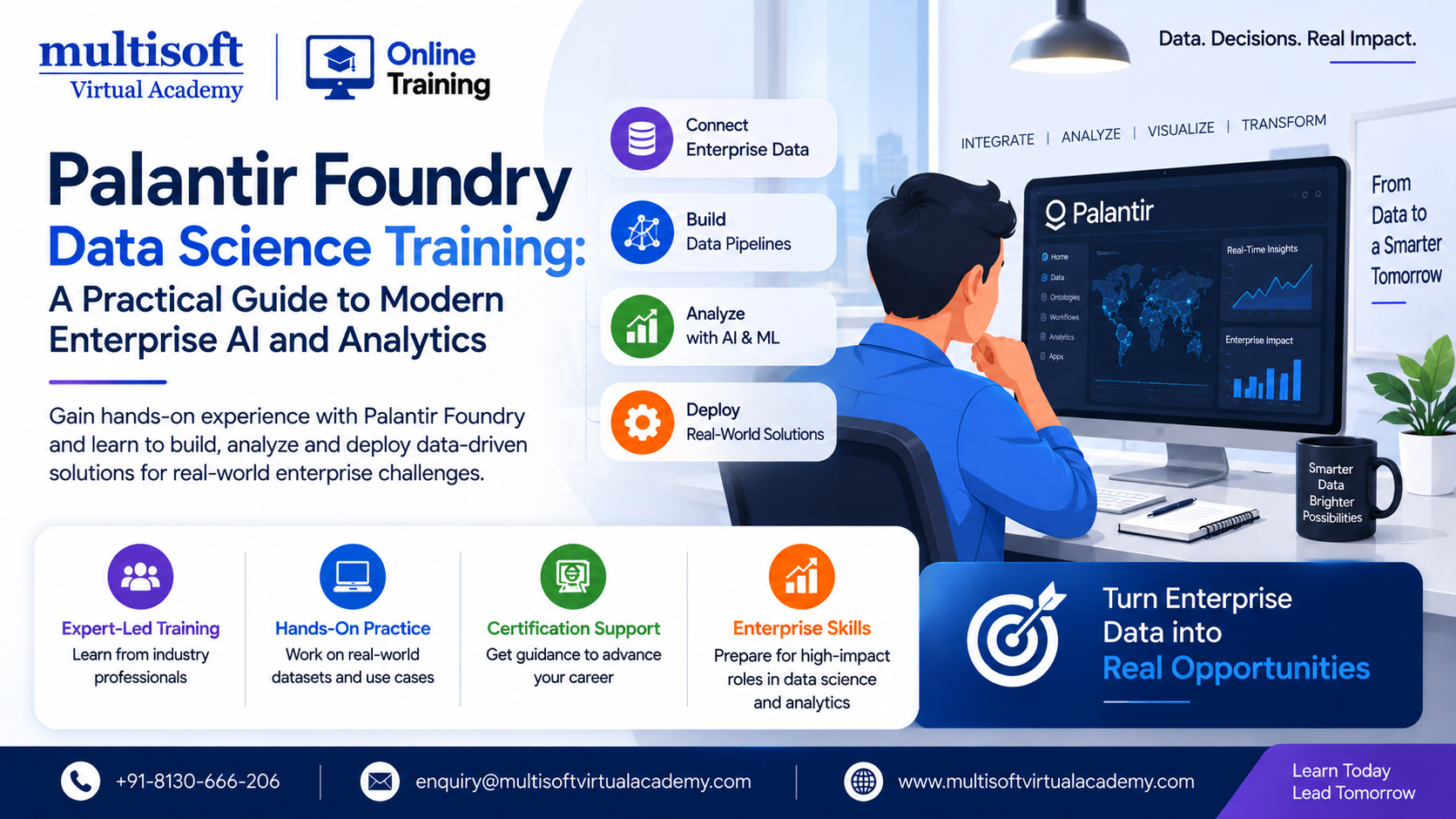
Data science is rapidly moving beyond traditional notebooks and isolated machine learning experiments. Modern organizations need professionals who can connect enterprise data, analytics, machine learning and artificial intelligence within secure and scalable environments. This growing demand has made Palantir Foundry Data Science Training an increasingly relevant learning path for data scientists, analysts, engineers and AI professionals.
Palantir Foundry provides an environment where organizations can integrate data, develop analytical workflows, create machine learning models and connect insights with operational processes. Its data science capabilities support both code-based and visual workflows while maintaining data lineage, governance and reproducibility.
For professionals looking to strengthen their capabilities in enterprise data science, a structured Palantir Foundry Data Science Training program can provide practical exposure to data integration, analytics, machine learning, model development and AI-enabled workflows.
Traditional data science workflows can involve multiple disconnected tools for data preparation, model development, experimentation, deployment and monitoring. This can create challenges around collaboration, governance and reproducibility.
Foundry approaches these challenges by bringing data and analytical workflows into an integrated platform. Data scientists can use Python, R and SQL through Code Workbook and can also work with JupyterLab and RStudio through Code Workspaces. Models and analyses can be connected with other components of the platform for operational use.
This makes Palantir Data Science particularly relevant for professionals who want to understand how machine learning can move from experimentation toward real-world business applications.
Palantir Foundry Data Science Training is a specialized learning program designed to help professionals understand how data science workflows can be developed and managed within Palantir Foundry.
A comprehensive Palantir Foundry Course may cover areas such as:
The exact curriculum can vary by training provider and learner requirements. However, the primary objective should be to develop practical knowledge that can be applied to enterprise data and AI projects.
A good Palantir Foundry Training program should combine platform knowledge with practical data science concepts.
Quality data is the foundation of every successful machine learning project. Learners should understand how enterprise datasets can be connected, organized, transformed and prepared for analysis.
This includes understanding data pipelines, structured datasets, transformations, data quality and lineage. These skills are particularly valuable when working with large and continuously changing enterprise datasets.
Foundry provides multiple analytical applications for exploring and understanding data. Its analytics capabilities support table-based, geospatial and temporal analysis along with code-based workflows.
Professionals undertaking Palantir Data Analytics Training can learn how to move from raw information to actionable insights using visualization, exploration and analytical techniques.
Programming remains an important part of modern data science.
Foundry's Code Workbook supports Python, R and SQL for data analysis and machine learning development. Professionals can also use Code Workspaces with development environments such as JupyterLab and RStudio.
Therefore, Palantir Foundry Data Science Training can be particularly valuable for professionals who already have knowledge of Python, SQL or R and want to apply those skills within an enterprise platform.
Machine learning is one of the most important components of a modern data science workflow.
Foundry supports machine learning development through tools designed for model training, evaluation and deployment. Its official documentation provides workflows for supervised machine learning projects and explains how data, code, models and development environments can be connected.
Learners can explore concepts such as:
One of the notable developments in Foundry is Model Studio, which became generally available in February 2026. It provides a no-code environment for training machine learning models for tasks including forecasting, classification and regression.
This is significant because machine learning is increasingly being used by teams beyond traditional data science departments.
A Palantir Foundry Certification learning path that introduces both code-based and no-code approaches can help professionals understand different ways of developing machine learning solutions.
Model Studio also includes experiment tracking, performance metrics, data lineage and security controls, helping organizations maintain greater visibility into model development.
SQL continues to be an essential skill for data professionals. Foundry's SQL Studio provides a dedicated environment for SQL analysis across tabular data and Ontology object types.
The platform also provides AI-assisted query writing capabilities, allowing users to write, explain and debug supported SQL queries through an AI interface.
This development reflects a broader trend toward AI-assisted data analytics, where professionals combine traditional analytical skills with artificial intelligence.
Consequently, professionals searching for Palantir Foundry Training Online, Palantir AI Training or Enterprise AI Training can benefit from understanding how SQL, analytics and AI increasingly work together.
The Foundry Ontology is another important concept for learners.
Rather than treating enterprise information simply as disconnected tables, the Ontology helps represent real-world entities and relationships in a structured way. Applications and analytical workflows can use these objects to support operational decision-making.
For data scientists, understanding the relationship between datasets, analytical models and Ontology objects can provide a more complete view of how data science solutions become useful business applications.
This is one reason why Palantir Foundry Data Engineering and Palantir Foundry Data Science are closely connected learning areas.
The evolution of enterprise AI has also expanded the role of Palantir Foundry.
Palantir's platform includes AIP capabilities for connecting organizations with generative AI, building AI-enabled applications and developing governed AI workflows.
Recent Foundry updates also demonstrate the growing emphasis on evaluating and improving AI workflows. For example, evaluation suites in Pipeline Builder allow teams to test LLM workflow outputs before production changes are deployed.
Therefore, a modern Palantir AIP Training program can complement traditional data science education by introducing learners to:
This training can be relevant to several professional groups.
Data scientists can learn how to connect analytical models with enterprise data and operational workflows.
ML engineers can benefit from understanding model development, deployment, evaluation and production workflows.
Data engineers can strengthen their understanding of how data pipelines support analytics and machine learning.
Analysts can learn how enterprise data can be explored and transformed into actionable insights.
AI professionals can explore how data platforms, machine learning and generative AI can work together in enterprise environments.
Professionals transitioning into data science, machine learning or enterprise AI can use structured training to understand Foundry's ecosystem and workflows.
As organizations increasingly invest in data-driven decision-making and enterprise AI, professionals with combined data, analytics and machine learning skills can pursue a range of career opportunities.
Potential roles include:
A training program alone does not guarantee employment or certification. Career growth depends on practical skills, project experience, foundational knowledge and the ability to solve real business problems.
Before enrolling in a Palantir Foundry Course, professionals should evaluate the program carefully.
Look for training that offers:
Practical learning:
The course should include realistic exercises rather than focusing only on theoretical explanations.
Data science fundamentals:
Learners should understand machine learning and analytics concepts alongside platform functionality.
Hands-on projects:
Projects can help learners understand how data moves from preparation to analysis and model deployment.
Updated curriculum:
Foundry continues to evolve. Recent additions such as Model Studio and SQL Studio demonstrate why training content should be regularly updated.
AI integration:
Modern enterprise data science increasingly intersects with generative AI, LLMs and intelligent workflows.
Governance and security:
Professionals should understand data lineage, access controls, model governance and responsible AI practices.
Reading documentation can provide foundational knowledge, but practical experience is essential for developing confidence.
A strong Palantir Foundry Data Science Training experience should encourage learners to work through realistic scenarios such as customer analytics, demand forecasting, predictive maintenance, fraud detection, operational optimization or business forecasting.
A typical machine learning project can involve defining a business objective, preparing datasets, engineering features, training a model, evaluating performance and deploying the resulting model. Foundry's own supervised machine learning tutorial follows this type of structured workflow.
This project-based approach helps learners understand not just how a tool works but why a particular data science workflow is required.
The future of enterprise data science is likely to involve closer integration between data engineering, analytics, machine learning and generative AI.
Organizations increasingly want AI systems that can work with trusted enterprise information while maintaining appropriate governance and control. Foundry's current platform direction reflects this convergence of data, AI and operational workflows.
Recent developments such as AI-assisted SQL, no-code model development, LLM evaluation workflows and AI engineering capabilities demonstrate how rapidly the enterprise data landscape is changing.
For professionals, this means that learning only one isolated technology may not be enough. A broader combination of data science, machine learning, data engineering, AI and analytics skills can provide a stronger foundation for working with modern enterprise platforms.
Palantir Foundry Data Science Training can be a valuable learning path for professionals who want to develop practical capabilities in enterprise data analytics, machine learning and AI. As organizations increasingly connect data platforms with intelligent applications, understanding data preparation, analytics, modeling, governance and AI workflows can become an important professional advantage. Multisoft Virtual Academy provides specialized training and learning support for professionals seeking to develop practical knowledge in Palantir Foundry Data Science and related enterprise technology domains.
| Start Date | Time (IST) | Day | |||
|---|---|---|---|---|---|
| 19 Sep 2026 | 06:00 PM - 10:00 AM | Sat, Sun | |||
| 20 Sep 2026 | 06:00 PM - 10:00 AM | Sat, Sun | |||
| 26 Sep 2026 | 06:00 PM - 10:00 AM | Sat, Sun | |||
| 27 Sep 2026 | 06:00 PM - 10:00 AM | Sat, Sun | |||
|
Schedule does not suit you, Schedule Now! | Want to take one-on-one training, Enquiry Now! |
|||||






 Join our Live Instructor-Led online classes delivered by industry experts
 Let's Get Started