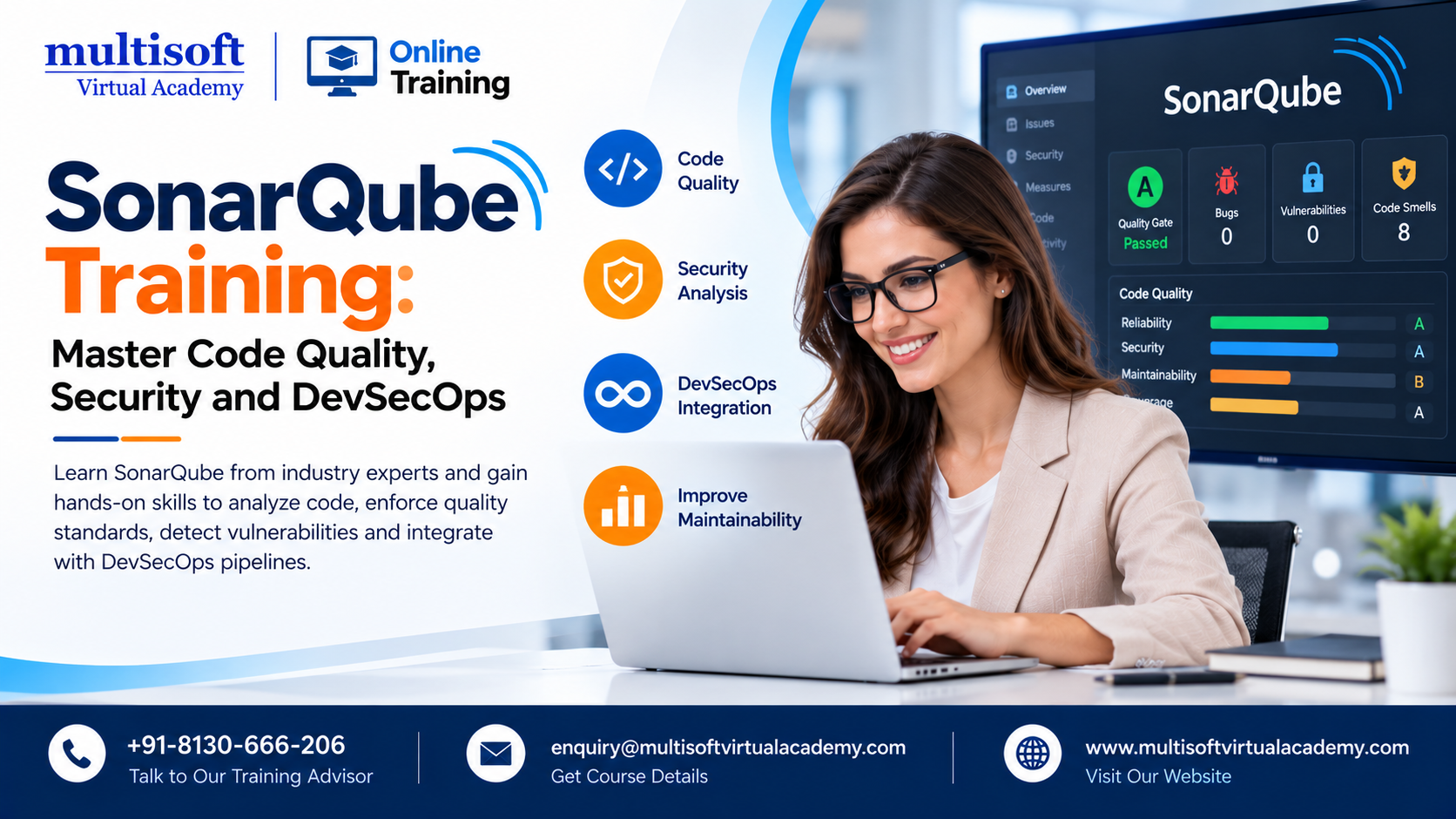
Modern software development is no longer focused only on writing functional code. Development teams must also deliver applications that are secure, maintainable, reliable, and ready for continuous deployment. As organizations increasingly adopt Agile, DevOps, cloud-native development, and CI/CD practices, automated code quality and security analysis have become an important part of the software development lifecycle.
SonarQube Training helps developers, DevOps engineers, software testers, and technical professionals understand how to identify coding issues, improve maintainability, detect security risks, and integrate continuous code inspection into development workflows. SonarQube analyzes source code against configurable rules and can identify issues such as bugs, vulnerabilities, code smells, and security hotspots.
SonarQube Training is a code quality and security analysis platform designed to help development teams continuously inspect their source code. It evaluates code against rules and generates findings that can help teams improve reliability, maintainability, and security.
Rather than waiting until the testing or production stage to discover coding problems, teams can introduce automated analysis much earlier in the development process. This approach supports the principles of shift-left testing and DevSecOps, where quality and security become part of everyday development.
SonarQube categorizes findings into areas such as:
These categories help developers understand whether an issue affects application reliability, security, or maintainability.
Software applications are becoming larger and more complex. Developers may work across multiple programming languages, frameworks, repositories, cloud environments, and deployment pipelines. Manual code reviews alone may not provide a consistent way to identify every potential quality issue.
This is where SonarQube Online Training can provide practical value.
A structured SonarQube course can help professionals understand how to:
The objective is not simply to learn the SonarQube interface. Professionals should understand how automated code analysis fits into the complete software development lifecycle.
One of the most important concepts covered in SonarQube Training is static code analysis.
Static analysis examines source code without requiring the application to be executed. Automated rules can identify patterns that may indicate defects, security weaknesses, maintainability problems, or coding inconsistencies.
For development teams, this creates an additional layer of automated feedback before software reaches production.
For example, a SonarQube analysis may help identify:
Learning how to interpret these findings is just as important as knowing how to run a scan.
SonarQube Quality Gates are another major topic for professionals learning SonarQube.
A quality gate establishes conditions that determine whether analyzed code meets an organization's quality requirements. In simple terms, it helps answer an important question:
Quality gates can evaluate metrics related to issues, security, maintainability, reliability, code coverage, duplication, and other quality indicators. Sonar's recommended quality-gate approach emphasizes keeping new code clean instead of requiring development teams to immediately resolve every historical issue in a large legacy codebase.
This approach is particularly useful for organizations working with continuously changing applications.
A properly designed quality gate can help development teams establish consistent standards before code is merged or released.
A SonarQube Quality Profile determines which rules are applied during code analysis. Understanding these profiles is important because different projects may require different standards.
For example, a development team working on a Java application may have different requirements from a team developing a Python, JavaScript, TypeScript, C#, or C++ application.
SonarQube provides a rules system that analyzes source code and produces issues according to configured standards. Rules can address bugs, vulnerabilities, code smells, and security hotspots.
Through SonarQube Certification Training or a comprehensive SonarQube course, learners can understand how rules work, how issues are prioritized, and how quality settings can be aligned with project requirements.
The SonarQube Scanner is an important component of SonarQube implementation. It enables projects to send source-code analysis information to the SonarQube platform.
Understanding scanners is particularly useful for developers and DevOps engineers because code analysis needs to become part of an automated development workflow.
A typical workflow may involve:
This makes code quality a repeatable part of the development process rather than an occasional manual activity.
Modern DevOps teams rely heavily on automation. SonarQube CI/CD integration allows code analysis to become part of automated build and deployment workflows.
When integrated into CI/CD, SonarQube can provide developers with feedback close to the time when code is written. Quality-gate results can also be used to influence whether a build or pull request should move forward.
SonarQube documentation notes that quality-gate results can be reported to CI pipelines and can be used to fail a pipeline when the configured quality requirements are not satisfied.
This makes SonarQube particularly relevant to professionals working in:
Security cannot be treated as a final-stage activity in modern software development. Organizations increasingly incorporate security checks throughout the development lifecycle.
SonarQube for DevSecOps supports this approach by helping teams identify security-related issues during development.
Security vulnerabilities and security hotspots provide different types of information. A vulnerability represents code that may be exploitable, while a security hotspot highlights security-sensitive code that requires developer review.
Professionals learning SonarQube should therefore understand not only how to find security findings but also how to investigate, prioritize, and remediate them.
Code quality is more than eliminating bugs. Maintainable code should be understandable, consistent, testable, and easier to modify.
Poor-quality code can create long-term technical debt. As applications grow, technical debt may increase development time and make future changes more difficult.
SonarQube helps teams establish measurable quality practices by providing information about code issues, maintainability, reliability, security, duplication, complexity, and test coverage.
This allows technical teams to move from subjective discussions about code quality toward measurable quality objectives.
A well-designed SonarQube Training Course can benefit professionals at different stages of their careers.
Developers can learn how to identify and resolve code-quality problems before they become larger application issues.
DevOps professionals can learn how to integrate SonarQube with CI/CD pipelines and automate quality checks.
Security teams can use code-analysis findings to support secure development practices and identify security-sensitive coding patterns.
QA teams can gain greater visibility into code quality and collaborate more effectively with development teams.
Technical leaders can establish quality standards, monitor technical debt, and create consistent development practices across projects.
A comprehensive SonarQube Course can cover both fundamental and advanced concepts.
Typical learning areas may include:
The exact curriculum should be aligned with the learner's programming language, development environment, and professional objectives.
The demand for software professionals who understand automation, cloud platforms, DevOps, and application security continues to influence the technology job market.
Learning SonarQube Online Training can complement existing skills in technologies such as Java, Python, JavaScript, C#, C++, DevOps tools, Jenkins, Git, Docker, Kubernetes, Azure DevOps, GitHub Actions, and other CI/CD platforms.
However, SonarQube should not be treated as an isolated skill. Its greatest value comes when professionals understand how it connects with development, testing, security, version control, and deployment processes.
For this reason, hands-on learning is especially valuable. Practical exercises involving source-code analysis, quality profiles, quality gates, scanner configuration, and CI/CD integration can help learners develop skills that are closer to real project requirements.
Professionals often search for SonarQube Certification because they want a structured way to validate their knowledge.
Certification can be useful as part of a broader professional development strategy, but practical knowledge remains essential. Employers typically value the ability to apply tools to real development and DevOps workflows.
A strong learning path should therefore combine theoretical understanding with practical implementation.
Instead of focusing only on completing a certificate, learners should aim to understand questions such as:
Answering these questions demonstrates meaningful SonarQube expertise.
The increasing adoption of automated software development, cloud-native applications, DevOps, and AI-assisted coding makes continuous code-quality management increasingly relevant.
As development teams produce code faster, automated mechanisms for evaluating reliability, maintainability, and security become more important.
SonarSource has also introduced AI-focused quality capabilities, reflecting the growing need to evaluate AI-generated code alongside traditionally developed software.
For professionals, this creates an opportunity to combine SonarQube knowledge with AI development, application security, DevOps automation, and modern software engineering practices.
SonarQube Training can be suitable for:
Basic programming and software-development knowledge can make it easier to understand SonarQube concepts, although the ideal prerequisites depend on the specific training level.
Before enrolling in a SonarQube Training Course, consider whether the program provides practical exposure rather than only theoretical explanations.
Look for training that covers:
It is also useful to choose training that reflects current SonarQube capabilities because the platform, rules, integrations, and development practices continue to evolve.
SonarQube has become an important part of modern software quality and secure development practices, particularly for teams adopting DevOps, CI/CD, and DevSecOps. Learning SonarQube Training can help professionals understand static code analysis, quality gates, security hotspots, vulnerabilities, code smells, quality profiles, and automated quality management. For learners seeking structured and practical SonarQube Online Training, SonarQube Certification Training, and SonarQube Course opportunities, Multisoft Virtual Academy acts as a professional service provider focused on helping technology professionals develop relevant, practical skills for modern software development and DevOps environments.
| Start Date | Time (IST) | Day | |||
|---|---|---|---|---|---|
| 03 Oct 2026 | 06:00 PM - 10:00 AM | Sat, Sun | |||
| 04 Oct 2026 | 06:00 PM - 10:00 AM | Sat, Sun | |||
| 10 Oct 2026 | 06:00 PM - 10:00 AM | Sat, Sun | |||
| 11 Oct 2026 | 06:00 PM - 10:00 AM | Sat, Sun | |||
|
Schedule does not suit you, Schedule Now! | Want to take one-on-one training, Enquiry Now! |
|||||






 Join our Live Instructor-Led online classes delivered by industry experts
 Let's Get Started